Blog about Blog about 3

  1. There are 30 days in April. On 1 April 2018—Easter Sunday and/or April Fool’s Day—I declared on my cursed blog that I would write something on the blog every day this month. I failed to write every day on the blog in the month of April; specifically, I did not post stuff on April 13, April 20, or April 24.
  2. (Not a reason for not posting on any of these dates but fun: April 13 was a Friday the 13th; April 20 is 4/20; April 24 is my cousin’s birthday).
  3. On the 1 April Blog about post I specifically hunted down the Fool card in the Rider-Waite tarot deck that I keep out for fun. I always thought tarot was foolish silliness, even if I found some of the aesthetics attractive, before a third or maybe fourth rereading of Gravity’s Rainbow prompted my buying a deck for research purposes. The deck figures heavily in Pynchon’s novel, providing a mystical and indeterminate contrast to the novel’s motif of mathematical precision. At some point I start flipping a card every day—not as some kind of superstitious soothsaying totem, but rather for fun. I don’t know. I scattered some of those cards into these posts when I photographed books; every card was a card I flipped that day, aside from The Fool.
  4. This morning I flipped the Two of Wands, a card I like. I like most of the Wands suit (and generally dislike the Swords suit; the Cups are my thing though). It’s in the pic above, which is a lazy attempt at an organizing principle for this post, which is not The Last Blog about post, but the last one for April 2018. (Tomorrow is May 2018).
  5. I mean what I mean is, Trying to blog every day was rewarding but also exhausting. I was surprised at some of what I wrote, even a little tiny small bit happy with some of it, and I still have a slim deck of ideas on deck. I think I’ll try to do one or two of these a week, and at least do one on Sundays.
  6. So I said above (by said I mean wrote) that I used a picture as an organizing principle for this disorganized post. The pic is of a loose stack of books that I’ve read or am reading or intend to read or have maybe halfway sorta given up on. It’s a pile that needs organizing. So, from top to bottom:
  7. I reread Hawthorne’s The Blithedale Romance this month and loved it. I almost started a reread of The House of Seven Gables after reading it—and typing this out now, I realize that that’s what I’d like to read soon, actually. One of the favorite posts I did in this Blog about series was on making a cocktail Hawthorne’s narrator drinks in the novel.
  8. I picked up Players after reading DeLillo’s The Names, which I wrote about early in these Blog about posts. It’s been hanging out unattended for a few weeks and I’m sure I’ll get to it in 38 months.
  9. I said I’d finally read Middlemarch this year, but I find myself unwilling to commit after two or three chapters and am irritated with myself in my constantly transferring it from room to room without reading it or shelving it. Maybe I’m only interested in it because it is monstrous. (I love big fat monsters; make me read Middlemarch).
  10.  I wrote one of these Blog about posts about Gerald Murnane’s story “Stream System.” I have another thing sketched out for his story “Stone Quarry” which is like this wonderfully satirical take on metafiction. I’m mostly enjoying reading this book slowly. I hate the drive to read too fast.
  11. I read The Passion According to G.H. by Clarice Lispector maybe five or six years ago and I pulled it out the other day because I think I’d like to reread it, because that’s what I like—rereading—I mean, I’ d prefer to reread Middlemarch without all the hard labor of, like, reading it first. But then I realized I’d never actually finished it. So I need to read it so I can reread it.
  12. I got the Hob Broun in the mail today and I’m going to quit writing this stupid fucking blog and go read it now.
  13. I’ll do another one of these tomorrow if I feel like it, but not if I don’t feel like it, and if I don’t not feel like it, maybe.

Hob Broun’s Cardinal Numbers (Book acquired, 30 April 2018)

img_9613

I first heard of Hob Broun a few years ago from the literary critic David Winters, who is a fan of Broun’s work. I’ve had Broun on a list of writers I mean to read for a long time now (an actual physical list, by the way, which I keep in my wallet). However, I’ve yet to come across one of his books in a bookstore. Anyway so well—

The inaugural issue of the new literary magazine Egress has a feature on Broun, which reignited my interest in him. I’ve been emailing the editors of Egress, David Winters and Andrew Latimer, for an interview about Egress (which will post sometime in the next day or two), and David basically talked me into breaking down and buying the book online (I got it for five bucks). A snippet of our upcoming interview:

Biblioklept: I know David has been enthusiastic about Hob Broun’s writing for a few years. Broun is sort of a “writer’s writer’s writer,” if that makes sense. The first issue of Egress features a section titled “Remembering Hob Broun: 1950-1987”; in addition to remembrances from the novelist Sam Lipsyte and Kevin McMahon, who befriended Broun when they attended Reed College together in the late sixties, you include a full color selection from one of Broun’s journals. Can you describe some of the journal for readers, and talk a bit about how the Broun section came together? For readers unfamiliar with Broun, what’s the appeal?

David Winters: Broun is a ‘writer’s (writer’s) writer’ only in that he isn’t well-known–his work isn’t at all opaque or aloof. He published three books in his lifetime, the novels Odditorium (1983) and Inner Tube (1985), and the superb short story collection Cardinal Numbers (1988). While writing Inner Tube, Broun underwent emergency surgery to remove a spinal tumour. He was left paralysed from the neck down. Remarkably, he finished the novel–and wrote the stories in Cardinal Numbers–using a kind of writing-machine: an oral catheter (or ‘sip-and-puff device’) connected to a customised word processor, triggered by his breath whenever a letter flashed on the screen. This aspect of Broun’s life lends itself to mythologization: what better image of writerly dedication? At the same time, it risks obscuring what really matters: the work itself. I was delighted, then, when Kevin McMahon got in touch. Kevin’s essay only glances at Broun’s illness, giving us, instead, a vivid portrait of the man behind the myth. Best of all, Kevin sent us Broun’s personal journal. It’s an extraordinary artefact–a scrapbook of doctored magazine clippings and miniature, fragmentary narratives–unmistakably Brounian in its pulpy, screwball surreality. Broun’s journal is continuous with his fiction (Cardinal Numbers contains the manifesto-like statement, ‘modus operandi: montage, collage, bricolage’), but, unlike his fiction, it wasn’t created for public consumption. Not unlike the art of, say, Ray Johnson or Joseph Cornell, it gives us a glimpse of a private world, a game played for inscrutable reasons—what Don DeLillo calls “the pure game of making up”. Our celebration of Broun ends with a wonderful essay by Sam Lipsyte–a writer Andrew and I both revere–who captures his essence far better than either of us ever could.

Biblioklept: Which of Broun’s three books do you think is the best starting place for folks interested in his work after reading about him in Egress?

DWCardinal Numbers, without a doubtOpen Road recently reissued all three titles as e-books, but I’d recommend picking up the old Knopf hardbacks, which can be had for as little as a dollar. Another Broun novel–a previously unpublished manuscript–might be out in a year or two.

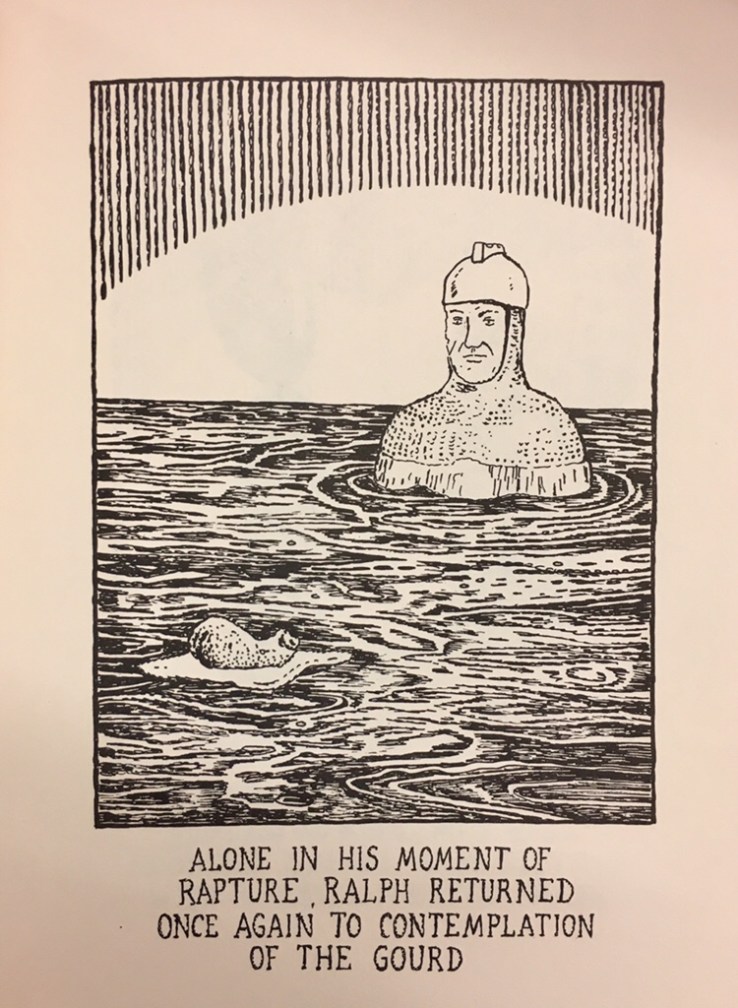
Contemplation (Glen Baxter)

img_9407

Petunia Parade — Jamie Adams

adams-petuniaparade-2016-2m

Petunia Parade, 2016 by Jamie Adams (b. 1961)

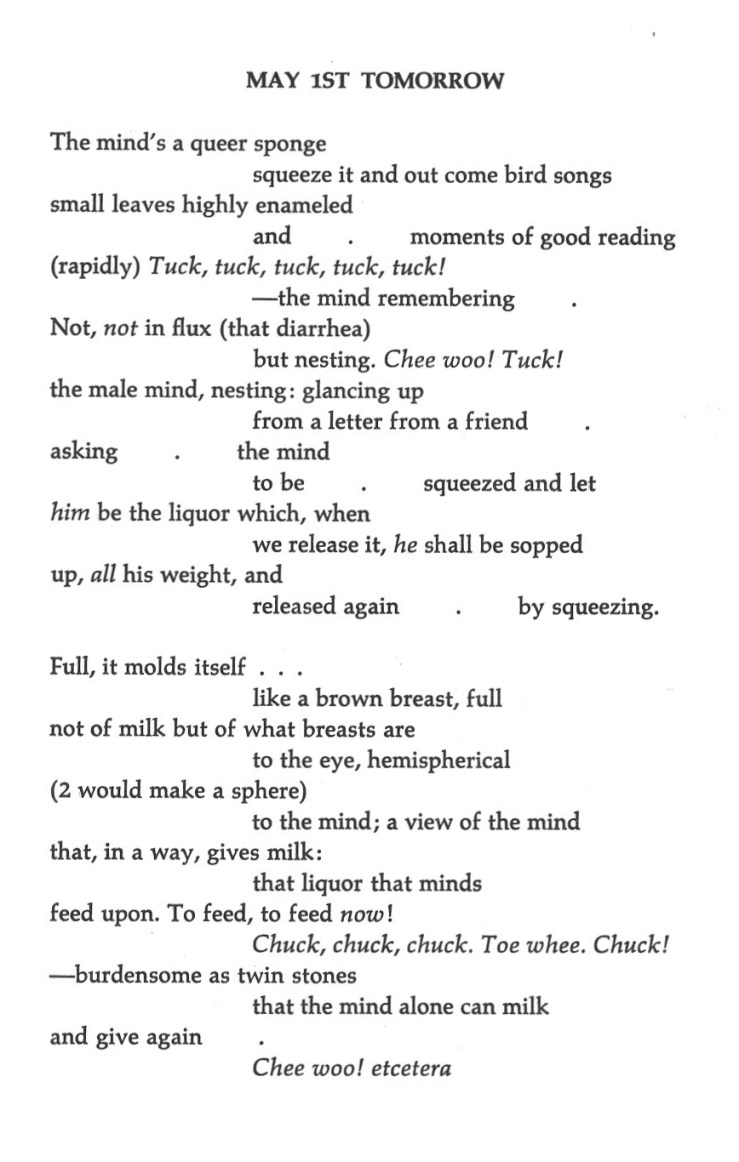
“May 1st Tomorrow” — William Carlos Williams

wcw