
The editors of The Comics Journal have put together an extended feature called “The Best Comics of 2018.” The full feature is pretty cool (and pretty enormous), and is a great place for anyone looking for a diverse concentration of new comix to read. Here’s my entry:
- Slum Wolf by Tadao Tsuge (English translation by Ryan Holmberg, NYRC) This collection of “alternative manga” (from The New York Review of Books’ NYRC imprint) showcases nine rough and seedy stories focused on the kimin, the “abandoned people” who live on the margins of Japanese society. Under Tsuge’s mean humor is a diamond-sharp kernel of pathos for all humanity, rendered in spare, even rushed art. Tsuge draws as if his ink and paper might be snatched away at any moment by some civilizing agent who would keep his slum wolves away from respectable eyes. His world isn’t pretty but it is somehow beautiful.
- Hieronymus & Bosch by Paul Kirchner. (Tanibus) Paul Kirchner continues his late career renaissance with Hieronymus & Bosch, a collection of over eighty comic strips set in Hell. The plot of most of these one-pagers is pretty straightforward: Hieronymus and his wooden toy duck Bosch try to escape—either Hell itself, or the boredom of Hell—and fail. Kirchner’s Hell is a slapstick paradise, and if Hieronymus is eternally doomed, at least he finds some solace in his own creative prowess.
- Samplerman, January 2018-December 2018 by Yvan Guillo. (Self-published) In a profile a few years back, the artist Yvan Guillo (who works under the name Samplerman) declared: “I am half the artist and half in the audience, exploring all these pages, picking the things I want to use, making a template and watching the composition being made nearly by itself.” Guillo perfectly describes his techniques of collage, amalgamation, and transformation—and also describes the pure joy that teems through his work. The Samplerman strips synthesize the history of cartooning into something transcendent and energetic, a reining-in of visual entropy into a strange new order.
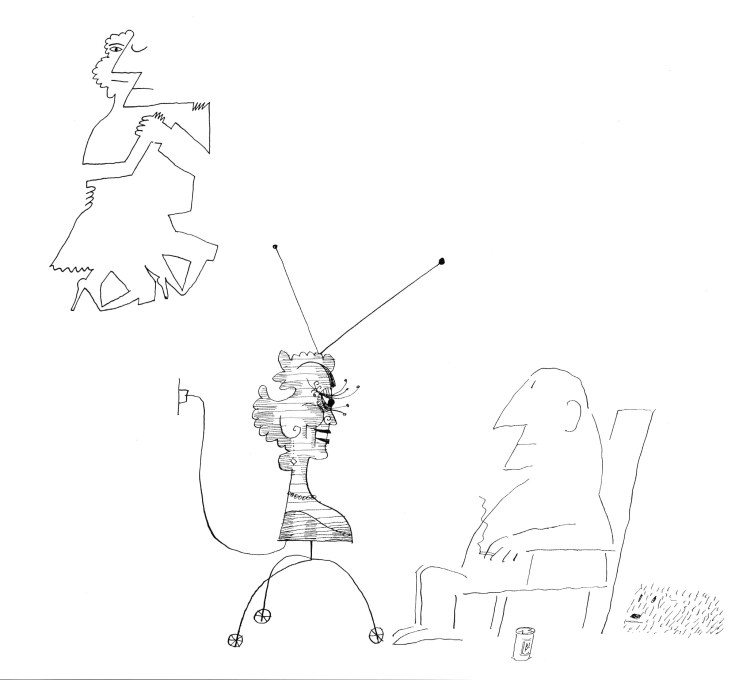
- The Labyrinth by Saul Steinberg. (NYRB) First published in 1960 and back in print again from the NRYB this year, Saul Steinberg’s The Labyrinth condenses the modern and the mythic. “Steinberg was a lyricist of the metal nib—a twirler of nonverbal non sequiturs,” notes novelist Nicholson Baker in his introduction to the new volume. Steinberg’s lyrical non sequiturs evince in squiggles and dots, tangles and loops which turn into well-dressed men and staid women, cityscapes and night scenes, cocktail parties and art shows. Steinberg turns Abraham Lincoln into Don Quixote, with Santa as his Sancho Panza. He takes us out of urbane New York and into midcentury America, land of motor courts and baseball parks, a knotty chaotic chorus of life. Steinberg could seemingly do anything with ink, as the range of styles in The Labyrinth shows, but what he ultimately did was utterly-Steinbergian. The Labyrinth echoes Whitman’s Leaves of Grass, which sought a century earlier, to find a new language to describe a new country. Steinberg looked at America through new eyes, and, like Whitman before him, found a new language of expression—the language of labyrinthine lines on paper.
- Nancy by Olivia Jaimes. (GoComics/United Feature Syndicate) I ♥ Nancy.

 Biblioklept