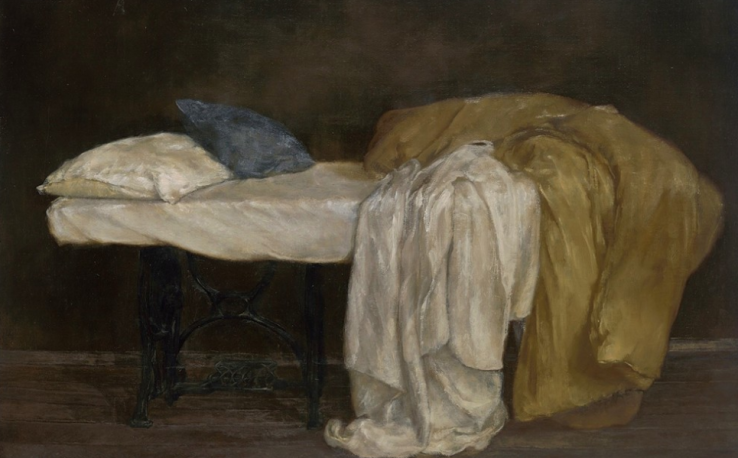
Empty Bed — Anne Herrero 

Empty Bed, 2014 by Anne Herrero (b. 1984)

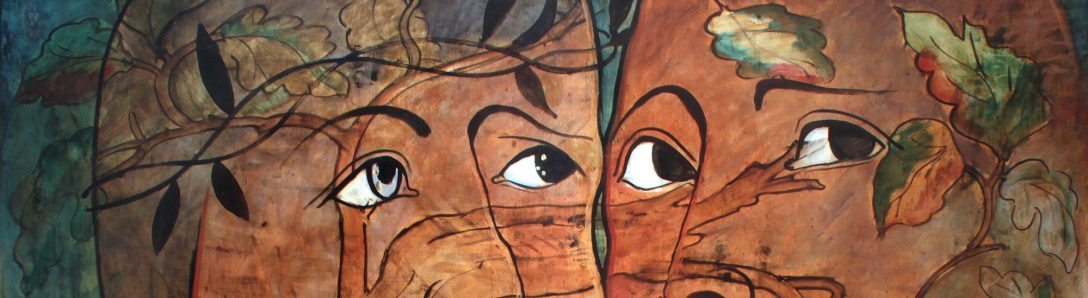
Look at the boy and apologize | Claudia Rankine

A Lady Reading — Gwen John

A Lady Reading 1909-11 by Gwen John 1876-1939

A Lady Reading, 1911 by Gwen John (1876–1939)

New novels from Cormac McCarthy in the fall of 2022

Cormac McCarthy has two novels coming out later this year: The Passenger and Stella Maris. Speculation about The Passenger has percolated for years, with increased interest after McCarthy read excerpts at the Santa Fe Institute in August of 2015. The reading was captured on video and disseminated on the internet and subsequently transcribed (stirring protest from the Cormac McCarthy Society).

A story in The New York Times reports that The Passenger and Stella Maris “represent a major stylistic and thematic departure for McCarthy” and that his “longtime publisher, Alfred A. Knopf, will release” the novels a month apart this fall.

As of now, Knopf’s website doesn’t include any info about the novels, but the NYT story does include what appears to be cover art:

McCarthy’s UK publisher, Pan Macmillan, does have some info on their website about the books, which will apparently be released in a “box set” edition in the UK.

Pan Macmillan also offers some descriptions of the books:

The Passenger

1980, PASS CHRISTIAN, MISSISSIPPI: It is three in the morning when Bobby Western zips the jacket of his wetsuit and plunges from the boat deck into darkness. His divelight illuminates the sunken jet, nine bodies still buckled in their seats, hair floating, eyes devoid of speculation. Missing from the crash site are the pilot’s flightbag, the plane’s black box, and the tenth passenger. But how? A collateral witness to machinations that can only bring him harm, Western is shadowed in body and spirit – by men with badges; by the ghost of his father, inventor of the bomb that melted glass and flesh in Hiroshima; and by his sister, the love and ruin of his soul. Traversing the American South, from the garrulous bar rooms of New Orleans to an abandoned oil rig off the Florida coast, The Passenger is a breathtaking novel of morality and science, the legacy of sin, and the madness that is human consciousness.

Stella Maris

1972, BLACK RIVER FALLS, WISCONSIN: Alicia Western, twenty years old, with forty thousand dollars in a plastic bag, admits herself to the hospital. A doctoral candidate in mathematics at the University of Chicago, Alicia has been diagnosed with paranoid schizophrenia, and she does not want to talk about her brother, Bobby. Instead, she contemplates the nature of madness, the human insistence on one common experience of the world; she recalls a childhood where, by the age of seven, her own grandmother feared for her; she surveys the intersection of physics and philosophy; and she introduces her cohorts, her chimeras, the hallucinations that only she can see. All the while, she grieves for Bobby, not quite dead, not quite hers. Told entirely through the transcripts of Alicia’s psychiatric sessions, Stella Maris is a searching, rigorous, intellectually challenging coda to The Passenger, a philosophical inquiry that questions our notions of God, truth, and existence.

McCarthy is now 88. His last novel, The Road, came out sixteen years ago. He also wrote the screenplay for The Counselor (2013, dir. Ridley Scott), and some nonfiction stuff. My guess is that these two novels are likely the last we’ll get from him. But I hope not.

Here are two photographs of Cormac McCarthy playing pool in El Paso, Texas, in 1998:


“Fore!” — William S. Burroughs

“Fore!”

from

Cities of the Red Night

by

William S. Burroughs


The liberal principles embodied in the French and American revolutions and later in the liberal revolutions of 1848 had already been codified and put into practice by pirate communes a hundred years earlier. Here is a quote from Under the Black Flag by Don C. Seitz:

Captain Mission was one of the forbears of the French Revolution. He was one hundred years in advance of his time, for his career was based upon an initial desire to better adjust the affairs of mankind, which ended as is quite usual in the more liberal adjustment of his own fortunes. It is related how Captain Mission, having led his ship to victory against an English man-of-war, called a meeting of the crew. Those who wished to follow him he would welcome and treat as brothers; those who did not would be safely set ashore. One and all embraced the New Freedom. Some were for hoisting the Black Flag at once but Mission demurred, saying that they were not pirates but liberty lovers, fighting for equal rights against all nations subject to the tyranny of government, and bespoke a white flag as the more fitting emblem. The ship’s money was put in a chest to be used as common property. Clothes were now distributed to all in need and the republic of the sea was in full operation.

Mission bespoke them to live in strict harmony among themselves; that a misplaced society would adjudge them still as pirates. Self-preservation, therefore, and not a cruel disposition, compelled them to declare war on all nations who should close their ports to them. “I declare such war and at the same time recommend to you a humane and generous behavior towards your prisoners, which will appear by so much more the effects of a noble soul as we are satisfied we should not meet the same treatment should our ill fortune or want of courage give us up to their mercy.…” The Nieustadt of Amsterdam was made prize, giving up two thousand pounds and gold dust and seventeen slaves. The slaves were added to the crew and clothed in the Dutchman’s spare garments; Mission made an address denouncing slavery, holding that men who sold others like beasts proved their religion to be no more than a grimace as no man had power of liberty over another.…

Mission explored the Madagascar coast and found a bay ten leagues north of Diégo-Suarez. It was resolved to establish here the shore quarters of the Republic—erect a town, build docks, and have a place they might call their own. The colony was called Libertatia and was placed under Articles drawn up by Captain Mission. The Articles state, among other things: all decisions with regard to the colony to be submitted to vote by the colonists; the abolition of slavery for any reason including debt; the abolition of the death penalty; and freedom to follow any religious beliefs or practices without sanction or molestation. Continue reading ““Fore!” — William S. Burroughs”

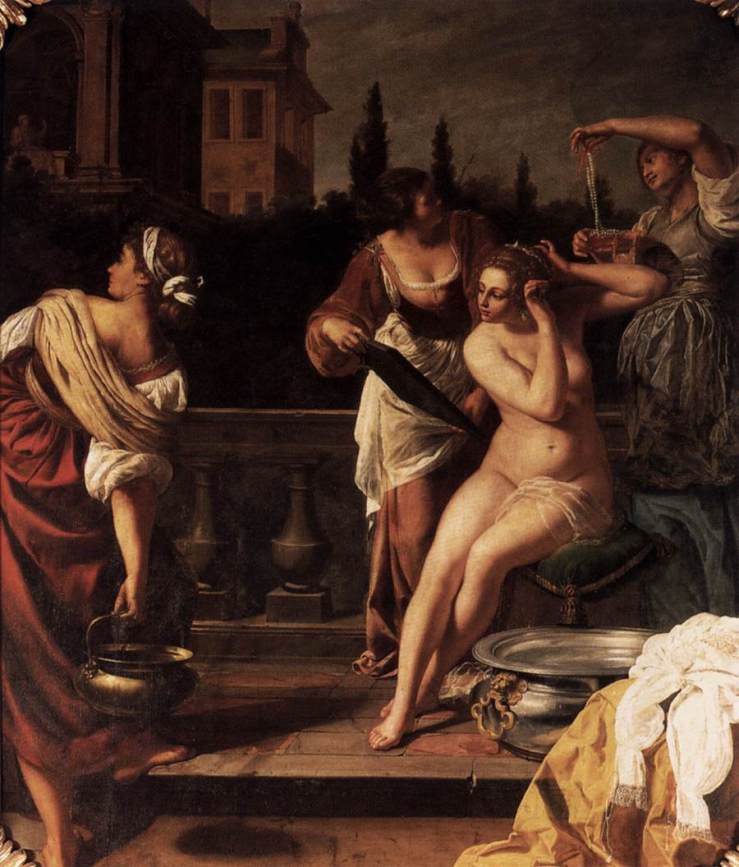
Bathsheba — Artemisia Gentileschi

Bathsheba, c. 1645–1650 by Artemisia Gentileschi (1593-1653)

“Fox” — Rita Dove

“Fox”

by

Rita Dove


She knew what
she was and so
was capable
of anything
anyone
could imagine.
She loved what
she was, there
for the taking,
imagine.

She imagined
nothing.
She loved
nothing more
than what she had,
which was enough
for her,
which was more
than any man
could handle.

Photographic portrait of Donald Barthelme at his drum kit, taken by his father Donald Barthelme, Sr.

db

Donkey — Eckhart Hahn

Donkey, 2019 by Eckhart Hahn (b. 1971)

Hero’s Journey — Susannah Martin

Hero’s Journey, 2021 by Susannah Martin (b. 1964)

See the girl | A report from Marlon James’s novel Moon Witch, Spider King

One night I was in the dream jungle. It was not a dream, but a memory that jump up in my sleep to usurp it. And in the dream memory is a girl. See the girl.

These four sentences open Marlon James’s novel Moon Witch, Spider King, the not-exactly sequel to 2019’s Black Leopard, Red WolfThat novel centered on Tracker and his quest to recover a missing child of enormous importance. Black Leopard, Red Wolf is a bizarre beast, a post-postmodern fantasy that queered its genre conventions and consistently contested the very notion that a story could ever be told straight. In it, Tracker segues between ever-shifting fellowships and nebulous nemeses–including the Moon Witch Sogolon, the protagonist of Moon Witch, Spider King.

Moon Witch, Spider King takes Sogolon as its viewpoint character, and the first seven chapters of this long, long novel (about a quarter of its 600ish pages) read far more straightforward than its predecessor. The narrative gambit of Black Leopard, Red Wolf is that Tracker, captured, is telling his story to an inquisitor—and that telling is a repeated deferral, teleporting through time and space (much like the “Ten and Nine Doors” that Tracker’s fellowship uses to teleport between city-states). Tracker does all he can do to tell any truth aslant. So far, James’s new novel follows a less demanding trajectory. The repeated invocation to “See the girl” follows our hero as her circumstances rise—although Sogolon experiences her rise in a picaresque, out-of-the-frying-pan-into-the-fire spirit.

We first find her an orphan of sort, a neglected witch-child more-or-less imprisoned in a termite hill by three cruel brothers, who blame her for killing their mother, who died birthing her. Sogolon even has to name herself. She escapes only to find herself in new peril, the house of Miss Azora. It’s a whorehouse, but Sogolon mixes potions to protect herself from its patrons–excepting one. The motif of male predation repeats in Moon Witch, as well as Sogolon’s resistance against those who would take her and take from her. In time, Sogolon finds herself into the house of a fallen aristocrat. Master Komwono may hold the title, but its Mistress Komwono who runs the show. Sogolon continues to spy and absorb, to play dumb, to use how others perceive her apparent weakness as an actual strength.

After Master Komwono dies under mysterious circumstances (take a guess!), Mistress Komwono is summoned back to the kingdom of Fasisi, from which she had previously been banished. A soldier named Keme is part of the caravan to bring the Komwono household to the capital, and Sogolon finds herself taken with the man. When they arrive at the palace, things take an even more sinister turn: the King is dying and his sister has disappeared (or been disapperead).

Here is where the plot machinations of Moon Witch truly kick in, shifting into a novel of political court intrigue. Mistress Komwono gives poor Sogolon to the princess of Fasisi, and she is drawn into all sorts of machinations. We begin to see the plotting of the Aesi (another of Tracker’s antagonists), whose Machiavellian moves are yet oblique to the young girl. In the meantime, witches are being burned, and Keme meets with his own fellowship (of griots and warriors and sentient lions) in a floating city. There’s a lot going on.

There’s a lot going on, but it’s a fun going on. See the girl, the narrator repeatedly intones, and James’s prose is marvelously vivid, setting strange scene after strange scene. And while the narrative voice, focused on Sogolon, is a removed third-person, I can’t help but now notice that the book opens with an I: “One night I was in the dream jungle”…who is this I, who so quickly disappears after a few sentences, replaced by the dream-memory incantation: See the girl.

(Parenthetically—while there are no Blood Meridian vibes so far to Moon Witch, Spider King, that incantation See the girl nevertheless seems to echo that McCarthy’s novel’s opening line, See the child (itself perhaps an echo of Melville’s Call me Ishmael.))

Anyway–I’m digging Moon Witch thus far. I’ve been auditing the audiobook (narrated by Bahni Turpin) and then rereading bits for clarification. So far, I think that anyone interested in what Marlon James is doing with this so-called Dark Star trilogy would be absolutely fine starting with this one. The line is straighter than Black Leopard, the thread is easier to follow, and it’s not necessary to know the contours or details of the plot of that “first” novel. But it still points to the wonderful queer weirdness of that novel. More to come.

Read Edna St. Vincent Millay’s one-act play, Two Slatterns and a King

Two Slatterns and a King

A Moral Interlude

by

Edna St. Vincent Millay


PERSONS

The King
Chance the Vice
Tidy the false Slattern
Slut the true Slattern

The Prologue and the Epilogue Spoken by Chance


Two Slatterns and a King

PROLOGUE

I am that cunning infidel
By men called CHANCE,—you know me well.
It is through me you met your wives;
Through me your harvest blights or thrives;
And one and all, through me, to-day
Hither you came to see the play,
Which if your favor still you lend,
As now, so on until the end,
You shall be taught what way a King
Though a sublime and awful thing
And even wise, may come to be
A laughing-stock,—and all through me!
(Exit)
(enter King)
King:
I am the King of all this land:
I hold a sceptre in my hand;
Upon my head I wear a crown;
Everybody stands when I sit down. (Sits)
Chance (Appearing to audience; he is invisible
throughout the play to the other players in it.
):
Excepting me,—please bear in mind
I sit whenever I feel inclined. (Sits)
King:
Although my lands are wide and long,
My walls right thick, my armies strong,
I am not wholly satisfied.
Chance:
That is because you have no bride.
King:
Who speaks?—Come forth and, if you dare,
Say once again what causes my care!
Why I am discontent with life!
Chance:
It is because you have no wife.
King:
A woman in my royal house!
A woman! A wife! A bride! A spouse!
Bold stranger, this is not the cure,
For a woman I could never endure!
Chance:
Per-CHANCE to-morrow you will find
You have altered your imperial mind.
(Exeunt King and Chance severally)
(Enter Tidy)
Tidy:
I am TIDY, I have been
All my life both neat and clean.
From my outside to my in
Clean am I unto my skin.
Every day into a bucket
My hands I dip, my head I duck it;
And if the water plenty be
I sometimes wet some more of me.
This is my kitchen, where you will find
All things pleasant and to your mind;
Against the wall in orderly pairs—
One, two,—one, two,—observe my chairs
In the middle of the room my table stands:
I would not move it for many lands.
My basins and bowls are all in their places;
The bottoms of my pots are as clean as your faces.
My kettle boils so cheerily,
It is like a friendly voice to me;
About my work I merrily sing,
And I brush my hearth with a white duck’s wing.
Oh, full is every cupboard, sharp is every knife!—
My bright, sunny kitchen is the pride of my life!
(Exit Tidy)
(Enter Slut)
Slut:
I am SLUT; I am a slattern,
You must not take me for your pattern.
I spend my days in slovenly ease;
I sleep when I like and I wake when I please.
My manners, they are indolent;
In clutter and filth I am quite content.
Here is my kitchen, where I stir up my messes,
And wear out my old shoes and soiled silk dresses.
My table sags beneath the weight
Of stale food and unwashed plate;
The cat has tipped the pitcher o’er,—
The greasy stream drips onto the floor;
Under the table is a broken cup—
I am too tired to pick it up.
(Exit Slut)
(Enter King)

Continue reading “Read Edna St. Vincent Millay’s one-act play, Two Slatterns and a King”

Posted in Art

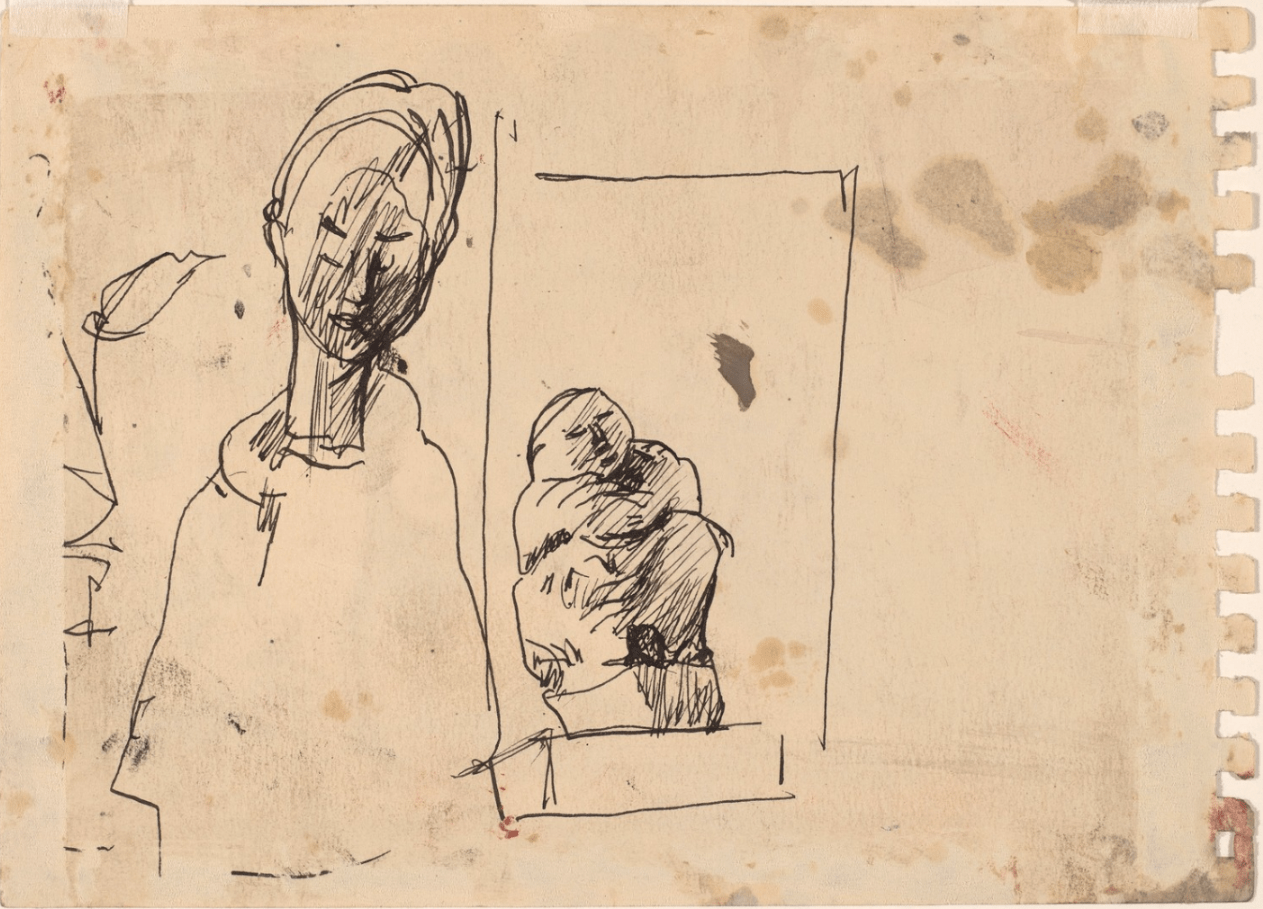
Untitled — Mark Rothko

Untitled [Verso], c. 1940 by Mark Rothko (1903-1970)

“The Unexplorer” — Edna St. Vincent Millay

esvm

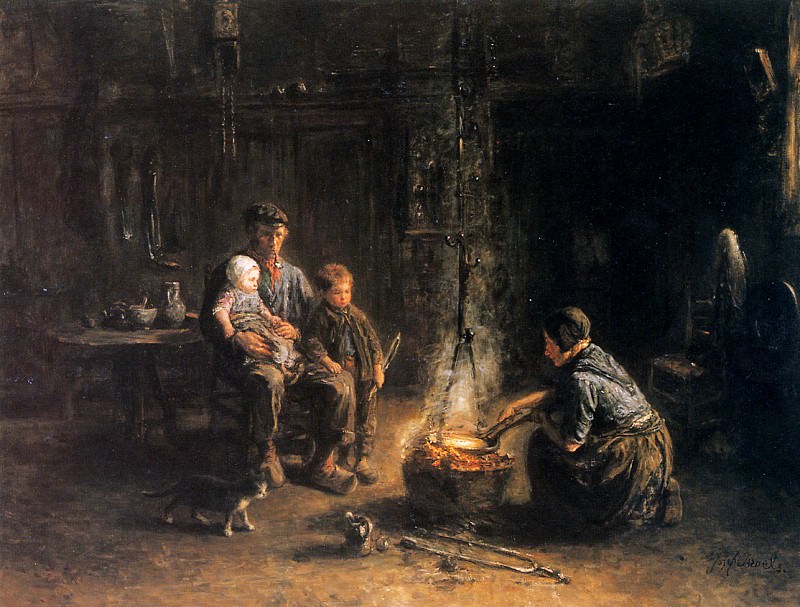
Pancake Day — Jozef Israëls

Pancake Day, c. 1885 by Jozef Israëls (1824-1911)

Home in Bed — Shannon Cartier Lucy 

Home in Bed, 2018 by Shannon Cartier Lucy (b. 1977)