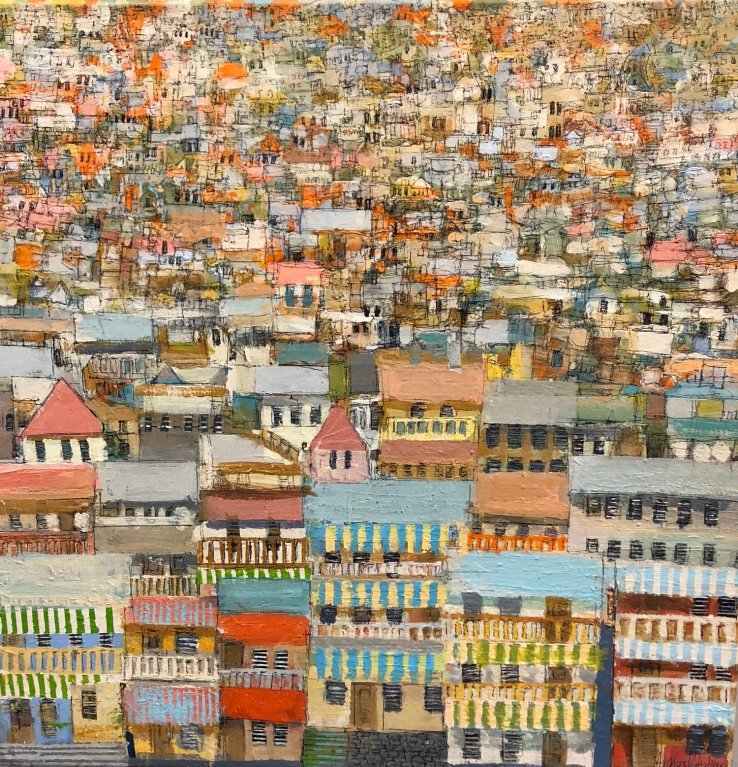
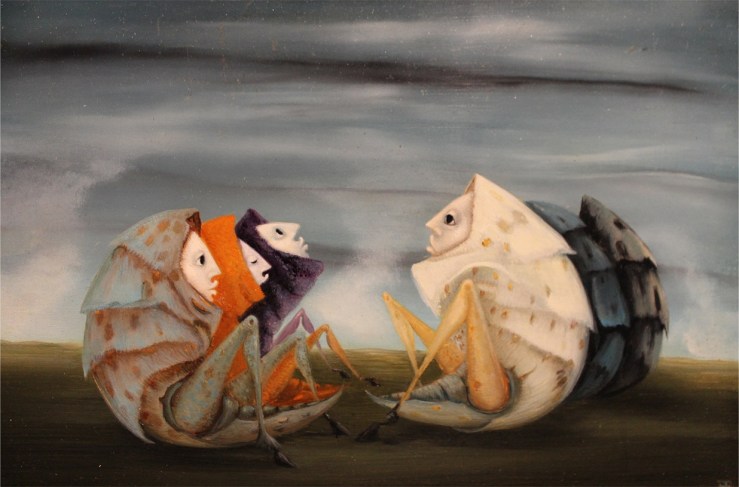
The Pandemic — Miles Cleveland Goodwin 

The Pandemic, 2021 by Miles Cleveland Goodwin (b. 1980)

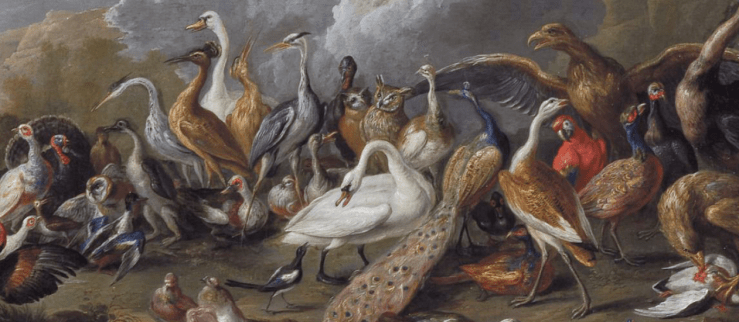
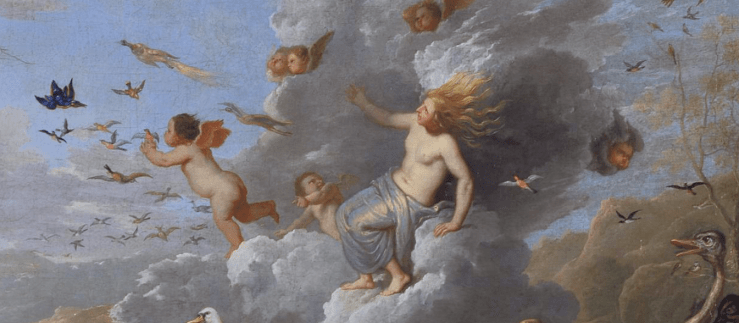
Allegory of Air (Detail) — Jan van Kessel the Elder

Allegory of Air (detail), 1661 by Jan van Kessel the Elder (1626-1679)

“little report of the day” — Jack Collum

“little report of the day”

by

Jack Collum


9:13 p.m., Lucky Bock in hand,
I inscribe: walked the lovely
33 blocks to school today, streets clear and
thick melting snow all around.
taught my 4 hours of poetry; the afternoon
class was hard; kid named Schweikert
kept on fucking up. took typed-up
poems of yesterday to Platt and put up
poster there of Anne and Reed’s reading Sat.
ate nearly 2 peanutbutter sandwiches with
raw carrots. typed. read kids’ poems.
at 4 I started home, got a ride
with Jim Bay. press release to daily paper.
stopped in Baird’s for 2 beers,
looked at paper. home, kissed Mara, Sierra.
in the mail: Out There, from Chicago, and a letter
stating the city of Grand Island had decided not
to prosecute re my arrest
Friday for intoxication. wonder why. Nick
the landlord didn’t show (he was supposed to
have us sign lease on the new duplex) (this place
gonna be torn down). ate
a very delicious supper, ham-and-cheese
rarebit with cold broccoli and cold oregano’d
tomato, cooked by Mara. paperwork, played a
game of solitaire, harried by Sierra’s
new red car. dropped over then
to the Korner Bar, put up a poster under the phone sign, said hi
to a few folks and got halloo’d by this guy I’d
spoken to 2 months before, who’d said his high
school son adored me, but it might be thought improper
that I hang around, shoot pool in Korner Bar.
a beefy mid-30’s man, he bought me a beer, apologized and
told me of his luck: he’d won a thousand one-hundred eighty
dollars today betting on one horse at Fonner Park.
we talked of poetry, family, work — he mentioned Kilmer,
Stevenson, Nash and others, quoted verbatim
his own published poem on fire-fighting (he is the G.I.
fire-chief). his boyhood favorites, whom he reads all of
even now: Edgar Rice Burroughts and Jules Verne. his son,
though epileptic, does the high jump at the high school; he was
disturbed that it wasn’t the broad jump, in which he
himself still holds a record, set in 1959.
the taxes have jumped up like crazy on their nice
spread just inside the city limits. I got up and
slapped him on the back and left, stopping first to ask
Clark, standing end of the bar, what he knew
of me on Friday night at the Kyriss. I’d blanked out
completely (woke up in jail, ate
blue oatmeal). he said I’d just got drunk, he thought Rod
had taken me home. he said, at one point,
just waking up, I’d grabbed the edge of the table and
tilted it till the glasses all came sliding
down and almost off, then tilted it back till they
slid back to where they were, and never spilled a drop.
he said I’d bought some beers for him and Pat but
before they could get to them drank
them up myself. okay, Clark, you’re a good guy with your
black curly hair and toothless grin, and your wild life. I was just
wondering. check with Rod when have a chance. —
and off, through mud and occasionally-lighted puddles,
home, where Mara’s napping still and there are (were)
5 Lucky Bocks in the white (today!) icebox. 9:50.
           (no. 2)
after finishing that
(immediately after, during, in
fact) the
strange thing is there’s so much left out.
last night finished reading
The Vicar of Wakefield. the bluejays and cardinals that called
on the way to school. my beard
suddenly seems soft (that thought
off some day-dreaming about talking to
poetry students). reread
(for the last “making” time) “the 14,” the magazine; it is
all set. the poems
there, here now, seemed so abstract,
compared with what I’m used to,
but that in a way intensely and properly shaking
feeling and talk, tonight. the
revolution
(Mara gets up, starts drinking Pepsi)
and all that. (yellow sweater).

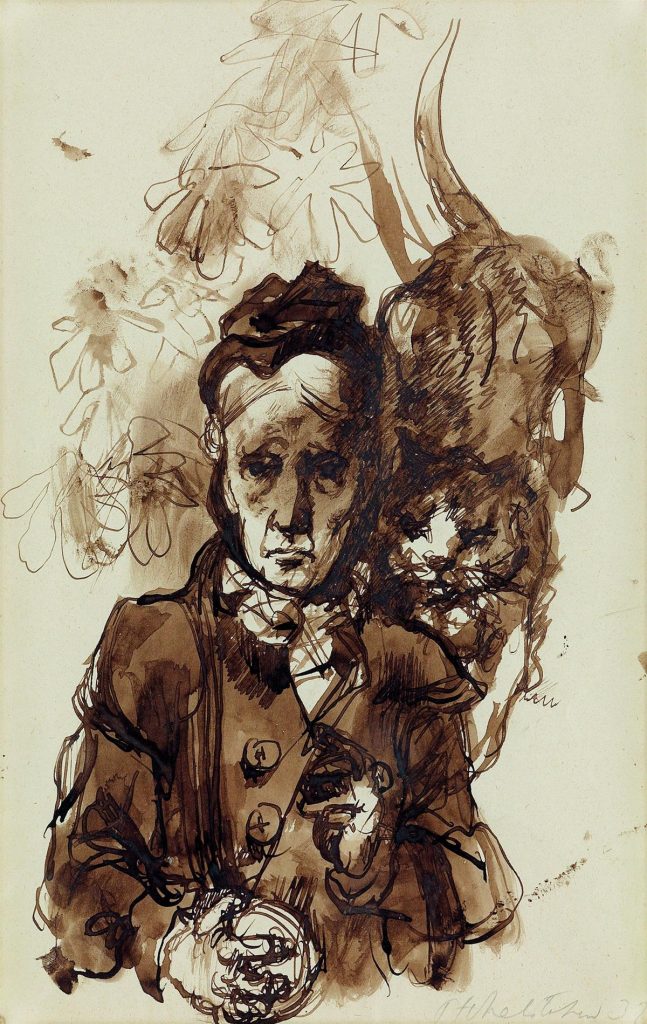
The Sorceress — Pavel Tchelitchew

The Sorceress, 1932 by Pavel Tchelitchew (1898-1957)

Mario Levrero’s The Luminous Novel (Book acquired, 30 March 2021)

Mario Levrero’s The Luminous Novel is forthcoming in English translation by Annie McDermott from the good folks at And Other Stories. It’s a big ole book! Here is And Other Stories’ blurb:

A writer attempts to complete the novel for which he has been awarded a big fat Guggenheim grant, though for a long time he succeeds mainly in procrastinating – getting an electrician to rewire his living room so he can reposition his computer, buying an armchair, or rather, two: ‘In one, you can’t possibly read: it’s uncomfortable and your back ends up crooked and sore. In the other, you can’t possibly relax: the hard backrest means you have to sit up straight and pay attention, which makes it ideal if you want to read.’

Insomniacs, romantics and anyone who’s ever written (or failed to write) will fall in love with this compelling masterpiece told by a true original, with all his infuriating faults, charming wit and intriguing musings.

I loved the last two And Other Stories editions I read, by the way. I highly recommend Norah Lange’s Notes from Childhood (translated by Nora Whittle) — I wrote about it here.

The other AOS book was Ann Quin’s 1969 avant garde novel Passages, which is unlike anything else I’ve ever read (although Joyce’s Ulysses, Jane Bowles’s Two Serious Ladies, Beckett, Derrida’s Glas, and Julia Kristeva come to mind). I reread it last weekend in an attempt to outline a review, which I hope to have up soon.

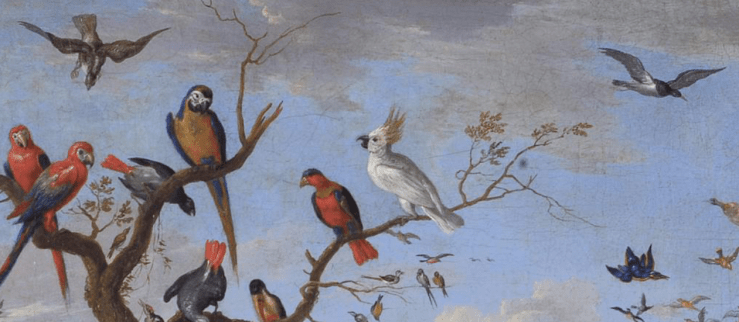
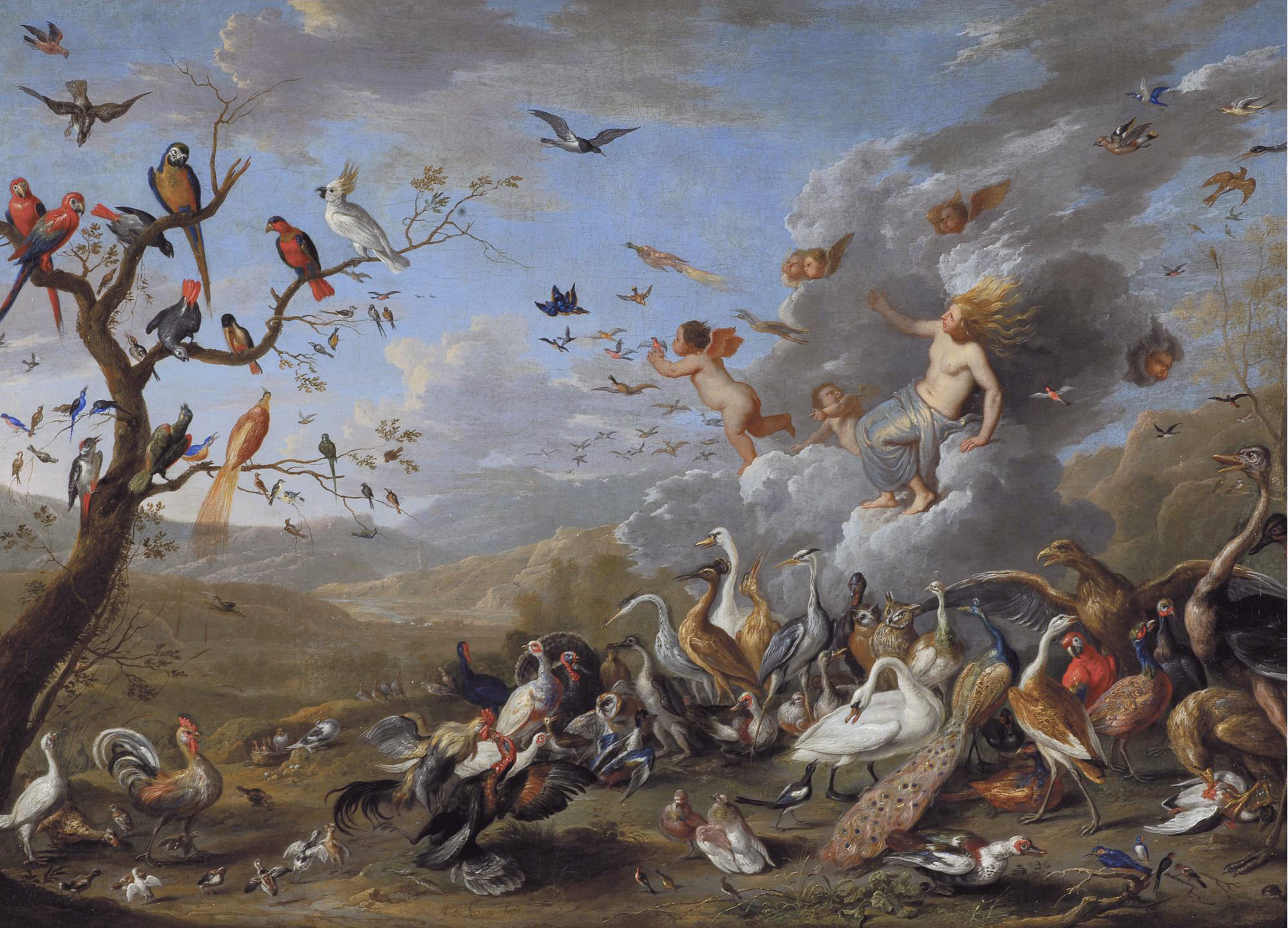
Allegory of Air (Detail) — Jan van Kessel the Elder

Allegory of Air (detail), 1661 by Jan van Kessel the Elder (1626-1679)

Chaos XLIX — Michael Palmer

Chaos XLIX by Michael Palmer (b. 1942)

Wait — Bridget Tichenor

Wait, 1961 by Bridget Tichenor (1917-1990)

Allegory of Air (Detail) — Jan van Kessel the Elder

Allegory of Air (detail), 1661 by Jan van Kessel the Elder (1626-1679)

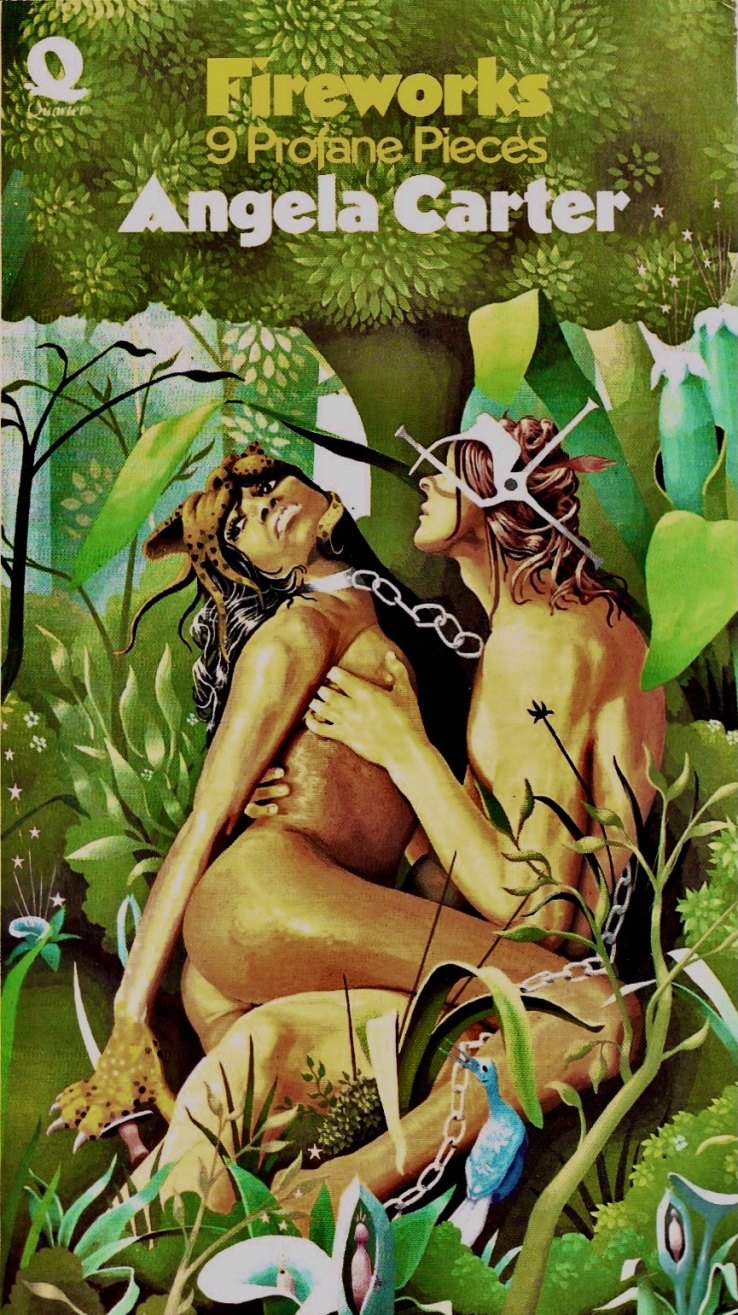
Angela Carter’s Fireworks (Book acquired, 2 April 2021)

I came across this 1976 first edition paperback of Angela Carter’s collection Fireworks two weeks ago and couldn’t pass it up, even though all of Fireworks is collected in Burning Your Boats, which I already own. I love the hornyassed cover by Bob Foulke. I cannot find anything else by Foulke on the internet.

Here is the opening of “The Executioner’s Beautiful Daughter”:

Here, we are high in the uplands.

A baleful almost-music, that of the tuneless cadences of an untutored orchestra repercussing in an ecstatic agony of echoes against the sounding boards of the mountains, lured us into the village square where we discover them twanging, plucking and abusing with horsehair bows a wide variety of crude stringed instruments. Our feet crunch upon dryly whispering shifting sawdust freshly scattered over impacted surfaces of years of sawdust clotted, here and there, with blood shed so long ago it has, with age, acquired the colour and texture of rust . . . sad, ominous stains, a threat, a menace, memorials of pain.

There is no brightness in the air. Today the sun will not irradiate the heroes of the dark spectacle to which accident and disharmony combined to invite us. Here, where the air is choked all day with diffuse moisture tremulously, endlessly the point of becoming rain, light falls as if filtered through muslin so at all hours a crepuscular gloaming prevails; the sky looks as though it is about to weep and so, gloomily illuminated through unshed tears, the tableau vivant before us is suffused with the sepia tints of an old photograph and nothing within it moves. The intent immobility of the spectators, wholly absorbed as they are in the performance of their hieratic ritual, is scarcely that of living things and this tableau vivant might be better termed a nature morte for the mirthless carnival is a celebration of a death. Their eyes, the whites of which are yellowish, are all fixed, as if attached by taut, invisible strings upon a wooden block lacquered black with the spilt dews of a millennia of victims.

And now the rustic bandsmen suspend their unmclodious music. This death must be concluded in the most dramatic silence. The wild mountain-dwellers are gathered together to watch a public execution; that is the only entertainment the country offers.

Time, suspended like the rain, begins again in silence, slowly.

News or Something — Pablo Martinez

News or Something, 2017 by Pablo Martinez

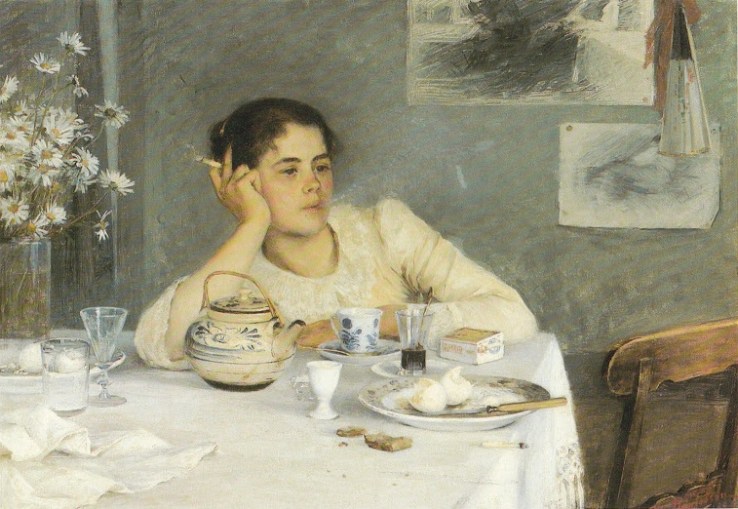
After Breakfast — Elin Danielson-Gambogi

After Breakfast, 1890 by Elin Danielson-Gambogi (1861-1919)

Posted in Art

“Seascape” — Elizabeth Bishop

“Seascape”

by

Elizabeth Bishop


This celestial seascape, with white herons got up as angels,
flying high as they want and as far as they want sidewise
in tiers and tiers of immaculate reflections;
the whole region, from the highest heron
down to the weightless mangrove island
with bright green leaves edged neatly with bird-droppings
like illumination in silver,
and down to the suggestively Gothic arches of the mangrove roots
and the beautiful pea-green back-pasture
where occasionally a fish jumps, like a wildflower
in an ornamental spray of spray;
this cartoon by Raphael for a tapestry for a Pope:
it does look like heaven.
But a skeletal lighthouse standing there
in black and white clerical dress,
who lives on his nerves, thinks he knows better.
He thinks that hell rages below his iron feet,
that that is why the shallow water is so warm,
and he knows that heaven is not like this.
Heaven is not like flying or swimming,
but has something to do with blackness and a strong glare
and when it gets dark he will remember something
strongly worded to say on the subject.

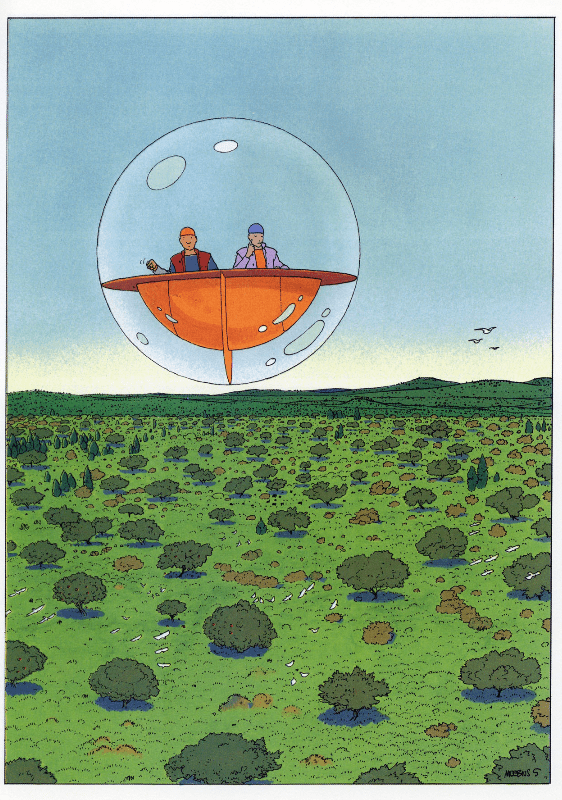
A page from Moebius’ The Gardens of Aedena

A page from The Gardens of Aedena by Moebius.

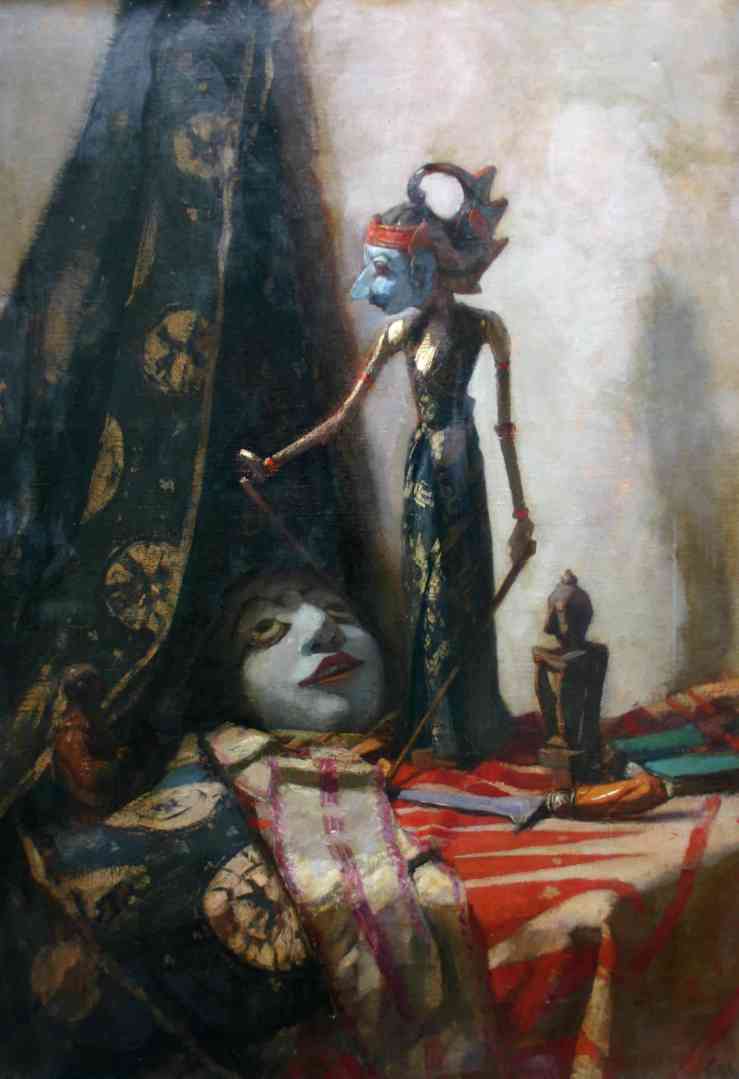
Still life with Wajang — Salomon Garf

Still Life with Wajang by Salomon Garf (1873-1943)

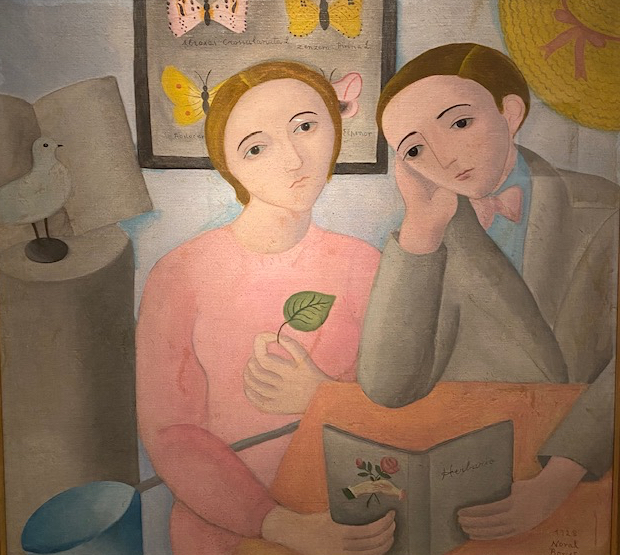
Herbario — Norah Borges

Herbario, 1928 by Norah Borges (1901–1998)

Theory of Relativity — Eduardo Paolozzi

Theory of Relativity, 1967 by Eduardo Paolozzi (1924–2005)