Biblioklept is twelve today.
Here are twelve books that I’ve never read before that I’ll try to read some time in the next twelve years.
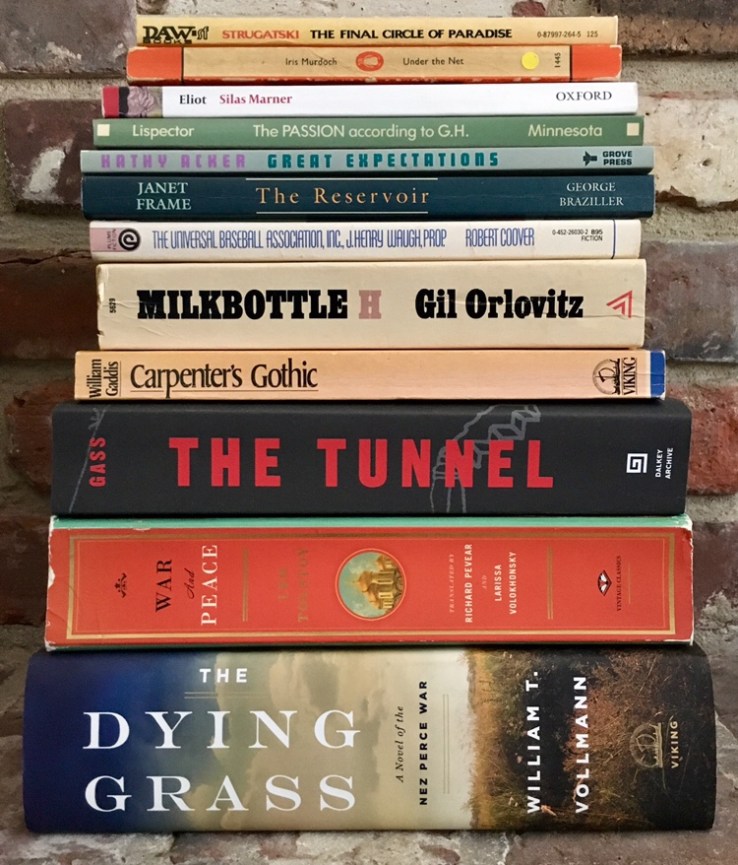
From top to bottom, with no real hierarchy other than the physical heft involved in composing the photograph above—
The Final Circle of Paradise by Arkady and Boris Strugatsky (trans. by Leonid Renen)
I snatched up this Daw mass market paperback of this Strugatsky brothers novel a few years ago; they aren’t as easy to find as you might think (although Chicago Review Press is slowly reissuing new translations).
Chance I’ll get to it soon: High. I’ve been on a Strugatsky kick the last two years and this is one that I physically own, so.
The Net by Iris Murdoch
I picked up a slim Penguin edition of The Net when I couldn’t find The Bell (not realizing that the “Iris Murdoch” section extended in my used bookshop and that there were plenty of copies of The Bell). I loved The Bell, and want to read more Murdoch. Folks told me not to do The Net next, but I own it. So maybe let’s call it a placeholder.
Chance I’ll get to it soon: The chance that I get to another Murdoch novel sometime later this year is very high.
Silas Marner by George Eliot
I finally read Middlemarch in 2018. I loved it but good lord it was long. Silas Marner is much shorter.
Chance I’ll get to it soon: Very high. It’s on deck after I finish up a few of the shorter novels and short story collections I’m reading now.
The Passion According to G.H. by Clarice Lispector (trans. by Ronald W. Sousa)
Like seemingly every book blogger, I went through a Lispector jag in the early part of this decade, gobbling up The Hour of the Star and Near to the Wild Heart. I had thought that I’d read The Passion According to G.H., but when I pulled it out earlier this year to look for something in it, I realized I hadn’t finished it—I probably hadn’t even gotten a third of the way through, if the idle bookmark (a charming doodle by my daughter) is any indication. Furthermore, the selection I was looking for, a passage on abjection, wasn’t even in Passion—it was in Wild Heart.
Chance I’ll get to it soon: Not extraordinarily high, but it’s unshelved, loose in the wilds now.
Great Expectations by Kathy Acker
I picked this one up a few weeks ago, and started in on it a bit—it’s short and has this kind of dark wild surreal icky sexy beach read vibe to it.
Chance I’ll get to it soon: I should’ve taken it camping with me next week. It’s the kind of book I want to read in a specific place that’s not, like, my couch or whatever. What I’m saying is that I’ll read this on the beach or in a tent or like, maybe you invite me down to stay at your place for a weekend but your house is so full of other guests, but, Guess what? There’s a wonderful little bedroom on your catamaran, which is docked gently right here. So after a night of good wine and good conversation, I’ll sneak off to the catamaran and read Kathy Acker before falling into wavy slumbers.
The Reservoir by Janet Frame
I read the first few of the stories in The Reservoir a few years ago and loved them but then got absorbed in something else. I was looking for a story by her to use in class, and I pulled this collection out, but it wasn’t in there. I think it’s in The New Yorker though.
Chance I’ll get to it soon: Again–I pulled it out of rotation, so who knows? I’m in the midst of another short story collection (which is frankly turning into a hate read at this point), so maybe a few of these Frames will be an antidote to the Very Clever Author Whose Work I Keep Wincing At.
The Universal Baseball Association, Inc., J. Henry Waugh, Prop. by Robert Coover
When I picked up The Universal Baseball Association, I knew that I wasn’t going to read it anytime soon, but I also knew that I’d regret not having picked up a copy for three bucks when I had the chance. I was finishing up Going for a Beer, Coover’s recent collection of greatest hits, and was frankly exhausted with the man (the stories in A Night at the Movies can, uh, be repetitive).
Chance I’ll get to it soon: Not very high. I downloaded a copy of his novel The Origin of the Brunists one night on a lark and I don’t know if I’ll get to it any time soon either.
Milkbottle H by Gil Orlovitz
A somewhat rare cult novel with no real visible cult, Olrovitz’s Milkbottle H has been described as “the Ulysses of Philadelphia.” I found it a few weeks ago in the miscellaneous O section of my local used bookstore for three bucks. The book is long and seems to employ a mix of modernist techniques that makes it, uh, confusing at first.
Chance I’ll get to it soon: Not high. Right now it’s more like a thing I want to do, but it looks like a project that will require its own special time.
Carpenter’s Gothic by William Gaddis
I hate that I still haven’t gotten past page 30 of Carpenter’s Gothic. I gave it a second shot a few years ago and then wound up rereading J R instead.
Chance I’ll get to it soon: Should I prioritize this one after Silas Marner? I’m sure some new novel/review copy will get in the way, mucking things up…but should I commit to Carpenter’s Gothic? (I recently wrote about wanting to reread The Recognitions, so…).
The Tunnel by William H. Gass
I made a Serious Attempt earlier this year and stalled out.
Chance I’ll get to it soon: I will make a Serious Attempt earlier next year (and likely stall out).
War and Peace by Leo Tolstoy
War and Peace is one of those big books that I can’t believe I haven’t read. Earlier this year I said I’d give it a shot and then I never did (I tried The Tunnel and then settled into Middlemarch).
Chance I’ll get to it soon: Can anyone suggest a good audiobook version?
The Dying Grass by William H. Vollmann
The Dying Grass is almost 1,400 pages. I tried reading the ebook when it came out but the page breaks were weird (Vollmann has a Whitmanesque style on the page). I downloaded the audiobook which is 54 hours long, but I kept losing the thread. I picked up a used copy of the hardback for six bucks and it’s a goddamn monster.
Chance I’ll get to it soon: Try holding your breath.