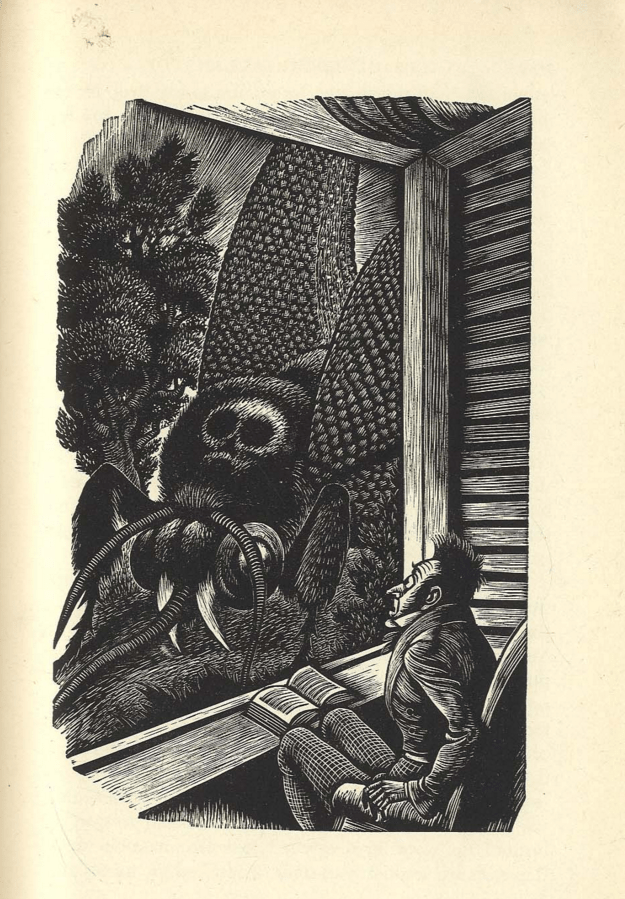
Illustration for Poe’s “The Sphinx,” Fritz Eichenberg
“The Sphinx”
by
Edgar Allan Poe
DURING the dread reign of the Cholera in New York, I had accepted the invitation of a relative to spend a fortnight with him in the retirement of his cottage ornee on the banks of the Hudson. We had here around us all the ordinary means of summer amusement; and what with rambling in the woods, sketching, boating, fishing, bathing, music, and books, we should have passed the time pleasantly enough, but for the fearful intelligence which reached us every morning from the populous city. Not a day elapsed which did not bring us news of the decease of some acquaintance. Then as the fatality increased, we learned to expect daily the loss of some friend. At length we trembled at the approach of every messenger. The very air from the South seemed to us redolent with death. That palsying thought, indeed, took entire possession of my soul. I could neither speak, think, nor dream of any thing else. My host was of a less excitable temperament, and, although greatly depressed in spirits, exerted himself to sustain my own. His richly philosophical intellect was not at any time affected by unrealities. To the substances of terror he was sufficiently alive, but of its shadows he had no apprehension.
His endeavors to arouse me from the condition of abnormal gloom into which I had fallen, were frustrated, in great measure, by certain volumes which I had found in his library. These were of a character to force into germination whatever seeds of hereditary superstition lay latent in my bosom. I had been reading these books without his knowledge, and thus he was often at a loss to account for the forcible impressions which had been made upon my fancy.
A favorite topic with me was the popular belief in omens—a belief which, at this one epoch of my life, I was almost seriously disposed to defend. On this subject we had long and animated discussions—he maintaining the utter groundlessness of faith in such matters,—I contending that a popular sentiment arising with absolute spontaneity- that is to say, without apparent traces of suggestion—had in itself the unmistakable elements of truth, and was entitled to as much respect as that intuition which is the idiosyncrasy of the individual man of genius.
The fact is, that soon after my arrival at the cottage there had occurred to myself an incident so entirely inexplicable, and which had in it so much of the portentous character, that I might well have been excused for regarding it as an omen. It appalled, and at the same time so confounded and bewildered me, that many days elapsed before I could make up my mind to communicate the circumstances to my friend. Continue reading ““The Sphinx” — Edgar Allan Poe”→
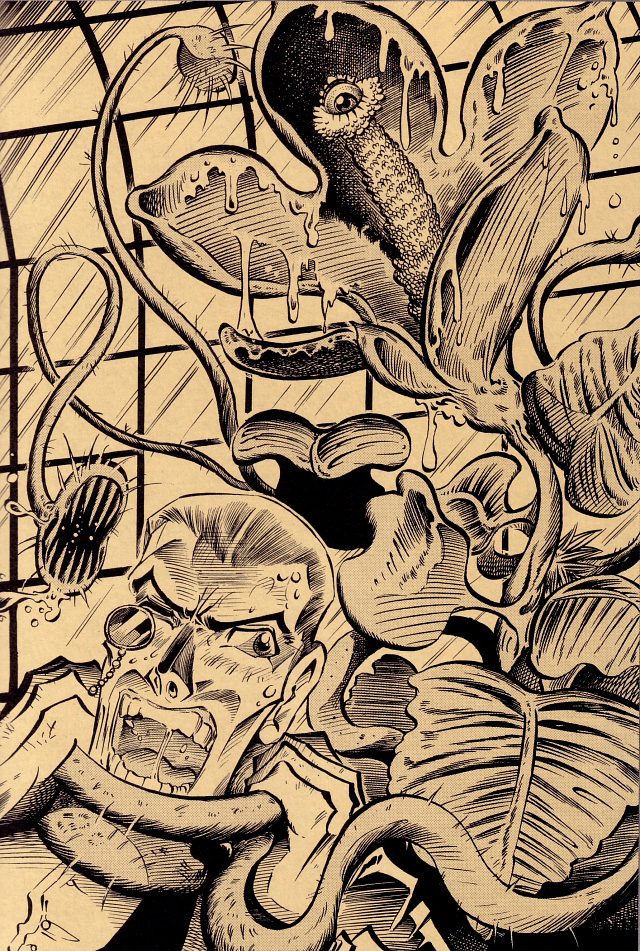
Illustration for “The Flowering of the Strange Orchid,” Tatsuya Morino
“The Flowering of the Strange Orchid”
by
H.G. Wells
The buying of orchids always has in it a certain speculative flavour. You have before you the brown shrivelled lump of tissue, and for the rest you must trust your judgment, or the auctioneer, or your good-luck, as your taste may incline. The plant may be moribund or dead, or it may be just a respectable purchase, fair value for your money, or perhaps – for the thing has happened again and again – there slowly unfolds before the delighted eyes of the happy purchaser, day after day, some new variety, some novel richness, a strange twist of the labellum, or some subtler coloration or unexpected mimicry.
Pride, beauty, and profit blossom together on one delicate green spike, and it may be, even immortality. For the new miracle of Nature may stand in need of a new specific name, and what so convenient as that of its discoverer? “Johnsmithia!” There have been worse names.
It was perhaps the hope of some such happy discovery that made Winter-Wedderburn such a frequent attendant at these sales – that hope, and also, maybe, the fact that he had nothing else of the slightest interest to do in the world. He was a shy, lonely, rather ineffectual man, provided with just enough income to keep off the spur of necessity, and not enough nervous energy to make him seek any exacting employments. He might have collected stamps or coins, or translated Horace, or bound books, or invented new species of diatoms. But, as it happened, he grew orchids, and had one ambitious little hothouse. Continue reading ““The Flowering of the Strange Orchid” — H.G. Wells”→
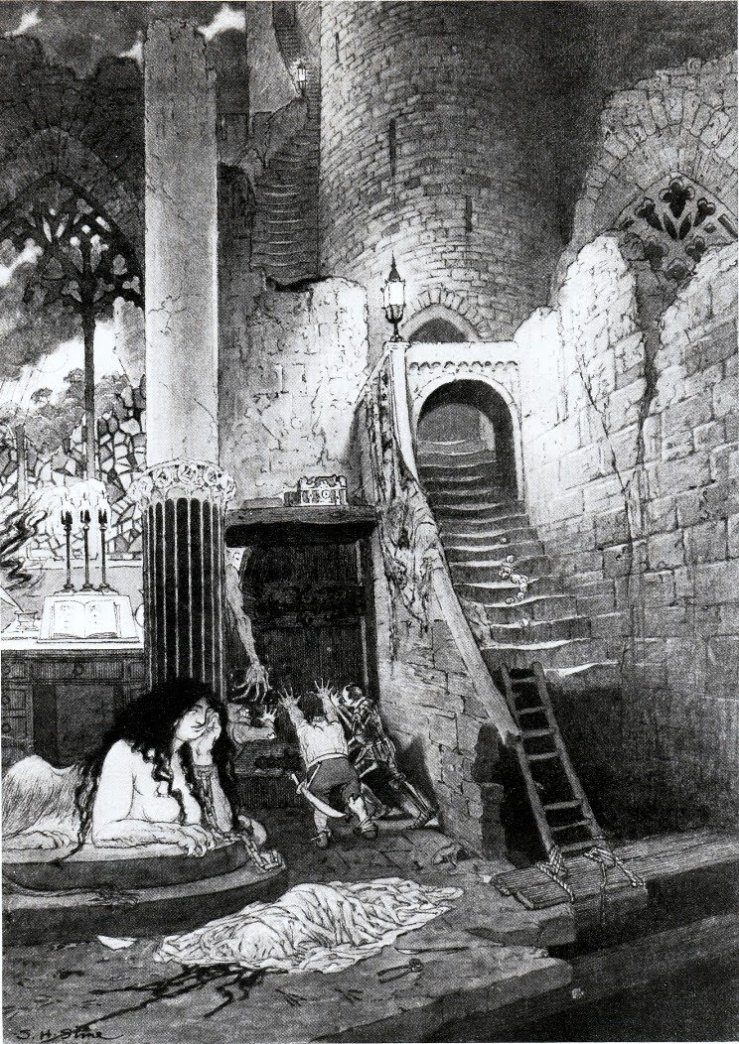
“The House of the Sphinx” illustration by Sidney Sime
“The House of the Sphinx”
by
Lord Dunsany
When I came to the House of the Sphinx it was already dark. They made me eagerly welcome. And I, in spite of the deed, was glad of any shelter from that ominous wood. I saw at once that there had been a deed, although a cloak did all that a cloak may do to conceal it. The mere uneasiness of the welcome made me suspect that cloak.
The Sphinx was moody and silent. I had not come to pry into the secrets of Eternity nor to investigate the Sphinx’s private life, and so had little to say and few questions to ask; but to whatever I did say she remained morosely indifferent. It was clear that either she suspected me of being in search of the secrets of one of her gods, or of being boldly inquisitive about her traffic with Time, or else she was darkly absorbed with brooding upon the deed.
I saw soon enough that there was another than me to welcome; I saw it from the hurried way that they glanced from the door to the deed and back to the door again. And it was clear that the welcome was to be a bolted door. But such bolts, and such a door! Rust and decay and fungus had been there far too long, and it was not a barrier any longer that would keep out even a determined wolf. And it seemed to be something worse than a wolf that they feared.
A little later on I gathered from what they said that some imperious and ghastly thing was looking for the Sphinx, and that something that had happened had made its arrival certain. It appeared that they had slapped the Sphinx to vex her out of her apathy in order that she should pray to one of her gods, whom she had littered in the house of Time; but her moody silence was invincible, and her apathy Oriental, ever since the deed had happened. And when they found that they could not make her pray, there was nothing for them to do but to pay little useless attentions to the rusty lock of the door, and to look at the deed and wonder, and even pretend to hope, and to say that after all it might not bring that destined thing from the forest, which no one named.
It may be said I had chosen a gruesome house, but not if I had described the forest from which I came, and I was in need of any spot wherein I could rest my mind from the thought of it.
I wondered very much what thing would come from the forest on account of the deed; and having seen that forest—as you, gentle reader, have not—I had the advantage of knowing that anything might come. It was useless to ask the Sphinx—she seldom reveals things, like her paramour Time (the gods take after her), and while this mood was on her, rebuff was certain. So I quietly began to oil the lock of the door. And as soon as they saw this simple act I won their confidence. It was not that my work was of any use—it should have been done long before; but they saw that my interest was given for the moment to the thing that they thought vital. They clustered round me then. They asked me what I thought of the door, and whether I had seen better, and whether I had seen worse; and I told them about all the doors I knew, and said that the doors of the baptistry in Florence were better doors, and the doors made by a certain firm of builders in London were worse. And then I asked them what it was that was coming after the Sphinx because of the deed. And at first they would not say, and I stopped oiling the door; and then they said that it was the arch-inquisitor of the forest, who is investigator and avenger of all silverstrian things; and from all that they said about him it seemed to me that this person was quite white, and was a kind of madness that would settle down quite blankly upon a place, a kind of mist in which reason could not live; and it was the fear of this that made them fumble nervously at the lock of that rotten door; but with the Sphinx it was not so much fear as sheer prophecy.
The hope that they tried to hope was well enough in its way, but I did not share it; it was clear that the thing that they feared was the corollary of the deed—one saw that more by the resignation upon the face of the Sphinx than by their sorry anxiety for the door.
The wind soughed, and the great tapers flared, and their obvious fear and the silence of the Sphinx grew more than ever a part of the atmosphere, and bats went restlessly through the gloom of the wind that beat the tapers low.
Then a few things screamed far off, then a little nearer, and something was coming towards us, laughing hideously. I hastily gave a prod to the door that they guarded; my finger sank right into the mouldering wood—there was not a chance of holding it. I had not leisure to observe their fright; I thought of the back-door, for the forest was better than this; only the Sphinx was absolutely calm, her prophecy was made and she seemed to have seen her doom, so that no new thing could perturb her.
But by mouldering rungs of ladders as old as Man, by slippery edges of the dreaded abyss, with an ominous dizziness about my heart and a feeling of horror in the soles of my feet, I clambered from tower to tower till I found the door that I sought; and it opened on to one of the upper branches of a huge and sombre pine, down which I climbed on to the floor of the forest. And I was glad to be back again in the forest from which I had fled.
And the Sphinx in her menaced house—I know not how she fared—whether she gazes for ever, disconsolate, at the deed, remembering only in her smitten mind, at which the little boys now leer, that she once knew well those things at which man stands aghast; or whether in the end she crept away, and clambering horribly from abyss to abyss, came at last to higher things, and is wise and eternal still. For who knows of madness whether it is divine or whether it be of the pit?
Illustration for E.T.A. Hoffmann’s “The Sandman” — Mario Laboccetta
“The Sandman”
by
E.T.A. Hoffmann
English translation by John Oxenford
NATHANIEL TO LOTHAIRE.
Certainly you must all be uneasy that I have not written for so long—so very long. My mother, I am sure, is angry, and Clara will believe that I am passing my time in dissipation, entirely forgetful of the fair angel-image that is so deeply imprinted in my heart and mind. Such, however, is not the case. Daily and hourly I think of you all, and in my sweet dreams the kindly form of my lovely Clara passes before me, and smiles upon me with her bright eyes as she was wont when I appeared among you. Alas, how could I write to you in the distracted mood which has hitherto disturbed my every thought! Something horrible has crossed my path of life. Dark forebodings of a cruel, threatening, fate spread themselves over me like dark clouds, which no friendly sunbeam can penetrate. Now will I tell you what has befallen me. I must do so, that I plainly see—but if I only think of it, it will laugh out of me like mad. Ah, my dear Lothaire, how shall I begin it? How shall I make you in any way sensible that that which occurred to me a few days ago could really have such a fatal effect on my life? If you were here you could see for yourself, but now you will certainly take me for a crazy ghost-seer. In a word, the horrible thing which happened to me, and the painful impression of which I in vain endeavour to escape, is nothing more than this; that some days ago, namely on the 30th of October, at twelve o’clock at noon, a barometer-dealer came into my room and offered me his wares. I bought nothing, and threatened to throw him down stairs, upon which he took himself off of his own accord.
You suspect that only relations of the most peculiar kind, and exerting the greatest influence over my life can give any import to this occurrence, nay, that the person of that unlucky dealer must have a hostile effect upon me. So it is, indeed. I collect myself with all my might, that patiently and quietly I may tell you so much of my early youth as will bring all plainly and clearly in bright images before your active mind. As I am about to begin I fancy that I hear you laughing and Clara saying: “Childish stories indeed!” Laugh at me I beseech you, laugh with all your heart. But, heavens, my hair stands on end, and it seems as if I am asking you to laugh at me, in mad despair, as Franz Moor asked Daniel.But to my story.
Excepting at dinner time I and my brothers and sisters saw my father very little during the day. He was, perhaps, busily engaged at his ordinary occupation. After supper, which, according to the old custom was served up at seven o’clock, we all went with my mother into my father’s work-room, and seated ourselves at the round table. My father smoked tobacco and drank a large glass of beer. Often he told us a number of wonderful stories, and grew so warm over them that his pipe continually went out. I had to light it again, with burning paper, which I thought great sport. Often, too, he would give us picture-books, and sit in his arm-chair silent and thoughtful, puffing out such thick clouds of smoke that we all seemed to be swimming in the clouds. On such evenings as these my mother was very melancholy, and immediately the clock struck nine, she would say: “Now children, to bed—to bed! The Sandman is coming, I can see.” And certainly on all these occasions I heard something with a heavy, slow step go bouncing up the stairs. That I thought must be the Sandman. Once that dull noise and footstep were particularly fearful, and I asked my mother, while she took us away: “Eh, mamma, who is this naughty Sandman, who always drives us away from papa? What does he look like?” “There is no Sandman, dear child,” replied my mother. “When I say the Sandman comes, I only mean that you are sleepy and cannot keep your eyes open,—just as if sand had been sprinkled into them.” This answer of my mother’s did not satisfy me—nay, in my childish mind the thought soon matured itself that she only denied the existence of the Sandman to hinder us from being terrified at him. Certainly I always heard him coming up the stairs. Full of curiosity to hear more of this Sandman, and his particular connection with children, I at last asked the old woman who tended my youngest sister what sort of man he was. “Eh, Natty,” said she, “do you not know that yet? He is a wicked man, who comes to children when they will not go to bed, and throws a handful of sand into their eyes, so that they start out bleeding from their heads. These eyes he puts in a bag and carries them to the half-moon to feed his own children, who sit in the nest up yonder, and have crooked beaks like owls with which they may pick up the eyes of the naughty human children.” Continue reading ““The Sandman” — E.T.A. Hoffmann”→
From Zora Neale Hurston’s novelization of folklore, Mules and Men:
It was slavery time, Zora, when Big Sixteen was a man. They called ‘im Sixteen cause dat was de number of de shoe he wore. He was big and strong and Ole Massa looked to him to do everything.
One day Ole Massa said, “Big Sixteen, Ah b’lieve Ah want you to move dem sills Ah had hewed out down in de swamp.
“I yassuh, Massa.”
Big Sixteen went down in de swamp and picked up dem 12 X 12’s and brought ’em on up to de house and stack ,em. No one man ain’t never toted a 12 X 12 befo’ nor since.
So Ole Massa said one day, “Go fetch in de mules. Ah want to look ’em over.”
Big Sixteen went on down to, de pasture and caught dem mules by de bridle but they was contrary and balky and he tore de bridles to pieces pullin’ on ’em, so he picked one of ’em up under each arm and brought ’em up to Old Massa.
He says, “Big Sixteen, if you kin tote a pair of balky mules, you kin do anything. You kin ketch de Devil.”
“Yassuh, Ah kin, if you git me a nine-pound hammer and a pick and shovel!”
Ole Massa got Sixteen de things he ast for and tole ‘im to go ahead and bring him de Devil.
Big Sixteen went out in front of de house and went to diggin’. He was diggin’ nearly a month befo’ he got where he wanted. Then he took his hammer and went and knocked on de Devil’s door. Devil answered de door hisself.
“Who dat out dere?”
“It’s Big Sixteen.”
“What you want?”
“Wanta have a word wid you for a minute.”
Soon as de Devil poked his head out de door, Sixteen him over de head wid dat hammer and picked ‘im up and carried ‘im back to Old Massa.
Ole Massa looked at de dead Devil and hollered, “Take dat ugly thing ‘way from here, quick! Ah didn’t think you’d, ketch de Devil sho ’nuff.”
So Sixteen picked up de Devil and throwed ‘im back down de hole.
Way after while, Big Sixteen died and went up to Heben. But Peter looked at him and tole ‘im to g’wan ‘way from dere. He was too powerful. He might git outa order and there wouldn’t be nobody to handle ‘im. But he had to, go somewhere so he went on to hell.
Soon as he got to de gate de Devil’s children was playin’ in de yard and they seen ‘im and run to de house, says, “Mama, mama! Dat man’s out dere dat kilt papa!”
So she called ‘im in de house and shet de door. When Sixteen got dere she handed ‘im a li’l piece of fire and said, “You ain’t comin’ in here. Here, take dis hot coal and g’wan off and start you a hell uh yo’ own.”
So when you see a Jack O’Lantern in de woods at night you know it’s Big Sixteen wid his piece of fire lookin’ for a place to go.








 Biblioklept