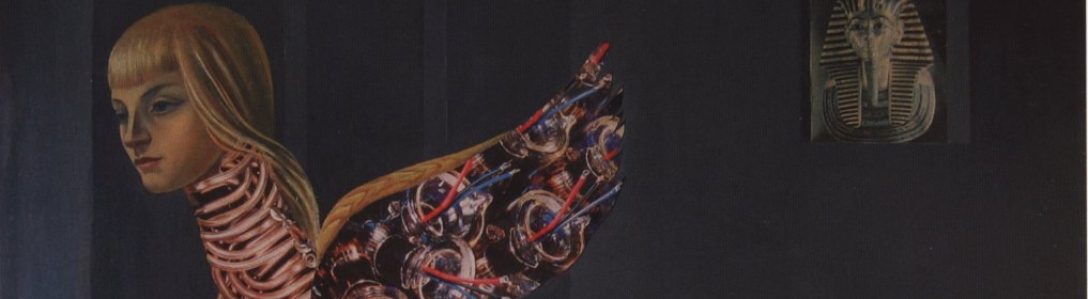
Jack be Nimble, Jack be Quick — Leonora Carrington

Read Katherine Anne Porter’s short story “Flowering Judas”

“Flowering Judas”

by

Katherine Anne Porter

Braggioni sits heaped upon the edge of a straight-backed chair much too small for him, and sings to Laura in a furry, mournful voice. Laura has begun to find reasons for avoiding her own house until the latest possible moment, for Braggioni is there almost every night. No matter how late she is, he will be sitting there with a surly, waiting expression, pulling at his kinky yellow hair, thumbing the strings of his guitar, snarling a tune under his breath. Lupe the Indian maid meets Laura at the door, and says with a flicker of a glance towards the upper room, ‘He waits.’

Laura wishes to lie down, she is tired of her hairpins and the feel of her long tight sleeves, but she says to him, ‘Have you a new song for me this evening?’ If he says yes, she asks him to sing it. If he says no, she remembers his favorite one, and asks him to sing it again. Lupe brings her a cup of chocolate and a plate of rice, and Laura eats at the small table under the lamp, first inviting Braggioni, whose answer is always the same: ‘I have eaten, and besides, chocolate thickens the voice.’

Laura says, ‘Sing, then,’ and Braggioni heaves himself into song. He scratches the guitar familiarly as though it were a pet animal, and sings passionately off key, taking the high notes in a prolonged painful squeal. Laura, who haunts the markets listening to the ballad singers, and stops every day to hear the blind boy playing his reed-flute in Sixteenth of September Street, listens to Braggioni with pitiless courtesy, because she dares not smile at his miserable performance. Nobody dares to smile at him. Braggioni is cruel to everyone, with a kind of specialized insolence, but he is so vain of his talents, and so sensitive to slights, it would require a cruelty and vanity greater than his own to lay a finger on the vast cureless wound of his self-esteem. It would require courage, too, for it is dangerous to offend him, and nobody has this courage. Continue reading “Read Katherine Anne Porter’s short story “Flowering Judas””

Kindle Cover Disasters

tumblr_nmhce7z9RS1uorx89o1_1280

Kindle Cover Disasters is a tumblr devoted to Kindle cover disasters. My friend sent me the link so you must suffer too. Here are a few selections that are relatively SFW, but the site itself is not always this, uh, tame. Continue reading “Kindle Cover Disasters”

Marlene Deller — Jack Bush

Women Dancing in Bird Bodies — Hans Thoma

A montage of fragments deleted from Inherent Vice

Allegory of Happiness — Agnolo Bronzino

Read “The Ones Who Walk Away from Omelas” by Ursula K. LeGuin

“The Ones Who Walk Away from Omelas”

by

Ursula K. LeGuin

With a clamor of bells that set the swallows soaring, the Festival of Summer came to the city Omelas, bright-towered by the sea. The rigging of the boats in harbor sparkled with flags. In the streets between houses with red roofs and painted walls, between old moss-grown gardens and under avenues of trees, past great parks and public buildings, processions moved. Some were decorous: old people in long stiff robes of mauve and grey, grave master workmen, quiet, merry women carrying their babies and chatting as they walked. In other streets the music beat faster, a shimmering of gong and tambourine, and the people went dancing, the procession was a dance. Children dodged in and out, their high calls rising like the swallows’ crossing flights over the music and the singing. All the processions wound towards the north side of the city, where on the great water-meadow called the Green Fields boys and girls, naked in the bright air, with mud-stained feet and ankles and long, lithe arms, exercised their restive horses before the race. The horses wore no gear at all but a halter without bit. Their manes were braided with streamers of silver, gold, and green. They flared their nostrils and pranced and boasted to one another; they were vastly excited, the horse being the only animal who has adopted our ceremonies as his own. Far off to the north and west the mountains stood up half encircling Omelas on her bay. The air of morning was so clear that the snow still crowning the Eighteen Peaks burned with white-gold fire across the miles of sunlit air, under the dark blue of the sky. There was just enough wind to make the banners that marked the racecourse snap and flutter now and then. In the silence of the broad green meadows one could hear the music winding through the city streets, farther and nearer and ever approaching, a cheerful faint sweetness of the air that from time to time trembled and gathered together and broke out into the great joyous clanging of the bells.

Joyous! How is one to tell about joy? How describe the citizens of Omelas?

Continue reading “Read “The Ones Who Walk Away from Omelas” by Ursula K. LeGuin”

Guitarra Minhota — Eduardo Viana

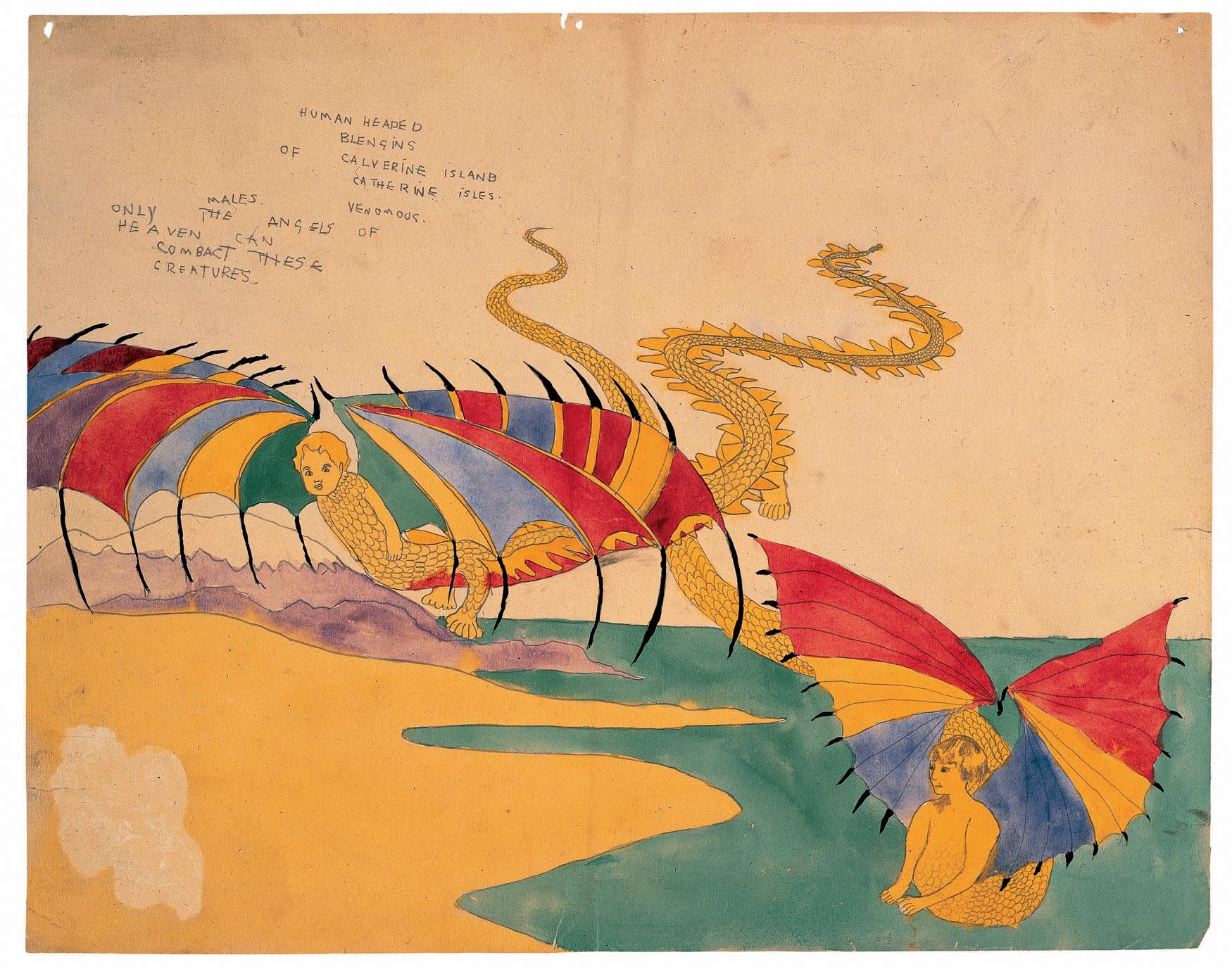
Human headed Blengins of Calverine Island Catherine Isles. — Henry Darger

2001.16.5

Robert Coover reads “The Fallguy’s Faith”

Read along here.

Falling from favor, or grace, some high artifice, down he dropped like a discredited predicate through what he called space (sometimes he called it time) and with an earsplitting crack splattered the base earth with his vital attributes. Oh, I’ve had a great fall, he thought as he lay there, numb with terror, trying desperately to pull himself together again. This time (or space) I’ve really done it! He had fallen before of course: short of expectations, into bad habits, out with his friends, upon evil days, foul of the law, in and out of love, down in the dumps—indeed, as though egged on by some malevolent metaphor generated by his own condition, he had always been falling, had he not?—but this was the most terrible fall of all. It was like the very fall of pride, of stars, of Babylon, of cradles and curtains and angels and rain, like the dread fall of silence, of sparrows, like the fall of doom.

Disks of Newton, Study for Fugue in Two Colors — Frantisek Kupka

Scupstoel — Rogier van der Weyden

Portrait of Lucian Freud — Francis Bacon

freud bacon

Glossary of Hobo Terms

GLOSSARY OF HOBO TERMS
(from Nels Anderson’s The Milk and Honey Route)

This list of words and phrases is in no sense complete. Nor is it solely hobo slang. Many terms began in Hobohemia and were taken up in time by other groups. Other terms are found among both hobo and other groups, but in each case with a different meaning. Indeed, you will find a hobo term with one meaning on the Pacific and another on the Atlantic Seaboard, and still another in the Southland. In this book I have made no strained effort to use much of this freightyard folklore. This is opposite to the practice of many contemporary hobo writers. They think by the use of slang to add a bona fide touch to the fiction they weave. I am including this glossary largely for the information of those of you who may be interested, and for reference if you want to test some of the “authorities” in this field.

Accommodation – A local freight train. It may carry passengers.
Adam and Eve on a raft – Two fried eggs on toast. “Wreck ’em” if they are scrambled. “With their eyes open,” if not.
Alligator bait – Fried or stewed liver. Too costly now for hobos.
Anchor – A pick. Companion tool of the shovel or banjo.
Angel – A person who gives more than you expect. One who takes an interest without trying to reform you.
Angel food – Mission preaching about the Bread of Life.
AngelinaPunk or road kid acting as a hobo’s companion.
A-No-1 – A famous tramp who writes his name “on everything like J. B. King.” He writes books about his alleged adventures. Many young hobos write this monicker on water tanks, and chalk it on box cars.
AuntieAngelina grown older.
Axle grease – Butter. Sometimes called plaster.
Baldy – Generally an old man “with a high forehead”.
Balloon – A roll of bedding carried on the back; a bindle.
Barnacle – A fellow who sticks to one job a year or more.
Banjo – A short-handled shovel. Continue reading “Glossary of Hobo Terms”

A deleted scene from Inherent Vice