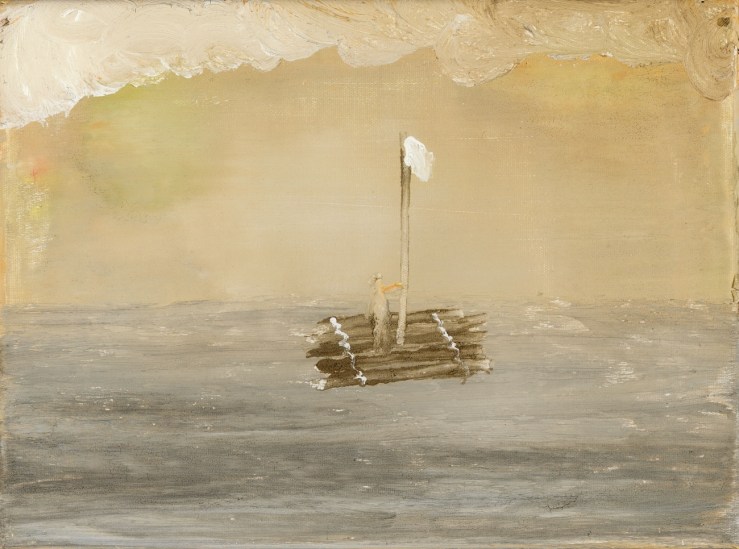
Whetting the Scythe — Kathe Kollwitz

Whetting the Scythe, 1908 by Kathe Kollwitz (1867-1945)

“On Trout” — Anne Carson

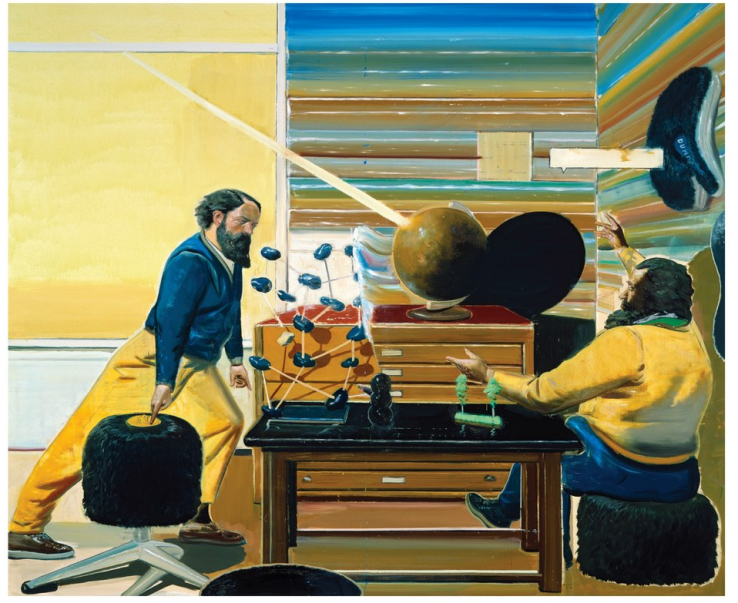
Expressions — Jamian Juliano-Villani

Expressions, 2018 by Jamian Juliano-Villani  (b. 1987)

Sunday equinox blog | Atlanta, Di Benedetto, a Paley poem, ghosting William S. Burroughs, etc.

My spring break, which is to say the spring break of the community college which employs me to teach English, rarely coincides with my children’s spring break, but this year it did, and we took full advantage, spending a week in Atlanta. We stayed in Inman Park, enjoying the BeltLine and the city’s vibe in general. Airport aside, I hadn’t been to Atlanta in twenty years, and I took pleasure in our week there. (I dug the High Museum in particular, and shared some favorites from our visit on Twitter.)

I can’t remember the last time I visited a city and didn’t buy a book. A Capella Books was a short walk from our place; it’s a small, well-curated bookshop with a limited selection. A Capella offered a number of signed books by musicians, including Billy Bragg and Chris Frantz. I thought I might regret not picking up a signed copy of Frantz’s memoir Remain in Love (which I read last year), but I feel no regret as I type this sentence. I also visited Posman Books at Ponce Market. It veers close to something like a tasteful gift shop/stationery joint, but the small fiction and poetry selection is pretty good, even if a lot of it is shelf candy. I think if I’d been willing to drive farther out I might’ve found some deeper cuts. (My wife pointed out that our local used bookstore, 1.1 miles away, has utterly spoiled me.)

Anyway: No books acquired in Atlanta. (I did buy some records though: Fat Mattress’s debut and Fleetwood Mac’s Heroes Are Hard to Find.)

I brought Esther Allen’s new translation of Antonio di Benedetto’s novel The Silentiary with me to reread on the trip. I read it back in January, dogeared it, and started a review, but found that I wanted to let it settle a bit. I liked it the first time round, but the reread revealed a sadder, deeper novel than I had initially estimated.

Other stuff I’ve been reading:

Grace Paley’s late collection of poems, Fidelity. Grand stuff. Sample:

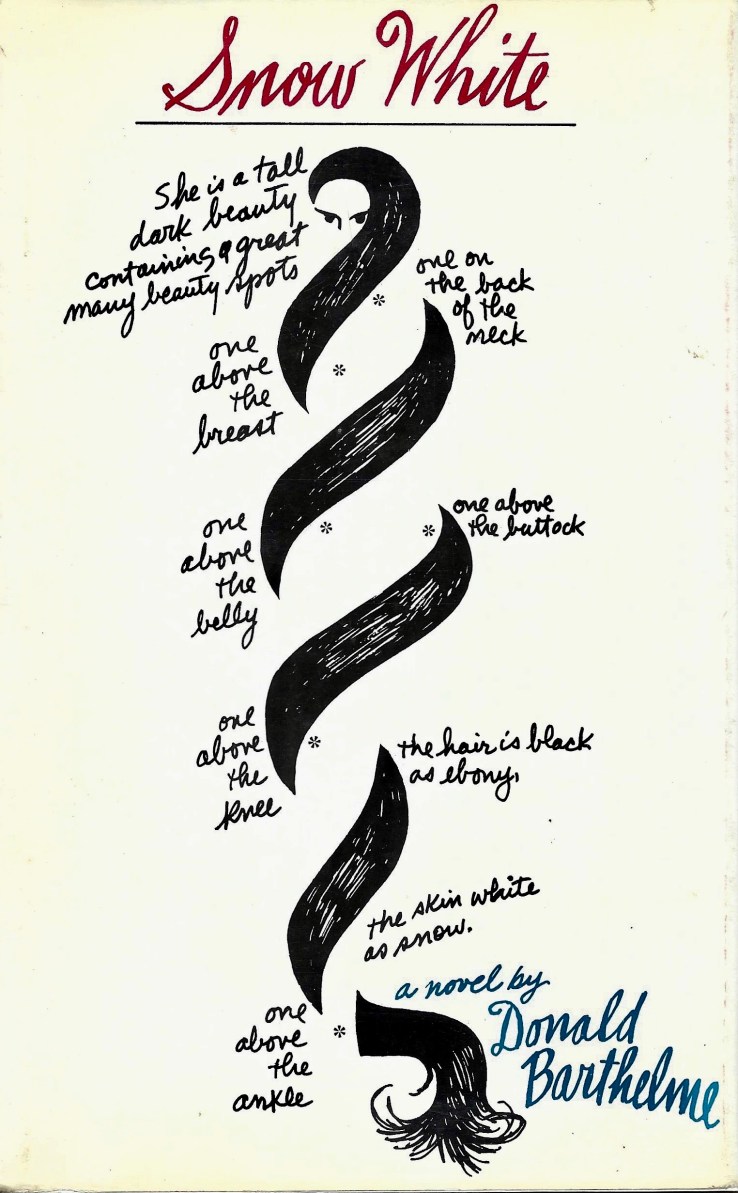
I’ve also been picking through Helen Moore Barthelme’s biography Donald Barthelme: Genesis of a Cool Sound, although there’s nothing particularly revelatory about it.

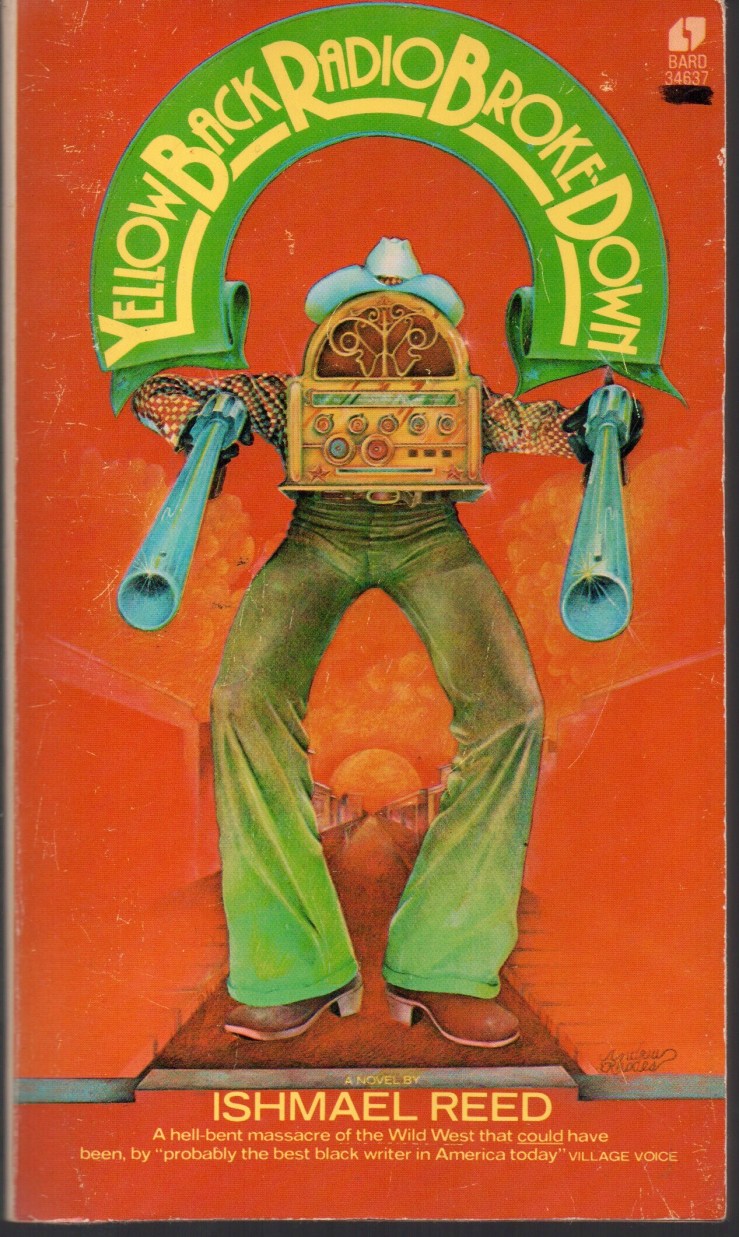
I picked up the Paley and Barthelme when I swung by our campus library to get Don’t Hide the Madness, a series of conversations between Allen Ginsberg and William S. Burroughs. Burroughs is getting pretty close to the end of his life here, and Ginsberg seems to want to get him to further cement a cultural legacy through a late oral autobiography. Burroughs repeatedly derails these attempts though, which is hilarious. Burroughs talks about whatever comes to mind (often his guns). The cover by Robert Crumb is worth sharing:

I initially requested the Burroughs book because I’ve been rereading Cities of the Red Night—and absolutely loving it—and I was trying to figure out who it was who may or may not have played a role in ghostwriting the book with Burroughs. Cities is straighter than much of Burroughs’ work—but it’s still thoroughly Burroughsian. It’s entirely possible that a straighter hand cobbled Burroughs’ images and fragments together, at least to some extent, although I think it’s erroneous to refer to the novel as ghostwritten. As far as I can tell, the claim originates with Dennis Cooper’s obituary in the October 1997 issue of Spin:

My initial guess was that Cooper here insinuates that Victor Bockris helped arrange Cities of the Red Night. Bockris was around Burroughs a lot when Burroughs was working on Cities; however, Bockris suggests that it was Burroughs who corrected his prose:

From 1979 to 1981, I had the privilege of working with William Burroughs (aged sixty-five to sixty-seven) editing two books: my portrait With William Burroughs: A Report from the Bunker (St. Martins, 1996), and his selected essays, The Adding Machine (Arcade, 1996). At the same time, Burroughs was finishing his long-awaited novel, Cities of the Red Night (Holt, 1981), which would inaugurate a whole new person and period in his career, opening the doors to sixteen highly productive, positive years (1981-97) writing, painting, acting, performing, recording. Consequently, I suppose I am one of the ten to twelve people who ever got close enough to Bill professionally to see into his writing center. When I gave him the manuscript of With William Burroughs (75 percent of which was taped dialogue of conversations between Burroughs and fifteen other celebrities), he not only corrected the sometimes atrocious writing, he added a handful of precious inserts.

More digging seems to suggest that it was the artist Steven Lowe who helped Burroughs arrange Cities. Rick Castro’s appreciation of Lowe goes as far as to assert that, Lowe “was a ghostwriter for Burroughs, assisting on Cities of the Red NightJunkie, and a few other titles.”

Ultimately, I agree with Jamie Russell in Queer Burroughs (2001), that

The rumor that the post-Red Night trilogy texts were partly ghostwritten is perhaps…more of a compliment than the criticism it was intended to be, since it highlights Burroughs’ central theme of the 1980s and 1990s texts: the creation of a post-corporeal real. Who needs a body to write with anyway?

Typing that out, I realize that I’ve inserted an entirely different post into this Sunday equinox post. Oh well.

I love Cities of the Red Night—it’s funny and gross and oddly sweet and even sentimental, an ironic pastiche of the so-called “boys books” genre, as well as a howl against war, conformity, and the military-industrial-entertainment complex. The novel it most reminds me of (apart from other Burroughs’ novels) is Thomas Pynchon’s Against the Day.

I’m also, thanks to the audiobook, into the third section of Marlon James’ Moon Witch, Spider King. The second section focused on the protagonist Sogolon’s domestic life. Frankly, the section sags, although I understand that it likely girds the emotional core of the events to come. The novel pivots dramatically in section three, “Moon Witch.” Sogolon has lost her memory, and is in a strange sunken city centuries in the future. That’s the good shit. More thoughts to come.


“Spring Spleen” — Lydia Davis

Spring — Rene Magritte

8slur6j

Spring, 1965 by Rene Magritte

The High-Mind and Disrepute — Lynette Yiadom-Boakye

Lynette Yiadom-Boakye works on canvas and linen

The High-Mind and Disrepute, 2020 by Lynette Yiadom-Boakye (b. 1977)

Chasseress — Romaine Brooks

Chasseress, 1920 by Romaine Brooks (1874-1970)

Red Letter No. 12 — Jen Mazza 

Red Letter No. 12, 2007 by Jen Mazza (b. 1972)

Many Irish heroes and heroines of antiquity | From James Joyce’s Ulysses

He wore a long unsleeved garment of recently flayed oxhide reaching to the knees in a loose kilt and this was bound about his middle by a girdle of plaited straw and rushes. Beneath this he wore trews of deerskin, roughly stitched with gut. His nether extremities were encased in high Balbriggan buskins dyed in lichen purple, the feet being shod with brogues of salted cowhide laced with the windpipe of the same beast. From his girdle hung a row of seastones which dangled at every movement of his portentous frame and on these were graven with rude yet striking art the tribal images of many Irish heroes and heroines of antiquity, Cuchulin, Conn of hundred battles, Niall of nine hostages, Brian of Kincora, the Ardri Malachi, Art MacMurragh, Shane O’Neill, Father John Murphy, Owen Roe, Patrick Sarsfield, Red Hugh O’Donnell, Red Jim MacDermott, Soggarth Eoghan O’Growney, Michael Dwyer, Francy Higgins, Henry Joy M’Cracken, Goliath, Horace Wheatley, Thomas Conneff, Peg Woffington, the Village Blacksmith, Captain Moonlight, Captain Boycott, Dante Alighieri, Christopher Columbus, S. Fursa, S. Brendan, Marshal Mac-Mahon, Charlemagne, Theobald Wolfe Tone, the Mother of the Maccabees, the Last of the Mohicans, the Rose of Castille, the Man for Galway, The Man that Broke the Bank at Monte Carlo, The Man in the Gap, The Woman Who Didn’t, Benjamin Franklin, Napoleon Bonaparte, John L. Sullivan, Cleopatra, Savourneen Deelish, Julius Caesar, Paracelsus, sir Thomas Lipton, William Tell, Michelangelo, Hayes, Muhammad, the Bride of Lammermoor, Peter the Hermit, Peter the Packer, Dark Rosaleen, Patrick W. Shakespeare, Brian Confucius, Murtagh Gutenberg, Patricio Velasquez, Captain Nemo, Tristan and Isolde, the first Prince of Wales, Thomas Cook and Son, the Bold Soldier Boy, Arrah na Pogue, Dick Turpin, Ludwig Beethoven, the Colleen Bawn, Waddler Healy, Angus the Culdee, Dolly Mount, Sidney Parade, Ben Howth, Valentine Greatrakes, Adam and Eve, Arthur Wellesley, Boss Croker, Herodotus, Jack the Giantkiller, Gautama Buddha, Lady Godiva, The Lily of Killarney, Balor of the Evil Eye, the Queen of Sheba, Acky Nagle, Joe Nagle, Alessandro Volta, Jeremiah O’Donovan Rossa, Don Philip O’Sullivan Beare. A couched spear of acuminated granite rested by him while at his feet reposed a savage animal of the canine tribe whose stertorous gasps announced that he was sunk in uneasy slumber, a supposition confirmed by hoarse growls and spasmodic movements which his master repressed from time to time by tranquillising blows of a mighty cudgel rudely fashioned out of paleolithic stone.

A passage from the “Cyclops” episode of Joyce’s Ulysses. 

  I asked Kelley what it feels like to be hanged | From William S. Burroughs’ Cities of the Red Night

An excerpt from

Cities of the Red Night

by

William S. Burroughs


Kelley told me his story. He started his career as a merchant seaman. In the course of an argument he killed the quartermaster, for which he was tried and sentenced to hang. His ship at that time was in the harbor of Tangier. The sentence was carried out in the marketplace, but some pirates who were present cut him down, carried him to their ship, and revived him. It was thought that a man who had been hanged and brought back to life would not only bring luck to their venture but also ensure protection against the fate from which he had been rescued. While he was still insensible the pirates rubbed red ink into the hemp marks, so that he seemed to have a red rope always around his neck.

The pirate ship was commanded by Skipper Nordenholz, a renegade from the Dutch Navy who was still able to pass his ship as an honest merchant vessel flying the Dutch flag. Strobe was second in command. Barely had they left Tangier headed for the Red Sea via the Cape of Good Hope when a mutiny broke out. The crew was in disagreement as to the destination, being minded to head for the West Indies. They had also conceived a contempt for Strobe as an effeminate dandy. After he had killed five of the ringleaders they were forced to revise this opinion. The mutinous crew was then put ashore and a crew of acrobats and dancing boys taken on, since Nordenholz had already devised a way in which they could be put to use.

Kelley claims to have learned the secrets of death on the gallows, which gives him invincible skill as a swordsman and such sexual prowess that no man or woman can resist him, with the exception of Captain Strobe, whom he regards as more than human. “Voici ma lettre de marque,” he says, running his fingers along the rope mark. (A letter of marque was issued to privateers by their government, authorizing them to prey on enemy vessels in the capacity of accredited combatants, and thus distinguishing them from common pirates. Such a letter often, but by no means always, saved the bearer from the gallows.) Kelley tells me that the mere sight of his hemp marks instills in adversaries a weakness and terror equal to the apparition of Death Himself.

I asked Kelley what it feels like to be hanged.

“At first I was sensible of very great pain due to the weight of my body and felt my spirits in a strange commotion violently pressed upwards. After they reached my head, I saw a bright blaze of light which seemed to go out at my eyes with a flash. Then I lost all sense of pain. But after I was cut down, I felt such intolerable pain from the prickings and shootings as my blood and spirits returned that I wished those who cut me down could have been hanged.”

Paul Verlaine, Bibi la Purée and Stéphane Mallarmé at the Café Procope — Serafino Macchiati

Paul Verlaine, Bibi la Purée and Stéphane Mallarmé at the Café Procope, 1890 by Serafino Macchiati (1861-1916)

The Giant — Julio Larraz

The Giant, 1975 by Julio Larraz (b. 1944)

Posted in Art

Reader with a Lamp — József Rippl-Rónai

T43204_2_8, 6/26/07, 11:25 AM, 8C, 5968×7480 (0+344), 100%, Custom, 1/50 s, R72.3, G53.7, B60.6

Reader with a Lamp, 1895 by József Rippl-Rónai (1861-1927 )

 Woman Laocoön — Maria Lassnig

Woman Laocoön, 1976 by Maria Lassnig (1919-2014)

Two Eyes and Two Heads — Wenceslaus Hollar

Two Eyes and Two Heads (between 1644–52), by Wenceslaus Hollar (1607–1677)

Posted in Art

In the Clouds No. 1 — Wei Dong

In the Clouds No. 1, 2002 by Wei Dong (b. 1968)