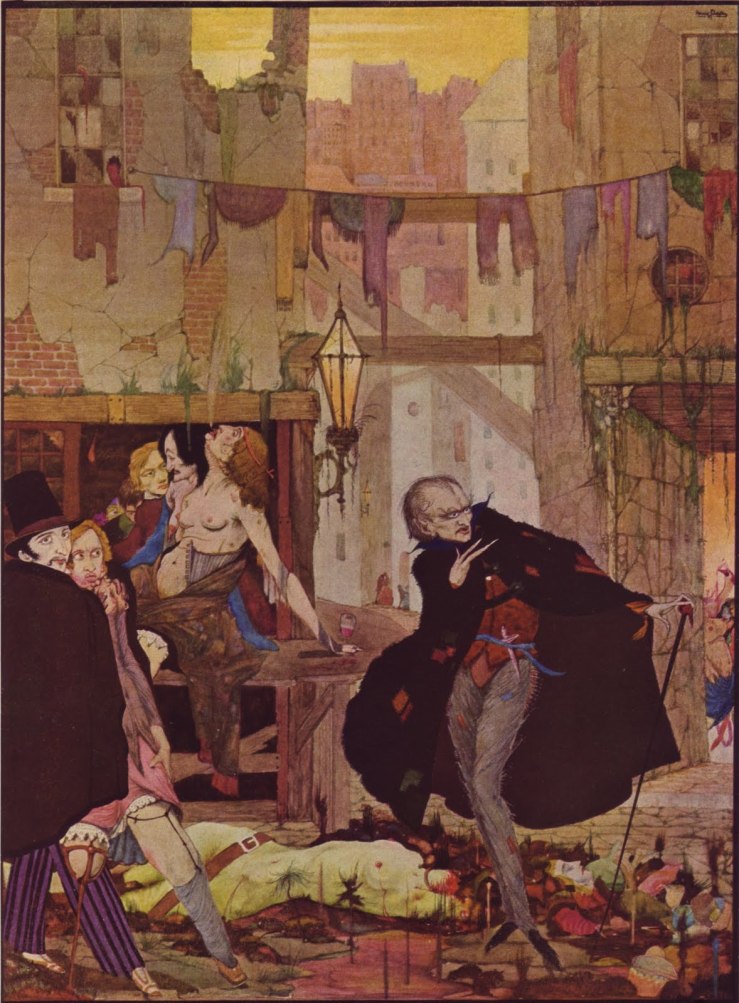
Harry Clarke’s illustration for “The Man of the Crowd,” 1923
“The Man of the Crowd”
by
Edgar Allan Poe
     Ce grand malheur, de ne pouvoir être seul.

              La Bruyère.
IT was well said of a certain German book that “er lasst sich nicht lesen“—it does not permit itself to be read. There are some secrets which do not permit themselves to be told. Men die nightly in their beds, wringing the hands of ghostly confessors and looking them piteously in the eyes—die with despair of heart and convulsion of throat, on account of the hideousness of mysteries which will not suffer themselves to be revealed. Now and then, alas, the conscience of man takes up a burthen so heavy in horror that it can be thrown down only into the grave. And thus the essence of all crime is undivulged.
Not long ago, about the closing in of an evening in autumn, I sat at the large bow window of the D——- Coffee-House in London. For some months I had been ill in health, but was now convalescent, and, with returning strength, found myself in one of those happy moods which are so precisely the converse of ennui—moods of the keenest appetency, when the film from the mental vision departs—the [Greek phrase]—and the intellect, electrified, surpasses as greatly its every-day condition, as does the vivid yet candid reason of Leibnitz, the mad and flimsy rhetoric of Gorgias. Merely to breathe was enjoyment; and I derived positive pleasure even from many of the legitimate sources of pain. I felt a calm but inquisitive interest in every thing. With a cigar in my mouth and a newspaper in my lap, I had been amusing myself for the greater part of the afternoon, now in poring over advertisements, now in observing the promiscuous company in the room, and now in peering through the smoky panes into the street.
This latter is one of the principal thoroughfares of the city, and had been very much crowded during the whole day. But, as the darkness came on, the throng momently increased; and, by the time the lamps were well lighted, two dense and continuous tides of population were rushing past the door. At this particular period of the evening I had never before been in a similar situation, and the tumultuous sea of human heads filled me, therefore, with a delicious novelty of emotion. I gave up, at length, all care of things within the hotel, and became absorbed in contemplation of the scene without. Continue reading ““The Man of the Crowd” — Edgar Allan Poe”→








 Biblioklept