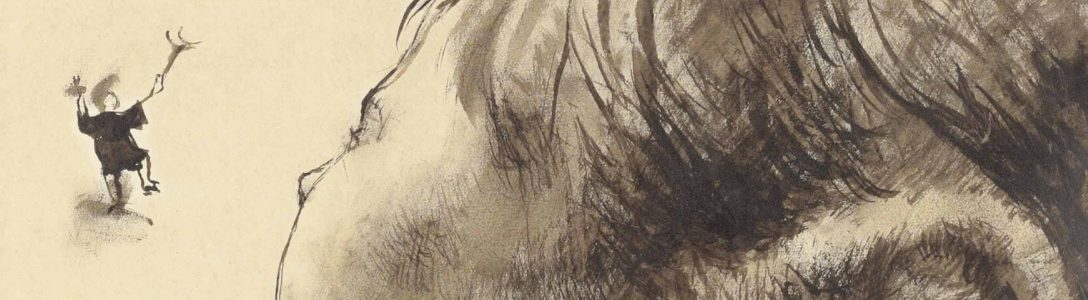
“…a face worthy of a murderer” (From Hell)

A page from Alan Moore and Eddie Campbell’s outstanding graphic novel From Hell, an encyclopedic account of the Jack the Ripper murders. In this scene, our evil protagonist Dr. Gull undergoes a transcendent experience, and appears to William Blake, inspiring The Ghost of a Flea

Blake’s The Head of the Ghost of a Flea

I pulled the image of From Hell from this fantastic detailed review by Miguel at St. Orberose (far better than my own my own meager tackle at writing about the book). Plenty more images there, along with a comprehensive analysis of (what I take to be) Moore’s best work.

Halloween — Grandma Moses

Illustration to A Modern Dance of Death — Joseph Sattler

02-joseph-sattler-modern-dance-of-death-1894

therapy — Michael Raedecker

Conference — Albert Bloch

Bolaño’s Werewolves

In the first chapter of his estimable volume The Book of Were-Wolves (1865), Sabine Baring-Gould outlines his project (emphasis mine):

In the following pages I design to investigate the notices of were-wolves to be found in the ancient writers of classic antiquity, those contained in the Northern Sagas, and, lastly, the numerous details afforded by the mediæval authors. In connection with this I shall give a sketch of modern folklore relating to Lycanthropy.

It will then be seen that under the veil of mythology lies a solid reality, that a floating superstition holds in solution a positive truth.

This I shall show to be an innate craving for blood implanted in certain natures, restrained under ordinary circumstances, but breaking forth occasionally, accompanied with hallucination, leading in most cases to cannibalism. I shall then give instances of persons thus afflicted, who were believed by others, and who believed themselves, to be transformed into beasts, and who, in the paroxysms of their madness, committed numerous murders, and devoured their victims.

The first few chapters of the book recount werewolf mythology in heavily archetypal terms: we’re talking Greek and Norse stuff here, really ancient stories that tap into primal-human-animal-instinct and so forth. Then there are a few chapters on Scandinavian werewolves (and other shapeshifters) that reminded me of William Vollmann’s marvelous saga The Ice-Shirt, a book that treats warriors shifting into bears as totally standard fare. The book then tackles “The Were-Wolf in the Middle Ages,” where Baring-Gould relies heavily on monks who seem to view their subject through the heady lens of supernaturalism. Baring-Gould weaves together these culturally disparate stories, citing a strong backlist of sources, and refraining from pointing out the obvious archetypal flavor that girds these tales.

It’s in Chapter VI, “A Chamber of Horrors,” that mythology and archetype give way to a kind of terrible realism. Perhaps this is simply an effect of records-keeping, of the vague fact that narratives and terms of the early Renaissance seem so much more accessible to us than, say, the terms of Scandinavian saga. In any case, the book takes on a horrific scope: the vagaries of myth give way to dates, names, places, witnessestrialsverdicts. To go back to Baring-Gould’s intro, we see the “solid reality” under “the veil of mythology,” stripped away. Continue reading “Bolaño’s Werewolves”

Woman Reading a Letter — Pieter de Hooch

Untitled — Zdislav Beksinski

Witch — Andy Warhol

Warhol_Witch

La Comedie de la Mort — Rodolphe Bresdin

In the Garden — Alfred Stevens

Watch Can–The Documentary, a Film about Can–The Band

Decoy — Simon Stalenhag

decoy_1920_badge

The Witch with the Comb — Paul Klee

Portrait of Alexandre Benois — Leon Bakst

Sorceress — Dominique Vivant Denon

A Reading in the Garden — Theo van Rysselberghe