
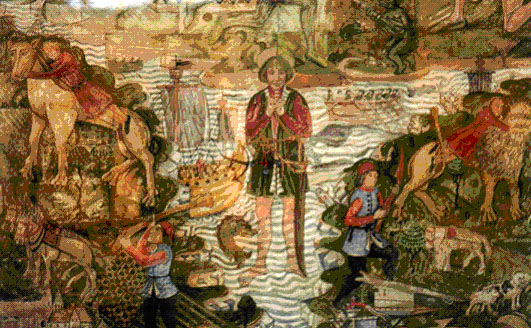
At The Guardian, Russell Hoban writes about how a viewing of The Legend of St. Eustace at Canterbury Cathedral inspired his post-apocalyptic classic Riddley Walker. The anecdote will be familiar to anyone who’s reread the introduction to Riddley Walker, but Hoban’s essay still interesting. From his essay–
The first time I stood in Canterbury Cathedral and tilted my head back to look up, up, up to that numinous fan-vaulting I felt the uprush past me of all the centuries of prayer, of hope and fear and yearning, yearning for answers and, if possible, salvation.
Breathing in this atmosphere I made my way through the nave to those stone steps trodden by successive waves of pilgrims, some with beads, some with cameras. Up those worn- down steps, past the place where the remembered blood of Thomas Becket seethes on the stones, to the north aisle where on one wall remains the faint earth-green tracery ofThe Legend of St Eustace. Facing it on the opposite wall is Professor Tristram’s reconstruction of the 15th-century painting.
Whatever talent I have for writing lies in being friends with my head: I know its vagaries, its twists and turns, its hobo journeys in fast freights, riding the blinds to unknown destinations. Sometimes I get thrown off the train in the middle of nowhere; sometimes I get to the Big Rock Candy Mountain. If you Google for Eustace you’ll find that he has no official standing among the beatified. Perhaps his legend turned up on the back of some Middle-Ages cornflakes box and grew from there. Being thus non-factual, Eustace is quite at home in a work of fiction. According to the legend he was a general in the Roman army to begin with, but one day hunting in the forest, he saw a little crucified Jesus between the antlers of a stag, as vividly shown in the 15th-century painting by Pisanello.


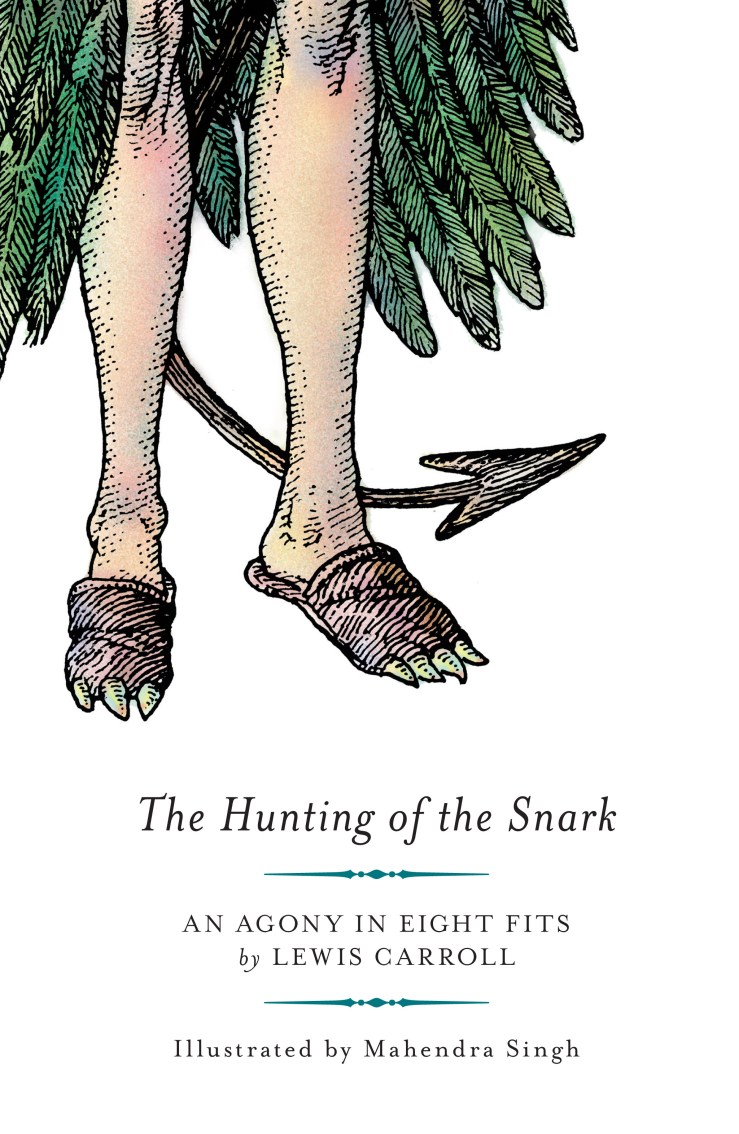 I scrapped my first two drafts for a review of Melville House’s new edition of Lewis Carroll’s The Hunting of the Snark. The problem was that I was struggling to figure out Carroll’s Nonsense poem (subtitled An Agony in Eight Fits) about a ten man crew who take to the sea, to, you know, hunt a Snark. The Bellman seems to lead them. There’s the Banker, Baker, and other guys whose names start with “b” — including enemies the Beaver and the Butcher (who wind up tight allies). The poem is both silly and dense, rippling with weird wordplay and allusions that are, for the most part, beyond me. It’s often hard to follow, and sometimes has the effect of making the reader (or at least this reader) feel like he’s skating on the surface of some deeper profundities — or, alternately, maybe it’s just Nonsense, to use Carroll’s term.

 Biblioklept