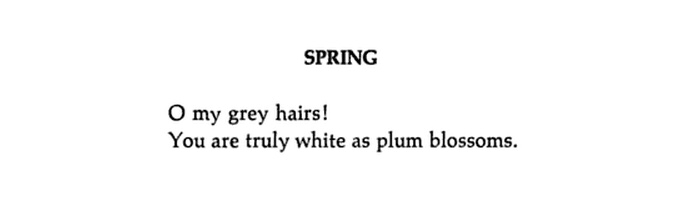
“Spring” — William Carlos Williams

“For the Anniversary of My Death” — W.S. Merwin

“For the Anniversary of My Death”

by

W.S. Merwin


Every year without knowing it I have passed the day
When the last fires will wave to me
And the silence will set out
Tireless traveler
Like the beam of a lightless star
Then I will no longer
Find myself in life as in a strange garment
Surprised at the earth
And the love of one woman
And the shamelessness of men
As today writing after three days of rain
Hearing the wren sing and the falling cease
And bowing not knowing to what

“The Fish” — Elizabeth Bishop

“The Fish”

by

Elizabeth Bishop


I caught a tremendous fish
and held him beside the boat
half out of water, with my hook
fast in a corner of his mouth.
He didn’t fight.
He hadn’t fought at all.
He hung a grunting weight,
battered and venerable
and homely. Here and there
his brown skin hung in strips
like ancient wallpaper,
and its pattern of darker brown
was like wallpaper:
shapes like full-blown roses
stained and lost through age.
He was speckled with barnacles,
fine rosettes of lime,
and infested
with tiny white sea-lice,
and underneath two or three
rags of green weed hung down.
While his gills were breathing in
the terrible oxygen
—the frightening gills,
fresh and crisp with blood,
that can cut so badly—
I thought of the coarse white flesh
packed in like feathers,
the big bones and the little bones,
the dramatic reds and blacks
of his shiny entrails,
and the pink swim-bladder
like a big peony.
I looked into his eyes
which were far larger than mine
but shallower, and yellowed,
the irises backed and packed
with tarnished tinfoil
seen through the lenses
of old scratched isinglass.
They shifted a little, but not
to return my stare.
—It was more like the tipping
of an object toward the light.
I admired his sullen face,
the mechanism of his jaw,
and then I saw
that from his lower lip
—if you could call it a lip—
grim, wet, and weaponlike,
hung five old pieces of fish-line,
or four and a wire leader
with the swivel still attached,
with all their five big hooks
grown firmly in his mouth.
A green line, frayed at the end
where he broke it, two heavier lines,
and a fine black thread
still crimped from the strain and snap
when it broke and he got away.
Like medals with their ribbons
frayed and wavering,
a five-haired beard of wisdom
trailing from his aching jaw.
I stared and stared
and victory filled up
the little rented boat,
from the pool of bilge
where oil had spread a rainbow
around the rusted engine
to the bailer rusted orange,
the sun-cracked thwarts,
the oarlocks on their strings,
the gunnels—until everything
was rainbow, rainbow, rainbow!
And I let the fish go.

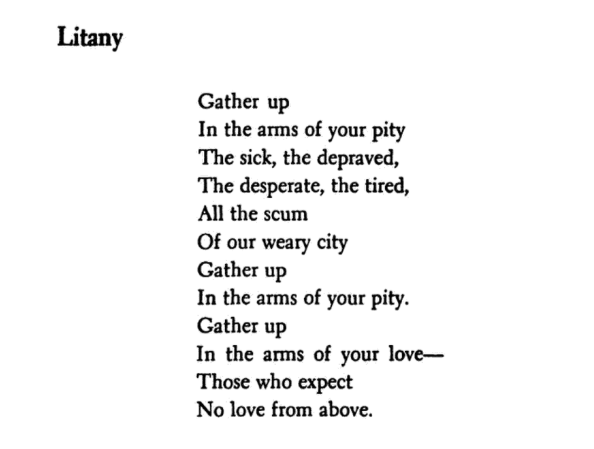
“Litany” — Langston Hughes

Screenshot 2019-02-01 at 3.44.18 PM

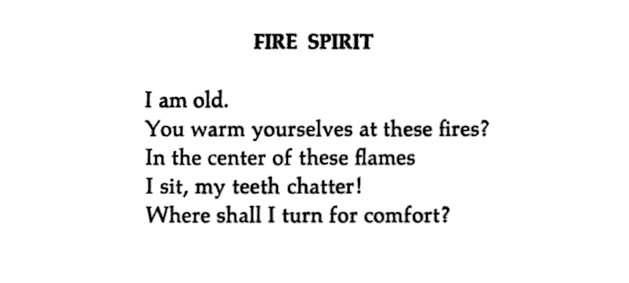
“Fire Spirit” — William Carlos Williams

wcw

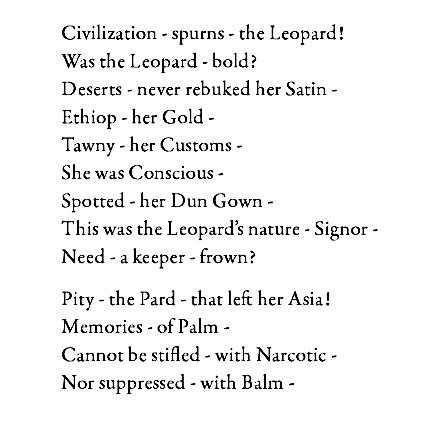
“Civilization — spurns — the Leopard!” — Emily Dickinson

leopard

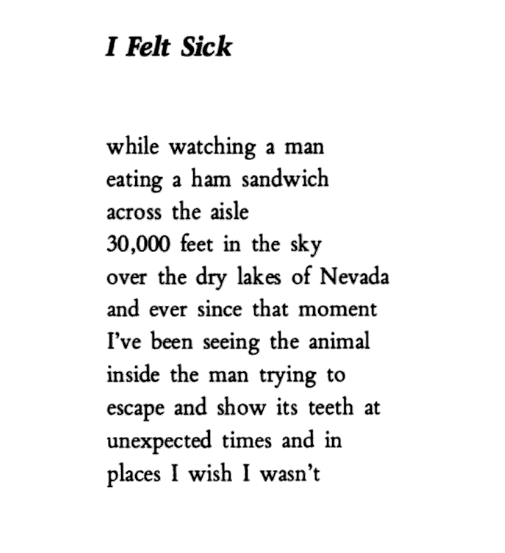
“I Felt Sick” — Tom Clark

tc

“One day is there of the series / Termed Thanksgiving day” — Emily Dickinson

ED

“Cy est Pourtraicte, Madame Ste Ursule, et les Unze Mille Vierges” — Wallace Stevens

“Cy est Pourtraicte, Madame Ste Ursule, et les Unze Mille Vierges”

by

Wallace Stevens

from Harmonium (1923)


Ursula, in a garden, found
A bed of radishes.
She kneeled upon the ground
And gathered them,
With flowers around,
Blue, gold, pink, and green.

She dressed in red and gold brocade
And in the grass an offering made
Of radishes and flowers.

She said, “My dear,
Upon your altars,
I have placed
The marguerite and coquelicot,
And roses
Frail as April snow;
But here,” she said,
“Where none can see,
I make an offering, in the grass,
Of radishes and flowers.”
And then she wept
For fear the Lord would not accept.
The good Lord in His garden sought
New leaf and shadowy tinct,
And they were all His thought.
He heard her low accord,
Half prayer and half ditty,
And He felt a subtle quiver,
That was not heavenly love,
Or pity.

This is not writ
In any book.

“In Defense of Mechanisms” — Colin James

“In Defense of Mechanisms”

by

Colin James

                    Pursued, I ran on the litter strewn beach.
                    Dogs howled, glancing back was not productive.
                    Among the less than pristine dunes
                    were painted signs conceived in a hurry,
                    DR. MOREAU NO LONGER PRACTICES HERE!
                    I stumbled, my thighs inconsolably stressed.
                    To pause was not entirely temporary.
                    I heard my own scream not express optimism,

                    that one obtuse voice as close as is to breathing.

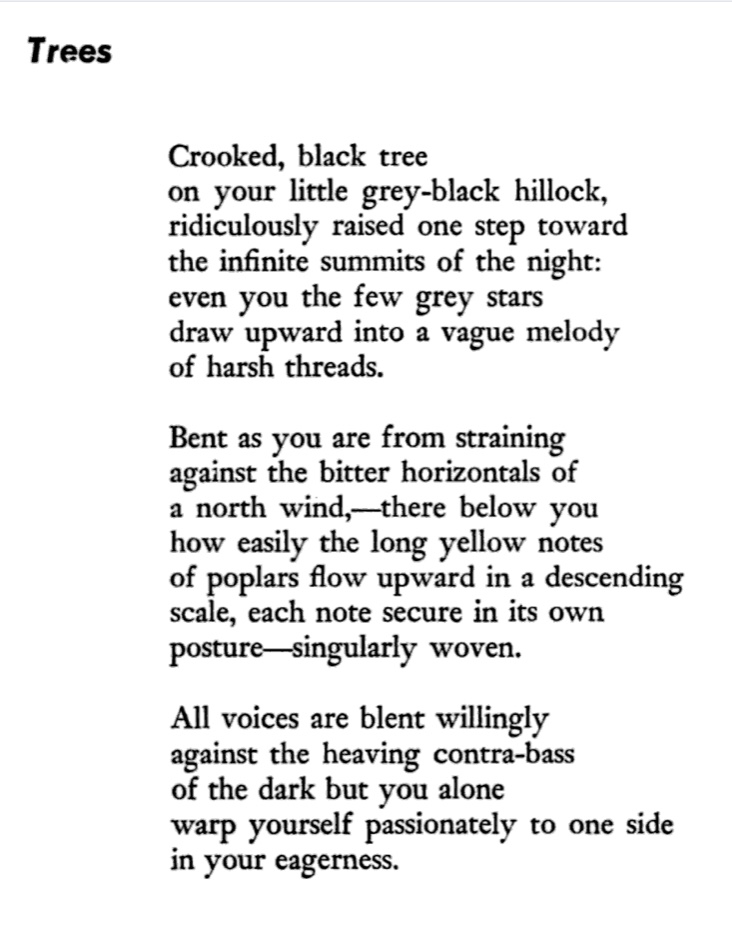
“Trees” — William Carlos Williams

“Exceptions to the Instinctual” — Colin James

“Exceptions to the Instinctual”

by

Colin James

             The Draculaian fang
             is really only for grip.
             Mouth forms a salacious
             sucker draining the body
             of all its fluids.
             The heart an aperitif.
             Don’t listen to the others.
             That fool Van Helsing known
             to prance about his boudoir
             inappropriately attired in nothing
             other than thigh high boots,
             practicing his crucifixion rebuttal
             in front of a wall mirror.
             Someone substituted the hair
             from an ogre’s dong into
             his mother’s precious locket.
             The smell of which he would
             describe in despair as substantially
             stronger than a generation’s decline.

RIP Tom Clark

img_0843

RIP Tom Clark, 1941-2018

The American poet Tom Clark died in the first hour of Saturday, August 18th, 2018 in Berkely California. The cause of the death happened a few hours earlier, late Friday night, as a motorist collided his sedan into Tom Clark as Clark tried to cross the street. Clark was 77.

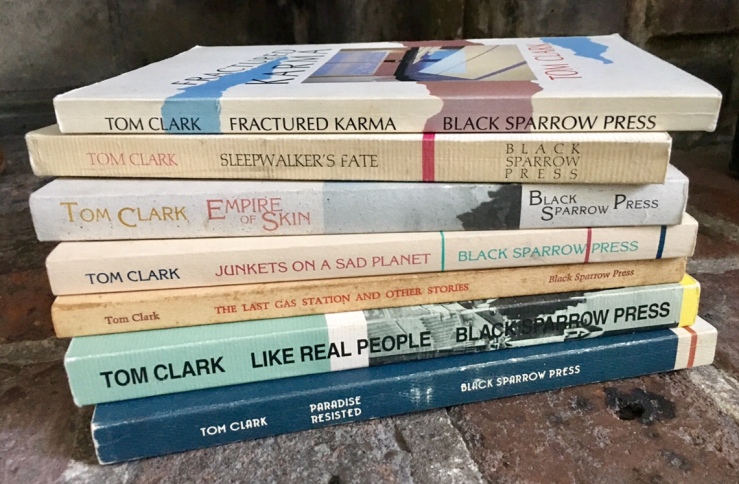
Tom Clark authored over two dozen poetry collections, many published by Black Sparrow Press. He also wrote a number of literary biographies, including a pair on Jack Kerouac, bios of Robert Creeley and Charles Olson, and a biography of John Keats called Junkets from a Sad Planet that is actually a series of poems. (But also actually a biography of Keats). Clark was the poetry editor for The Paris Review from 1963-1973 (maybe you read his interview with Allen Ginsberg there). Clark was also a blogger—an excellent blogger. He updated his blog a few hours before the car collision that killed him.

I first read Tom Clark in the middle of September, 2013. I read Fractured Karma (1990) and I had never heard of him before. I know the time specifically not because I have a good memory (I don’t), but because I wrote about it then:

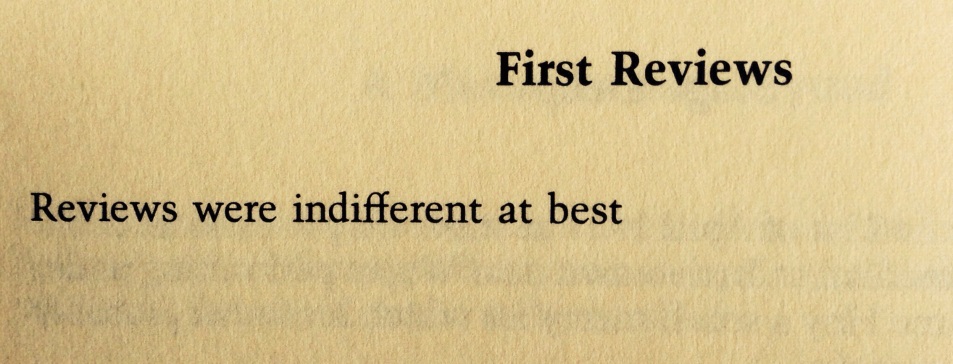
I picked up Tom Clark’s Fractured Karma two weeks ago somewhat randomly. My local bookshop had reorganized some shelves, putting all the Black Sparrow titles together. Fractured Karma must have been on top, because I don’t see how else I would’ve picked up a book with the word “karma” in the title. The book opened to this page:
20130927-141831.jpg

That’s all there is on that page, and something about it—the form, the phrasing—cracked me up. It’s part of a long poem called “He was born blind” about the British comedy actor George Formby. The poem is amazing: I read it there in the store. It reminded me immediately of David Markson’s notecard novels—something about how Clark includes so much reality into his poem. But there’s also this perceptive (if oblique) sense of humor behind it all. I ended up devouring the book, reading the whole thing that weekend. It was one of those holy shit reading moments, frankly. Once I finish typing this I’m going to go pick my kids up and we’re going to go to the bookstore and I’m going to get another Tom Clark book and read it this weekend.

I actually did go to the bookstore after writing that post and pick up another book by Clark, Sleepwalker’s Fate (1992). The store had several books by Clark, and I wasn’t sure which one to get. I remember that the title Sleepwalker’s Fate stood out, so I picked it up and thumbed through it, and I remember reading the poem “Terminator Too” there in the store—it did something electric to me—the goofy title, the winking irony, but also the earnestness of the poem, which paraphrases a few lines from Wordsworth’s Preface to Lyrical Ballads. Here it is:

“Terminator Too” by Tom Clark—

Poetry, Wordsworth
wrote, will have no
easy time of it when
the discriminating

powers of the mind
are so blunted that
all voluntary
exertion dies, and

the general
public is reduced
to a state of near
savage torpor, morose,

stuporous, with
no attention span
whatsoever; nor will
the tranquil rustling

of the lyric, drowned out
by the heavy, dull
coagulation
of persons in cities,

where a uniformity
of occupations breeds
cravings for sensation
which hourly visual

communication of
instant intelligence
gratifies like crazy,
likely survive this age.

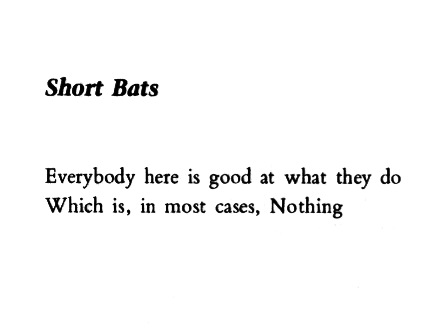
Sleepwalker’s Fate is a good starting place to read Tom Clark’s poetry, as are Fractured Karma and the collection Paradise Revisited (1984). Here’s one from Paradise Revisited:
IMG_3222

The later poetry collection Like Real People (1995) is also pretty great. It includes this humdinger:

Like Real People also includes a series of autobiographical sketches and stories told in an engaging but straightforward manner. The epilogue there is particularly good—Clark mulls over what it means to write an autobiography, straining against his anxieties over framing his own life stories. Tellingly, he lards the essay with quotes and ideas from other folks. Clark’s poetry often takes on the form of translation, citation, history, or reinterpretation (as we see in “Terminator Too,” above), and works like Empire of Skin (1997) and Junkets on a Sad Planet (1994) are particularly ambitious. Empire of Skin is a series of poems that take on the history of the American fur trade through a lens critical of Manifest Destiny. Junkets on a Sad Planet is an impressionistic series of riffs on Keats’ short life (“junkets” is a pun). From Junkets

img_0847

What a lovely condensation of biography, history, and poetic anxiety!

I’ll close with one of my favorite Clark poems, “Heavy,” which discharges poetic anxiety. Clark dedicated the poem to Jack Kerouac and Charles Olson—the gods in the first line, perhaps?–figures he would later write biographies on.

Peace be with Tom Clark.

heavy

“The Girl” — William Carlos Williams

the girl

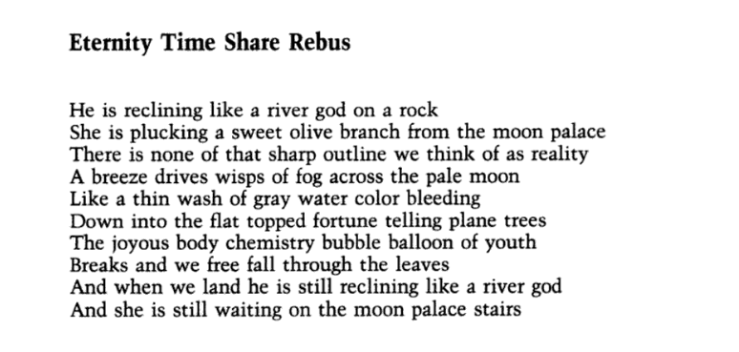
“Eternity Time Share Rebus” — Tom Clark

Screenshot 2018-06-30 at 7.48.37 PM

“The Uses of Poetry” — William Carlos Williams

uses

“Walter, leave off” | D.H. Lawrence on Walt Whitman

From D.H. Lawrence’s chapter on Whitman in Studies in Classic American Literature (more):

POST-MORTEM effects?

But what of Walt Whitman?

The ‘good grey poet’.

Was he a ghost, with all his physicality?

The good grey poet.

Post-mortem effects. Ghosts.

A certain ghoulish insistency. A certain horrible pottage of human parts. A certain stridency and portentousness. A luridness about his beatitudes.

DEMOCRACY! THESE STATES! EIDOLONS! LOVERS, ENDLESS LOVERS!

ONE IDENTITY!

ONE IDENTITY!

I AM HE THAT ACHES WITH AMOROUS LOVE.

Do you believe me, when I say post-mortem effects ?

When the Pequod went down, she left many a rank and dirty steamboat still fussing in the seas. The Pequod sinks with all her souls, but their bodies rise again to man innumerable tramp steamers, and ocean-crossing liners. Corpses.

What we mean is that people may go on, keep on, and rush on, without souls. They have their ego and their will, that is enough to keep them going.

So that you see, the sinking of the Pequod was only a metaphysical tragedy after all. The world goes on just the same. The ship of the soul is sunk. But the machine-manipulating body works just the same: digests, chews gum, admires Botticelli and aches with amorous love.

I AM HE THAT ACHES WITH AMOROUS LOVE.

What do you make of that? I AM HE THAT ACHES. First generalization. First uncomfortable universalization. WITH AMOROUS LOVE! Oh, God! Better a bellyache. A bellyache is at least specific. But the ACHE OF AMOROUS LOVE!

Think of having that under your skin. All that!

I AM HE THAT ACHES WITH AMOROUS LOVE.

Walter, leave off. You are not HE. You are just a limited Walter. And your ache doesn’t include all Amorous Love, by any means. If you ache you only ache with a small bit of amorous love, and there’s so much more stays outside the cover of your ache, that you might be a bit milder about it.

I AM HE THAT ACHES WITH AMOROUS LOVE.

CHUFF! CHUFF! CHUFF!

CHU-CHU-CHU-CHU-CHUFF!

Reminds one of a steam-engine. A locomotive. They’re the only things that seem to me to ache with amorous love. All that steam inside them. Forty million foot-pounds pressure. The ache of AMOROUS LOVE. Steam-pressure. CHUFF!

An ordinary man aches with love for Belinda, or his Native Land, or the Ocean, or the Stars, or the Oversoul: if he feels that an ache is in the fashion.

It takes a steam-engine to ache with AMOROUS LOVE. All of it.

Walt was really too superhuman. The danger of the superman is that he is mechanical.