“May-Day” — Ralph Waldo Emerson

“May-Day” by Ralph Waldo Emerson

Daughter of Heaven and Earth, coy Spring,
With sudden passion languishing,
Maketh all things softly smile,
Painteth pictures mile on mile,
Holds a cup with cowslip-wreaths,
Whence a smokeless incense breathes.
Girls are peeling the sweet willow,
Poplar white, and Gilead-tree,
And troops of boys
Shouting with whoop and hilloa,
And hip, hip three times three.
The air is full of whistlings bland;
What was that I heard
Out of the hazy land?
Harp of the wind, or song of bird,
Or clapping of shepherd’s hands,
Or vagrant booming of the air,
Voice of a meteor lost in day?
Such tidings of the starry sphere
Can this elastic air convey.
Or haply ‘t was the cannonade
Of the pent and darkened lake,
Cooled by the pendent mountain’s shade,
Whose deeps, till beams of noonday break,
Afflicted moan, and latest hold
Even unto May the iceberg cold.
Was it a squirrel’s pettish bark,
Or clarionet of jay? or hark,
Where yon wedged line the Nestor leads,
Steering north with raucous cry
Through tracts and provinces of sky,
Every night alighting down
In new landscapes of romance,
Where darkling feed the clamorous clans
By lonely lakes to men unknown.
Come the tumult whence it will,
Voice of sport, or rush of wings,
It is a sound, it is a token
That the marble sleep is broken,
And a change has passed on things.
Continue reading ““May-Day” — Ralph Waldo Emerson”

“I dreamt that the Earth was finished” — Roberto Bolaño

31. I dreamt that Earth was finished. And the only
human being to contemplate the end was Franz
Kafka. In heaven, the Titans were fighting to the
death. From a wrought-iron seat in Central Park,
Kafka was watching the world burn.

32. I dreamt I was dreaming and I came home
too late. In my bed I found Mário de Sá-Carneiro
sleeping with my first love. When I uncovered them
I found they were dead and, biting my lips till they
bled, I went back to the streets.

33. I dreamt that Anacreon was building his castle
on the top of a barren hill and then destroying it.

34. I dreamt I was a really old Latin American
detective. I lived in New York and Mark Twain
was hiring me to save the life of someone without
a face. “It’s going to be a damn tough case, Mr.
Twain,” I told him.

35. I dreamt I was falling in love with Alice Sheldon.
She didn’t want me. So I tried getting myself killed
on three continents. Years passed. Finally, when I
was really old, she appeared on the other end of the
promenade in New York and with signals (like the
ones they use on aircraft carriers to help the pilots
land) she told me she’d always loved me.

36. I dreamt I was 69ing with Anaïs Nin on an
enormous basaltic flagstone.

Read more short poems from Roberto Bolaño’s Tres (New Directions) in translation by Laura Healy.

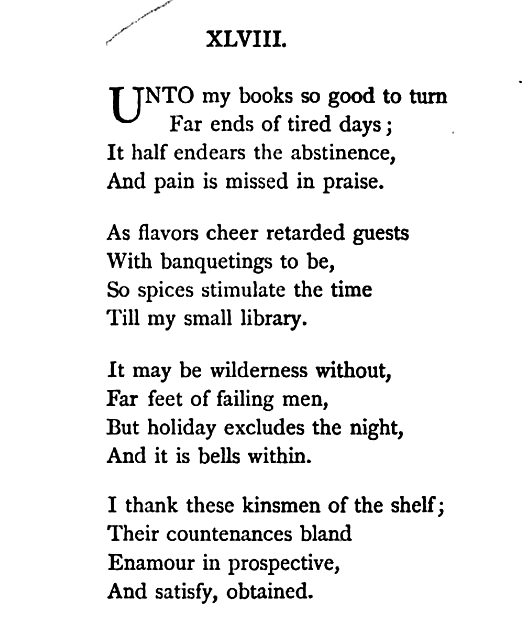
“Unto my books so good to turn” — Emily Dickinson

Capture

“Dreames” — Robert Herrick

Capture

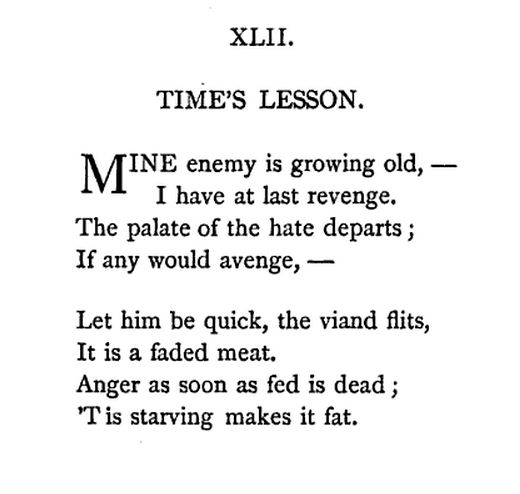
“Mine enemy is growing old” — Emily Dickinson

Capture

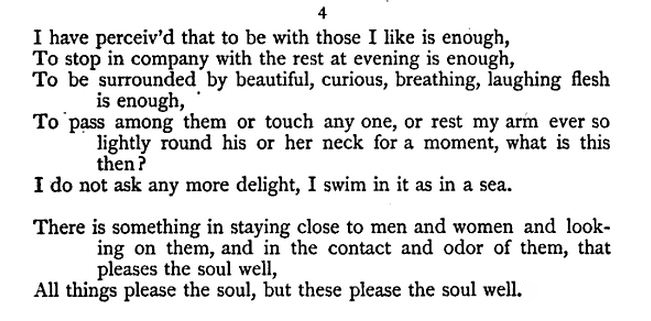
“I do not ask any more delight” (Walt Whitman)

Capture

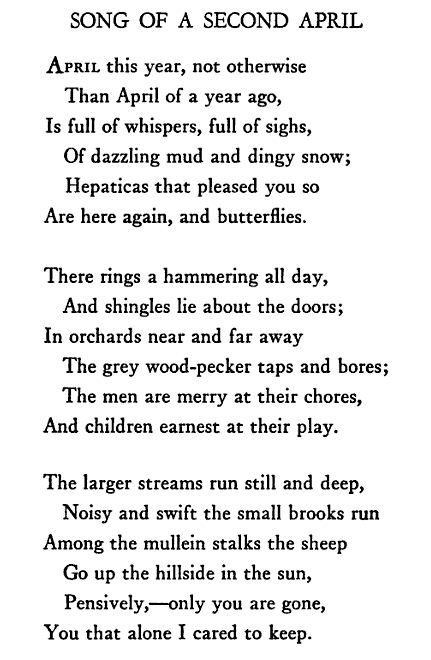
“Song of a Second April” — Edna St. Vincent Millay

millay

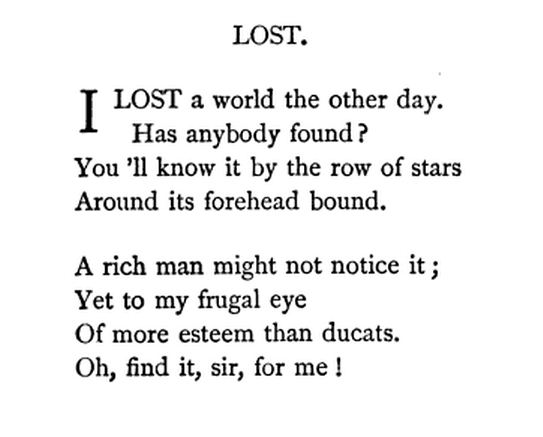
“I lost a World the other day” — Emily Dickinson

lost

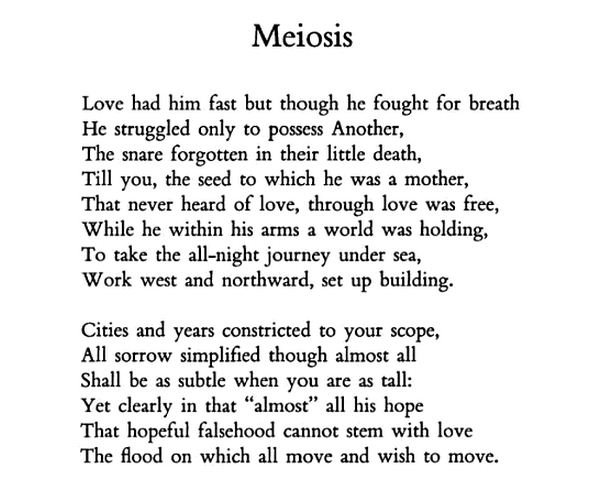
“Meiosis” — W.H. Auden

meiosis

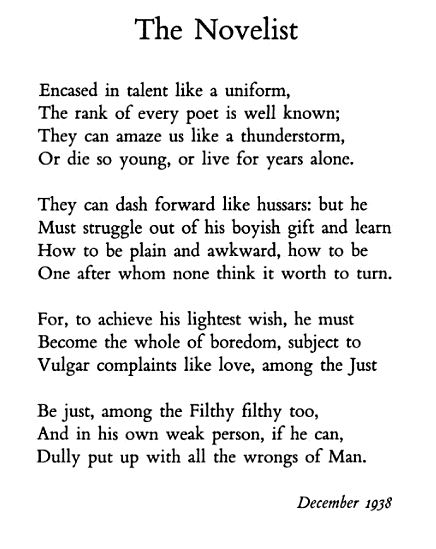
“The Novelist” — W.H. Auden

Capture

“I like a look of agony” — Emily Dickinson

Capture

Poet Sleep (Samuel Johnson)

sleep

“Bluebeard” — Edna St. Vincent Millay

“Bluebeard” by Edna St. Vincent Millay—

This door you might not open, and you did;
So enter now, and see for what slight thing
You are betrayed… Here is no treasure hid,
No cauldron, no clear crystal mirroring
The sought-for truth, no heads of women slain
For greed like yours, no writhings of distress,
But only what you see… Look yet again—
An empty room, cobwebbed and comfortless.
Yet this alone out of my life I kept
Unto myself, lest any know me quite;
And you did so profane me when you crept
Unto the threshold of this room to-night
That I must never more behold your face.
This now is yours. I seek another place.

“I had not time to hate, because” — Emily Dickinson

ed

“T.S. Eliot” — Ezra Pound

“T.S. Eliot” by Ezra Pound (from Instigations)

Il n’y a de livres que ceux où un écrivain s’est raconté lui-même en racontant les mœurs de ses contemporains—leurs rêves, leurs vanités, leurs amours, et leurs folies.— Remy de Gourmont.

De Gourmont uses this sentence in writing of the incontestable superiority of “Madame Bovary,” “L’Éducation Sentimentale” and “Bouvard et Pécuchet” to “Salammbô” and “La Tentation de St. Antoine.” A casual thought convinces one that it is true for all prose. Is it true also for poetry? One may give latitude to the interpretation of rêves; the gross public would have the poet write little else, but De Gourmont keeps a proportion. The vision should have its place in due setting if we are to believe its reality.

The few poems which Mr. Eliot has given us maintain this proportion, as they maintain other proportions of art. After much contemporary work that is merely factitious, much that is good in intention but impotently unfinished and incomplete; much whose flaws are due to sheer ignorance which a year’s study or thought might have remedied, it is a comfort to come upon complete art, naïve despite its intellectual subtlety, lacking all pretense.

It is quite safe to compare Mr. Eliot’s work with anything written in French, English or American since the death of Jules Laforgue. The reader will find nothing better, and he will be extremely fortunate if he finds much half as good.

The necessity, or at least the advisability of comparing English or American work with French work is not readily granted by the usual English or American writer. If you suggest it, the Englishman answers that he has not thought about it—he does not see why he should bother himself about what goes on south of the channel; the American replies by stating that you are “no longer American.” This is the bitterest jibe in his vocabulary. The net result is that it is extremely difficult to read one’s contemporaries. After a time one tires of “promise.” Continue reading ““T.S. Eliot” — Ezra Pound”

“How Do I Love Thee?” — Elizabeth Barrett Browning

Capture

“Man Carrying Thing” — Wallace Stevens

“Man Carrying Thing” by Wallace Stevens:

The poem must resist the intelligence
Almost successfully. Illustration:

A brune figure in winter evening resists
Identity. The thing he carries resists

The most necessitous sense. Accept them, then,
As secondary (parts not quite perceived

Of the obvious whole, uncertain particles
Of the certain solid, the primary free from doubt,

Things floating like the first hundred flakes of snow
Out of a storm we must endure all night,

Out of a storm of secondary things),
A horror of thoughts that suddenly are real.

We must endure our thoughts all night, until
The bright obvious stands motionless in cold.