Guy Fawkes Day and V for Vendetta

“Remember, remember the 5th of November…”

I was lucky enough to live in New Zealand for a few years as a kid, so I got to experience Guy Fawkes Day. We made effigies of Guy, and then we burned them on a bonfire. There was a barbecue, and fireworks. To me it seemed a strange mixture of the Fourth of July and Halloween.

It was a few years after my last Guy Fawkes experience that I read Alan Moore’s V for Vendetta. V, an anarchist who wears a stylized Guy Fawkes mask, wages a vigilante war on a harsh authoritarian government. Along with Frank Miller’s The Dark Knight Returns, V was a first for me, something different than the stuff I was reading at the time, stuff like The Uncanny X-Men and the ill-fated Valiant Comics imprint (I actually made a small fortune selling early Valiant issues I owned).  

A film version of V for Vendetta was released in 2006; Alan Moore famously had his name removed from it. I enjoyed the film, although it certainly wasn’t as good or thought-provoking as Moore’s original story; and even though the film looked good, the passive experience of watching an action movie can’t measure up to David Lloyd’s original art work and that wonderful space between the panels of comics that engages the reader’s imagination.
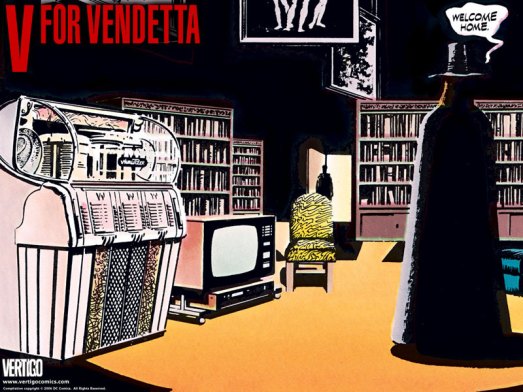
v_for_vendetta_5_800×600.jpg

This afternoon I finished the first graphic novel of Alan Moore’s  run writing Swamp Thing, and I can’t wait until my library hold on the second graphic novel comes in. I had no idea Saga of the Swamp Thing would be as good as it was, nor as beautifully illustrated; it’s actually much better than V for Vendetta or Moore’s other famed work, Watchmen (and none of these titles are even in the same league as Moore’s masterpiece, From Hell). Alan Moore and Steve Bissette’s run on the DC Comics series essentially led to DC’s creation of the edgier Vertigo imprint for their more “mature” titles, such as The Sandman. These titles helped to change the audiences of “comic books” and helped to make the graphic novel a new standard in the medium (no mean feat, considering the fanboyish culture of comic nerds, a culture that prizes rarity of print run over quality of storytelling).

V for Vendetta illustrates what happens when we don’t allow for dissent, what happens when ideas are both prescribed and proscribed, and all dialogue is muted. Authoritarian governments consolidate their power from the silencing of ideas. A healthy society requires all sorts of opinions, even ones we don’t like. The smiling Americans in this photo aren’t burning effigies of would-be revolutionaries, they are burning something much more dangerous–books.

book-burning.jpg

100 Most Frequently Challenged Books

Via bibliophil,  (links by biblioklept):

The 100 Most Frequently Challenged Books
of 1990–2000
Compiled by the Office for Intellectual Freedom, American Library Association. The ALA Office for Intellectual Freedom does not claim comprehensiveness in recording challenges.
1. Scary Stories (Series) by Alvin Schwartz
2. Daddy’s Roommate by Michael Willhoite
3. I Know Why the Caged Bird Sings by Maya Angelou
4. The Chocolate War by Robert Cormier
5. The Adventures of Huckleberry Finn by Mark Twain
6. Of Mice and Men by John Steinbeck
7. Harry Potter (Series) by J.K. Rowling
8. Forever by Judy Blume
9. Bridge to Terabithia by Katherine Paterson
10. Alice (Series) by Phyllis Reynolds Naylor
11. Heather Has Two Mommies by Leslea Newman
12. My Brother Sam is Dead by James Lincoln Collier and Christopher Collier
13. The Catcher in the Rye by J.D. Salinger
14. The Giver by Lois Lowry
15. It’s Perfectly Normal by Robie Harris
16. Goosebumps (Series) by R.L. Stine
17. A Day No Pigs Would Die by Robert Newton Peck
18. The Color Purple by Alice Walker
19. Sex by Madonna
20. Earth’s Children (Series) by Jean M. Auel
21. The Great Gilly Hopkins by Katherine Paterson
22. A Wrinkle in Time by Madeleine L’Engle
23. Go Ask Alice by Anonymous
24. Fallen Angels by Walter Dean Myers
25. In the Night Kitchen by Maurice Sendak
26. The Stupids (Series) by Harry Allard
27. The Witches by Roald Dahl
28. The New Joy of Gay Sex by Charles Silverstein
29. Anastasia Krupnik (Series) by Lois Lowry
30. The Goats by Brock Cole
31. Kaffir Boy by Mark Mathabane
32. Blubber by Judy Blume
33. Killing Mr. Griffin by Lois Duncan
34. Halloween ABC by Eve Merriam
35. We All Fall Down by Robert Cormier
36. Final Exit by Derek Humphry
37. The Handmaid’s Tale by Margaret Atwood
38. Julie of the Wolves by Jean Craighead George
39. The Bluest Eye by Toni Morrison
40. What’s Happening to my Body? Book for Girls: A Growing-Up Guide for Parents & Daughters by Lynda Madaras
41. To Kill a Mockingbird by Harper Lee
42. Beloved by Toni Morrison
43. The Outsiders by S.E. Hinton
44. The Pigman by Paul Zindel
45. Bumps in the Night by Harry Allard
46. Deenie by Judy Blume
47. Flowers for Algernon by Daniel Keyes
48. Annie on my Mind by Nancy Garden
49. The Boy Who Lost His Face by Louis Sachar
50. Cross Your Fingers, Spit in Your Hat by Alvin Schwartz
51. A Light in the Attic by Shel Silverstein
52. Brave New World by Aldous Huxley
53. Sleeping Beauty Trilogy by A.N. Roquelaure (Anne Rice)
54. Asking About Sex and Growing Up by Joanna Cole
55. Cujo by Stephen King
56. James and the Giant Peach by Roald Dahl
57. The Anarchist Cookbook by William Powell
58. Boys and Sex by Wardell Pomeroy
59. Ordinary People by Judith Guest
60. American Psycho by Bret Easton Ellis
61. What’s Happening to my Body? Book for Boys: A Growing-Up Guide for Parents & Sons by Lynda Madaras
62. Are You There, God? It’s Me, Margaret by Judy Blume
63. Crazy Lady by Jane Conly
64. Athletic Shorts by Chris Crutcher
65. Fade by Robert Cormier
66. Guess What? by Mem Fox
67. The House of Spirits by Isabel Allende
68. The Face on the Milk Carton by Caroline Cooney
69. Slaughterhouse-Five by Kurt Vonnegut
70. Lord of the Flies by William Golding
71. Native Son by Richard Wright
72. Women on Top: How Real Life Has Changed Women’s Fantasies by Nancy Friday
73. Curses, Hexes and Spells by Daniel Cohen
74. Jack by A.M. Homes
75. Bless Me, Ultima by Rudolfo A. Anaya
76. Where Did I Come From? by Peter Mayle
77. Carrie by Stephen King
78. Tiger Eyes by Judy Blume
79. On My Honor by Marion Dane Bauer
80. Arizona Kid by Ron Koertge
81. Family Secrets by Norma Klein
82. Mommy Laid An Egg by Babette Cole
83. The Dead Zone by Stephen King
84. The Adventures of Tom Sawyer by Mark Twain
85. Song of Solomon by Toni Morrison
86. Always Running by Luis Rodriguez
87. Private Parts by Howard Stern
88. Where’s Waldo? by Martin Hanford
89. Summer of My German Soldier by Bette Greene
90. Little Black Sambo by Helen Bannerman
91. Pillars of the Earth by Ken Follett
92. Running Loose by Chris Crutcher
93. Sex Education by Jenny Davis
94. The Drowning of Stephen Jones by Bette Greene
95. Girls and Sex by Wardell Pomeroy
96. How to Eat Fried Worms by Thomas Rockwell
97. View from the Cherry Tree by Willo Davis Roberts
98. The Headless Cupid by Zilpha Keatley Snyder
99. The Terrorist by Caroline Cooney
100. Jump Ship to Freedom by James Lincoln Collier and Christopher Collier

Any favorites on the list? I’ve got a few. I’ve read or at least familiar with 57 of these, including most of the top 25. What’s the beef with Where’s Waldo? Image links to a much better write up on banned books via the MPBA.

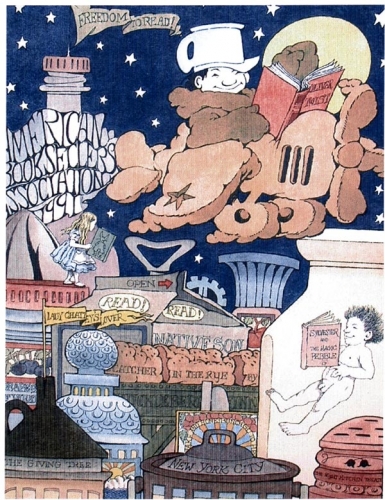
Freedom to Read

freedom-to-read.jpg

Freedom to Read, poster by Maurice Sendak. Image links to a concise history of book bannings.

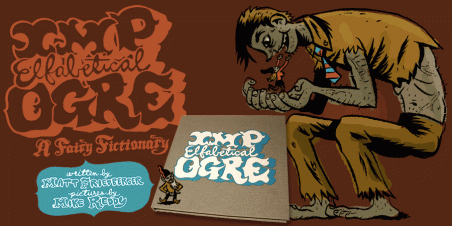
Imp Elfabetical Ogre

Imp Elfabetical Ogre is “A Fairy Fictionary” written by Matt Friedberger, chief songwriter/musician in my favorite working band, The Fiery Furnaces. Furnaces cover artist Mike Reddy illustrates some of Friedberger’s rhymes about ogres, pixies, elves, and gnomes.

opener21.gif

I’m not sure if this is an actual book or just an internet thing or what…it seems incomplete. The pun in the title, and the neologism “Fictionary” seem to suggest a larger, more comprehensive catalog of all things spritely. Just like the Furnaces’ lyrics, the words are highly alliterative and the tales are a little silly. Thanks to RP for sending me the link!

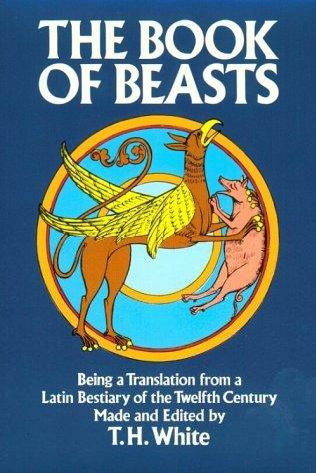
Other recommended bestiaries:

T.H. White? The Twelfth Century? Count me in!

n27697.jpg

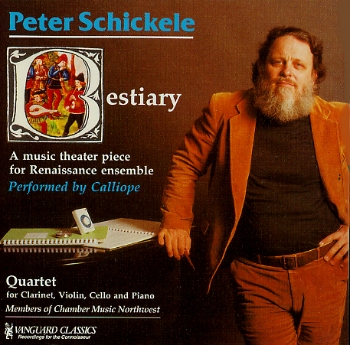
This Peter Shickele (aka PDQ Bach) record looks fantastic, you must admit. Image links to tracklisting, performers, and even some free audio samples! You can also buy this record–on cassette or vinyl only–for a mere $8 (but act fast, “supplies are limited”).

bestiary.jpg

A Wrinkle in Time

I loved this book as a kid. Madeline L’Engle’s A Wrinkle in Time explores the the intersections of space and time against a backdrop of adolescent angst. Our intrepid heroine Meg goes on a trans-dimensional quest to find her missing physicist father. Dad has disappeared due to his work on a project involving a tesseract. Go check out Tomorrowland’s brilliant write up of the tesseract.

Scary Stories–Halloween Edition

In the final edition of the 2006 Scary Books series, I take a critical look at some of my 11th graders’ scary stories.

First up is Niki H*nry’s “The Book of the Dead.” This tale is indicative of most of the students’ stories: unwitting protagonists stumble into inexplicable situations that are not of their making. After some confusion, the writer runs out of ideas and the protagonist is killed, usually with a knife. Readers of “The Book of the Dead” will be left wondering just what the book of the dead is–although it does have the power to turn a reader into a zombie.

Freud M*ltinord captures the terror and confusion of change in “Home Alone,” wherein a ten year old boy is left home alone in a strange new house. The real horror though is Freud’s inscrutable handwriting.

I truly enjoyed Chris Tutwil*r’s “Donna’s Reward,” featuring an infanticidal psychopath named “Doom” who carves up his victims–disrespectful teens–with a knife. Again with the knives.

Brittany H*rndon’s “On a Midnight Train to Georgia” illustrates the fear and confusion of a teen on the run from…? Who knows? Brittany didn’t quite finish the assignment. Still, this story expresses the same teenage fears that Roy Orbison immortalized in his classic “Running Scared.”

Anakar*n Diaz’s aptly-titled “Scary Story” (aside: I wonder if Anakar*n is making a postmodern gesture with the title here, perhaps alluding to some of John Barth’s work) features an evil scarecrow who transforms bad boys into scarecrows. Diaz turns a striking phrase: “the scarecrow spirit felt the pain of his life of being an outsider.”

In “The Gods,” Pam*l*rin Ajani recasts the origin stories of her native tribe, the Yoruba. This was very interesting for me, because her story intersected with my own current reading, Lydia Cabrera’s Afro-Cuban Tales.

Seymone Rams*y’s untitled piece is a highly sexualized vampire story (again, I suspect the refusal to title her work, to give a name to horror, is some type of fancy postmodern thing on Seymone’s part). Best line: “Baby, you know you’re my dark chocolate don’t you? So you don’t mind if I take a bite?”

Hannah F^jardo’s “Be Careful Before Wishing” is a reframing of the classic cautionary tale that people should be careful before wishing. Because wishes can come out, y’know, bad and stuff.

Rayna Sm!th’s “The Deaths” I thoroughly enjoyed. Rayna casts herself as the reluctant Sherlock Holmes (she even has a pipe with bubbles) in a murder mystery plot set in the family home. It’s just like I always tell these kids: familial spaces are always haunted spaces!

Similarly, Carolann* Dona explores murder in familial spaces in the excellent tale “The Cloaked Murderer,” in which a princess works out her rage by killing her parents. Her plot to rule the kingdom is foiled by a younger sister who reluctantly saves the day.

Lizbeth Martin*z tackles the revenge story in an animist motif in “The Bear’s Revenge,” in which a jilted teddy bear murders a young girl. I especially like Lizbeth’s use of present tense–it creates a mood of immediacy and suspense.

I regret that I have not the time to expound further upon the works of these young scholars; suffice to say that this random sampling should serve to illustrate the general plots, motifs, and tropes at work in the seething, horrific crucible-minds of teens.

Charles Bukowski

I must have been in the 1oth or 11th grade when I borrowed three Charles Bukowski novels from M***ael J***ings. These were:

Women, easily my favorite and Bukowski’s best. I didn’t return this one.

The short story collection, Tales of Ordinary Madness. I kept this one too, but it is no longer in my possession. Loaned out, never to be returned.

And another collection, The Most Beautiful Woman in Town. I think I gave this back; anyway, I don’t have it anymore.

I was reading Henry Miller and Hemingway at the time, and macho Bukowski fit right in. Something about being a teenager, trying to gain access to the “adult world”–or something like the adult world. How to act, what to say. I read just about all the short stories that Bukowski wrote. Factotum and Post Office were two of my favorites. Everyday when I see our mailman I think of Post Office.

 Our mailman is old, and skinny as a sick girl, and he has a nose like a bird’s beak to boot. He runs his entire route; he has a strange little knock-kneed hustle. He always tells me to “Stay safe” when I see him. He’s withered. Post Office makes working for the post office sound like an annihilating, damning, Sisyphean task. I wonder: “Does the mailman not feel safe?”

Charles Bukowski

Bukowski painted some pictures.

Factotum was recently made into a movie starring Matt Dillon as Bukowski’s alter-ego, Henry Chinaski. Mickey Rourke played the “real” Bukowski in a horrible-looking movie called Barfly. I haven’t seen either film.

So Bukowski’s sort of been “branded” commodified as “type”–like Hemingway and Miller (and HST, and Anaïs Nin, and Wm Burroughs,  and Nietzsche, and so on) He becomes a stolen writer, a lazy gesture, a footnote in the movie Swingers. Then again, maybe a few people saw that movie and picked up Hollywood, a really funny late-period Bukowski novel about making the film that will come to be Barfly. In Hollywood, Bukowski endures the trouble of having other people manipulate his writing and sweats sweats sweats that he might have sold out.

Jack O’ Lanterns 2006

dscn2548.JPG

dscn2551.JPG

Halloween Craft Links

Benfrank 

Go check out MAKE’s Halloween blog for plenty of cool Halloween projects–cool pumpkin carving stencils, homemade costumes, DIY scary sound generators, and more. Check out the whole site while you’re there. Good stuff.

The Pumpkin Lady shares lots of cool easy-to-use stencils, including this nifty Shakespeare design:

If you are a socially-challenged misfit with plenty of spare time, go to Raven’s Blight to download PDF how-to’s for constructing paper Halloween toys, like this “Moving Sculpture.”

little fella

Halloween Web has all of your fake-blood-needs covered, including this classic recipe:

Homemade Fake Blood

1 c. Karo Syrup

1 Tbsp Water

2 Tbsp Red Food Coloring

1 tsp Yellow Food Coloring

Mix together in a mixing bowl and you’re done. Try adding blue or yellow for a different shade.

Scary Books–Pt IV

What are some of your favorite scary books and stories? Please share.

Jeff Smith–Bone

I got Jeff Smith’s Bone: One Volume Edition in the mail today. I love getting mail, maybe that’s why I love Netflix so much.

This book collects every single issue of Smith’s self-published Bone comic book series, which first came out back in the early nineties…I still have the first couple of issues (think they might be worth anything?)

When Bone originally came out, I was very much into Dave Sim’s Cerebus and other black & white indie comics of a “dark” nature–and despite Dave Sim’s recommendations, Bone was too sweet-natured for me. I couldn’t appreciate Smith’s Walt Kelley-esqe art (the Pogo strip had perplexed me as a kid), and Smith’s layered plot moved too slowly–I realize now it started slow because Smith had all 1300 pages of the series plotted out from the first issue.

A few weeks ago, I was searching through some old graphic novels, looking for a particular Asterix book for some reason, when I came across the first graphic novel in the Bone series, Out from Boneville. I started re-reading it to find that it was waaaaaay funnier than I had realized, and that the art was beautiful and logical and spare and clean. Luckily, Smith has made his work easily accessible, in one big (seriously, this book is heavy) edition.

Will post more on this as I read. 

Guns n’ Roses Update

The perfect gift for someone special: check out The Axl Rose and Sidekick Cat Commemorative Dish, available at The Daily Gut.

A few days back this blog reported that Guns n’ Roses are supposed to play Jacksonville on Tuesday, October 31st–Halloween Night. As of now, the tickets are still on sale. For a mere $77.50 a ticket, you will be able to print your own ticket via an internet purchase. For an extra $10 you can even arrange parking ahead of time. Bonus! Has this event been promoted on local radio? I don’t listen to radio, other than 8 minutes of NPR over the morning drive to work. Are the people of Jax psyched? Is Axl Rose a has-been? Will they even play? Who cares?

The Audioklept Special Edition

All the big indie records of 2006: One sentence reviews. Part One.

Bonnie ‘Prince’ Billy–The Letting Go: Who knew he had another record this good in him?

Neko Case–Fox Confessor Brings the Flood: “Star Witness” is the best song of 2006.

Destroyer–Destroyer’s Rubies: Dan Bejar is over the top and this record is gorgeous.

Thom Yorke–The Eraser: […] hmmm […] oh sorry, I must’ve dozed off there […] 

The Walkmen–A Hundred Miles Off: I recently heard “The Rat” in the background of an NCAA Football commercial–I enjoyed that more than anything on this record.

The Walkmen–Pussycats: Uhmmm…yeah…uhmmm, okay cool guys, you have your own studio, you can just do whatever you want I guess.

Beck–The Information: Beck’s a fucking scientologist.

Ghostface Killah–Fishscale: I’m supposed to love this, right?

Girl Talk–Night Ripper: This might be the year’s best album…

The Flaming Lips–At War With the Mystics: It seems like they will continue to make these types of records.

The Decemberists–The Crane Wife: This is overrated, boring crap.

The Hold Steady–Boys and Girls in America: …speaking of overrated, boring crap.

The Fiery Furnaces–Bitter Tea: Their prettiest album yet; not as good as Blueberry Boat but better than any record by any other band that came out this year.

Matthew Friedberger–Winter Women: Contains no fewer than four radio gems.

Matthew Friedberger–Holy Ghost Language School: I keep meaning to listen to it again.

Lambchop–Damaged: I’m too busy for this level of subtlety.

Lambchop–The Decline of Country & Western Civilization, Pt. 2: The Woodwind Years: Their title is too long–counts as review.

Mercury Rev–Essential Mercury Rev: Go out and buy the real “essential” Mercury Rev: Yerself is Steam, Bocces, and See You on the Other Side.

Gnarls Barkley–St. Elsewhere: We will all remember this album as fondly as we remember that Chumbawumba album, or possibly our EMF Greatest Hits CD. 

Scary Stories: Scary Books–Part III

When was the last time you read Poe? Stories like “The Tell-Tale Heart” and “The Fall of the House of Usher” explore the ebb and flow of manic identity and the horror of displacement. These are rich texts. While you’re revisiting Poe, check out the lesser-known but masterful “Descent into the Maelstrom.”

I always read “The Raven” with my students on Halloween, and then we watch The Simpsons version of “The Raven” from one of the first “Treehouse of Horror” episodes.

Check it out!


This edition makes a great introduction to Kafka. “In the Penal Colony,” the horrific tale of a machine that kills you by inscribing your sentence on you, is pretty scary.

Danny Rolling: From Hell–Part II

 While I took an afternoon nap, serial killer Danny Rolling was killed by the State of Florida. Sixteen years ago in Gainesville, FL, Rolling went on a killing spree, murdering and mutilating five college students.

I graduated from the University of Florida in 2001. A decade after the murders, you would meet someone–a grad student, a law student, a native–who had a story about that weekend. They made it sound scary as hell.

Anyone who’s lived in Gainesville or even spent some time there will be familiar with the 34th Street mural wall. One panel of the wall is dedicated to the victims of the slaying: Sonja Larson, Christina Powell, Christa Hoyt, Tracy Paules, and Manuel Taboada. The panel seems to be repainted annually; sometimes due to vandalism.

Go here for a detailed chronological account of the murders

These murders were horrific, terrible crimes; random and indeterminate, but premeditated nonetheless. Rolling mutilated the corpses, beheading one of them; he also took body parts from the victims. There is no doubt in my mind that this man was a monster, a killer out of the woods like Grendel. And he got exactly what he wanted: fame and infamy and attention. He channeled hell and brought it to earth; I’m sure that hell still exists for some of his victim’s families to this day. Pragmatically, it is right and proper that Rolling be executed.

I still find myself opposed to the death penalty. I don’t pity Rolling and I don’t aim to add to his fame–but he has bought his fame by personifying abject horror, and this is Halloween horror-time. And as just and right as it seems that Rolling die, I still believe that it is wrong for our state government to kill him. I am not arguing that the death penalty is not a deterrent, or that the appeals process death row inmates go through is just as costly as life imprisonment; my argument is simple: murdering people is wrong. It is wrong and therefore against the law, so we (the “we” of community and society who consent to just government) do not kill. If we kill each other we cannot thrive. Rolling’s crime illustrates the human and social disruption of murder. These killings, these gruesome hyperboles of annihilation, show exactly why it is so important that government discontinue use of the death penalty.

Many, many times I have thought: “That person should be killed. That person should be shot.” I have had these murderous thoughts about awful psychopaths and child molesters and about people I am in strong disagreement with and people who have cut me off in traffic. I have had them in brief passing and I have concentrated on them with intensity, giving them much of my time. However, I know that these feelings are rooted in revenge fantasy and rotten wish-fulfillment. I think that when we buy into the death penalty as a punishment, we validate murder. We endorse a moral paradox: killing is wrong, so we will kill you. This type of social paradox becomes a vicious circle. The revenge cycle is metonymized so perfectly in everything from gang warfare to the Israeli–Palestinian conflict. Confronted with the sheer evidence of such futility and emptiness in violence, I think it only sensical and right that we choose to end capital punishment. Otherwise we only help to maintain the hell that Rolling has channelled, a hell we choose to keep.

From Hell: Scary Books–Part II

 Alan Moore (writer), Eddie Campbell (artist).

Alan Moore’s well-researched, 500+ page graphic novel theorizes that the Jack the Ripper murders were in fact a conspiracy to get rid of a royal’s illegitimate child who posed a threat to the Victorian lineage. I can’t say enough good things about this book. I am a huge fan of graphic novels, and this is one of the best, right up there with Art Spiegelman’s Maus, Dave Sim’s Cerebus and Joe Sacco’s Palestine. The intricate plot involves Masonic conspiracy, Victorian sexual mores, 19th century surgery, insanity, and a blood ritual resulting in transcendental time travel. Eddie Campbell’s art does a wonderful tight-rope act in putting order to chaos. His scratchy inks burst with emotion–I can’t imagine a better artist for this story. I actually wonder if some of Moore’s other work (V for Vendetta, Watchmen) would resonate deeper with me had an artist of Campbell’s caliber (Bill Sienkiewicz or Mike Mignola, possibly) worked on those books. I doubt it though. I always recommend this book to persons who don’t think graphic novels are literary. I won’t loan it out though. I don’t want it to go MIA.

(By the way, the Hughes brothers-directed movie adaptation of this novel, starring Johnny Depp, IS NOT the same story at all. I know, hard to believe that Hollywood could screw up great source material, but nonetheless true).

Scary Books–Part I

I love Halloween.

Some favorite scary books:

The monster’s point of view.

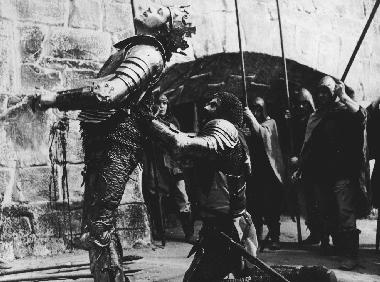
One of my classes is reading this version of Macbeth right now. I know–the cover sucks (the cauldron look’s like a latte), but I think it makes a fantastic introduction to Shakespeare; great for highschool students.

 We’re also watching Roman Polanski’s 1971 film version.

macbeth1.jpg

 And who can deny this old chestnut?