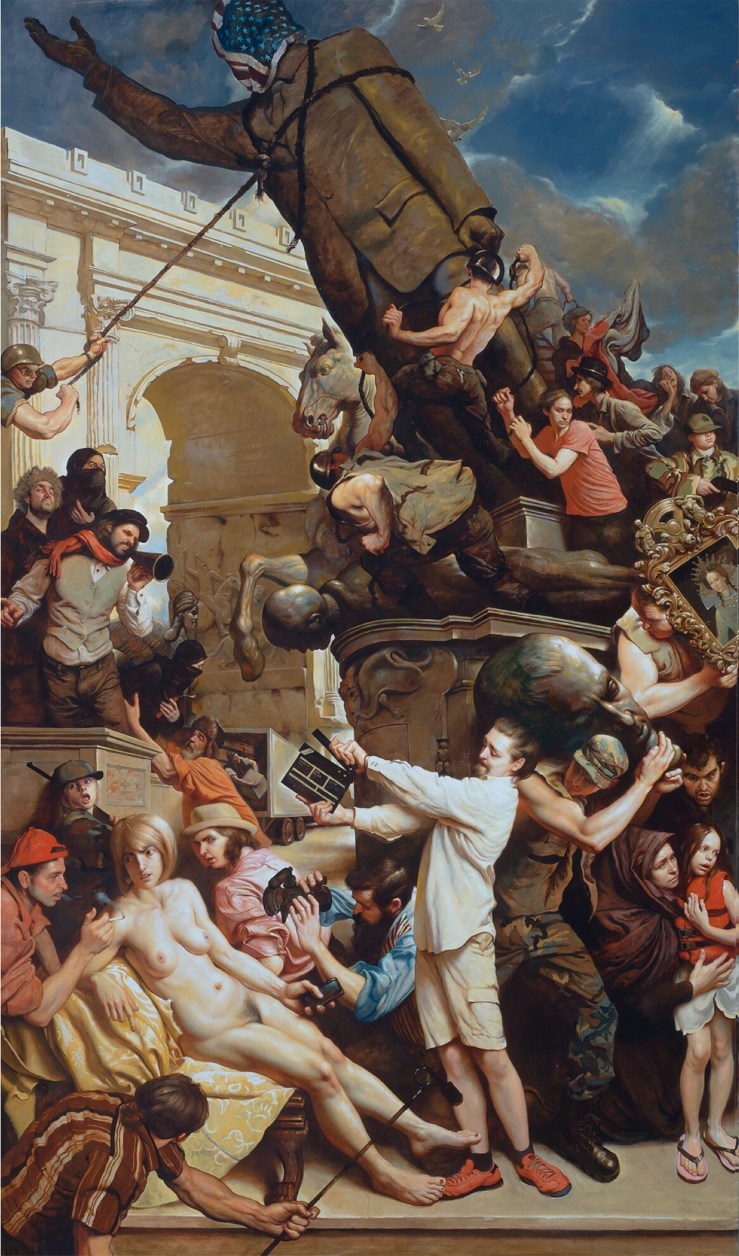
“Thanksgiving” — Kenneth Koch

“Thanksgiving”

by

Kenneth Koch


What’s sweeter than at the end of a summer’s day
To suddenly drift away
From the green match-wrappers in an opened pocketbook
And be part of the boards in a tavern?

A tavern made of new wood.
There’s an orange-red sun in the sky
And a redskin is hunting for you underneath ladders of timber.
I will buy this tavern. Will you buy this tavern? I do.

In the Indian camp there’s an awful dismay.
Do they know us as we know they
Know us or will know us, I mean a—
I mean a hostile force, the month of May.

How whitely the springtime is blossoming,
Ugh! all around us!
It is the brilliant Indian time of year
When the sweetest Indians mate with the sweetest others.

But I fear the white men, I fear
The rent apple blossom and discarded feathers
And the scalp lying secretly on the ground
Like an unoffending nose!

But we’ve destroyed all that. With shocking guns.
Peter Stuyvesant, Johnny Appleseed, Aaron Copeland.
We’ve destroyed all that. Come,
Do you believe right was on either side?

How would you like to be living in an Indian America,
With feathers dressing every head? We’d eat buffalo hump
For Thanksgiving dinner. Everyone is in a tribe.
A girl from the Bep Tribe can’t marry a brave from the Bap tribe. Is that democracy?
And then those dreary evenings around the campfires
Listening to the Chief! If there were a New York
It would be a city of tents, and what do you suppose
Our art and poetry would be like? For the community! the tribe!
No beautiful modern abstract pictures, no mad incomprehensible
Free lovable poems! And our moral sense! tribal.
If you would like to be living in an Indian America
Why not subscribe to the newspaper, Indian America?

In Wisconsin, Ben, I stand, I walk up and down and try to decide.

Is this country getting any better or has it gotten?
If the Indian New York is bad, what about our white New York?
Dirty, unwholesome, the filthy appendage to a vast ammunition works, I hate it!
Disgusting rectangular garbage dump sending its fumes up to suffocate the sky—
Foo, what fumes! and the scaly white complexion of her citizens.
There’s hell in every firm handshake, and stifled rage in every look.
If you do find somewhere to lie down, it’s a dirty inspected corner,
And there are newspapers and forums and the stinking breath of Broadway
To investigate what it feels like to be a source of stench
And nothing else. And if one does go away,
It is always here, waiting, for one to come back. And one does come back,
As one does come back to the bathroom, and to a fine suffering.

Where else would I find such ardent and grateful spirits
Inspired and wasted and using and used by this horrible city,
New York, New York? Can the Pilgrims’ Thanksgiving dinner really compare to it?
And the Puritans? And the single-minded ankle-divided Indians?
No, nothing can compare to it! So it’s here we speak from the heart
And it’s rotting so fast that what we say
Fades like the last of a summer’s day.
Rot which makes us as prolific as the sun on white unfastened clouds.
“First Thanksgiving” — Sharon Olds

“First Thanksgiving”

by

Sharon Olds


When she comes back, from college, I will see
the skin of her upper arms, cool,
matte, glossy. She will hug me, my old
soupy chest against her breasts,
I will smell her hair! She will sleep in this apartment,
her sleep like an untamed, good object,
like a soul in a body. She came into my life the
second great arrival, after him, fresh
from the other world—which lay, from within him,
within me. Those nights, I fed her to sleep,
week after week, the moon rising,
and setting, and waxing—whirling, over the months,
in a slow blur, around our planet.
Now she doesn’t need love like that, she has
had it. She will walk in glowing, we will talk,
and then, when she’s fast asleep, I’ll exult
to have her in that room again,
behind that door! As a child, I caught
bees, by the wings, and held them, some seconds,
looked into their wild faces,
listened to them sing, then tossed them back
into the air—I remember the moment the
arc of my toss swerved, and they entered
the corrected curve of their departure.

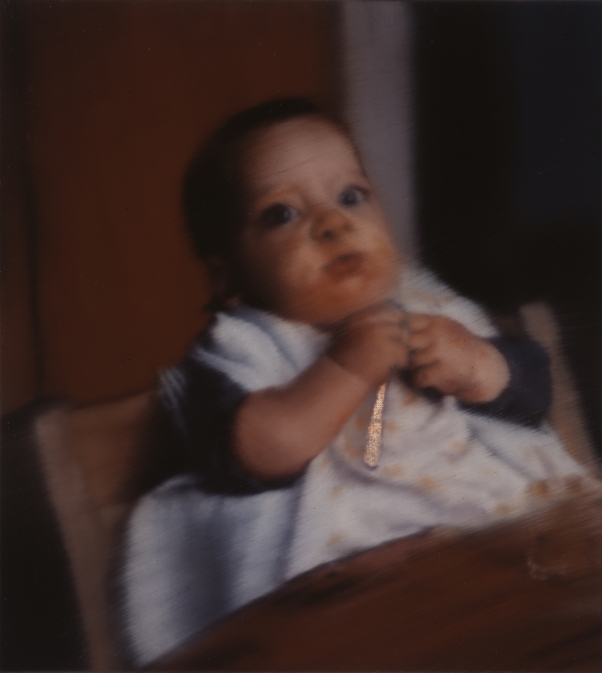
Moritz — Gerhard Richter

Moritz, 2000 by  Gerhard Richter (b. 1932)

Orca — Angela Gram

Orca, 2020 by Angela Gram (b. 1985)

Vast practical joke | Moby-Dick

There are certain queer times and occasions in this strange mixed affair we call life when a man takes this whole universe for a vast practical joke, though the wit thereof he but dimly discerns, and more than suspects that the joke is at nobody’s expense but his own. However, nothing dispirits, and nothing seems worth while disputing. He bolts down all events, all creeds, and beliefs, and persuasions, all hard things visible and invisible, never mind how knobby; as an ostrich of potent digestion gobbles down bullets and gun flints. And as for small difficulties and worryings, prospects of sudden disaster, peril of life and limb; all these, and death itself, seem to him only sly, good-natured hits, and jolly punches in the side bestowed by the unseen and unaccountable old joker. That odd sort of wayward mood I am speaking of, comes over a man only in some time of extreme tribulation; it comes in the very midst of his earnestness, so that what just before might have seemed to him a thing most momentous, now seems but a part of the general joke.

From Ch. 49 of Moby-Dick by Herman Melville.

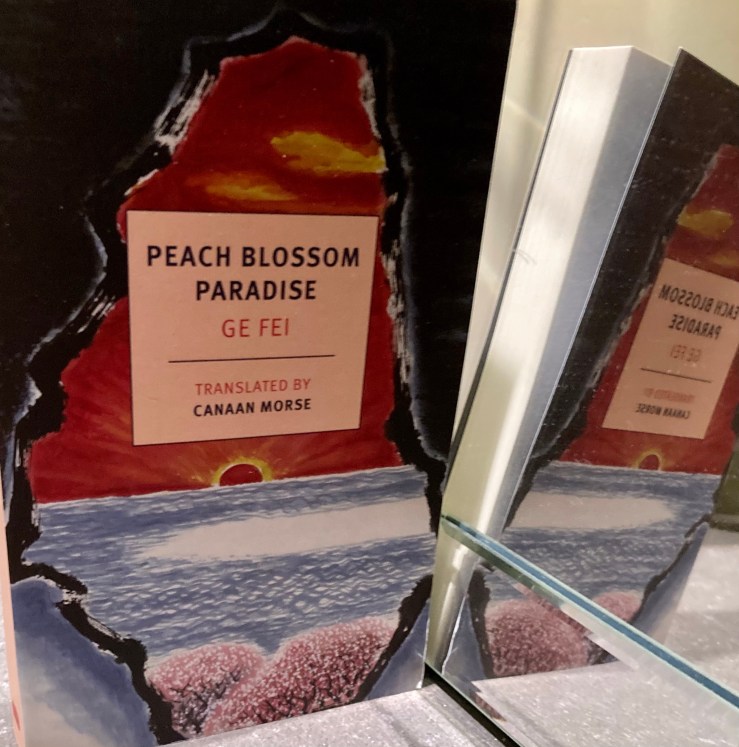
Ge Fei’s Peach Blossom Paradise (Book acquired, 12 Nov. 2020)

Ge Fei’s novel Peach Blossom Paradise, translated from the Chinese by Canaan Morse, is forthcoming from. Their blurb:

In 1898 reformist intellectuals in China persuaded the young emperor that it was time to transform his sclerotic empire into a prosperous modern state. The Hundred Days’ Reform that followed was a moment of unprecedented change and extraordinary hope—brought to an abrupt end by a bloody military coup. Dashed expectations would contribute to the revolutionary turn that Chinese history would soon take, leading in time to the deaths of millions.

Peach Blossom Paradise, set at the time of the reform, is the story of Xiumi, the daughter of a wealthy landowner and former government official who falls prey to insanity and disappears. Days later, a man with a gold cicada in his pocket turns up at his estate and is inexplicably welcomed as a relative. This mysterious man has a great vision of reforging China as an egalitarian utopia, and he will stop at nothing to make it real. It is his own plans, however, which come to nothing, and his “little sister” Xiumi is left to take up arms against a Confucian world in which women are chattel. Her campaign for change and her struggle to seize control over her own body are continually threatened by the violent whims of men who claim to be building paradise.

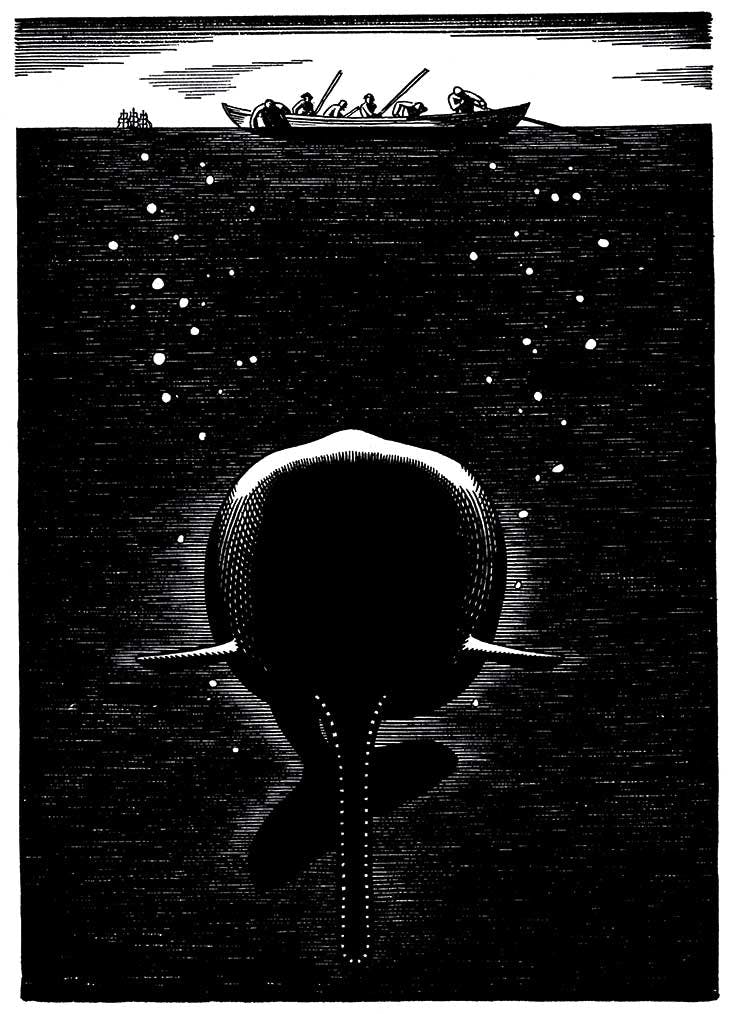
Whale beneath the Sea — Rockwell Kent

Whale beneath the Sea,1930 by Rockwell Kent (1882–1971)

“Variations on a Theme by William Carlos Williams” — Kenneth Koch

“Variations on a Theme by William Carlos Williams”

by

Kenneth Koch


1

I chopped down the house that you had been saving to live in next
summer.
I am sorry, but it was morning, and I had nothing to do
and its wooden beams were so inviting.

2

We laughed at the hollyhocks together
and then I sprayed them with lye.
Forgive me. I simply do not know what I am doing.

3

I gave away the money that you had been saving to live on for the next ten
years.
The man who asked for it was shabby
and the firm March wind on the porch was so juicy and cold.

4

Last evening we went dancing and I broke your leg.
Forgive me. I was clumsy, and
I wanted you here in the wards, where I am the doctor!

Self-Portrait — Christian Schad

Self-Portrait, 1927 by Christian Schad (1894-1982)

Blog about some recent reading

I have a leak in my roof and I’ve canceled my Thanksgiving plans and I’m not sure what to do about the soft coup, but, books—

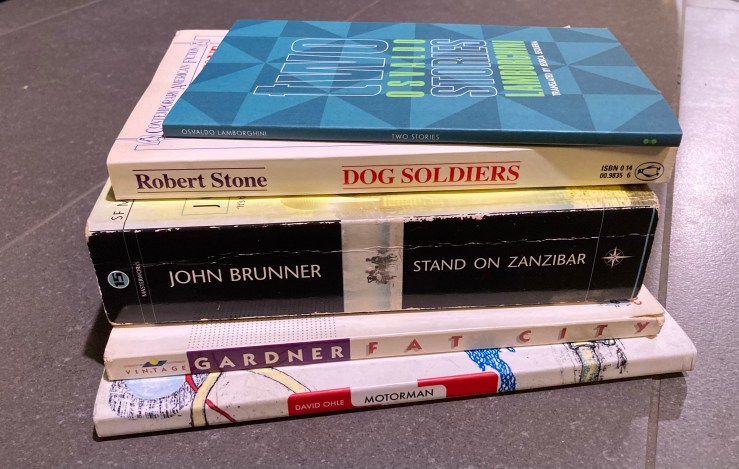
Top to bottom:

I’m still scratching my head about Two Stories by Osvaldo Lamborghini (translated by Jessica Sequeira). Sneaky strange stuff, prose-poem stuff like elastic concrete, or concrete elastic.

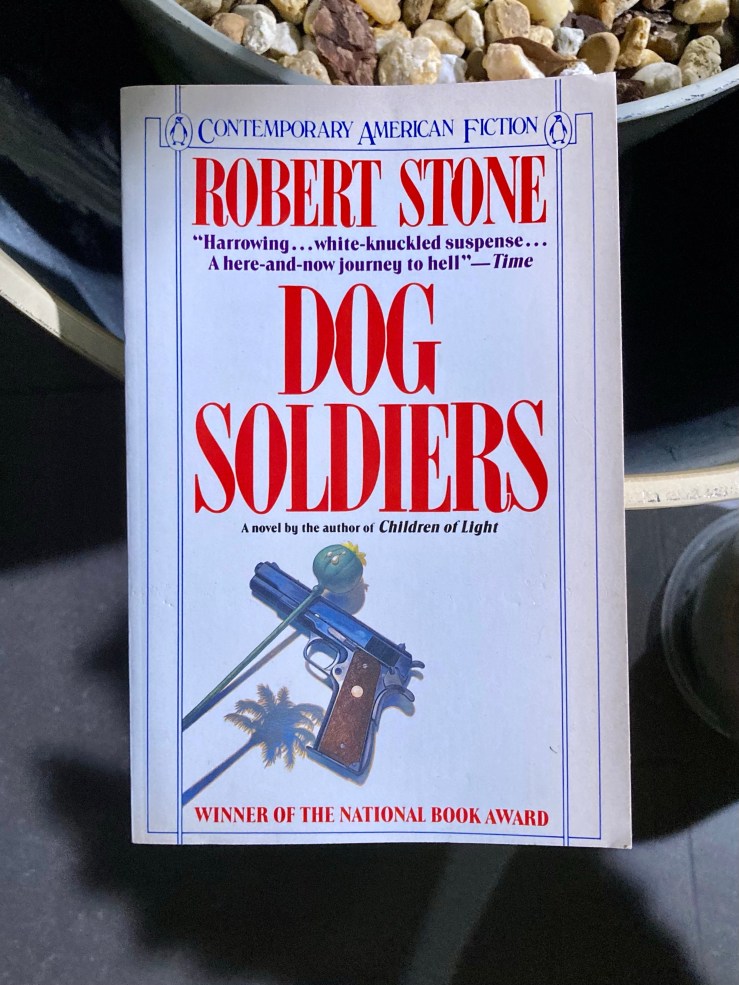
Started Robert Stone’s Dog Soldiers last night (on the late David Berman’s recommendation) and really digging it so far. Set at the end of the Vietnam War, it seems to be about a heroin deal going sideways. Maybe the CIA is involved, maybe not. Everyone’s a bit grimy. I guess it comes from the Hemingway tree, or really, maybe, the Stephen Crane tree—Denis Johnson’s tree, Leonard Gardner’s tree, Raymond Carver’s tree, etc. Reminds me a lot of Johnson’s Angels (and, to some extent, Tree of Smoke), but also Russell Banks’s 1985 novel Continental Drift, which I read years ago, hated, and still remember—which means I think it must be a really good novel?

I wrote Top to bottom up at the top, but Leonard Gardner’s Fat City is in line with Stone’s Dog Soldiers—Stone’s losers, I guess. The book is about an “old” boxer (he’s not thirty) on the way out of his career and a young boxer on the rise. (Rise here is a really suspect term.) I really can’t believe I was 41 when I read this. I should’ve read it at 20. I wouldn’t have understood it the same way, of course, and the biggest sincerest compliment I can pin on the novel is that I would’ve loved it at 20 but I know that I would’ve appreciated it more 20 years later. There are plenty of novels that I read and think, Hmm, would’ve loved this years ago, but now, nah, but Fat City is wonderful. It’s a boxing story, sure, but it’s really a book about bodies breaking down, aging, getting stuck in dreams and fantasies. Gardner’s only novel (!) is simultaneously mock-tragic and real tragic, pathetic and moving, and very very moving. Great stuff.

John Brunner’s big fat dystopian novel Stand on Zanzibar frankly overwhelmed me and then sorta underwhelmed me there at the end. This sci-fi classic is a big weird shaggy dog that managed to predict the future in all kinds of ways, and it’s mean and funny, but it’s also bloated and booming, the kind of novel that sucks all the air out of the room. It’s several dozen essays dressed up as sci-fi adventure—not a bad deal in and of itself—but there’s very little space left for the reader.

David Ohle’s lean mean mutant Motorman is a dystopia carved from stranger stuff. Ohle’s cult novel leaves plenty of room for the reader to wonder and wander around in. Abject, spare, funny, and depressing, Motorman sputters and jerks on its own nightmare logic. Its hapless hero Moldenke anti-quests through an artificial world, tumbling occasionally into strange moments of agency, but mostly lost and unillusioned in a broken universe. I loved it.

After I finished it, I made a list with no name of books that are “like” Motorman in their “unalikeness” to other books:


“All art constantly aspires towards the condition of etc. etc.”

To the Last Syllable of Recorded Time — Sanam Khatibi

To the Last Syllable of Recorded Time, 2019 by Sanam Khatibi (b. 1979)

Robert Stone’s Dog Soldiers (Book acquired, 17 Nov. 2020)

I’ve been looking for a copy of Robert Stone’s 1974 novel Dog Soldiers for a little over a year now. By looking I mean scanning over the Robert Stone section (dude has his own little placard) of my beloved used bookshop, seeing literally dozens of copies for pretty much every Stone book except Dog Soldiers.

My interest in the novel I owe to the late great freight date David Berman, who reportedly repeatedly said it was his favorite novel. The guitarist William Tyler–whom I did not get to see play with Steven Gunn earlier this year, way back in March, way back in early COVID days—attests that Berman “told me his favorite novel was Dog Soldiers by Robert Stone.” I think I also heard that Dog Soldiers was Berman’s fave from the writer John Lingan, probably on twitter, although the detail is not included in his fantastic 2019 profile of Berman. And Berman mentioned the book in his Reddit AMA as part of his answer to book recommendations for someone starting college:

Poetics of Space by Gaston Bachelard

Dog Soldiers by Robert Stone

Anatomy of Melancholy by Robert Burton

Complete Emily Dickinson

Anyway…I found Dog Soldiers, finally, today. I stopped in quickly to pick up two novels for my son, whose reading virility is through the roof now—dude reads like 600 pages a week—and I had a few minutes before I needed to attend my carpool duties and, finally, today, I read Dog Soldiers. I think I’ll read it next, and maybe write something about it here—something not about Berman, but who knows.

Seated Woman — Rik Wouters

MSKG – Zittende vrouw bij het venster of Portret van Nel Duerinc

Seated Woman, 1915 by Rik Wouters (1882-1916)

“The Ball Poem” — John Berryman

“The Ball Poem”

by

John Berryman


What is the boy now, who has lost his ball.
What, what is he to do? I saw it go
Merrily bouncing, down the street, and then
Merrily over—there it is in the water!
No use to say ‘O there are other balls’:
An ultimate shaking grief fixes the boy
As he stands rigid, trembling, staring down
All his young days into the harbour where
His ball went. I would not intrude on him,
A dime, another ball, is worthless. Now
He senses first responsibility
In a world of possessions. People will take balls,
Balls will be lost always, little boy,
And no one buys a ball back. Money is external.
He is learning, well behind his desperate eyes,
The epistemology of loss, how to stand up
Knowing what every man must one day know
And most know many days, how to stand up
And gradually light returns to the street,
A whistle blows, the ball is out of sight.
Soon part of me will explore the deep and dark
Floor of the harbour . . I am everywhere,
I suffer and move, my mind and my heart move
With all that move me, under the water
Or whistling, I am not a little boy.

The Fall of Troy — Adam Miller

The Fall of Troy, 2019 by Adam Miller (b. 1979)

“On Rectification” — Anne Carson