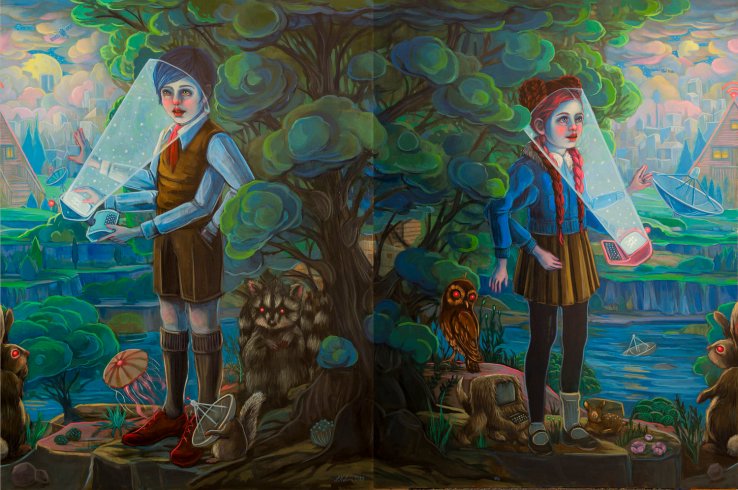
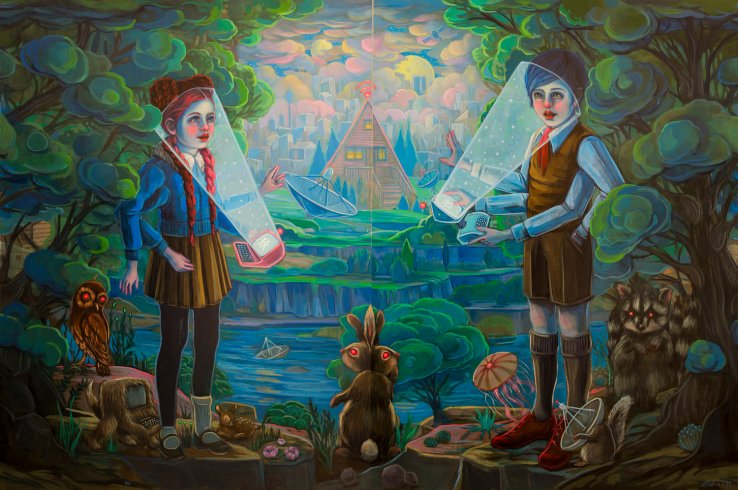
I consider myself a student of colours and shades and hues and tints (From Gerald Murnane’s Border Districts)

I consider myself a student of colours and shades and hues and tints. Crimson lake, burnt umber, ultramarine … I was too clumsy as a child to paint with my moistened brush the scenery that I would have liked to bring into being. I preferred to leave untouched in their white metallic surroundings my rows of powdery rectangles of water-colours, to read aloud one after another of the tiny printed names of the coloured rectangles, and to let each colour seem to soak into each word of its name or even into each syllable of each word of each name so that I could afterwards call to mind an exact shade or hue from an image of no more than black letters on a white ground.

Deep cadmium, geranium lake, imperial purple, parchment … after the last of our children had found employment and had moved out of our home, my wife and I were able to buy for ourselves things that had previously been beyond our means. I bought my first such luxury, as I called it, in a shop selling artists’ supplies. I bought there a complete set of coloured pencils made by a famous maker of pencils in England: a hundred and twenty pencils, each stamped with gold lettering along its side and having at its end a perfectly tapered wick. The collection of pencils is behind me as I write these words. It rests near the jars of glass marbles and the kaleidoscope mentioned earlier. None of the pencils has ever been used in the way that most pencils are used, but I have sometimes used the many-striped collection in order to confirm my suspicion as a child that each of what I called my long-lost moods might be recollected and, perhaps, preserved if only I could look again at the precise shade or hue that had become connected with the mood – that had absorbed, as it were, or had been permeated with, one or more of the indefinable qualities that constitute what is called a mood or a state of feeling. During the weeks since I first wrote in the earlier pages of this report about the windows in the church of white stone, I have spent every day an increasing amount of time in moving my pencils to and fro among the hollow spaces allotted to them in their container. I seem to recall that I tried sometimes, many years ago, to move my glass marbles from place to place on the carpet near my desk with the vague hope that some or another chance arrangement of them would restore to me some previously irretrievable mood. The marbles, however, were too variously coloured, and each differed too markedly from the other. Their colours seemed to vie, to compete. Or, a single marble might suggest more than I was in search of: a whole afternoon in my childhood or a row of trees in a backyard when I had wanted back only a certain few moments when my face was brushed by a certain few leaves. Among the pencils are many differing only subtly from their neighbours. Six at least I might have called simply red if I had not learned long ago their true names. With these six, and with still others from each side of them, I often arrange one after another of many possible sequences, hoping to see in the conjectured space between some or another unlikely pair a certain tint that I have wanted for long to see.

From Gerald Murnane’s 2018 novel Border Districts.

The Sacrifice — Martin Wittfooth

thepassions_sacrifice_web

The Sacrifice, 2011 by Martin Wittfooth (b. 1981)

Desayuno sobre la Obrera — Carmen Chami 

carmen-chami-desayuno-sobre-la-obrera

Desayuno sobre la Obrera by Carmen Chami (b. 1974)

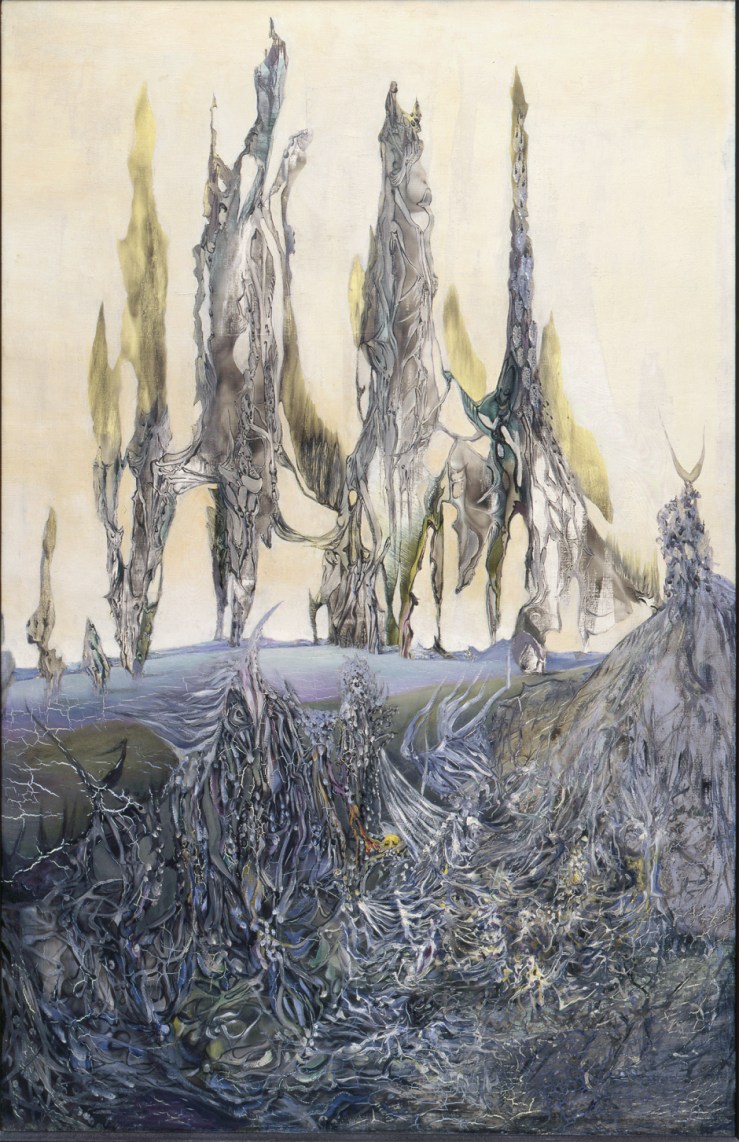
The Strangers — Wolfgang Paalen

wolfgan-paalen-les-ecc81trangers-19371

Les étrangers (The Strangers), 1937 by Wolfgang Paalen (1905-1959)

I failed as a reader of fiction (From Gerald Murnane’s Border Districts)

Whenever I tried long ago to learn from books about the workings of minds, I was equally troubled whether I read fiction or non-fiction. In the same way that I struggled and failed to follow plots and to comprehend the motives of characters, so did I struggle to follow arguments and to understand concepts. I failed as a reader of fiction because I was constantly engaged not with the seeming subject-matter of the text but with the doings of personages who appeared to me while I tried to read and with the scenery that appeared around them. My image-world was often only slightly connected with the text in front of my eyes; anyone privy to my seeming-sights might have supposed I was reading some barely recognisable variant of the text, a sort of apocrypha of the published work. As a reader of texts intended to explain the mind, I failed because the words and phrases in front of my eyes gave rise only to the poorest sort of image. Reading about our minds or the mind, and about purported instincts or aptitudes or faculties, not to mention such phantasms as ego, id, and archetype, I supposed the endless-seeming landscapes of my own thoughts and feelings must have been a paradise by comparison with the drab sites where others located their selves or their personalities or whatever they called their mental territories. And so, I decided long ago to take no further interest in the theoretical and to study instead the actual, which was for me the seeming-scenery behind everything I did or thought or read.

From Gerald Murnane’s 2018 novel Border Districts.
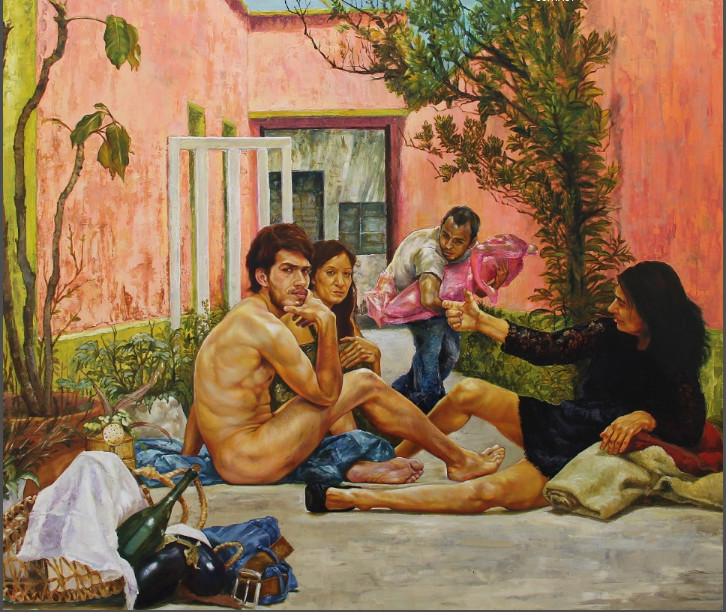
img_2844

Untitled — Riccardo Tommasi Ferroni

55764

Untitled by Riccardo Tommasi Ferroni (1934-2000)

Dark Water, Shima — Ikenaga Yasunari

045

Dark Water, Shima by Ikenaga Yasunari

あなたのなかの暗い水。

目を閉じる、
ゆらゆら揺れる。

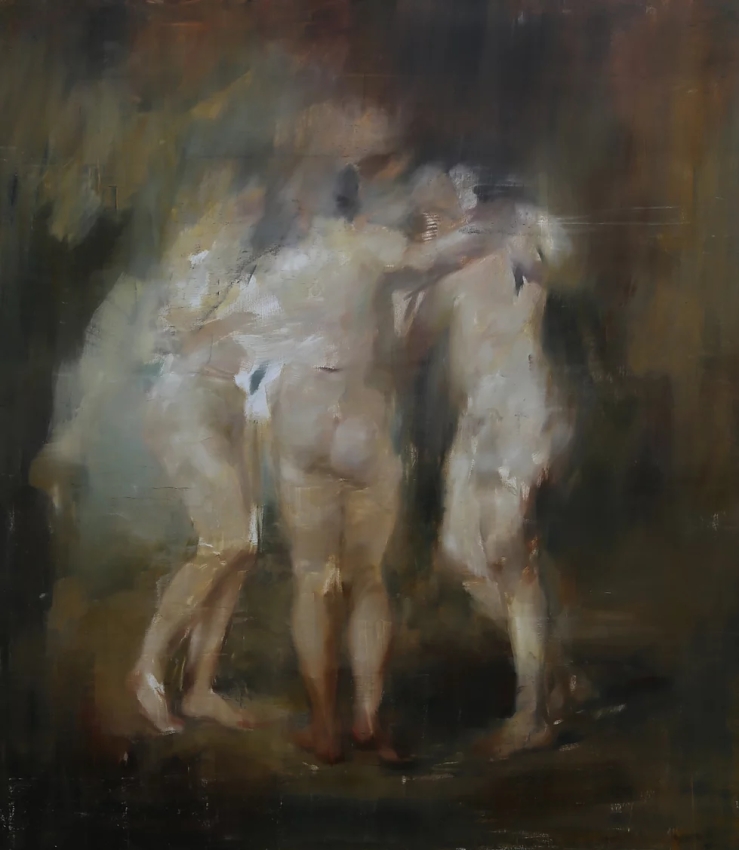
The Three Graces, after Rubens — Jake Wood-Evans

The Three Graces, after Rubens, 160x140c

The Three Graces, after Rubens, 2018 by Jake Wood-Evans (b. 1980)

Don Quixote — Daniele Galliano

daniele-galliano-don-quixote-2014-oil-on-paper-cm-70x50-2-large-728x1024

Don Quixote, 2014 by Daniele Galliano (b. 1961)

Book Party — Jansson Stegner

903f24c59e384c0ba0376ba728674765

Book Party, 2016 by Jansson Stegner (b. 1972)

Way too cheap (From Thomas Pynchon’s Vineland)

“Whole problem ’th you folks’s generation,” Isaiah opined, “nothing personal, is you believed in your Revolution, put your lives right out there for it—but you sure didn’t understand much about the Tube. Minute the Tube got hold of you folks that was it, that whole alternative America, el deado meato, just like th’ Indians, sold it all to your real enemies, and even in 1970 dollars—it was way too cheap. . . .”

A critique (by Gen X punker Isaiah Two Four) of the Baby Boomers. From Thomas Pynchon’s 1990 novel Vineland.  The “Tube” is television, of course, but might be a placeholder for any passively-consumed entertainment.

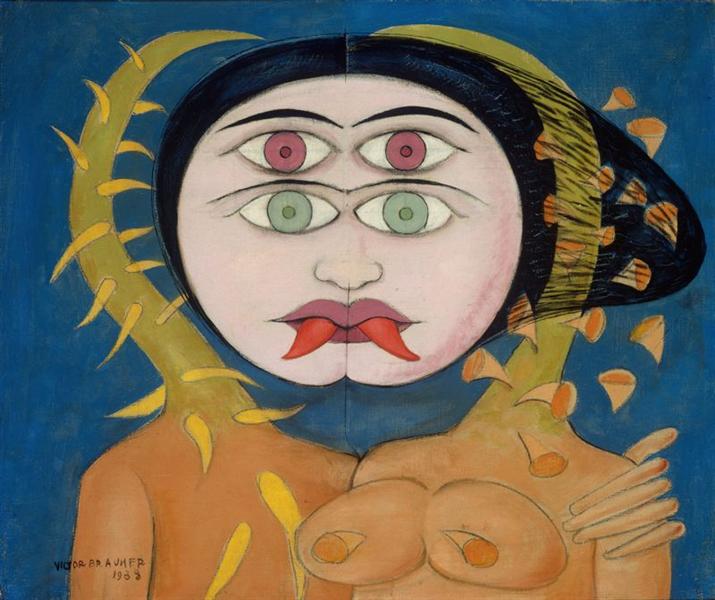
Gemini — Victor Brauner

gemini-1938.jpglarge

Gemini, 1938 by Victor Brauner (1903-1966)

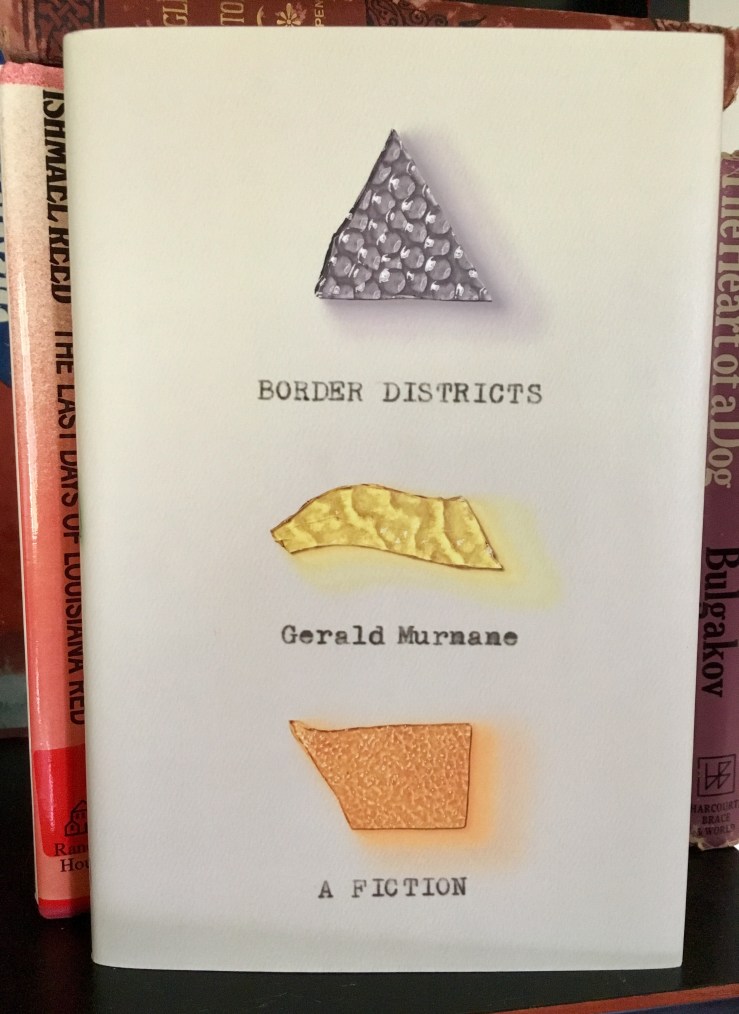
Gerald Murnane’s Border Districts (Book acquired, 20 May 2019

img_2844

I picked up a hardback copy of Gerald Murnane’s latest novel Border Districts on something of a whim today. It’s only 120 pages in hardback, and, despite Murnane’s metamodernist mode, is probably a bit more cohesive than the last few novels I’ve read (Thomas Pynchon’s Vineland, Kathy Acker’s Don Quixote, and Marlon James’s Black Leopard, Red Wolf). First two paragraphs—

Two months ago, when I first arrived in this township just short of the border, I resolved to guard my eyes, and I could not think of going on with this piece of writing unless I were to explain how I came by that odd expression.

I got some of my schooling from a certain order of religious brothers, a band of men who dressed each in a black soutane with a bib of white celluloid at his throat. I learned by chance last year, and fifty years since I last saw anyone wearing such a thing, that the white bib was called a rabat and was a symbol of chastity. Among the few books that I brought here from the capital city is a large dictionary, but the word rabat is not listed in it. The word may well be French, given that the order of brothers was founded in France. In this remote district, I am even less inclined than I was in the suburbs of the capital city to seek out some or another obscure fact; here, near the border, I am even more inclined than of old to accept as well founded any supposition likely to complete a pattern in my mind and then to go on writing until I learn the meaning for me of such an image as that of the white patch which appeared just now against a black ground at the edge of my mind and will not be easily dislodged.


Forester — Tilo Baumgärtel

baumgaertel-waldarbeiter2c-20172c-occ88l-auf-leinwand2c-210x300cm

Waldarbeiter (Forester), 2017 by Tilo Baumgärtel (b. 1972)

Find My Friends — Lori Nelson

find_my_friends_position1find_my_friends_position2

Find My Friends, 2017 by Lori Nelson

I guess it’s over (From Thomas Pynchon’s Vineland)

Mucho blinked sympathetically, a little sadly. “I guess it’s over. We’re on into a new world now, it’s the Nixon Years, then it’ll be the Reagan Years—”

“Ol’ Raygun? No way he’ll ever make president.”

“Just please go careful, Zoyd. ’Cause soon they’re gonna be coming after everything, not just drugs, but beer, cigarettes, sugar, salt, fat, you name it, anything that could remotely please any of your senses, because they need to control all that. And they will.”

“Fat Police?”

“Perfume Police. Tube Police. Music Police. Good Healthy Shit Police. Best to renounce everything now, get a head start.”

“Well I still wish it was back then, when you were the Count. Remember how the acid was? Remember that windowpane, down in Laguna that time? God, I knew then, I knew. . . .”

They had a look. “Uh-huh, me too. That you were never going to die. Ha! No wonder the State panicked. How are they supposed to control a population that knows it’ll never die? When that was always their last big chip, when they thought they had the power of life and death. But acid gave us the X-ray vision to see through that one, so of course they had to take it away from us.”

“Yeah, but they can’t take what happened, what we found out.”

“Easy. They just let us forget. Give us too much to process, fill up every minute, keep us distracted, it’s what the Tube is for, and though it kills me to say it, it’s what rock and roll is becoming—just another way to claim our attention, so that beautiful certainty we had starts to fade, and after a while they have us convinced all over again that we really are going to die. And they’ve got us again.” It was the way people used to talk.

“I’m not gonna forget,” Zoyd vowed, “fuck ’em. While we had it, we really had some fun.”

“And they never forgave us.” Mucho went to the stereo and put on The Best of Sam Cooke, volumes 1 and 2, and then they sat together and listened, both of them this time, to the sermon, one they knew and felt their hearts comforted by, though outside spread the lampless wastes, the unseen paybacks, the heartless power of the scabland garrison state the green free America of their childhoods even then was turning into.

An elegiac passage from Thomas Pynchon’s 1990 novel Vineland.

Ferragosto IV — Cy Twombly

ferragosto-iv

Ferragosto IV, 1961 by Cy Twombly (1928-2011)