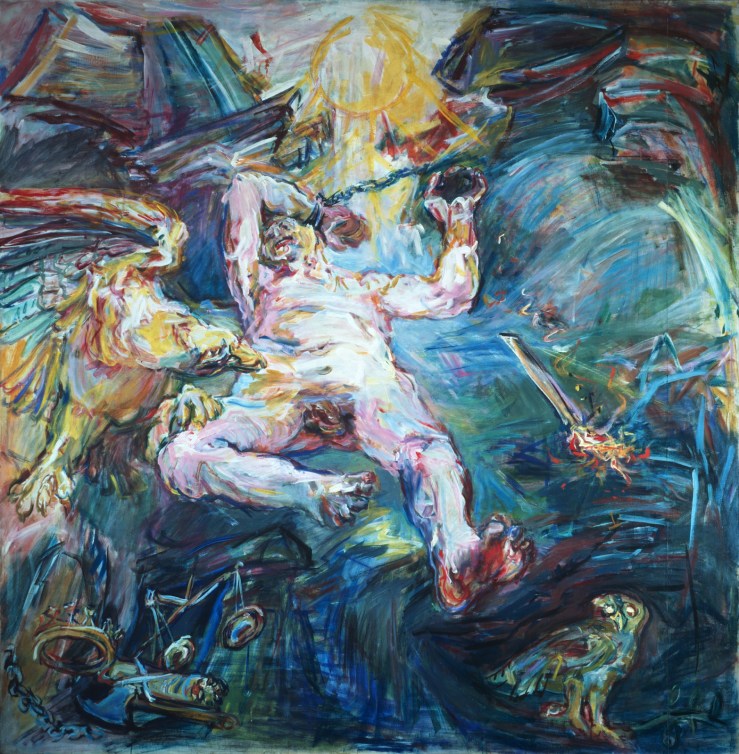
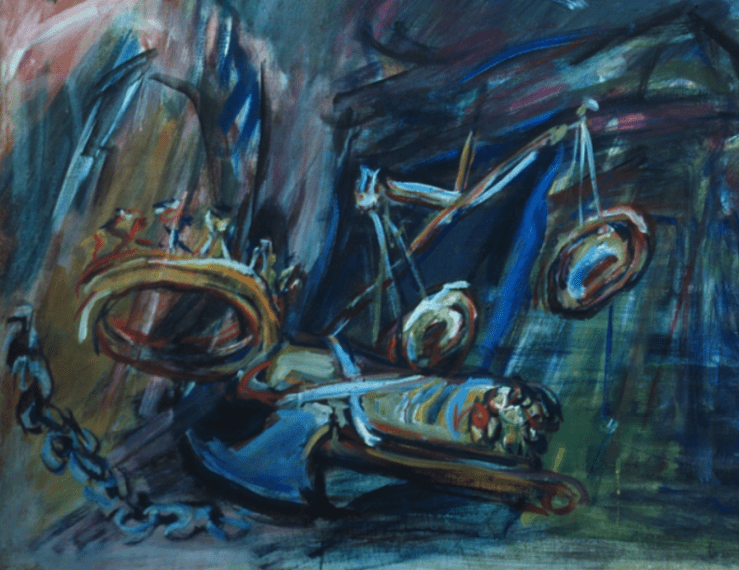
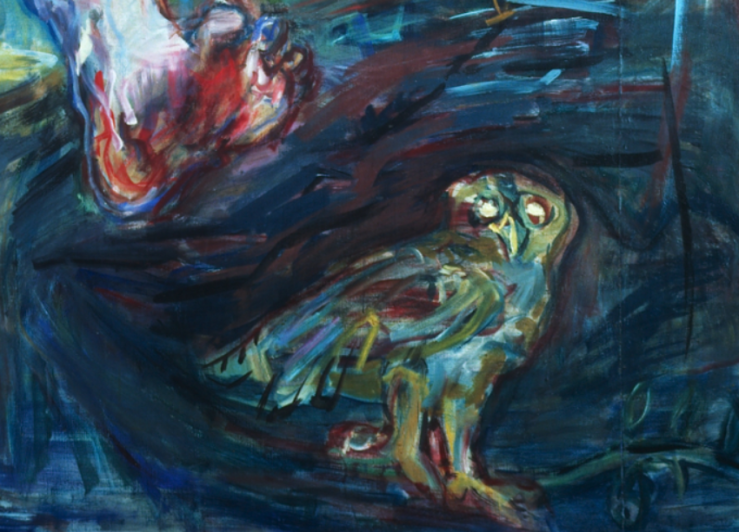
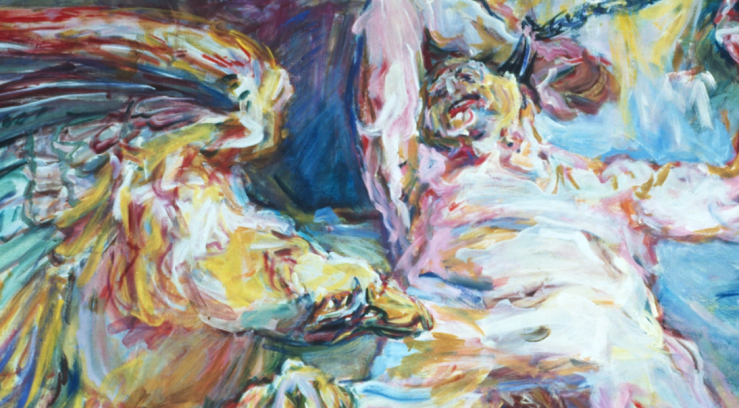
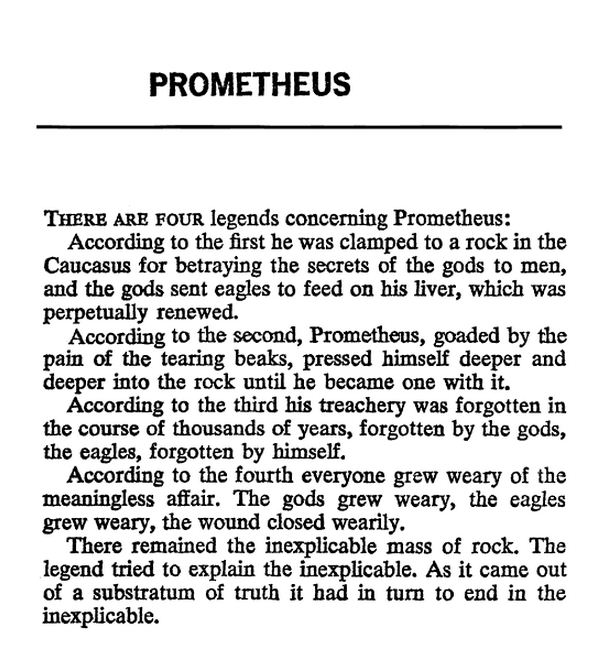
Prometheus (panel from The Prometheus Triptych), 1950 by Oskar Kokoschka (1886-1980)


I went to my favorite used bookshop on Friday afternoon to browse, order another Gerald Murnane novel, and pick up a copy of George Eliot’s Silas Marner.
I spied a late fifties mass market copy of Albert Camus’ novel Exile and the Kingdom from Vintage Books. I fell in love with the cover (by George Giusti) and ended up picking it up, although I’ll admit I haven’t read a Camus novel since college (it was The Plague if memory serves).
Browsing copies of Silas Marner, I found this monstrosity:

I don’t even know where to start with this cover. I mean, even the colors seem to clash. It doesn’t really come across in the photo, but this hardback has a cheap greasy feel to it. I initially assumed that it was some kind of TV or film tie in, but as far as I can tell…no. Horrifying. I ended up going with the Oxford edition with Ferdinand Hodler’s painting Unemployed on the cover.
When I got home, the mail had come. It included a copy of Peter Kuper’s Kafkaesque, which collects 14 of Kuper’s illustrated Kafka translations. Publisher Norton’s blurb:
Award-winning graphic novelist Peter Kuper presents a mesmerizing interpretation of fourteen iconic Kafka short stories.
Long fascinated with the work of Franz Kafka, Peter Kuper began illustrating his stories in 1988. Initially drawn to the master’s dark humor, Kuper adapted the stories over the years to plumb their deeper truths. Kuper’s style deliberately evokes Lynd Ward and Frans Masereel, contemporaries of Kafka whose wordless novels captured much of the same claustrophobia and mania as Kafka’s tales. Working from new translations of the classic texts, Kuper has reimagined these iconic stories for the twenty-first century, using setting and perspective to comment on contemporary issues like civil rights and homelessness.
Longtime lovers of Kafka will appreciate Kuper’s innovative interpretations, while Kafka novices will discover a haunting introduction to some of the great writer’s most beguiling stories, including “A Hunger Artist,” “In The Penal Colony,” and “The Burrow.” Kafkaesque stands somewhere between adaptation and wholly original creation, going beyond a simple illustration of Kafka’s words to become a stunning work of art.
It was September now, a season of rains. The gray sky above the city washed with darker scud like ink curling in a squid’s wake. The blacks can see the boy’s fire at night and glimpses of his veering silhouette slotted in the high nave, outsized among the arches. All night a ruby glow suffuses the underbridge from his garish chancel lamps. The city’s bridges all betrolled now what with old ventriloquists and young melonfanciers. The smoke from their fires issues up unseen among the soot and dust of the city’s right commerce.
Sometimes in the evening Suttree would bring beers and they’d sit there under the viaduct and drink them. Harrogate with questions of city life.
You ever get so drunk you kissed a nigger?
Suttree looked at him. Harrogate with one eye narrowed on him to tell the truth. I’ve been a whole lot drunker than that, he said.
Worst thing I ever done was to burn down old lady Arwood’s house.”
“You burned down an old lady’s house?
Like to of burnt her down in it. I was put up to it. I wasnt but ten year old.
Not old enough to know what you were doing.
Yeah.–Hell no that’s a lie. I knowed it and done it anyways.
Did it burn completely down?
Plumb to the ground. Left the chimbley standin was all. It burnt for a long time fore she come out.
Did you not know she was in there?
I disremember. I dont know what I was thinkin. She come out and run to the well and drawed a bucket of water and thowed it at the side of the house and then just walked on off towards the road. I never got such a whippin in my life. The old man like to of killed me.
Your daddy?
Yeah. He was alive then. My sister told them deputies when they come out to the house, they come out there to tell her I was in the hospital over them watermelons, she told em I didnt have no daddy was how come I got in trouble. But shit fire I was mean when I did have one. It didnt make no difference.
Were you sorry about it? The old lady’s house I mean.
Sorry I got caught.
Suttree nodded and tilted his beer. It occurred to him that other than the melon caper he’d never heard the city rat tell anything but naked truth.
A vignette from Cormac McCarthy’s Suttree—a transition scene perhaps, but one that draws Suttree and Harrogate closer, even as it underlines their differences.
In my review of Suttree a few years back, I argued that the novel is a grand synthesis of American literature, brimming with literary allusions. I singled out Faulkner’s “A Rose for Emily” as the basis for a later scene with Harrogate, so I can’t help but think of Faulkner’s “Barn Burning” here.
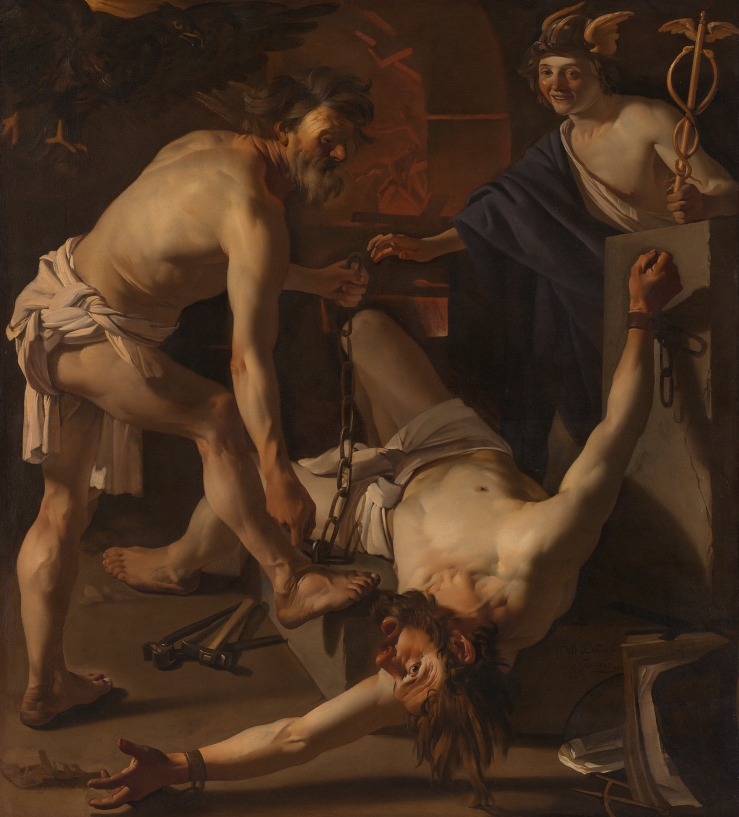
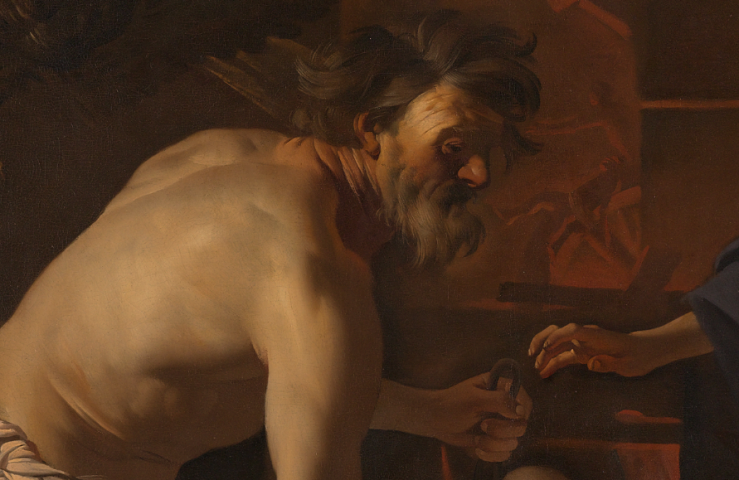
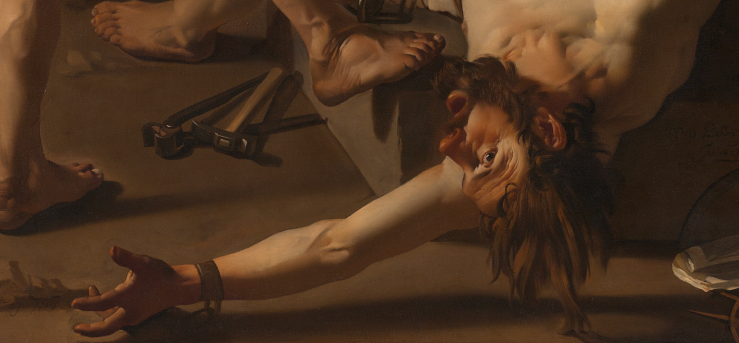
Prometheus Being Chained by Vulcan, 1623 by Dirck van Baburen (c. 1595– 1624)
A tailor is detected by Mr. Leach, because his coat had not a single wrinkle in it. I saw him exhibiting patterns of fashions to Randall, the village tailor. Mr. Leach has much tact in finding out the professions of people. He found out a blacksmith, because his right hand was much larger than the other.
A man getting subscriptions for a religious and abolition newspaper in New York,–somewhat elderly and gray-haired, quick in his movements, hasty in his walk, with an eager, earnest stare through his spectacles, hurrying about with a pocket-book of subscriptions in his hand,–seldom speaking, and then in brief expressions,–sitting down before the stage comes, to write a list of subscribers obtained to his employers in New York. Withal, a city and business air about him, as of one accustomed to hurry through narrow alleys, and dart across thronged streets, and speak hastily to one man and another at jostling corners, though now transacting his affairs in the solitude of mountains.
An old, gray man, seemingly astray and abandoned in this wide world, sitting in the bar-room, speaking to none, nor addressed by any one. Not understanding the meaning of the supper-bell till asked to supper by word of mouth. However, he called for a glass of brandy.
A pedlar, with girls’ neckerchiefs,–or gauze,–men’s silk pocket-handkerchiefs, red bandannas, and a variety of horn combs, trying to trade with the servant-girls of the house. One of them, Laura, attempts to exchange a worked vandyke, which she values at two dollars and a half; Eliza, being reproached by the pedlar, “vows that she buys more of pedlars than any other person in the house.”
A drove of pigs passing at dusk. They appeared not so much disposed to ramble and go astray from the line of march as in daylight, but kept together in a pretty compact body. There was a general grunting, not violent at all, but low and quiet, as if they were expressing their sentiments among themselves in a companionable way. Pigs, on a march, do not subject themselves to any leader among themselves, but pass on, higgledy-piggledy, without regard to age or sex.
From Nathaniel Hawthorne’s journal entry for Friday, August 31st, 1838. From Passages from the American Note-Books.
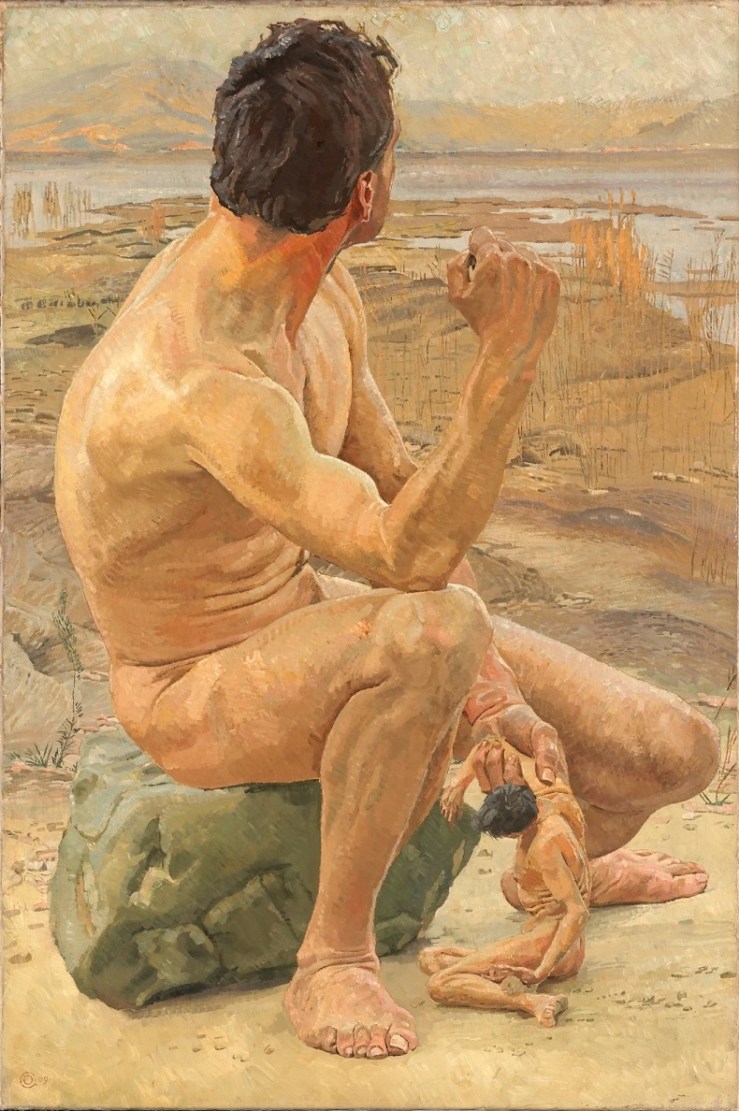
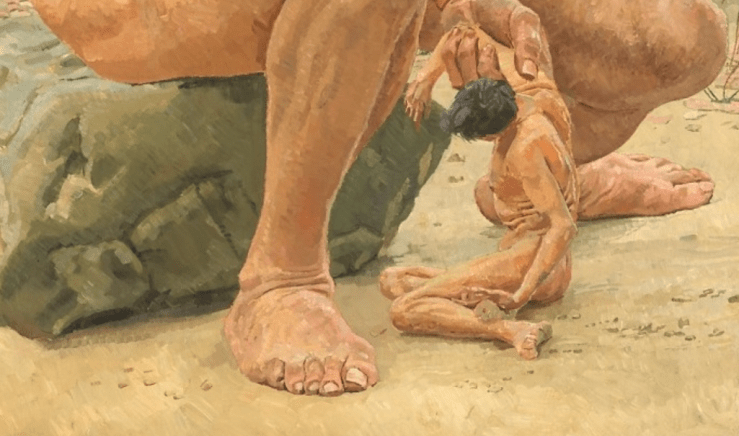
Prometheus, 1909 by Otto Greiner (1869-1916)
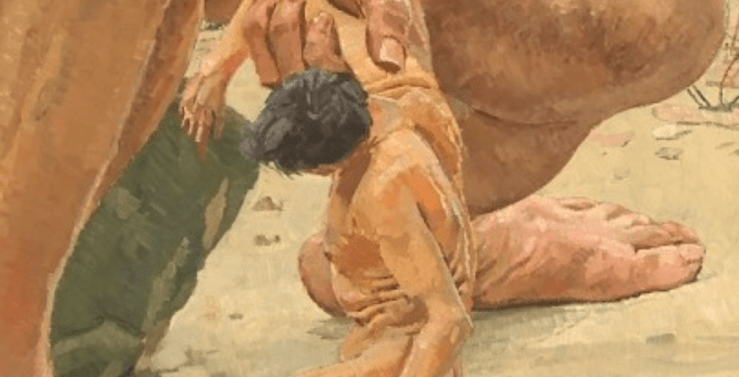

Three-Cornered Hat, 1943 by Walt Kuhn (1880-1949)
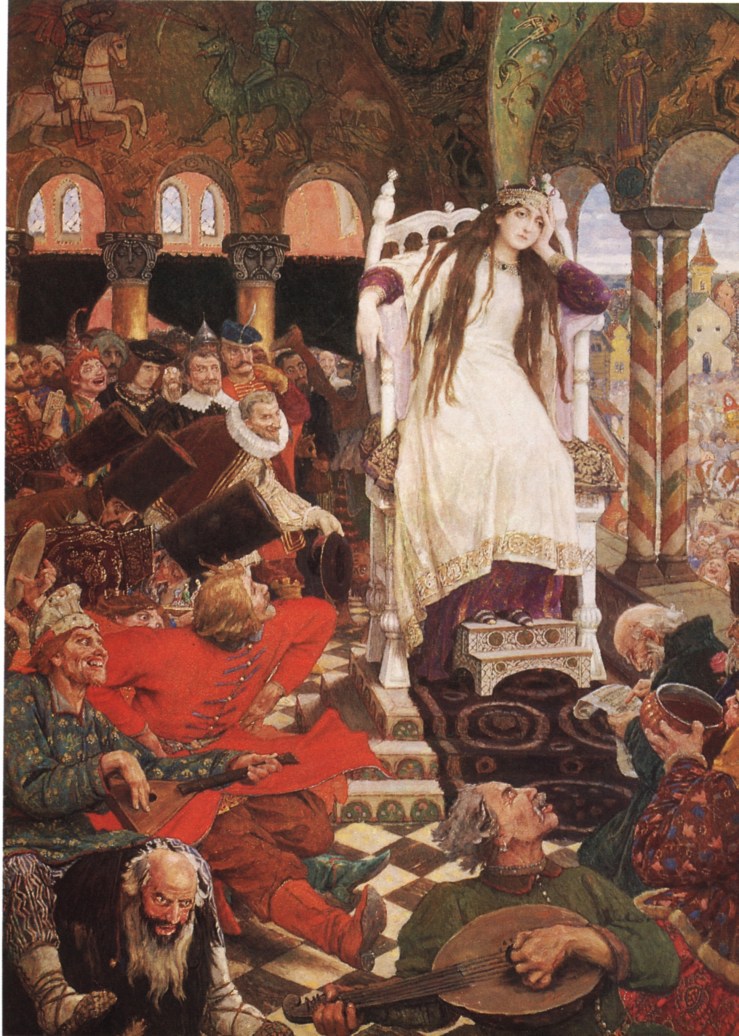
The Unsmiling Tsarena, 1926 by Viktor Vasnetsov (1848-1926)
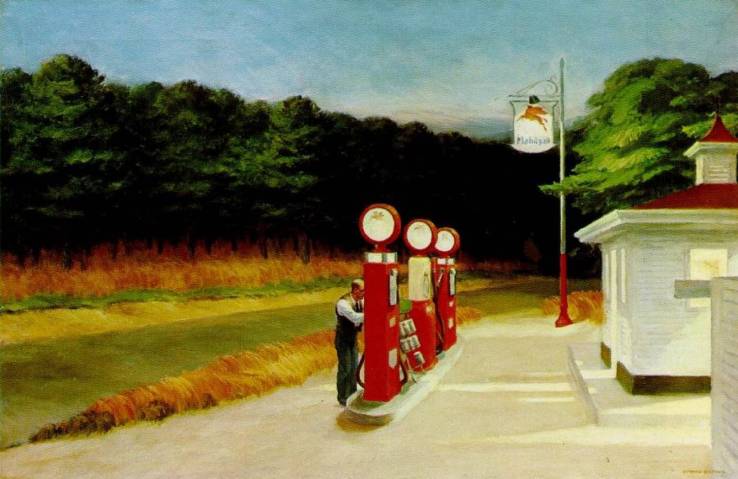
Edward Hopper, especially that painting of the gas station at night—Gas (1940)—was my inspiration for a lot of the songs I made up with my band The Modern Lovers when I was a kid. Especially “Roadrunner” owes to that gas station painting, but any songs I made up about lonely nights on lonely highways and the way lights were like friends in the dark. This is what “Roadrunner” was about. The Velvet Underground covered this kind of stark, lonely feeling of wonder and had a sound which, with its drowning darkness, felt right for my explorations into bleak, modern-world terror. That plus Hopper was a big part of my starting music.
From the Art News Muses column by Jonathan Richman.

The Listening Room, 1952 by Rene Magritte (1898-1967)
Olga Tokarczuk’s Flights,

being a book of diversions, of anything but the straight and narrow; a book bound by water, in that it is fluid, unfixed, and preoccupied with the very stuff, and the whales within; an interminable book, in which numerous stories never finish (for what is an ending but a wall to be destroyed or circumnavigated by time and other stories), but also a terminal book, in that it is “situated at the extremity of something” (New Oxford American Dictionary), like a book set on the eve of an important day, the day we leave, the day we make our move, the day we attack; and speaking of extremities, it is a book obsessed with fingers and toes and the blood vessels within, and all of the body’s parts, muscles in particular, and their preservation, long after the soul has left the body, submerged in anything from booze to Kaiserling III and held in a jar, transported across the world via horse and buggy or Russian galleon, to be placed on full display before students, kings, curious onlookers, and a grieving daughter, whose letters challenge the dubious practice of plastination; a book in which letters cross paths with lists, travelogues, tall tales, myths, ruminations on plastic bags and sanitary pads, dark matter and swastikas, stories that traverse the ruins of Athens, a boiler room in Moscow, the olive groves of Croatia, not to mention places without names, impossible to find on a map, without coordinates, all of it jumping from past to present and back again, if linear time is to be believed; a book of wandering women, who disappear and reappear on their own accord, slipping into the divine rhythms of circular time; a book about the temptation to make meaning out of any assortment of objects; a book made of 116 sections in all, which is the number of years the Hundred Years’ War actually lasted, and is the prefix for several European telephone helplines such as 116000, the hotline for missing children, or 116123, the emotional support helpline, according to Wikipedia, a site which may be, says Tokarczuk, “mankind’s most honest cognitive project,” except that it cannot index “its inverse, its inner lining, everything we don’t know”; a book populated by characters who either do not know, can’t figure it out, are lost, are trying to figure out what happened in that span of time that slipped their grasp, or those who know it all, who know the map like the back of their hand, or so they think; a book that anticipates the sovereignty of airports, those modern portals that make us time travelers, where you and I might collide, and if we do, will we talk to each other, tell our stories, move beyond the Three Travel Questions (where are you from, where are you coming from, where are you going) and into our ideas, those dangerous, viscous things, or will we simply utter apologies and head to our gates; a book that floods, that breaks at the seams and spills out into the world, so that fact and fiction get scrambled and mix in the deluge, becoming indistinguishable; a book with no answers, only arrows pointing in other directions, toward books yet to be written, histories to be retold, cities at the ends of the earth, or to the person nearest you; a book oriented, most importantly, toward other pilgrims…

…is masterfully translated from the Polish by Jennifer Croft, available from your English publisher of choice, and a magnificent read, one that travelled with me across Poland, Ireland, and the UK, and has convinced me, once and for all, that it is a crime never to read Moby-Dick.
(Image above, a map of Novaya Zemlya, via. Read an excerpt over at Asymptote, in their January 2016 issue.)
“Quite an original:” A phrase, we fancy, rather oftener used by the young, or the unlearned, or the untraveled, than by the old, or the well-read, or the man who has made the grand tour. Certainly, the sense of originality exists at its highest in an infant, and probably at its lowest in him who has completed the circle of the sciences.
As for original characters in fiction, a grateful reader will, on meeting with one, keep the anniversary of that day. True, we sometimes hear of an author who, at one creation, produces some two or three score such characters; it may be possible. But they can hardly be original in the sense that Hamlet is, or Don Quixote, or Milton’s Satan. That is to say, they are not, in a thorough sense, original at all. They are novel, or singular, or striking, or captivating, or all four at once.
More likely, they are what are called odd characters; but for that, are no more original, than what is called an odd genius, in his way, is. But, if original, whence came they? Or where did the novelist pick them up?
Where does any novelist pick up any character? For the most part, in town, to be sure. Every great town is a kind of man-show, where the novelist goes for his stock, just as the agriculturist goes to the cattle-show for his. But in the one fair, new species of quadrupeds are hardly more rare, than in the other are new species of characters—that is, original ones. Their rarity may still the more appear from this, that, while characters, merely singular, imply but singular forms so to speak, original ones, truly so, imply original instincts.
In short, a due conception of what is to be held for this sort of personage in fiction would make him almost as much of a prodigy there, as in real history is a new law-giver, a revolutionizing philosopher, or the founder of a new religion.
In nearly all the original characters, loosely accounted such in works of invention, there is discernible something prevailingly local, or of the age; which circumstance, of itself, would seem to invalidate the claim, judged by the principles here suggested.
Furthermore, if we consider, what is popularly held to entitle characters in fiction to being deemed original, is but something personal—confined to itself. The character sheds not its characteristic on its surroundings, whereas, the original character, essentially such, is like a revolving Drummond light, raying away from itself all round it—everything is lit by it, everything starts up to it (mark how it is with Hamlet), so that, in certain minds, there follows upon the adequate conception of such a character, an effect, in its way, akin to that which in Genesis attends upon the beginning of things.
For much the same reason that there is but one planet to one orbit, so can there be but one such original character to one work of invention. Two would conflict to chaos. In this view, to say that there are more than one to a book, is good presumption there is none at all. But for new, singular, striking, odd, eccentric, and all sorts of entertaining and instructive characters, a good fiction may be full of them. To produce such characters, an author, beside other things, must have seen much, and seen through much: to produce but one original character, he must have had much luck.
There would seem but one point in common between this sort of phenomenon in fiction and all other sorts: it cannot be born in the author’s imagination—it being as true in literature as in zoology, that all life is from the egg.
From Herman Melville’s novel The Confidence-Man.
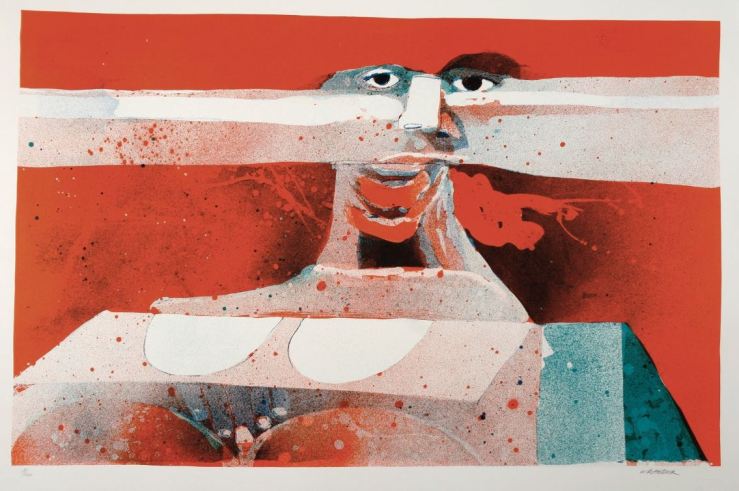
Sorrow, by Hans Graeder (1919-1999)
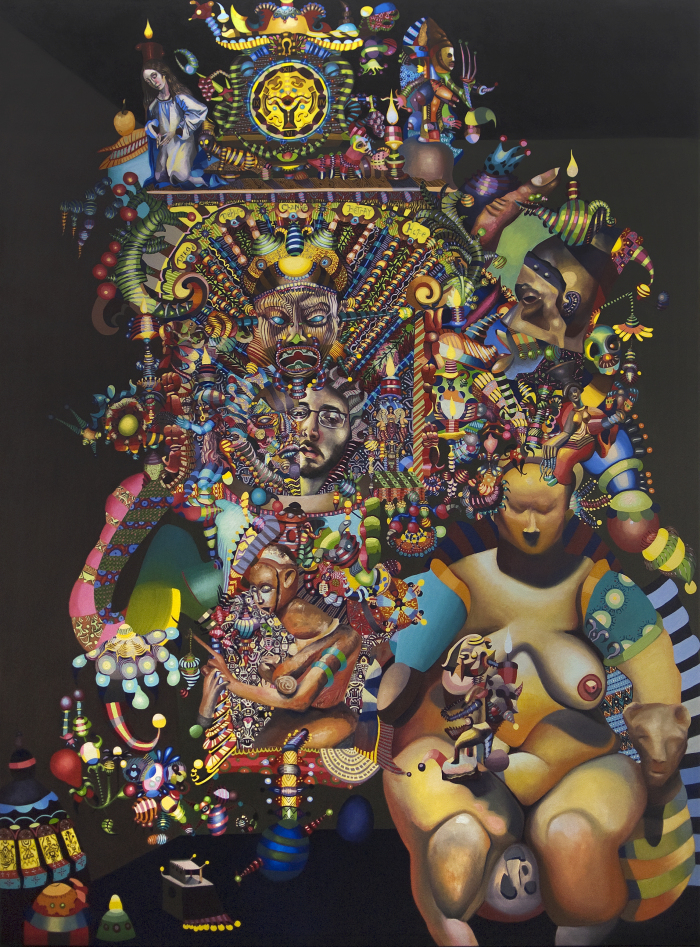
Venus and Time, 2013 by Jacob Hicks (b. 1985)
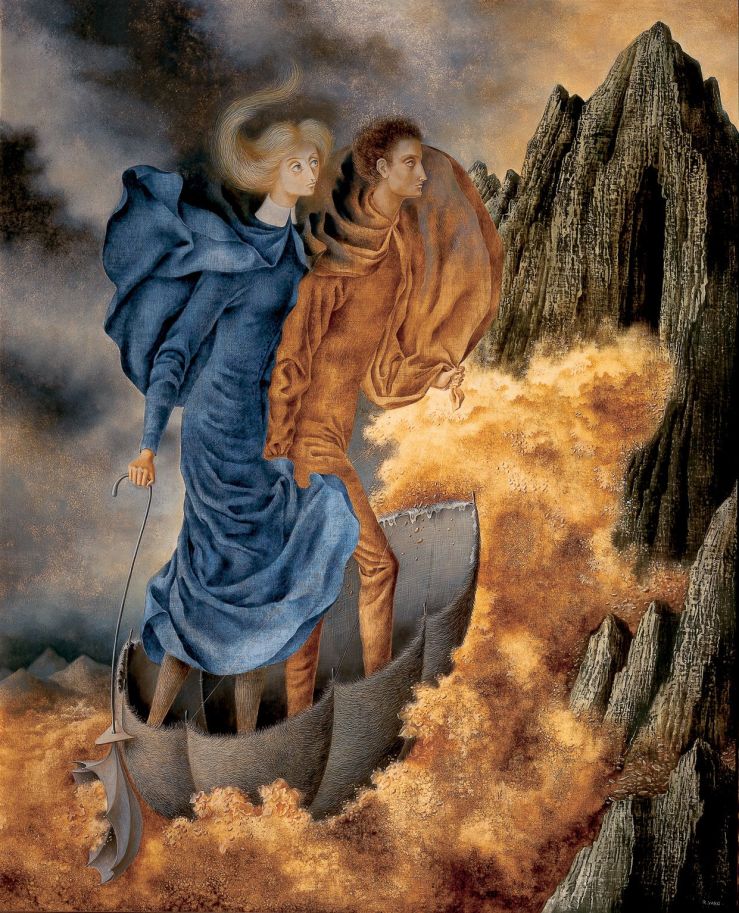
The Escape, 1961 by Remedios Varo (1908-1963)
“Anything in praise of the press I shall be happy to hear,” rejoined the cosmopolitan, “the more so,” he gravely proceeded, “as of late I have observed in some quarters a disposition to disparage the press.”
“Disparage the press?”
“Even so; some gloomy souls affirming that it is proving with that great invention as with brandy or eau-de-vie, which, upon its first discovery, was believed by the doctors to be, as its French name implies, a panacea—a notion which experience, it may be thought, has not fully verified.”
“You surprise me, Frank. Are there really those who so decry the press? Tell me more. Their reasons.”
“Reasons they have none, but affirmations they have many; among other things affirming that, while under dynastic despotisms, the press is to the people little but an improvisatore, under popular ones it is too apt to be their Jack Cade. In fine, these sour sages regard the press in the light of a Colt’s revolver, pledged to no cause but his in whose chance hands it may be; deeming the one invention an improvement upon the pen, much akin to what the other is upon the pistol; involving, along with the multiplication of the barrel, no consecration of the aim. The term ‘freedom of the press’ they consider on a par with freedom of Colt’s revolver. Hence, for truth and the right, they hold, to indulge hopes from the one is little more sensible than for Kossuth and Mazzini to indulge hopes from the other. Heart-breaking views enough, you think; but their refutation is in every true reformer’s contempt. Is it not so?”
“Without doubt. But go on, go on. I like to hear you,” flatteringly brimming up his glass for him.
“For one,” continued the cosmopolitan, grandly swelling his chest, “I hold the press to be neither the people’s improvisatore, nor Jack Cade; neither their paid fool, nor conceited drudge. I think interest never prevails with it over duty. The press still speaks for truth though impaled, in the teeth of lies though intrenched. Disdaining for it the poor name of cheap diffuser of news, I claim for it the independent apostleship of Advancer of Knowledge:—the iron Paul! Paul, I say; for not only does the press advance knowledge, but righteousness. In the press, as in the sun, resides, my dear Charlie, a dedicated principle of beneficent force and light. For the Satanic press, by its coappearance with the apostolic, it is no more an aspersion to that, than to the true sun is the coappearance of the mock one. For all the baleful-looking parhelion, god Apollo dispenses the day. In a word, Charlie, what the sovereign of England is titularly, I hold the press to be actually—Defender of the Faith!—defender of the faith in the final triumph of truth over error, metaphysics over superstition, theory over falsehood, machinery over nature, and the good man over the bad. Such are my views, which, if stated at some length, you, Charlie, must pardon, for it is a theme upon which I cannot speak with cold brevity…”
From Chapter 24 of Herman Melville’s novel The Confidence-Man.
 Biblioklept