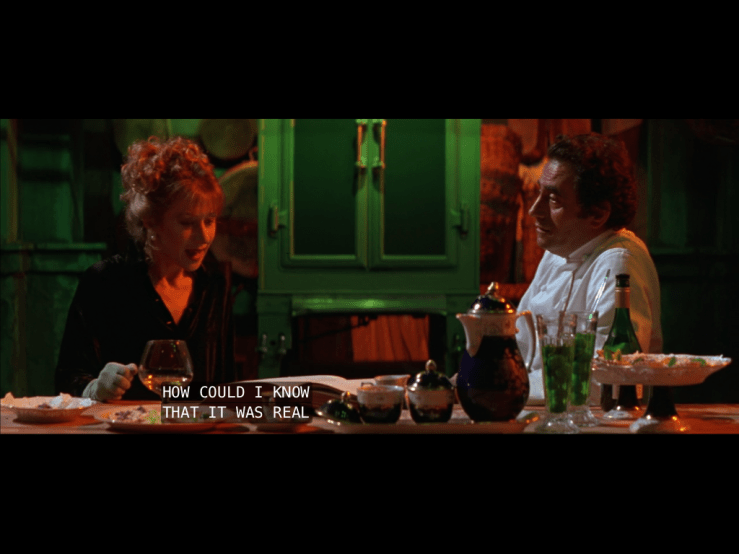
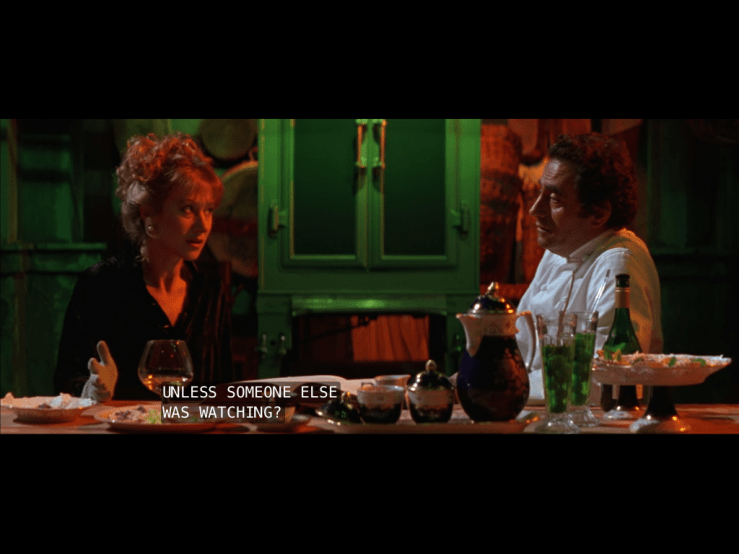
From The Cook, the Thief, His Wife & Her Lover (1989). Directed by Peter Greenaway. Cinematography by Sacha Vierny.
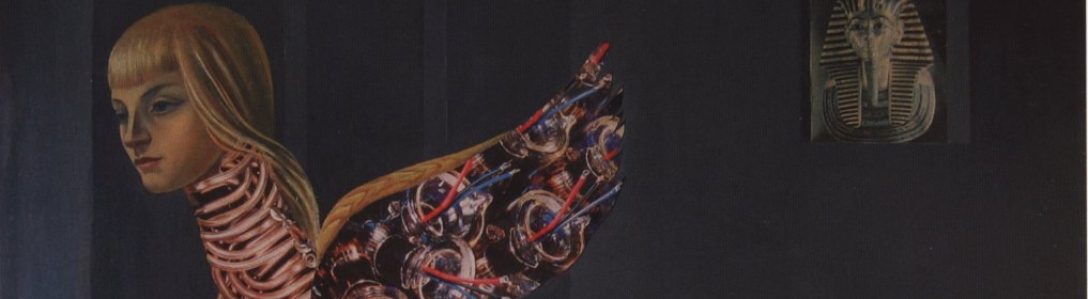
From The Cook, the Thief, His Wife & Her Lover (1989). Directed by Peter Greenaway. Cinematography by Sacha Vierny.




W. G. Sebald’s writing has been widely recognized for its intense, nuanced engagement with the Holocaust, the Allied bombing of Germany in WWII, and other episodes of violence throughout history. Through his inventive use of narrative form and juxtaposition of image and text, Sebald’s work has offered readers new ways to think about remembering and representing trauma.
In Sebald’s Vision, Carol Jacobs examines the author’s prose, novels, and poems, illuminating the ethical and aesthetic questions that shaped his remarkable oeuvre. Through the trope of “vision,” Jacobs explores aspects of Sebald’s writing and the way the author’s indirect depiction of events highlights the ethical imperative of representing history while at the same time calling into question the possibility of such representation.
Jacobs’s lucid readings of Sebald’s work also consider his famous juxtaposition of images and use of citations to explain his interest in the vagaries of perception. Isolating different ideas of vision in some of his most noted works, including Rings of Saturn, Austerlitz, and After Nature, as well as in Sebald’s interviews, poetry, art criticism, and his lecture Air War and Literature, Jacobs introduces new perspectives for understanding the distinctiveness of Sebald’s work and its profound moral implications.
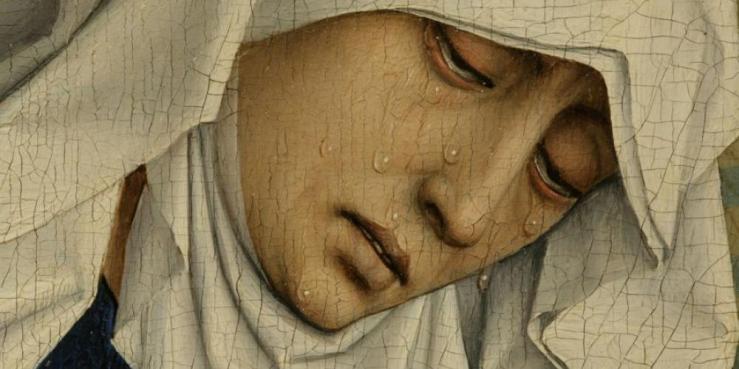
How difficult it is in general to bring the machinery of thought to a standstill is shown by Rousseau’s description of his apparently so happy days on the island in the Lac de Bienne. He has, as he writes in the fifth Promenade, deliberately forsworn the burden of work, and his greatest joy has been to leave his books safely shut away and to have neither ink nor paper to hand. However, since the leisure time thus freed up must be put to some use, Rousseau devotes himself to the study of botany, whose basic principles he had acquired in Môtiers on excursions with Jean Antoine d’Ivernois. “I set out to compose,” writes Rousseau in the fifth Promenade, “a Flora Petrinsularis and to describe every single plant on the island in enough detail to keep me busy for the rest of my days. They say a German once wrote a book about a lemon peel; I could have written one about every grass in the meadows, every moss in the woods, every lichen covering the rocks—and I did not want to leave even one blade of grass or atom of vegetation without a full and detailed description. In accordance with this noble plan, every morning after breakfast I would set out with a magnifying glass in my hand and my Systemae Naturae under my arm to study one particular section of the island, which I had divided for this purpose into small squares, intending to visit them all one after another in every season.” The central motif of this passage is not so much the impartial insight into the indigenous plants of the island as that of ordering, classification, and the creation of a perfect system. Thus this apparently innocent occupation—the deliberate resolve no longer to think and merely to look at nature—becomes, for the writer plagued by the chronic need to think and work, a demanding rationalistic project involving the compiling of lists, indices, and catalogs, along with the precise description of, for example, the long stamens of self-heal, the springiness of those of nettle and of wall-pellitory, and the sudden bursting of the seed capsules of balsam and of beech. Nonetheless, the leaves of the small herbaria which Rousseau later compiled for Madelon and Julie de la Tour and other young ladies take on the aspect of an innocent bricolage in comparison with the self-destructive business of writing to which he usually submitted himself. A faint aura of unconscious beauty still hovers over these flower collections, in which lichens, sprigs of veronica, lilies of the valley, and autumn crocuses have survived, pressed and a little faded, from the eighteenth century. They can still be admired today in the Musée Carnavalet and the Musée des Arts Décoratifs. The herbarium Rousseau compiled for himself, meanwhile—eleven quarto volumes—was, up to the Second World War, preserved in the Botanical Museum in Berlin, until, like so much and so many in that city, it went up in flames one night during one of the nocturnal bombing raids.
From W. G. Sebald’s essay “J’aurais voulu que ce lac eût été l’Océan.” Translated by Jo Catling and collected in A Place in the Country.
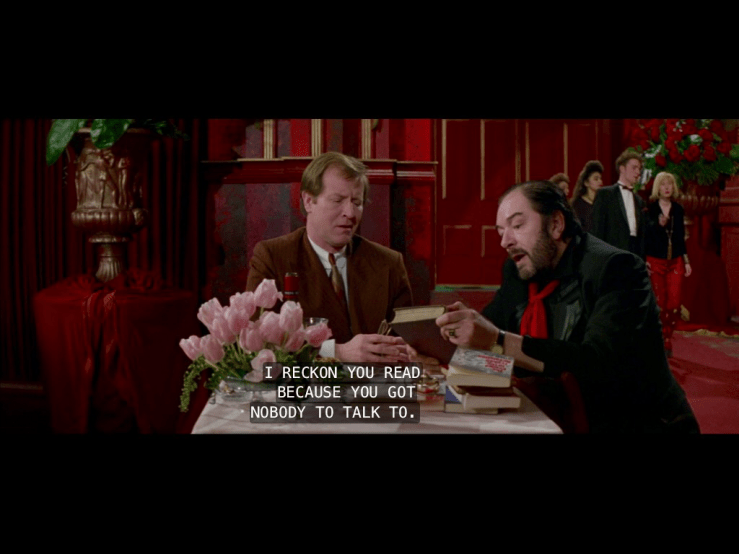
From The Cook, the Thief, His Wife & Her Lover (1989). Directed by Peter Greenaway. Cinematography by Sacha Vierny.
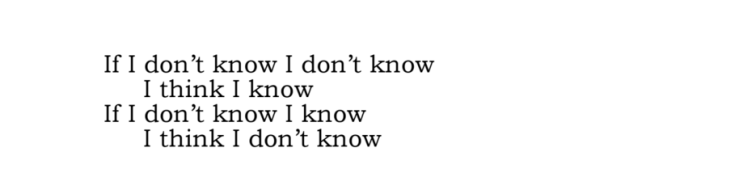
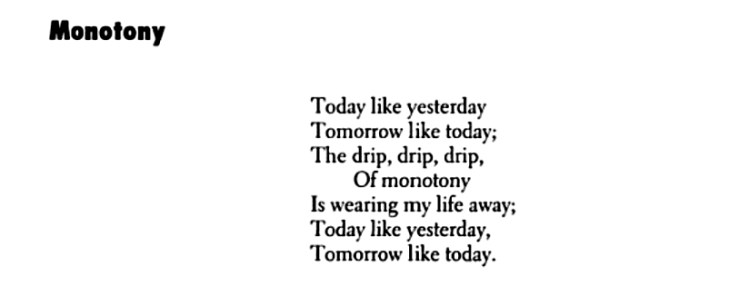
From R.D. Laing’s Knots (1970).

The poet is the sayer, the namer, and represents beauty. He is a sovereign, and stands on the centre. For the world is not painted or adorned, but is from the beginning beautiful; and God has not made some beautiful things, but Beauty is the creator of the universe. Therefore the poet is not any permissive potentate, but is emperor in his own right. Criticism is infested with a cant of materialism, which assumes that manual skill and activity is the first merit of all men, and disparages such as say and do not, overlooking the fact that some men, namely poets, are natural sayers, sent into the world to the end of expression, and confounds them with those whose province is action but who quit it to imitate the sayers. But Homer’s words are as costly and admirable to Homer as Agamemnon’s victories are to Agamemnon. The poet does not wait for the hero or the sage, but, as they act and think primarily, so he writes primarily what will and must be spoken, reckoning the others, though primaries also, yet, in respect to him, secondaries and servants; as sitters or models in the studio of a painter, or as assistants who bring building materials to an architect.
For poetry was all written before time was, and whenever we are so finely organized that we can penetrate into that region where the air is music, we hear those primal warblings and attempt to write them down, but we lose ever and anon a word or a verse and substitute something of our own, and thus miswrite the poem. The men of more delicate ear write down these cadences more faithfully, and these transcripts, though imperfect, become the songs of the nations. For nature is as truly beautiful as it is good, or as it is reasonable, and must as much appear as it must be done, or be known. Words and deeds are quite indifferent modes of the divine energy. Words are also actions, and actions are a kind of words.
The sign and credentials of the poet are that he announces that which no man foretold. He is the true and only doctor; he knows and tells; he is the only teller of news, for he was present and privy to the appearance which he describes. He is a beholder of ideas and an utterer of the necessary and causal. For we do not speak now of men of poetical talents, or of industry and skill in metre, but of the true poet.
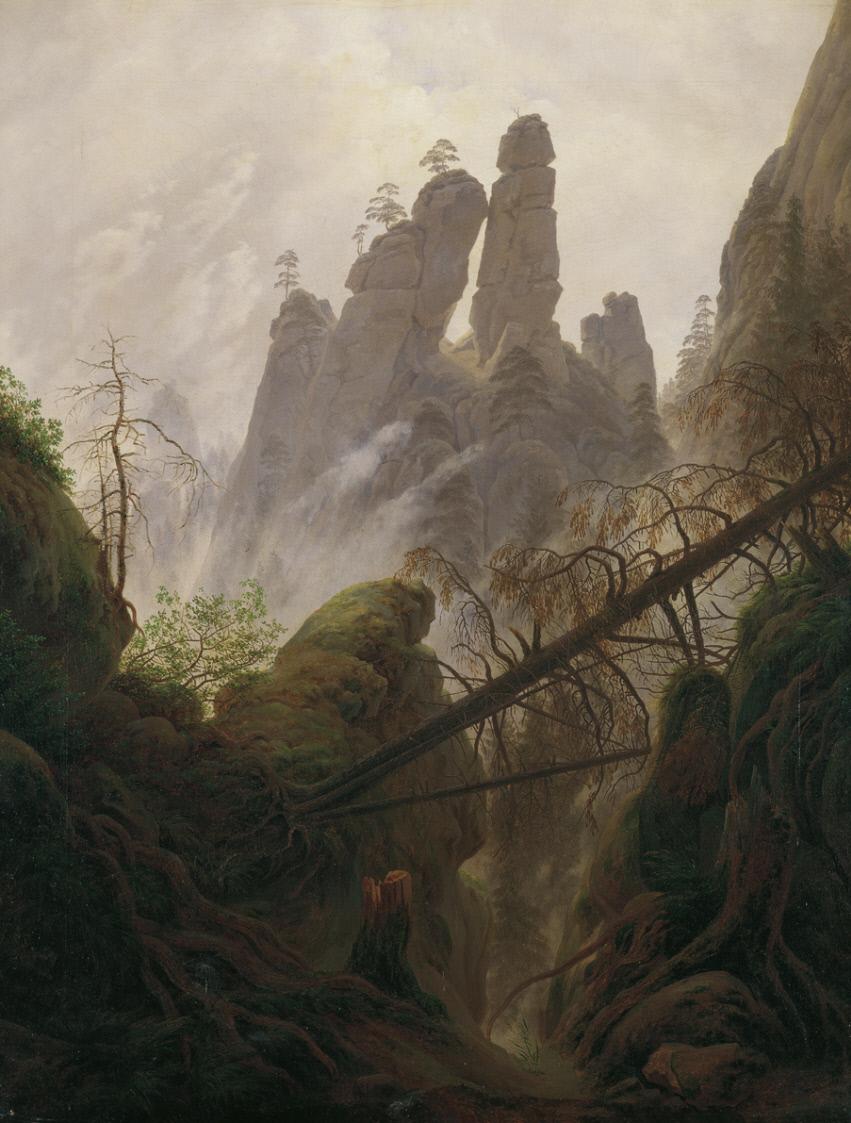

Don Juan and Faust alike are former villains of the orthodox mind made heroes in an age of unorthodoxy, Promethean or Satanic figures; and both come to stand for the lonely individual (the writer himself!) challenging the mores of bourgeois society, making patent to all men the ill-kept secret that the codes by which they live are archaic survivals without point or power.
Often the two archetypes are blended in a single literary character, as in the lover-scientist Goethe calls by the name of Faust. But there is a real difference between the rebel whose life style is cued by passion and the one whose life style is compounded out of pride and terror—between the seducer and the black magician. Faust challenges the limitations set upon experience not in the name of pleasure but of knowledge; he seeks not to taste life without restraint but to control it fully; and his essential crime (or glory!) is, therefore, not seduction but the Satanic bargain: to sell one’s soul to the Devil. But what does it mean to sell one’s soul? The symbol is immensely complex, its significances multiple; they can be summed up, however, in the single phrase to choose to be damned, whatever damnation is. Not to fall into error out of a passionate loss of self-control, not even to choose to sin at a risk of damnation; but to commit oneself to it with absolute certainty for “as long as forever is.”
Damnation itself means various things to men of varying belief: a commitment to the vagaries of the unconscious; an abandonment of the comforts of social life—of marriage and the family, wealth and recognition; a rejection of all bonds of love and sympathy, of humanity itself; a deliberate plunge into insanity; and acceptance of eternal torment for the soul. When Huck Finn cries out, “all right, I’ll go to Hell,” and Ahab, “From hell’s heart I stab at thee!”; when Hester Prynne tears off her scarlet letter, they are Faustian heroes; but so, too (in all modesty and moral elegance), is Henry James’s Strether when he rejects Mrs. Newsome and Maria Gostrey alike, refuses all rewards from life; and so, too, is Hawthorne when confiding to a friend, after the composition of The Scarlet Letter, that he had written a “hell-fired book.” Anyone who, in full consciousness, surrenders the hope of heaven (what everyone says heaven is) for the endurance of hell (what everyone knows hell to be) has entered into a pact with Satan; and the very act, therefore, of writing a gothic novel rather than a sentimental one, of devoting a long fiction to terror rather than love, is itself a Faustian commitment.
From Leslie Fiedler’s Love and Death in the American Novel.
 Biblioklept