In Ch. 23 of Cormac McCarthy’s novel Blood Meridian our protagonist the kid—now the man but always the kid—has cause to kill a kind of postfiguration of himself, Elrod, an ornery youth who attempts to murder the kid in the dark of night:
I knowed you’d be hid out, the boy called.
He pushed back the blanket and rolled onto his stomach and cocked the pistol and leveled it at the sky where the clustered stars were burning for eternity. He centered the foresight in the milled groove of the framestrap and holding the piece so he swung it through the dark of the trees with both hands to the darker shape of the visitor.
I’m right here, he said.
The boy swung with the rifle and fired.
You wouldnt of lived anyway, the man said.
When Elrod’s traveling companions come to fetch his body, we get this microbiography:
They come out here from Kentucky mister. This tyke and his brother. His momma and daddy both dead. His grandaddy was killed by a lunatic and buried in the woods like a dog. He’s never knowed good fortune in his life and now he aint got a soul in this world.
The line about the grandfather “killed by a lunatic and buried in the woods like a dog” instantly recalled for me the judge’s tale about the harnessmaker in Ch. XI. The tale begins thus:
In the western country of the Alleghenies some years ago when it was yet a wilderness there was a man who kept a harness shop by the side of the Federal road. He did so because it was his trade and yet he did little of it for there were few travelers in that place. So that he fell into the habit before long of dressing himself as an indian and taking up station a few miles above his shop and waiting there by the roadside to ask whoever should come that way if they would give him money. At this time he had done no person any injury.
And climaxes thus:
As they walked out they spoke of life in such a wild place where such people as you saw you saw but one and never again and by and by they came to the fork in the road and here the traveler told the old man that he had come with him far enough and he thanked him and they took their departure each of the other and the stranger went on his way. But the harnessmaker seemed unable to suffer the loss of his company and he called to him and went with him again a little way upon the road. And by and by they came to a place where the road was darkened in a deep wood and in this place the old man killed the traveler. He killed him with a rock and he took his clothes and he took his watch and his money and he buried him in a shallow grave by the side of the road. Then he went home.
The judge’s story goes on a bit longer, but the remarkable moment is when he finishes, all the men of Glanton’s company claim to know the story, but in variations—part of the book’s dark take on the Emersonian oversoul. (Later in the same chapter: “What is true of one man, said the judge, is true of many”).
To return to Elrod (the name means something like God rules): I’ve always read the kid’s killing him as foreshadowing to the kid’s own final encounter with the judge later in the same chapter. Maybe the grandfather-lunatic-burial is just another one of the judge’s damn riddles, but it’s got me perplexed. Maybe best not to look for too much order in the dance?


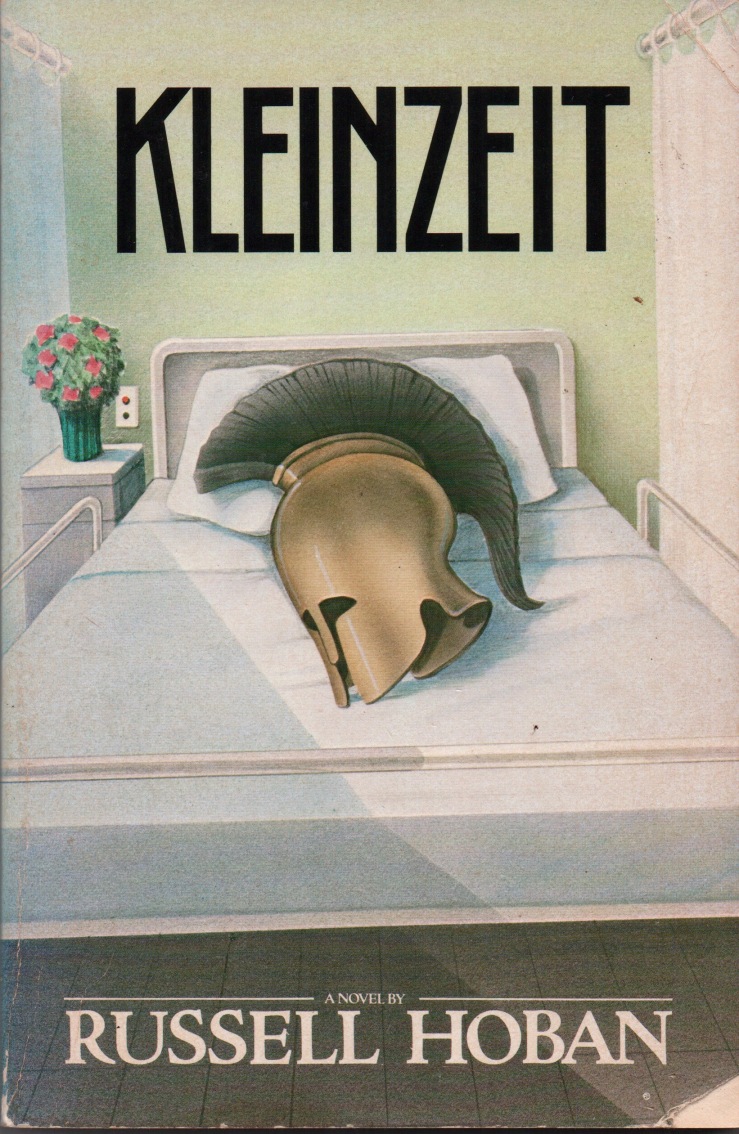
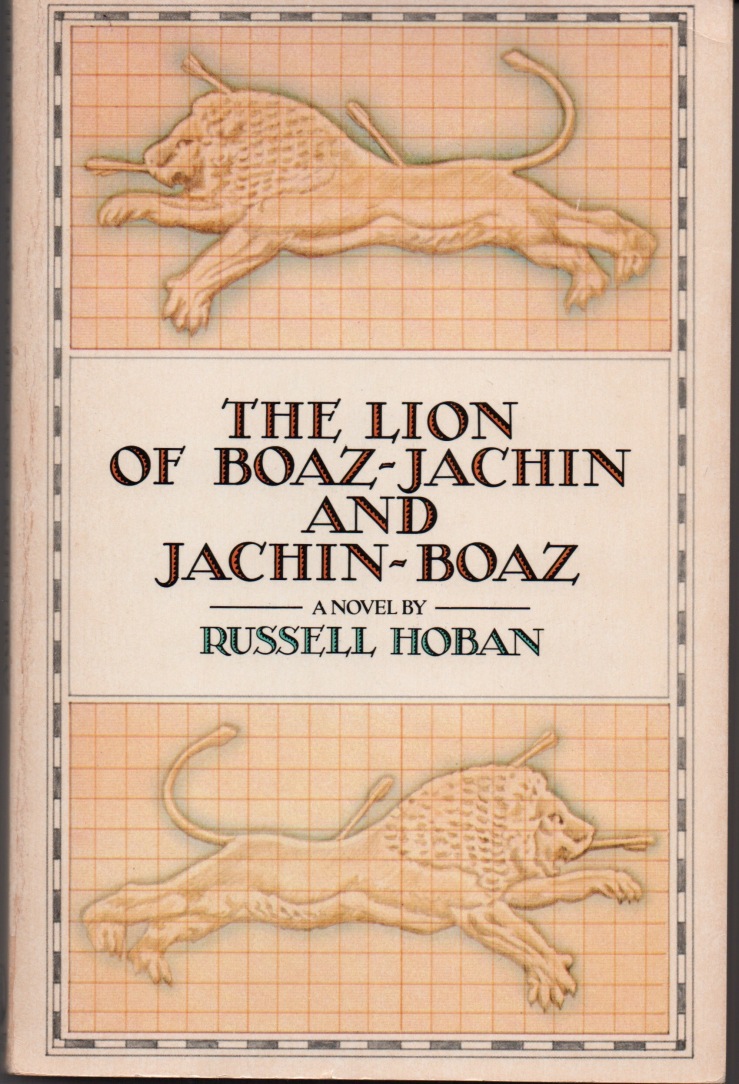 The Lion of Boaz-Jachin and Jachin-Boaz by Russell Hoban. 1983 Summit Books trade paperback edition. Cover design by Fred Marcellino. Hoban’s first novel. Not my favorite Hoban.
 Pilgermann by Russell Hoban. 1984 Washington Square Press trade paperback. No designer is credited, but look closely under the horse’s fore hooves and note the signature “Rowena” — Rowena Morrill. (Note also the pig and naked lady). Pilgermann, Hoban’s follow-up (and somehow-sequel) to Riddley Walker, was the occasion for this Sunday’s Three Books post. I was reminded of this strange, wicked, dark, funny, apocalyptic book as I finished a reread of Cormac McCarthy’s Blood Meridian and began Kazuo Ishiguro’s The Buried Giant this weekend. Pilgermann is difficult but rewarding, and probably underappreciated, even as a cult novel.







 Biblioklept