Impermanence Trajectory: Stained Seed — AUJIK

(More) / (About).


Butcher’s Stall with the Flight into Egypt — Pieter Aertsen

Watch Combustible, A Short Film by Katsuhiro Otomo

The first two minutes of this film are particularly captivating. (Select cc and then translate for a language other than Portuguese—the Portuguese to English translation is remarkably lucid).

Cthulhu — Tatsuya Morino

I was a slow reader (William H. Gass)

I was a slow reader. That is, I was slow getting to be fast. I remember having a hell of a lot of trouble reading in the third grade. I learned how to read in the fifth grade, I think it was. But that’s puzzling, because, although I remember having a lot of trouble when I was in school because I couldn’t read, I also remember that I was reading Malory’s Morte d’Arthur with love and astonishment then. It was the first book I read that I remember with absolute clarity. Yet that was before I officially “learned to read.” By the time I was in the seventh grade I was a speed-reader. I became a member of a speed-reading team. Speed-reading teams were at that time fairly common. Our high school had a team of readers, and you went out and read against other schools, and then did these comprehension tests. One year I was the speed-reading champ of the state of Ohio. I read slowly now. I learned to slow down, and read properly, when I started reading philosophy seriously, and, as a consequence, finally learned to read poetry properly too. Now I’m practically a lip reader again, although I can still go like hell if I have to.

From William H. Gass’s 1983 interview in Conjunctions.

Book and Guitar — Juan Gris

Untitled — Zdislav Beksinski

A Clip from The Kidnapping Of Michel Houellebecq

Michel Houellebecq is always performing Michel Houellebecq.

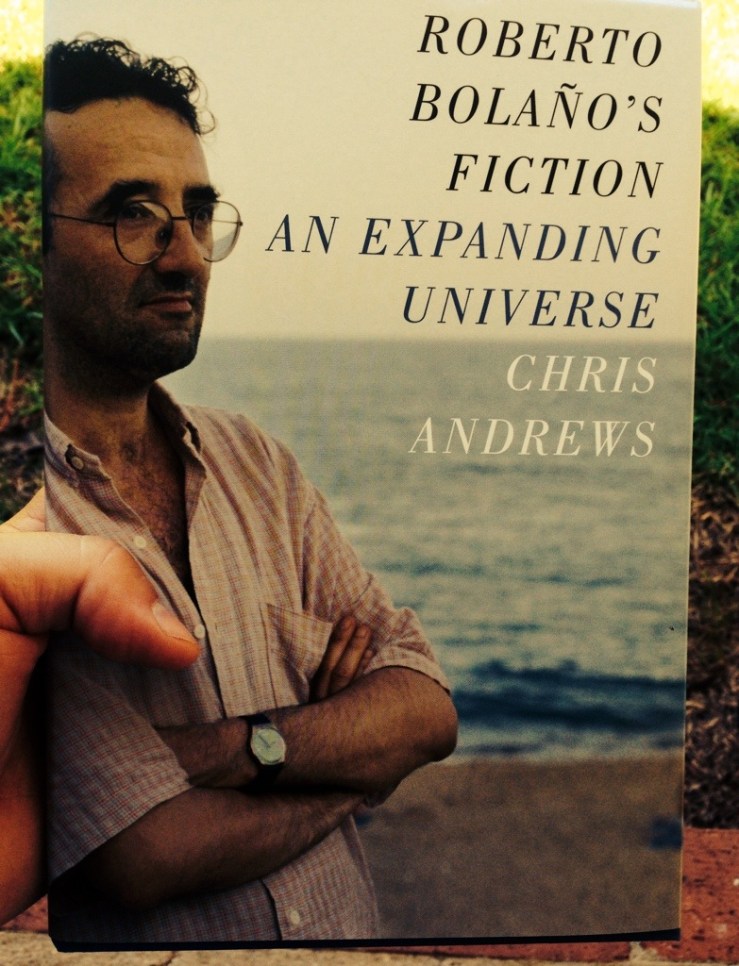
Roberto Bolaño’s Fiction (Book Acquired, 07.24.2014)

20140728-123758-45478204.jpg
So of course I’ve been eating up Roberto Bolaño’s Fiction: An Expanding Universe, a new critical study by Bolaño’s translator Chris Andrews. I’ve read the introduction and the first three chapters so far, and the study, far from being dry and academic, compels me to dig deeper.

The book really starts with the second chapter, with Andrews simply trying to situate Bolaño-as-publishing-phenomenon in the first chapter. The introduction—which you can read at publisher Columbia UP’s site—offers a clear overview of what Andrews aims to do.

Andrews writes that:

…the interconnected series of narratives that begins with Nazi Literatures in the Americas (originally published in 1996) and ends with the stories that appeared posthumously in The Secret of Evil … can be regarded as forming a single, openly structured edifice whose two sustaining pillars are The Savage Detectives and 2666, and for which Woes of the True Policeman served as a preparatory model.

Andrews’s description recalls Javier Moreno’s geometry of Bolaño’s fictions:
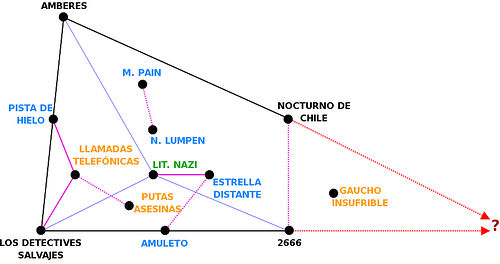
moreno

This model has greatly influenced my own reading of Bolaño over the years, leading to my conceptualization of Bolaño’s later work existing in a self-creating, self-deconstructing Bolañoverse.

Andrews’s description of the Bolañoverse (he doesn’t use the term):

Bolaño expanded or “exploded” his own published texts, blowing them up by adding new characters and episodes as well as circumstantial details. He also allowed characters to circulate or migrate from text to text, sometimes altering their names and properties. Within his novels and stories, he inclded representations of imagined texts and artworks, that is, metarepresentations. Finally, some of his characters and narrators are over-interpreters: they seize on details, invest them with significance, and invent stories to connect and explain them. 

More to come; for now, the publisher’s blurb:

Since the publication of The Savage Detectives in 2007, the work of Roberto Bolaño (1953–2003) has achieved an acclaim rarely enjoyed by literature in translation. Chris Andrews, a leading translator of Bolaño’s work into English, explores the singular achievements of the author’s oeuvre, engaging with its distinct style and key thematic concerns, incorporating his novels and stories into the larger history of Latin American and global literary fiction.

Andrews provides new readings and interpretations of Bolaño’s novels, including 2666, The Savage Detectives, and By Night in Chile, while at the same time examining the ideas and narrative strategies that unify his work. He begins with a consideration of the reception of Bolaño’s fiction in English translation, examining the reasons behind its popularity. Subsequent chapters explore aspects of Bolaño’s fictional universe and the political, ethical, and aesthetic values that shape it. Bolaño emerges as the inventor of a prodigiously effective “fiction-making system,” a subtle handler of suspense, a chronicler of aimlessness, a celebrator of courage, an anatomist of evil, and a proponent of youthful openness. Written in a clear and engaging style, Roberto Bolano’s Fiction offers an invaluable understanding of one of the most important authors of the last thirty years.
Woman with Mandolin in Yellow and Red — Max Beckmann

The final test of truth is ridicule (H.L. Mencken)

The final test of truth is ridicule. Very few religious dogmas have ever faced it and survived. Huxley laughed the devils out of the Gadarene swine. Dowie’s whiskers broke the back of Dowieism. Not the laws of the United States but the mother-in-law joke brought the Mormons to compromise and surrender. Not the horror of it but the absurdity of it killed the doctrine of infant damnation…. But the razor edge of ridicule is turned by the tough hide of truth. How loudly the barber-surgeons laughed at Harvey—and how vainly! What clown ever brought down the house like Galileo? Or Columbus? Or Jenner? Or Lincoln? Or Darwin?… They are laughing at Nietzsche yet…

From H.L. Mencken’s Damn! A Book of Calumny.


Ice Cream Cone (Despair) — Alex Gross

alex_gross_3

The Mysterious Barricades — René Magritte

“The Brawl” — Michelangelo Antonioni

20140716-162722-59242537.jpg

Dan McPharlin’s Miniatures

416065792_65f1783f12_o 253931431_68d402d800_o 422914358_3b8ee814af_o 2987819208_01e09a4855_o 3887819123_ecea97c74a_o

More.

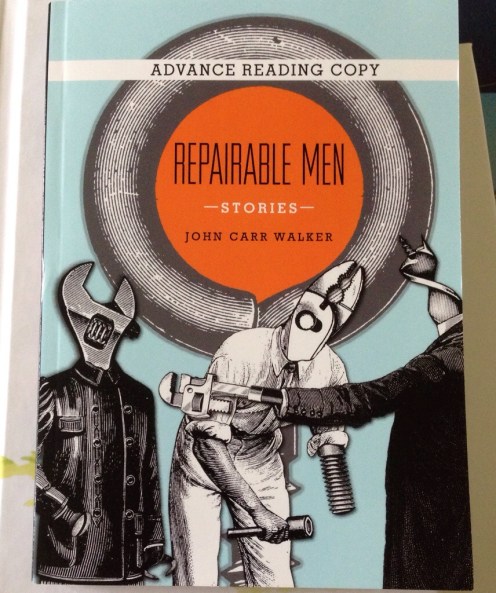
Repairable Men (Book Acquired, 7.21.2014)

20140728-123800-45480214.jpg

John Carr Walker’s collection Repairable Men is new from Sunnyoutside. Blurb from the author’s website:

The stories in Repairable Men look at the small towns and rural farms where families stay for generations and newcomers never quite feel at home. Whether trapped by dead-end work, hostile relatives, or the troubling legacies of their forebears, John Carr Walker’s characters are seeking escape, forgiveness, and redemption in the dusty corners of the new American West.

Read his story “Candelario.”


Speedway — Sybil Andrews