The Sensational News — René Magritte

Watch Kashtanka, A 1952 Animated Adaptation of Anton Chekhov’s Short Story

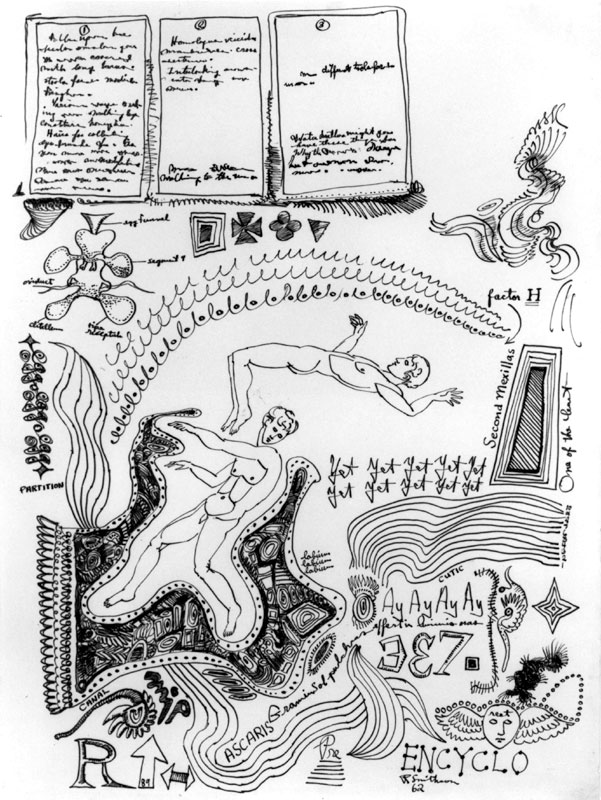
Encyclo — Robert Smithson

encyclo_800

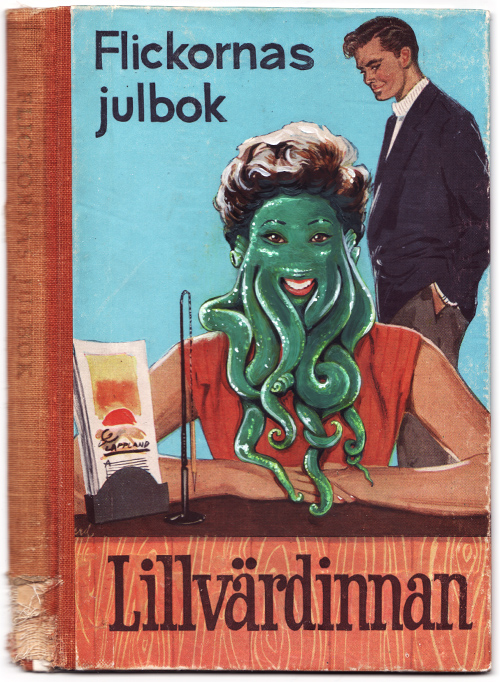
Little Hostess — Emmy Lincoln

Lillvardinnan_EmmyLincoln1

(More/via).

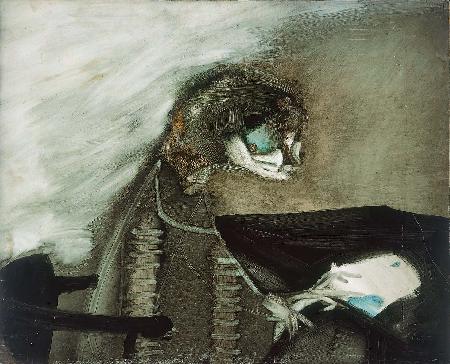
Man Reading — Paul Wunderlich

man-reading-1959

Lake Bride — Vangel Naumovski

Raymond Pettibon: “I read as I write, write as I read”

Read a 1999 interview with Raymond Pettibon in BOMB. Excerpt:

I read as I write, write as I read. If it used to take me five minutes to read the whole newspaper, now, my mind wanders, and then five minutes later I wonder, Gee, did I read that? I used to take notes, and I have notebooks full of drawings and notes that were partly quotations, and I’ve done a lot of marginalia, writing in books. I’m usually reading a number of books at a time, and whether I get through an individual one is probably unlikely. I’ve lost interest in narrative. (sigh) At least in the sense of seeing how a story comes out at the end. There’s a type of reading where you get lost in the narrative and you become part of the story and you’re compelled to finish. I don’t really have any interest in that. For me, reading has become more microscopic, more about dissecting the work. It may start on the level of the novel, then go down to theme or style, then to a paragraph, and finally a sentence. Or the sentence itself becomes about structure, or the words in it. Probably the most obvious example of that kind of reading is James Joyce. It becomes a kind of disease. Every text becomes related to another one, even in a different language, down to each individual word, which then becomes a clue into the etymology of the word, and then that etymological tree. A different context, a different language…you’re just making these associations from one thing to another. I used to start out with a simple drawing that would begin as an idea, and then my writing would make some associations with something else. And then, you know, a day later, or a year later, or whenever, the whole page would be covered with small, finely written text. And it would become a lot of things that were meant to be just in one drawing, expanded into this while still part of my notes. Voluminous notes. You do actually get lost in that morass of associations.


Tree of Hope, Remain Strong — Frida Kahlo

Reader in Green — Pierre-Auguste Renoir

Evening and Sorrow — Gustave Moreau

William Gaddis on the Pulitzer Prize: “The Ultimate Seal of Mediocrity”

In William Gaddis’s last novel Agapē Agape (2002), our embittered narrator excoriates the Pulitzer Prize:

. . . write what they want you’ll end up with a Pulitzer Prize follow you right to the grave. Maybe won the Medal of honor the George Cross even the Nobel but once you’ve been stigmatized with the ultimate seal of mediocrity your obit will read Pulitzer Prize Novelist Dies at whatever because they’re not advertising the winner no. No, like this whole plague of prizes wherever you look, it’s the prize givers promoting themselves, trying to rescue their thoroughly discredited profession of journalism. “The press is a school that serves to turn men into brutes,” Flaubert writes to George Sand “because it relieves them from thinking.” The prize winners? They’re just props, cartoonists, sports writers, political pundits, front page photos the bloodier the better for that instant of fame wrap the fish in tomorrow, good God how many Pulitzer Prizes are there? Over fifteen hundred entries, fourteen categories for journalists because if you started your bondage there you’re halfway home with that whole gang of sponsors, trustees, juries, God knows what who’ve survived that Slough of Despond and floated to the top. Just look at the next day’s New York Times, page after page bulging with self-congratulation with seven more categories to leech on, music, what they call drama and of course books where the Grey Lady finally got it both ways with their journalist who reviews books, like the misty-eyed ingenue but also destroys women writers and just for fairness crosses the gender line for an occasional assassination, give that lady a Pulitzer with oak leaf clusters! The books that are candidates are read by a jury whose decisions are passed up to the Olympian trustees with an eye to the multitude. We are thousands and they are millions, write the fiction they want or don’t write at all, ruling out Pound’s cry for the new, the challenging or what’s labeled difficult, so when Gravity’s Rainbow is being devoured by college youth everywhere and wins the National Book Award, its unanimous recommendation is overturned by the trustees for a double-talk spoof of academic vagaries by a bogus “Professor,” to everyone’s relief, and the author at peril escapes unblemished by the, no, no, no you can’t depend on it.
False — Jean-Michel Basquiat

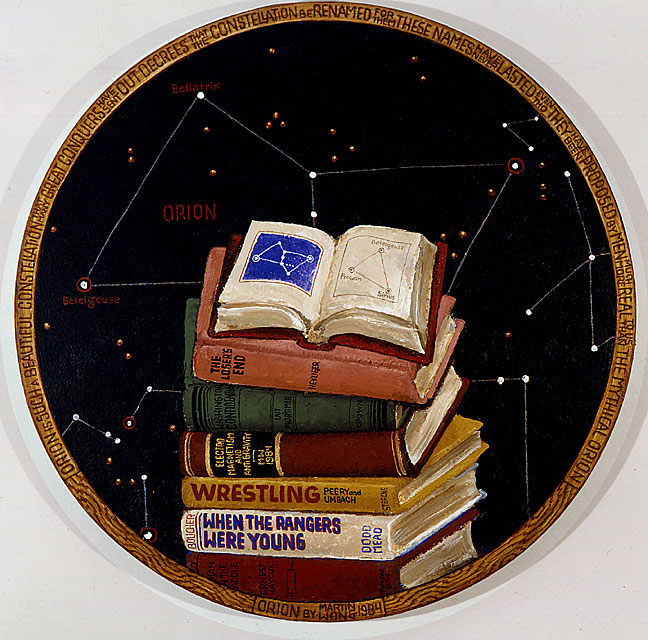
Orion — Martin Wong

02285

Theft of Substance — Remedios Varo

theft-of-substance

The Battle of Lapiths and Centaurs — Giorgio de Chirico

Sappho (Raphael + David Markson)

raphael sappho(2)


Capture