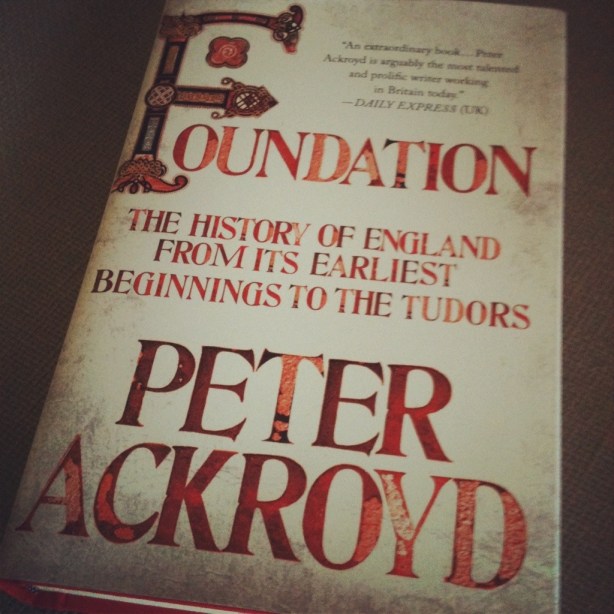
Ackroyd’s trademark insight and wit, and the glorious interconnectedness of all things, permeate each page. One thing that struck me was the realisation that history isn’t nearly as linear as we thought. Something is invented, or discovered, or philosophised, and we tend to think that that’s knowledge known from then on, but even in this single volume there are endless forgettings.
“Absolutely,” comes his fast answer, spoken, as ever, gently and with a strange mix of confidence and self-effacement. “One thing which most interested me was the fact that neglect, or our genius for forgetfulness, occurs at every level of social and political activity. The same mistakes, the same confusions, occur time and time again. It sometimes seems to me that the whole course of English history was one of accident, confusion, chance and unintended consequences – there’s no real pattern.”
What he discovered, or rediscovered, is that “what underlines that random happenstance are the deep continuities of national life that survive, uninfluenced by the surface events. In this book, I have little chapters on, say, medieval medicine, or punishment, or medieval humour, simply to convey the broad continuities that underlie this bewildering range of events. Continuities of the soil, the land, the earth.” And these help create human – English – sensibilities? “Yes. As I said in my London book, it’s a sort of territorial imperative, the landscape; the shape of the geology, almost, has a definite though not comprehended effect on human behaviour, human need. So that’s one of the things I was trying to explore I suppose.”







 Biblioklept