“Sun Worship. The Sources of Hallowe’en”

“Sun Worship. The Sources of Hallowe’en” is the first chapter of Ruth Edna Kelley’s The Book of Hallowe’en (1919)

If we could ask one of the old-world pagans whom he revered as his greatest gods, he would be sure to name among them the sun-god; calling him Apollo if he were a Greek; if an Egyptian, Horus or Osiris; if of Norway, Sol; if of Peru, Bochica. As the sun is the center of the physical universe, so all primitive peoples made it the hub about which their religion revolved, nearly always believing it a living person to whom they could say prayers and offer sacrifices, who directed their lives and destinies, and could even snatch men from earthly existence to dwell for a time with him, as it draws the water from lakes and seas.

In believing this they followed an instinct of all early peoples, a desire to make persons of the great powers of nature, such as the world of growing things, mountains and water, the sun, moon, and stars; and a wish for these gods they had made to take an interest in and be part of their daily life. The next step was making stories about them to account for what was seen; so arose myths and legends.

The sun has always marked out work-time and rest, divided the year into winter idleness, seed-time, growth, and harvest; it has always been responsible for all the beauty and goodness of the earth; it is itself splendid to look upon. It goes away and stays longer and longer, leaving the land in cold and gloom; it returns bringing the long fair days and resurrection of spring. A Japanese legend tells how the hidden sun was lured out by an image made of a copper plate with saplings radiating from it like sunbeams, and a fire kindled, dancing, and prayers; and round the earth in North America the Cherokees believed they brought the sun back upon its northward path by the same means of rousing its curiosity, so that it would come out to see its counterpart and find out what was going on.

All the more important church festivals are survivals of old rites to the sun. “How many times the Church has decanted the new wine of Christianity into the old bottles of heathendom.” Yule-tide, the pagan Christmas, celebrated the sun’s turning north, and the old midsummer holiday is still kept in Ireland and on the Continent as St. John’s Day by the lighting of bonfires and a dance about them from east to west as the sun appears to move. The pagan Hallowe’en at the end of summer was a time of grief for the decline of the sun’s glory, as well as a harvest festival of thanksgiving to him for having ripened the grain and fruit, as we formerly had husking-bees when the ears had been garnered, and now keep our own Thanksgiving by eating of our winter store in praise of God who gives us our increase.

Pomona, the Roman goddess of fruit, lends us the harvest element of Hallowe’en; the Celtic day of “summer’s end” was a time when spirits, mostly evil, were abroad; the gods whom Christ dethroned joined the ill-omened throng; the Church festivals of All Saints’ and All Souls’ coming at the same time of year—the first of November—contributed the idea of the return of the dead; and the Teutonic May Eve assemblage of witches brought its hags and their attendant beasts to help celebrate the night of October 31st.
Colombine — Francine van Hove

escrever - escritor, livro

The Magdalen Reading — Ambrosius Benson

“A very fanciful person, when dead, to have his burial in a cloud” (And other ideas from Nathaniel Hawthorne’s Note-Books)

  1. When scattered clouds are resting on the bosoms of hills, it seems as if one might climb into the heavenly region, earth being so intermixed with sky, and gradually transformed into it.
  2. A stranger, dying, is buried; and after many years two strangers come in search of his grave, and open it.
  3. The strange sensation of a person who feels himself an object of deep interest, and close observation, and various construction of all his actions, by another person.
  4. Letters in the shape of figures of men, etc. At a distance, the words composed by the letters are alone distinguishable. Close at hand, the figures alone are seen, and not distinguished as letters. Thus things may have a positive, a relative, and a composite meaning, according to the point of view.
  5. “Passing along the street, all muddy with puddles, and suddenly seeing the sky reflected in these puddles in such a way as quite to conceal the foulness of the street.”
  6. A young man in search of happiness,–to be personified by a figure whom he expects to meet in a crowd, and is to be recognized by certain signs. All these signs are given by a figure in various garbs and actions, but he does not recognize that this is the sought-for person till too late.
  7. If cities were built by the sound of music, then some edifices would appear to be constructed by grave, solemn tones,–others to have danced forth to light, fantastic airs.
  8. Familiar spirits, according to Lilly, used to be worn in rings, watches, sword-hilts. Thumb-rings were set with jewels of extraordinary size.
  9. A very fanciful person, when dead, to have his burial in a cloud.


From Nathaniel Hawthorne’s American Note-Books.

Young Woman Reading — Karl Müller

tumblr_n9wk6pWXoL1soqrhbo1_1280

Elizabeth Siddal — Dante Gabriel Rossetti

The Novel — Edward Cucuel

tumblr_mfms28V2tS1qaxacfo1_1280

Molly Reading a Book — Rose Mead

c6179e769d28a4cf6d376fb8dbf82831

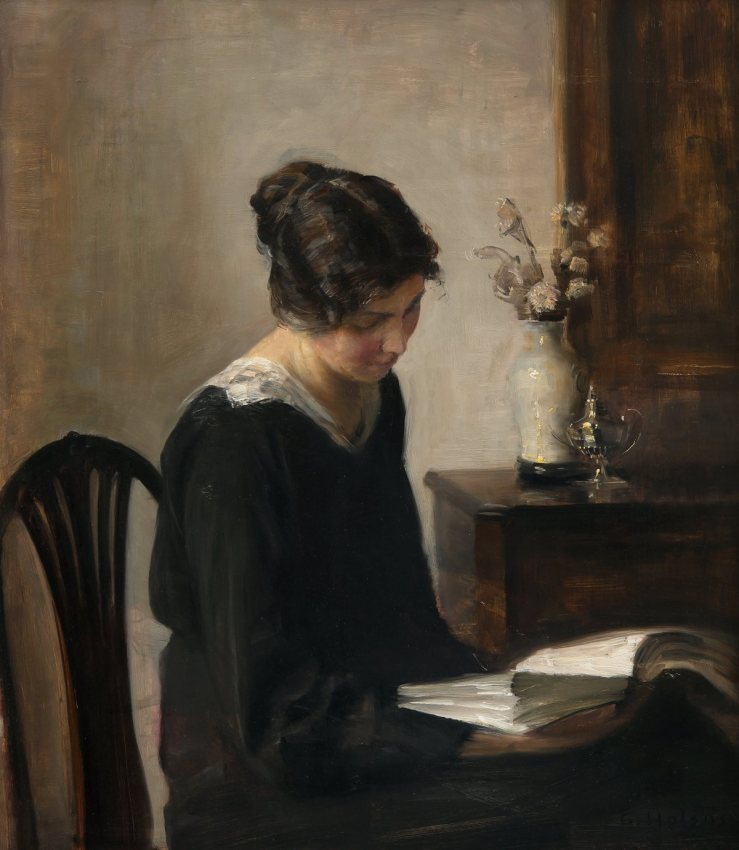
Lady in Black — Carl Vilhelm Holsøe

carl-vilhelm-holsc3b8e-lady-in-black

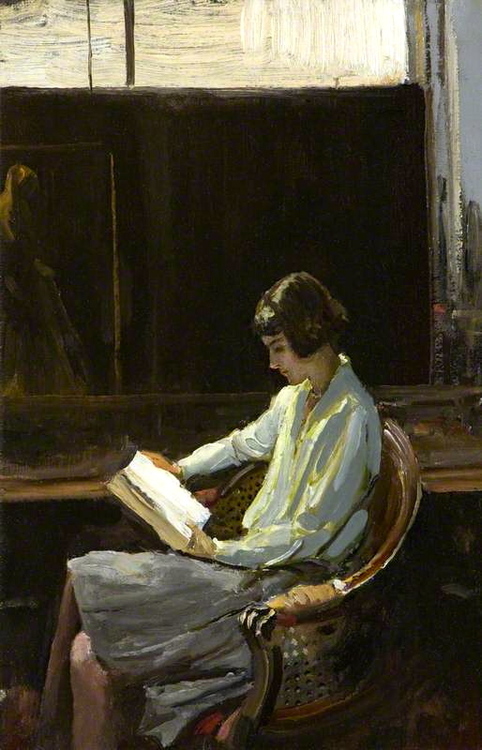
Alice — John Lavery

(c) Rosenstiel's; Supplied by The Public Catalogue Foundation

Edgar Poe, Charles Baudelaire, an Orangutan and the Raven — Julio Pomar

Vittoria Colonna from Barcelona — Sebastiano del Piombo

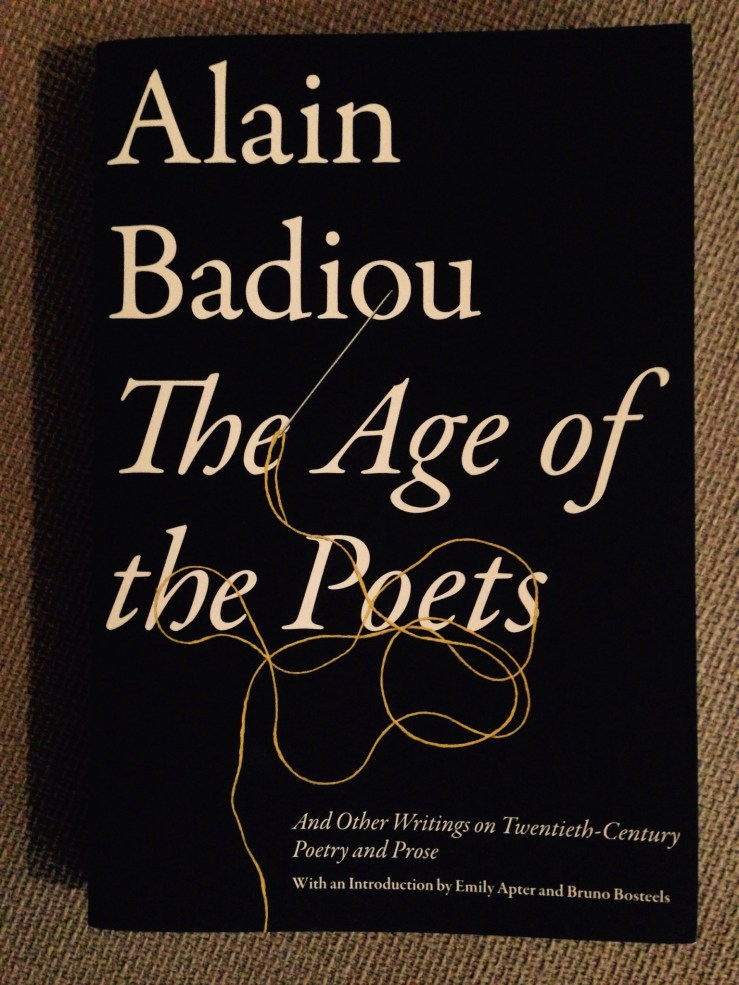
New Alain Badiou — The Age of the Poets (Book Acquired, 10.10.2014)

IMG_3585

New from Verso Books, a collection of writings from philosopher Alain Badiou. Verso’s blurb:

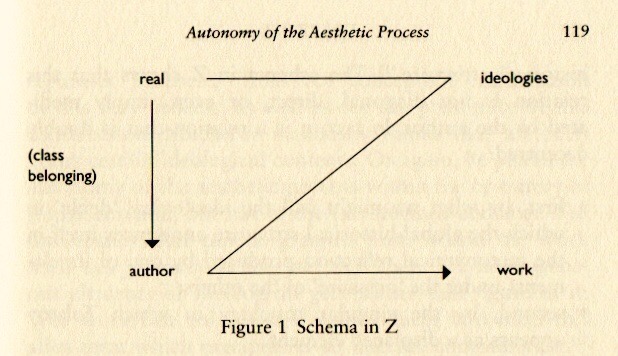
The Age of the Poets revisits the age-old problem of the relation between literature and philosophy, arguing against both Plato and Heidegger’s famous arguments. Philosophy neither has to ban the poets from the republic nor abdicate its own powers to the sole benefit of poetry or art. Instead, it must declare the end of what Badiou names the “age of the poets,” which stretches from Hölderlin to Celan. Drawing on ideas from his first publication on the subject, “The Autonomy of the Aesthetic Process,” Badiou offers an illuminating set of readings of contemporary French prose writers, giving us fascinating insights into the theory of the novel while also accounting for the specific position of literature between science and ideology.

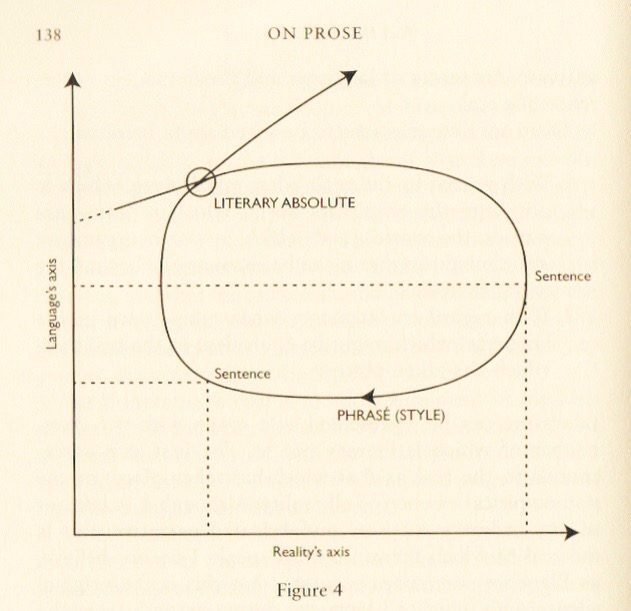
More to come—but for now: Diagrams! (I will try to understand them in context):

IMG_3588 IMG_3587

Ugolino Martelli — Agnolo Bronzino

An idiom characterizes a society (Flannery O’Connor)

An idiom characterizes a society, and when you ignore the idiom, you are very likely ignoring the whole social fabric that could make a meaningful character. You can’t cut characters off from their society and say much about them as individuals. You can’t say anything meaningful about the mystery of a personality unless you put that personality in a believable and significant social context. And the best way to do this is through the character’s own language. When the old lady in one of Andrew Lytle’s stories says contemptuously that she has a mule that is older than Birmingham, we get in that one sentence a sense of a society and its history. A great deal of the Southern writer’s work is done for him before he begins, because our history lives in our talk. In one of Eudora Welty’s stories a character says, ‘Where I come from, we use fox for yard dogs and owls for chickens, but we sing true.’ Now there is a whole book in that one sentence; and when the people of your section can talk like that, and you ignore it, you’re just not taking advantage of what`s yours. The sound of our talk is too definite to be discarded with impunity, and if the writer tries to get rid of it, he is liable to destroy the better part of his creative power.

From Flannery O’Connor’s lecture “Writing Short Stories.” Republished in Mystery and Manners.

The Cotter’s Saturday Night — David Wilkie

Read an excerpt from Denis Johnson’s forthcoming novel, The Laughing Monsters

In Arua we took rooms at The White Nile Palace Hotel. Here was the palace, but we’d crossed the Nile twenty kilometers ago. We arrived at night and formed no impression of the surrounding neighborhood except by its sounds—goats and cattle, arguments and celebrations. Surveying the parking area and later the tables in the café, I judged we’d come among missionaries and relief workers—Médecins sans Frontières sorts of people with good, big SUVs and clean hiking shoes. The grounds were well-kept and our quarters were comfortable. I hadn’t quite expected that.


At dinner Michael was nowhere in evidence. Davidia and I shared a table with an elderly, exhausted French woman of Arab descent who told us she studied torture. “And once upon a time before this, I spent years on a study of the Atlantic slave trade. Angola. Now it’s an analysis of the practices of torture under Idi Amin. Slavery. Torture. Don’t call me morbid. Is it morbid to study a disease? That’s how we find the cure for it. What is the cause of man’s inhumanity to man? Desensitization. The numbness of the perpetrator. Whether an activity produces pleasure, pain, discomfort, guilt, joy, triumph—before too long the soul grows tired and stops feeling. It doesn’t take long. Not too long at all, and then man becomes the devil, he laughs at his former scruples, he enslaves and tortures without compunction.” The woman’s taut, quivering neck, her mouth opening and closing . . . Halfway through her dessert of ice cream with chocolate sauce, without a word, she got up and left the table.

Read the rest of the excerpt at FS&G’s blog Work in Progress.