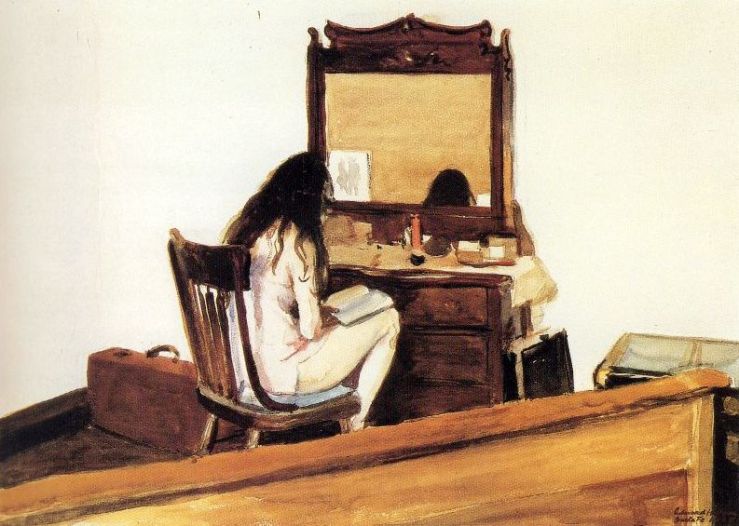
Interior (Model Reading) — Edward Hopper

edward-hopper-interior-model1

German Cases — Jörg Immendorff

Girl Reading (Thinking of Edward Hopper) — Kiko Esperilla

kiko esperilla

Self Portrait with Charlie Brown — Chris Ware

ware brown

Portrait of a Bishop — Pontormo

Portraits of Serafino and Francesco Falzacappa — Pier Leone Ghezzi

Gaby and Luciano — Franz Gertsch

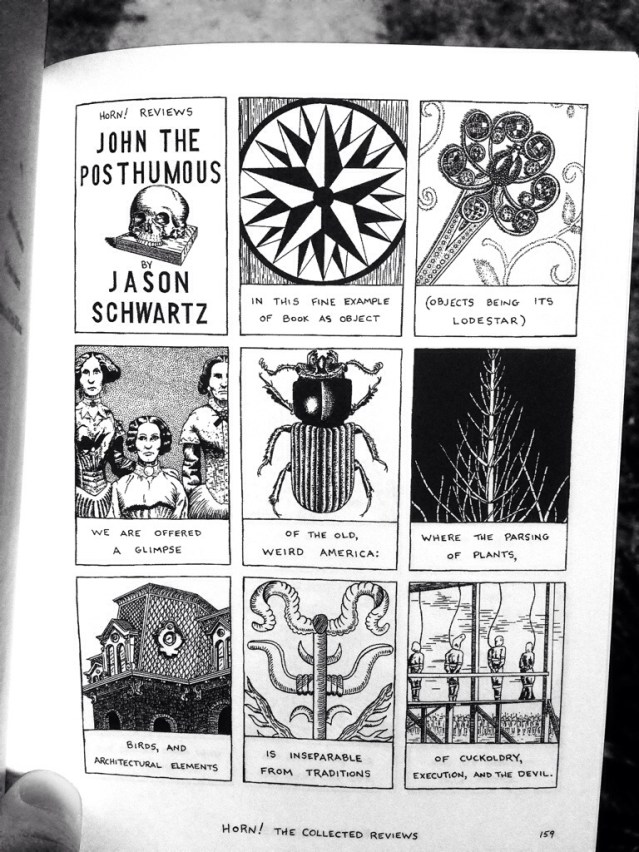
Horn! — Kevin Thomas’s Collected Reviews (Book Acquired, 6.14.2014)

20140618-113731-41851102.jpg

Kevin Thomas has been doing illustrated reviews of contemporary books for The Rumpus for a few years now. Now, the good people of OR Books have published the reviews in one volume—HORN! The Collected Reviews.

I’d read a few of Thomas’s reviews in the past and always been a bit jealous at his control of his medium—of his ability to go past or through or beyond the language under discussion to provoke with a sequence of images. Reviews is maybe not the right term—commentaries seems more fitting. Take his review of George Saunders’s Tenth of December for example, which manages to condense an overview of the collection’s themes along with a viewpoint on those themes into nine small panels. (I needed over 2000 words for my own review of the Saunders book).

Thomas’s technique works especially well with novels that are very difficult to write about/after, like one of my favorite recent titles, Jason Schwartz’s John the Posthumous. I stammered and hiccuped through my essay; Thomas explicates, illustrates, and piques reader interest—again, in just nine panels.

20140618-113733-41853283.jpg

I’ve been trying to limit myself to just a few strips a day from the collection, but more often than not I’ve failed, curious to see Thomas’s takes on Levin’s The Instructions (a novel I couldn’t finish), Peter Hook’s memoir, Renata Adler’s Speedboat (yes!) and more. Great stuff.

Fray Jerónimo Pérez — Francisco de Zurbarán

Dictionary — Liu Dan

June 16, 1838 (Nathaniel Hawthorne)

Tremont, Boston, June 16th.–Tremendously hot weather to-day. Went on board the Cyane to see Bridge, the purser. Took boat from the end of Long Wharf, with two boatmen who had just landed a man. Row round to the starboard side of the sloop, where we pass up the steps, and are received by Bridge, who introduces us to one of the lieutenants,–Hazard. Sailors and midshipmen scattered about,–the middies having a foul anchor, that is, an anchor with a cable twisted round it, embroidered on the collars of their jackets. The officers generally wear blue jackets, with lace on the shoulders, white pantaloons, and cloth caps. Introduced into the cabin,–a handsome room, finished with mahogany, comprehending the width of the vessel; a sideboard with liquors, and above it a looking-glass; behind the cabin, an inner room, in which is seated a lady, waiting for the captain to come on board; on each side of this inner cabin, a large and convenient state-room with bed,–the doors opening into the cabin. This cabin is on a level with the quarter-deck, and is covered by the poop-deck. Going down below stairs, you come to the ward-room, a pretty large room, round which are the state-rooms of the lieutenants, the purser, surgeon, etc. A stationary table. The ship’s main-mast comes down through the middle of the room, and Bridge’s chair, at dinner, is planted against it. Wine and brandy produced; and Bridge calls to the Doctor to drink with him, who answers affirmatively from his state-room, and shortly after opens the door and makes his appearance. Other officers emerge from the side of the vessel, or disappear into it, in the same way. Forward of the wardroom, adjoining it, and on the same level, is the midshipmen’s room, on the larboard side of the vessel, not partitioned off, so as to be shut up. On a shelf a few books; one midshipman politely invites us to walk in; another sits writing. Going farther forward, on the same level, we come to the crew’s department, part of which is occupied by the cooking-establishment, where all sorts of cooking is going on for the officers and men. Through the whole of this space, ward-room and all, there is barely room to stand upright, without the hat on. The rules of the quarterdeck (which extends aft from the main-mast) are, that the midshipmen shall not presume to walk on the starboard side of it, nor the men to come upon it at all, unless to speak to an officer. The poop-deck is still more sacred,–the lieutenants being confined to the larboard side, and the captain alone having a right to the starboard. A marine was pacing the poop-deck, being the only guard that I saw stationed in the vessel,–the more stringent regulations being relaxed while she is preparing for sea. While standing on the quarter-deck, a great piping at the gangway, and the second cutter comes alongside, bringing the consul and some other gentleman to visit the vessel. After a while, we are rowed ashore with them, in the same boat. Its crew are new hands, and therefore require much instruction from the cockswain. We are seated under an awning. The guns of the Cyane are medium thirty-two pounders; some of them have percussion locks.

At the Tremont, I had Bridge to dine with me: iced champagne, claret in glass pitchers. Nothing very remarkable among the guests. A wine-merchant, French apparently, though he had arrived the day before in a bark from Copenhagen: a somewhat corpulent gentleman, without so good manners as an American would have in the same line of life, but good-natured, sociable, and civil, complaining of the heat. He had rings on his fingers of great weight of metal, and one of them had a seal for letters; brooches at the bosom, three in a row, up and down; also a gold watch-guard, with a seal appended. Talks of the comparative price of living, of clothes, etc., here and in Europe. Tells of the prices of wines by the cask and pipe. Champagne, he says, is drunk of better quality here than where it grows.–A vendor of patent medicines, Doctor Jaques, makes acquaintance with me, and shows me his recommendatory letters in favor of himself and drugs, signed by a long list of people. He prefers, he says, booksellers to druggists as his agents, and inquired of me about them in this town. He seems to be an honest man enough, with an intelligent face, and sensible in his talk, but not a gentleman, wearing a somewhat shabby brown coat and mixed pantaloons, being ill-shaven, and apparently not well acquainted with the customs of a fashionable hotel. A simplicity about him that is likable, though, I believe, he comes from Philadelphia.–Naval officers, strolling about town, bargaining for swords and belts, and other military articles; with the tailor, to have naval buttons put on their shore-going coats, and for their pantaloons, suited to the climate of the Mediterranean. It is the almost invariable habit of officers, when going ashore or staying on shore, to divest themselves of all military or naval insignia, and appear as private citizens. At the Tremont, young gentlemen with long earlocks,–straw hats, light, or dark-mixed.–The theatre being closed, the play-bills of many nights ago are posted up against its walls.


From Nathaniel Hawthorne’s American Note-Books.

Young Woman Dreaming of The Ise Stories — Hosoda Eishi

My Father — Carlos Botelho

Book with Wavy Pages — Abelardo Morell

Daniel’s — Kenton Nelson

daniel's

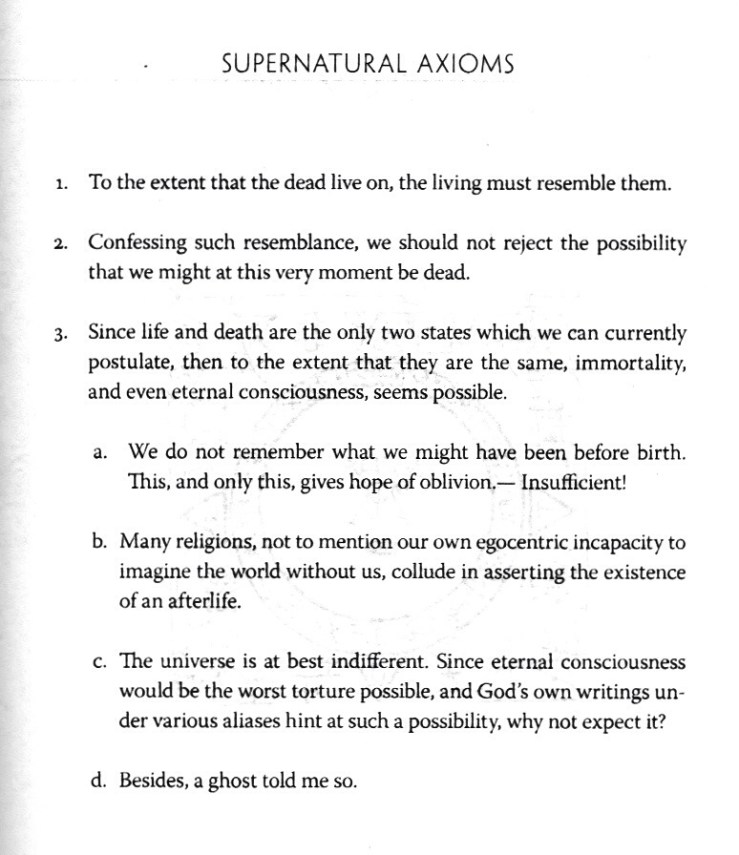
“The Forgetful Ghost,” A Supernatural Tale by William T. Vollmann

After my father died, I began to wonder whether my turn might come sooner rather than later. What a pity! Later would have been so much more convenient! And what if my time might be even sooner than soon? Before I knew it, I would recognize death by its cold shining as of brass. Hence in those days, I do confess, I felt sometimes angry that the treasures of sunlight escaped my hands no matter how tightly I clenched them. I loved life so perfectly, at least in my own estimation, that it seemed I deserved to live forever, or at least until later rather than sooner. But just in case death disregarded my all-important judgments, I decided to seek out a ghost, in order to gain expert advice about being dead. The living learn to weigh the merits of preparation against those of spontaneity, which is why they hire investment counselors and other fortune-tellers. And since I had been born an American, I naturally believed myself entitled to any destiny I could pay for. Why shouldn’t my postmortem years stretch on like a lovely procession of stone lamps?

If you believe, as H.P. Lovecraft asserted, that all cemeteries are subterraneously connected, then it scarcely matters which one you visit; so I put one foot before the other, and within a half-hour found myself allured by the bright green moss on the pointed tops of those ancient stone columns of the third Shogun’s loyally suicided retainers. Next I found, glowing brighter than the daylight, more green moss upon the stone railings and torii enclosing these square plots whose tombstones strained upward like trees, each stone engraved with its undertenant’s postmortem Buddhist name.

The smell of moss consists of new and old together. Dead matter having decayed into clean dirt, the dirt now freshens into green. It is this becoming-alive that one smells. I remember how when my parents got old, they used to like to walk with me in a certain quiet marsh. The mud there smelled clean and chocolate-bitter. I now stood breathing this same mossy odor, and fallen cryptomeria-needles darkened their shades of green and orange while a cloud slid over the sun. Have you ever seen a lizard’s eyelid close over his yellow orb? If so, then you have entered ghostly regions, which is where I found myself upon the sun’s darkening. All the same, I had not gone perilously far: On the other side of the wall, tiny cars buzzed sweetly, bearing living skeletons to any number of premortem destinations. Reassured by the shallowness of my commitment, I approached the nearest grave. 

The instant I touched the wet moss on the railing, I fell into communication with the stern occupant, upon whose wet dark hearthstone lay so many dead cryptomeria-tips. To say he declined to come out would be less than an understatement. It was enough to make a fellow spurn the afterlife! I experienced his anger as an electric shock. To him I was nothing, a rootless alien who lacked a lord to die for. Why should he teach me?

Humiliated, I turned away, and let myself into the lower courtyard behind the temple. Here grew the more diminutive ovoid and phallic tombs of priests. Some were incised with lotus wave-patterns. One resembled a mirror or hairbrush stood on end. I considered inviting myself in, but then I thought: If that lord up there was so cross, wouldn’t a priest have even less use for me? 

So I pulled myself up to the temple’s narrow porch and sat there with my feet dangling over, watching cherry blossoms raining down on the tombs. The gnarled arms of that tree pointed toward every grave, and afternoon fell almost into dusk. 

A single white blossom sped down like a spider parachuting down his newest thread. Then my ears began to ring—death’s call. 

So I ran away. I sat down in my room and hid. Looking out my window, I spied death up boards and pouring vinegar on nails. Death killed a dog. What if I were next?

Read the rest of “The Forgetful Ghost” at VICE.

The tale is collected in Vollmann’s forthcoming book, Last Stories and Other Stories.

A Bedtime Story (Detail) — Seymour Joseph Guy

20140604-130714-47234184.jpg