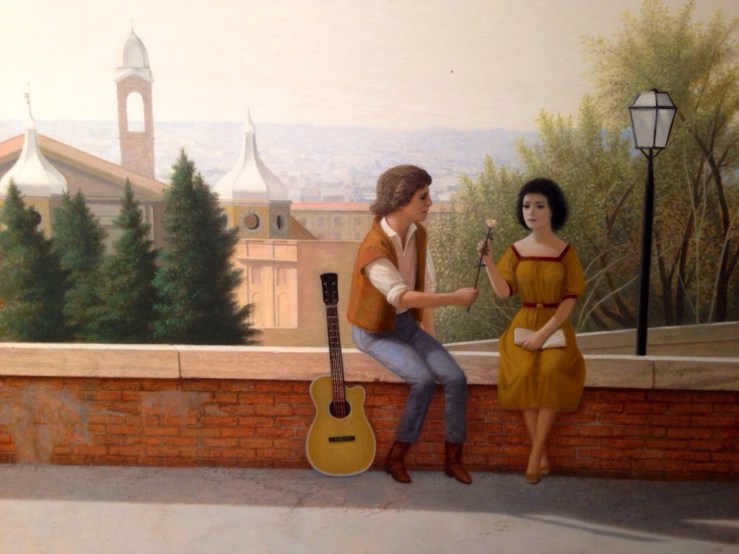
View of Rome — Joseph Jeffers Dodge

20140604-130712-47232460.jpg

“Go to hell, Roberto” | Roberto Bolaño’s The Unknown University

The Unknown University, Roberto Bolaño’s poetry collection—his complete poems, a bilingual edition, lovely, beautiful, over 800 pages—has been shifted all over my messy house this past month, wedged into ad hoc shelves, even conspicuously, for a time, fatly weighing down another Bolaño text, The Insufferable Gaucho (which I’ve been reading in tandem with/against The Unknown University), swollen and warped with saltwater from the gray Atlantic ocean.

I pecked at The Unknown University discursively, avoiding end notes, taking the rest of the Bolañoverse as my guide or frame or map or background for these poems. I read randomly, trying one poem at a time in no special order, taking crude stabs at the Spanish text on the left hand pages, clumsily matching them against Laura Healy’s fine translation, a poetics that matches the tone and rhythm and cadence and vibe of Bolaño’s other translators, Natasha Wimmer and Chris Andrews.

Then last night, a tale from The Insufferable Gaucho compelled me to read from The Unknown University straightwise, linear, 1-2-3, non-discursively, to take a stab at an orderly trajectory, reading it like a novel in fragments, perhaps.

The book is divided into three parts, each comprised of their own chapters or individual books. Last night I read, or reread, the first half of the first part: The Snow-NovelGuirat de BornelhStreets of BarcelonaIn the Reading Room of Hell.

The examples and citations in this riff come from those books, but I’d suggest that the images, motifs, and themes of these early poems—switchblades, hell, abysses, poets, girls, detectives, assassins, hunchbacks, genitals, sex, madness, blood—resonate throughout the entire volume (and throughout Bolaño’s oeuvre).

Perhaps the most central theme is Bolaño himself; The Unknown University often reads like a diffuse autobiography, with Bolaño’s concern for his own place in literature at the fore.

We see that anxiety in the first poem shared by the editors, a piece from 1990 included in the book’s intro:

Even a decade earlier, Bolaño prophesied that he would be carried to hell, a primal setting of the Bolañoverse. Bolaño’s romantic ancestor Jorge Luis Borges famously imagined Paradise as a kind of library. Bolaño inverts that image:
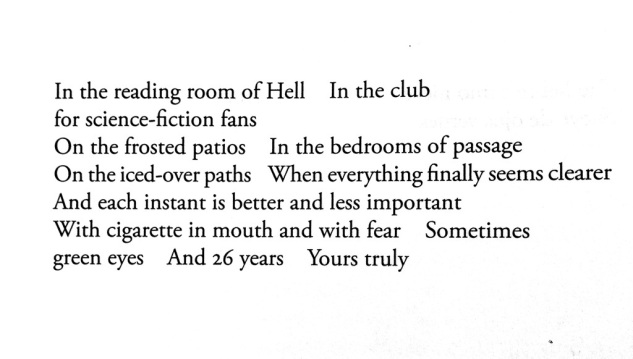
20140609-152831-55711939.jpgIn another poem, Bolaño seems to obliquely address Borges again (“Dear, this isn’t Paradise”), while also name-checking the heroes of that “club / for science-fiction fans” (including some perhaps-unlikely figures):
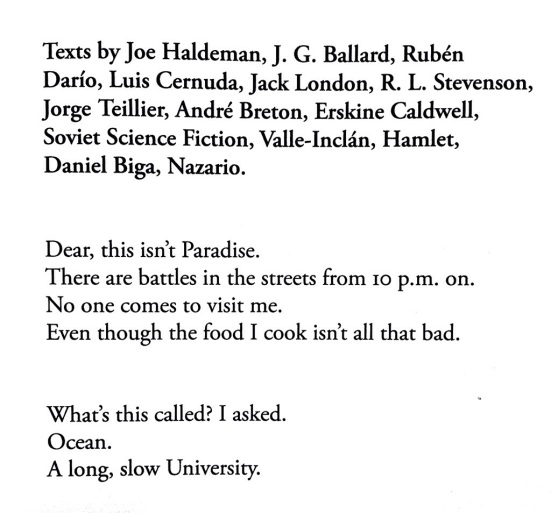
20140609-152831-55711467.jpg“A long, slow University.” Yes.

But how could Bolaño leave his hero Edgar Allan Poe from the curriculum? Oh, never mind. Here he is: 
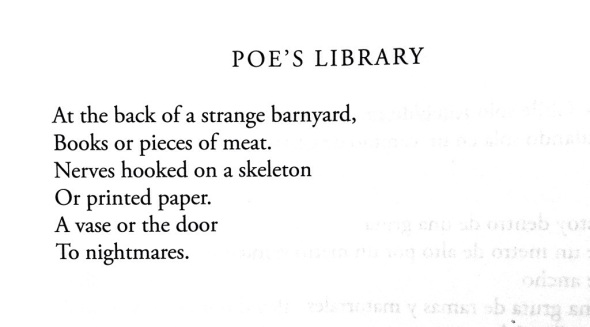
20140609-152830-55710956.jpg

The vase—Pandora’s box, Keats’s urn?—is a central image in these early poems. Dark, beautiful, and transformative, Bolaño seems to posit the vase—an object rendered somewhat mundane in its traditional place as an aesthetic object—as a portal to the abyss:
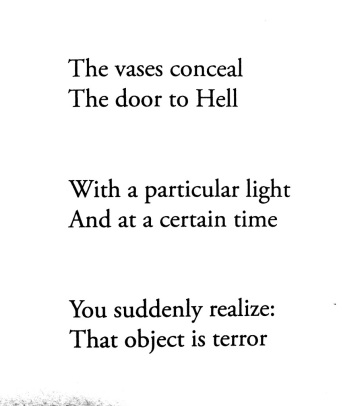
20140609-152830-55710494.jpg

Elsewhere our poet warns/invites us: “The nightmare begins over there, right there. / Further up, down, everything’s part of the / nightmare. Don’t stick your hand in that urn. Don’t / stick your hand in that hellish vase.” Reading the poem forces us to stick our hand in the vase.

If Bolaño seems occasionally melodramatic in his poems, a thrall to Baudelaire, he’s also keenly aware of it, even this early in his career. A twinning of irony and earnestness characterizes Bolaño’s writing, a savage self-reflexive humor that doesn’t necessarily reveal itself on first reading. When he begins a poem about a lost love, “Go to hell, Roberto, and remember you’ll never stick it in again,” the sentiment is simultaneously tragic and comic, the kind of personal confession that connects to the reader’s own experiences. “To be honest I don’t remember much now,” our narrator confides near the end, before the devastating conclusion, “She loved me forever / She crushed me.”

For Bolaño though, what’s perhaps most crushing is the loss of literature:
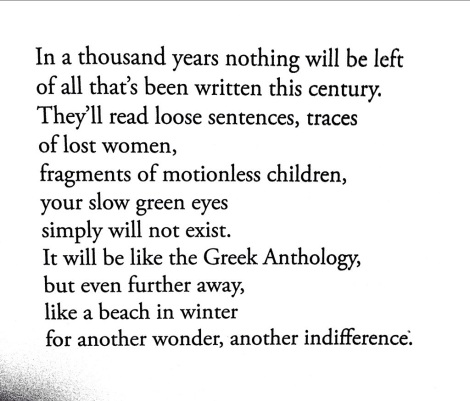
20140609-161756-58676319.jpg

And yet Bolaño sticks his arm into the vase, walks out over the chasm, dares for his poems to perhaps earn the right to be one of those “loose sentences, traces . . . fragments” that may survive.

In the very early poem “Work,” Bolaño romanticizes his own literary posterity:

Poetry that might champion my shadow in days to come

when I’ll be just a name not the man who wandered

with empty pockets, worked in slaughterhouses

on the old and on the new continent.

I seek credibility not durability for the ballads

I composed in honor of very real girls.

And mercy for my years before 26.

Seems like a reasonable request.

I don’t know if these poems are good or bad or excellent or what. I do know that I loved reading them and that they are of a piece with everything else I’ve read by Bolaño. The best moments recall his best writing, that strange mix of plain, even understated language, set against romantic violence and terrible madness. The poems here don’t distill the best of Bolaño into burning kernels of visceral realism; rather, they feel like the liquid filament of the Bolañoverse. Fantastic.

More to come.

The Unknown University is available now from New Directions.
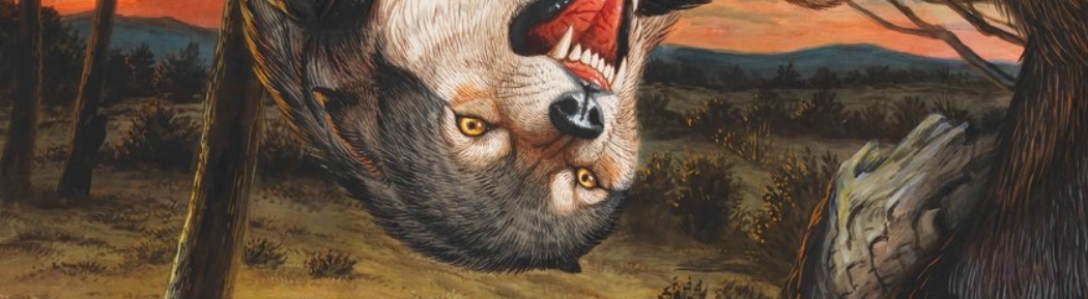
“Literature is a struggle over the nature of reality” (Dmitry Samarov’s Portrait of Richard Wright)

wrightcard3

Check out more of Dmitry Samarov’s greeting cards for the Chicago Literary Hall of Fame.

Miss Ingram (Detail) — Childe Hassam

20140604-130710-47230517.jpg

Spring in Zimme — Emil Nolde

Child with Red Hair Reading — Lilla Cabot Perry

Jean Reading — John Bratby

Illustration for Eugene Onegin — Anna and Elena Balbusso

Eugene Onegin by Anna and Elena Balbusso

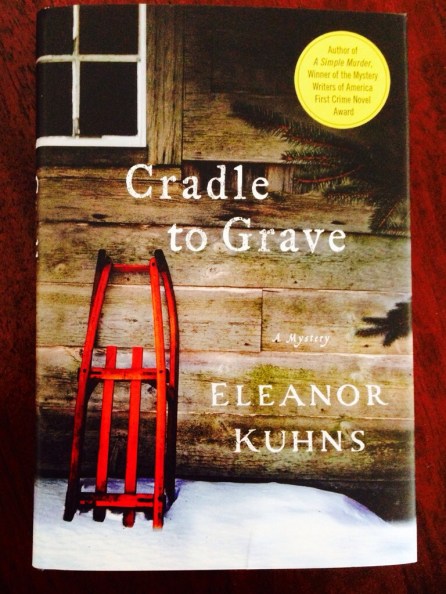
Cradle to Grave (Book Acquired, 5.27.2014)

20140528-143449-52489544.jpg

Cradle to Grave by Eleanor Kuhns. Publisher’s blurb:

Will Rees is adjusting to life on his Maine farm in 1797, but he’s already hungering for the freedom of the road, and his chance to travel comes sooner than he expects. Lydia has just received a letter from her old friend Mouse, a soft-spoken and gentle woman who now lives in the Shaker community in Mount Unity, New York. To Lydia and Rees’s astonishment, she’s in trouble with the law. She’s kidnapped five children, claiming that their mother, Maggie Whitney, is unfit to care for them.

Despite the wintry weather and icy roads, Rees and Lydia set out for New York, where they sadly conclude that Mouse is probably right and the children would be better off with her. There’s nothing they can do for Mouse legally, though, and they reluctantly set out for home. But before they’ve travelled very far, they receive more startling news: Maggie Whitney has been found murdered, and Mouse is the prime suspect.

In Cradle to Grave, Eleanor Kuhns returns with the clever plotting, atmospheric historical detail, and complexly drawn characters that have delighted fans and critics in her previous books.

“Books in the West” — Morely Roberts

“Books in the West”

from

Morely Roberts’s A Tramp’s Notebook

Since taking to writing as a profession I have lost most of the interest I had in literature as literature pure and simple. That interest gradually faded and “Art for Art’s sake,” in the sense the simple in studios are wont to dilate upon, touches me no more, or very, very rarely. The books I love now are those which teach me something actual about the living world; and it troubles me not at all if any of them betray no sense of beauty and lack immortal words. Their artistry is nothing, what they say is everything. So on the shelf to which I mostly resort is a book on the Himalayas; a Lloyd’s Shipping Register; a little work on seamanship that every would-be second mate knows; Brown’s Nautical Almanacs; a Channel Pilot; a Continental Bradshaw; many Baedekers; a Directory to the Indian Ocean and the China Seas; a big folding map of the United States; some books dealing with strategy, and some touching on medical knowledge, but principally pathology, and especially the pathology of the mind.

Yet in spite of this utilitarian bent of my thoughts there are very many books I know and love and sometimes look into because of their associations. As I cannot understand (through some mental kink which my friends are wont to jeer at) how anyone can return again and again to a book for its own sake, I do not read what I know. As soon would I go back when it is my purpose to go forward. A book should serve its turn, do its work, and become a memory. To love books for their own sake is to be crystallised before old age comes on. Only the old are entitled to love the past. The work of the young lies in the present and the future. Continue reading ““Books in the West” — Morely Roberts”

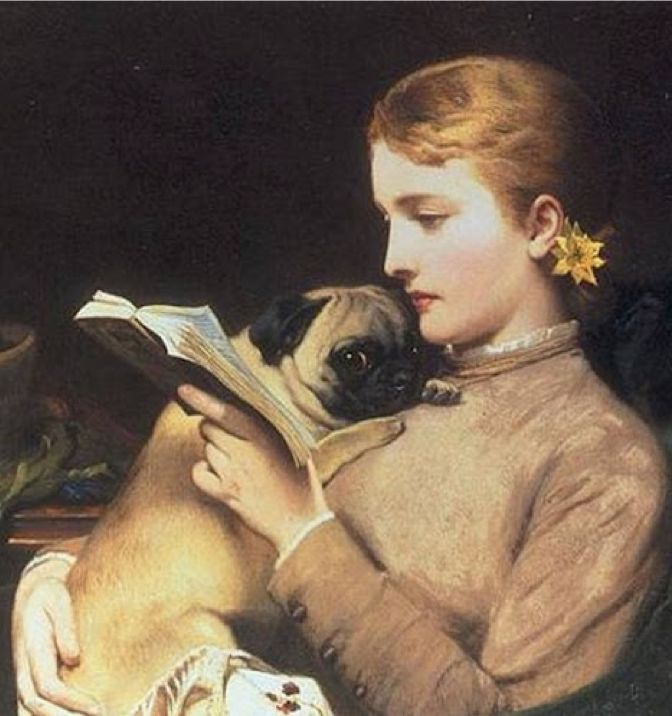
Girl Reading and a Pug — Charles Burton Barber

Charles Burton Barber

Days at Home — Kenton Nelson

days at home

Suspicions (David Markson)

20140529-203223-73943207.jpg

Self-portrait of the Artist — Winnaretta Singer

singer

The Beautiful Weirdness of Bob Schofield’s The Inevitable June

TIJ-COVER

Bob Schofield’s The Inevitable June continues theNewerYork Press’s dedication to beautiful weirdness. They’ve billed The Inevitable June as “words and art,” which is truth in advertising, yes, but is also a way of avoiding putting a label on this strange little book.

Is it a comic? A novella? A thought experiment? A prose-poem? A flip-book? Something entirely new? Yes.

But entirely new is wrong too, because, as the billing states, what we’ve got here are those ancient raw elements of storytelling, words and pictures, resynthesized into something that, in its strangeness, evokes newness and surpasses novelty. 

2

An initial simplicity of form, both in written and drawn line, allows the reader’s consciousness to slip into the strangeness of June. We begin with a simple black-on-white square (emblem of a page or a screen? (or hey man it’s just a square?)) which turns into a cube, or a box rather, one side open (a door; a window) its interior obscured. Should the reader stick his head in? Yes. The book seems to take place in this box, an imaginative dream-machine that we might recall from a childhood or two. 

What follows is an almanac of tragicomic weirdness, each entry logging the events of a new morning in an eternal June.

1

The clarity and concreteness of Schofield’s prose jars against its symantic expression, evoking a dream-nightmare world of continual creation and destruction. Every morning the world begins—and ends—anew, complete with new metaphors which crumble or dissolve or give way under the strain of the next morning’s creation.

3

The Inevitable June echoes with images of oceans and fires, glass airplanes and invisible pilots, octopuses and yetis, angels and demons. Its transmutations both challenge and invite the reader to play a game where the rules have not been, cannot be, verbalized. 

4

Is the game consciousness?

A version of consciousness anyway, a metaphor for consciousness—a collection of words and art, black and white lines, inky abysses and blank fields of possibility. If The Inevitable June attests that imaginative power can transform, it also underscores the costs and conditions of that transformation—the edges, the borders, the limits—the constraints of time, the days on a calendar. Interposed, our protagonist travels, falls, rises, dreams, and performs his various identities.   

I read Schofield’s  book a few times (it’s short) in different formats—on a laptop, a tablet, and then the physical book. Oh, and on my iPhone. I reread that thing on an iPhone waiting in my car to pick up my son from school. It was a different read each time, offering new strangenesses, new pathways, pratfalls, and pitfalls. The Inevitable June is not for all readers, obviously, but it gave me some joy in its puzzles and prose. Recommended.

Selected Reading (Nausea) — Eric Yahnker

nauseau

Something to Read — Vincent Giarrano

something