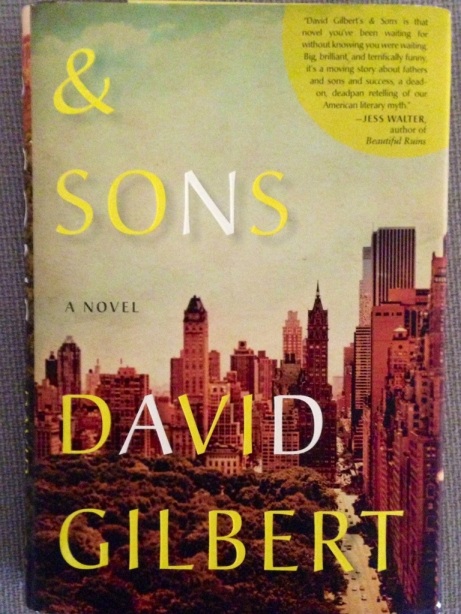
& Sons (Book Acquired, 7.09.2013)

20130709-141542.jpg

David Gilbert’s & Sons has gotten plenty of advanced praise and been likened to Wonder Boys and The Art of Fielding (which I couldn’t bring myself to waste my time to finish). Here’s John Irving’s blurb:
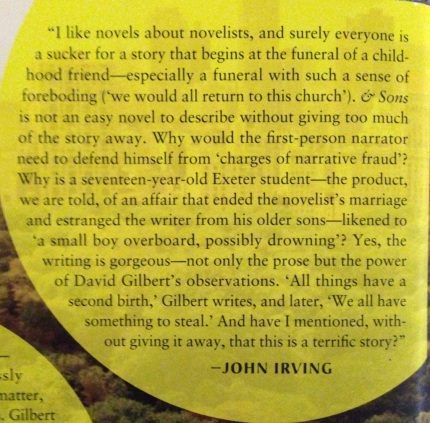
20130709-141554.jpg

And publisher Random House’s blurb:

The funeral of Charles Henry Topping on Manhattan’s Upper East Side would have been a minor affair (his two-hundred-word obit in The New York Times notwithstanding) but for the presence of one particular mourner: the notoriously reclusive author A. N. Dyer, whose novel Ampersand stands as a classic of American teenage angst. But as Andrew Newbold Dyer delivers the eulogy for his oldest friend, he suffers a breakdown over the life he’s led and the people he’s hurt and the novel that will forever endure as his legacy. He must gather his three sons for the first time in many years—before it’s too late.

So begins a wild, transformative, heartbreaking week, as witnessed by Philip Topping, who, like his late father, finds himself caught up in the swirl of the Dyer family. First there’s son Richard, a struggling screenwriter and father, returning from self-imposed exile in California. In the middle lingers Jamie, settled in Brooklyn after his twenty-year mission of making documentaries about human suffering. And last is Andy, the half brother whose mysterious birth tore the Dyers apart seventeen years ago, now in New York on spring break, determined to lose his virginity before returning to the prestigious New England boarding school that inspired Ampersand. But only when the real purpose of this reunion comes to light do these sons realize just how much is at stake, not only for their father but for themselves and three generations of their family.

In this daring feat of fiction, David Gilbert establishes himself as one of our most original, entertaining, and insightful authors. & Sons is that rarest of treasures: a startlingly imaginative novel about families and how they define us, and the choices we make when faced with our own mortality.


“The study of life not to be neglected for the sake of books” — Samuel Johnson

“The study of life not to be neglected for the sake of books” by Samuel Johnson

 On life, on morals, be thy thoughts employ’d;
Leave to the schools their atoms and their void.

IT is somewhere related by Le Clerc, that a wealthy trader of good understanding, having the common ambition to breed his son a scholar, carried him to an university, resolving to use his own judgment in the choice of a tutor. He had been taught, by whatever intelligence, the nearest way to the heart of an academick, and at his arrival entertained all who came about him with such profusion, that the professors were lured by the smell of his table from their books, and flocked round him with all the cringes of awkward complaisance. This eagerness answered the merchant’s purpose: he glutted them with delicacies, and softened them with caresses, till he prevailed upon one after another to open his bosom, and make a discovery of his competitions, jealousies, and resentments. Having thus learned each man’s character, partly from himself, and partly from his acquaintances, he resolved to find some other education for his son, and went away convinced, that a scholastick life has no other tendency than to vitiate the morals and contract the understanding: nor would he afterwards hear with patience the praises of the ancient authors, being persuaded that scholars of all ages must have been the same, and that Xenophon and Cicero were professors of some former university, and therefore mean and selfish, ignorant and servile, like those whom he had lately visited and forsaken.

Envy, curiosity, and a sense of the imperfection of our present state, incline us to estimate the advantages which are in the possession of others above their real value. Every one must have remarked, what powers and prerogatives the vulgar imagine to be conferred by learning. A man of science is expected to excel the unlettered and unenlightened even on occasions where literature is of no use, and among weak minds, loses part of his reverence, by discovering no superiority in those parts of life, in which all are unavoidably equal; as when a monarch makes a progress to the remoter provinces, the rustics are said sometimes to wonder that they find him of the same size with themselves. Continue reading ““The study of life not to be neglected for the sake of books” — Samuel Johnson”

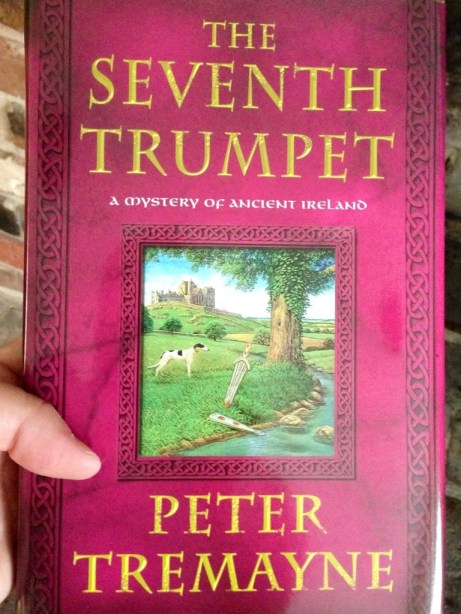
The Seventh Trumpet (Book Acquired, 7.01.2013)

20130709-140949.jpg

The Seventh Trumpet, another mystery from Peter Tremayne. Publisher Minotaur’s blurb:

When a murdered corpse of an unknown young noble is discovered, Fidelma of Cashel is brought in to investigate

Ireland, AD 670. When the body of a murdered young noble is discovered not far from Cashel, the King calls upon his sister, Fidelma, and her companion Eadulf to investigate. Fidelma, in addition to being the sister of the king, is a dailaigh—an advocate of the Brehon Law Courts—and has a particular talent for resolving the thorniest of mysteries.

But this time, Fidelma and Eadulf have very little to work with—the only clue to the noble’s identity is an emblem originating from the nearby kingdom of Laign. Could the murder be somehow related to the wave of violence erupting in the western lands of the kingdom? The turmoil there is being stirred up by an unknown fanatical figure who claims to have been summoned by “the seventh angel” to remove the “impure of faith.” Fidelma and Eadulf, once again grappling with a tangled skein of murder and intrigue, must somehow learn what connects the dead noble, a murdered alcoholic priest, and an abbot who has turned his monastery into a military fortress. When it appears that things cannot get more complex, Fidelma herself is abducted, and Eadulf must rescue her before the mystery can be solved.