“The Girl Who Owned a Bear” — L. Frank Baum

“The Girl Who Owned a Bear” by L. Frank Baum

Mamma had gone down-town to shop. She had asked Nora to look after Jane Gladys, and Nora promised she would. But it was her afternoon for polishing the silver, so she stayed in the pantry and left Jane Gladys to amuse herself alone in the big sitting-room upstairs.

The little girl did not mind being alone, for she was working on her first piece of embroidery—a sofa pillow for papa’s birthday present. So she crept into the big bay window and curled herself up on the broad sill while she bent her brown head over her work.

Soon the door opened and closed again, quietly. Jane Gladys thought it was Nora, so she didn’t look up until she had taken a couple more stitches on a forget-me-not. Then she raised her eyes and was astonished to find a strange man in the middle of the room, who regarded her earnestly.

He was short and fat, and seemed to be breathing heavily from his climb up the stairs. He held a work silk hat in one hand and underneath his other elbow was tucked a good-sized book. He was dressed in a black suit that looked old and rather shabby, and his head was bald upon the top.

“Excuse me,” he said, while the child gazed at him in solemn surprise. “Are you Jane Gladys Brown?”

“Yes, sir,” she answered.

“Very good; very good, indeed!” he remarked, with a queer sort of smile. “I’ve had quite a hunt to find you, but I’ve succeeded at last.”

“How did you get in?” inquired Jane Gladys, with a growing distrust of her visitor.

“That is a secret,” he said, mysteriously.

This was enough to put the girl on her guard. She looked at the man and the man looked at her, and both looks were grave and somewhat anxious.

“What do you want?” she asked, straightening herself up with a dignified air.

“Ah!—now we are coming to business,” said the man, briskly. “I’m going to be quite frank with you. To begin with, your father has abused me in a most ungentlemanly manner.”

Jane Gladys got off the window sill and pointed her small finger at the door.

“Leave this room ‘meejitly!” she cried, her voice trembling with indignation. “My papa is the best man in the world. He never ‘bused anybody!” Continue reading ““The Girl Who Owned a Bear” — L. Frank Baum”
“The Snow Child” — Angela Carter

“The Snow Child” by Angela Carter

Midwinter — invincible, immaculate. The Count and his wife go riding, he on a grey mare and she on a black one, she wrapped in the glittering pelts of black foxes; and she wore high, black, shining boots with scarlet heels, and spurs. Fresh snow fell on snow already fallen; when it ceased, the whole world was white. “I wish I had a girl as white as snow,” says the Count. They ride on. They come to a hole in the snow; this hole is filled with blood. He says: “I wish I had a girl as red as blood.” So they ride on again; here is a raven, perched on a bare bough. “I wish I had a girl as black as that bird’s feathers.”

As soon as he completed her description, there she stood, beside the road, white skin, red mouth, black hair and stark naked; she was the child of his desire and the Countess hated her. The Count lifted her up and sat her in front of him on his saddle but the Countess had only one thought:how shall I be rid of her?

The Countess dropped her glove in the snow and told the girl to get down to look for it; she meant to gallop off and leave her there but the Count said: “I’ll buy you new gloves.” At that, the furs sprang off the Countess’s shoulders and twined round the naked girl. Then the Countess threw her diamond brooch through the ice of a frozen pond: “Dive in and fetch it for me,” she said; she thought the girl would drown. But the Count said: “Is she a fish to swim in such cold weather?” Then her boots leapt off the Countess’s feet and on to the girl’s legs. Now the Countess was bare as a bone and the girl furred and booted; the Count felt sorry for his wife. They came to a bush of roses, all in flower. “Pick me one,” said the Countess to the girl. “I can’t deny you that,” said the Count.

So the girl picks a rose; pricks her finger on the thorn; bleeds; screams; falls.

Weeping, the Count got off his horse, unfastened his breeches and thrust his virile member into the dead girl. The Countess reined in her stamping mare and watched him narrowly; he was soon finished.

Then the girl began to melt. Soon there was nothing left of her but a feather a bird might have dropped; a blood stain, like the trace of a fox’s kill on the snow; and the rose she had pulled off the bush. Now the Countess had all her clothes on again. With her long hand, she stroked her furs. The Count picked up the rose, bowed and handed it to his wife; when she touched it, she dropped it. “It bites!” she said.

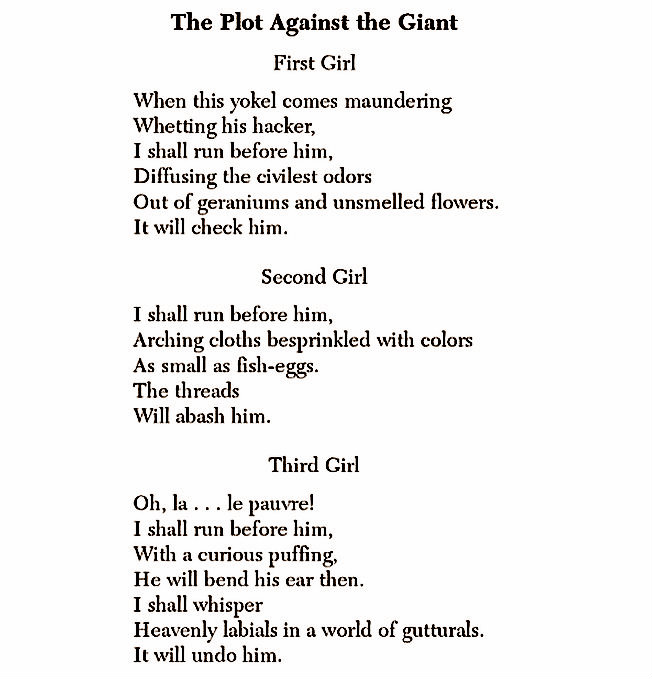
“The Plot Against the Giant” — Wallace Stevens

Capture

A.S. Byatt on Fairy Tales

What are fairy stories for? Freud gave an answer – they were related to daydreams and wish-fulfilment fantasies, in which the questing self meets helpers and enemies, and in which the ending is always happy. He wondered if myths were the “secular dreams of youthful humanity” but distinguished myths from fairy tales by claiming that myth is “related to disaster”. It can also be argued that myth is related to the human need to know what was before, and what will be after the individual life, the living society. Myths are concerned with origins, the fear of death, and the hope for the overcoming of death in another world. The universe of Asgard and Valhalla, of Olympus and Hades, is not the fairy-tale unreal world with its visiting suns and moons, castles and undifferentiated forests. We don’t put it together in our imaginations in the same way. There is neither explanation nor teaching in the true wonder tale.

Other things which are not essentially part of true fairy tales are character, psychological causation, and real morality. Princesses are virtually interchangeable – they are either kind and modest and housewifely, or vain and stupid and inconsiderate. They are called “princesses” but peasants and merchants’ daughters have the same limited and recognisable natures. Simpletons and gallant princes have the same chance of solving riddles, obtaining magic feathers, or keys, the same insect or fishy helpers. Lazy girls are caught out by boasts that they can spin flax into gold, and are helped by strange brownies, or dwarves, or other creatures. The best single description I know of the world of the fairy tale is that of Max Lüthi who describes it as an abstract world, full of discrete, interchangeable people, objects and incidents, all of which are isolated and are nevertheless interconnected, in a kind of web or network of two-dimensional meaning. Everything in the tales appears to happen entirely by chance – and this has the strange effect of making it appear that nothing happens by chance, that everything is fated.

Read the rest of A.S. Byatt’s 2004 piece on fairy tales in The Guardian.

Read “The Fir-Tree,” Hans Christian Andersen’s Depressing Story About the Existential Fate of a Christmas Tree

Hans Christian Andersen’s “The Fir-Tree,” a depressing story about a Christmas tree—

Far down in the forest, where the warm sun and the fresh air made a sweet resting-place, grew a pretty little fir-tree; and yet it was not happy, it wished so much to be tall like its companions— the pines and firs which grew around it. The sun shone, and the soft air fluttered its leaves, and the little peasant children passed by, prattling merrily, but the fir-tree heeded them not. Sometimes the children would bring a large basket of raspberries or strawberries, wreathed on a straw, and seat themselves near the fir-tree, and say, “Is it not a pretty little tree?” which made it feel more unhappy than before. And yet all this while the tree grew a notch or joint taller every year; for by the number of joints in the stem of a fir-tree we can discover its age. Still, as it grew, it complained, “Oh! how I wish I were as tall as the other trees, then I would spread out my branches on every side, and my top would over-look the wide world. I should have the birds building their nests on my boughs, and when the wind blew, I should bow with stately dignity like my tall companions.” The tree was so discontented, that it took no pleasure in the warm sunshine, the birds, or the rosy clouds that floated over it morning and evening. Sometimes, in winter, when the snow lay white and glittering on the ground, a hare would come springing along, and jump right over the little tree; and then how mortified it would feel! Two winters passed, and when the third arrived, the tree had grown so tall that the hare was obliged to run round it. Yet it remained unsatisfied, and would exclaim, “Oh, if I could but keep on growing tall and old! There is nothing else worth caring for in the world!” In the autumn, as usual, the wood-cutters came and cut down several of the tallest trees, and the young fir-tree, which was now grown to its full height, shuddered as the noble trees fell to the earth with a crash. After the branches were lopped off, the trunks looked so slender and bare, that they could scarcely be recognized. Then they were placed upon wagons, and drawn by horses out of the forest. “Where were they going? What would become of them?” The young fir-tree wished very much to know; so in the spring, when the swallows and the storks came, it asked, “Do you know where those trees were taken? Did you meet them?”

Continue reading “Read “The Fir-Tree,” Hans Christian Andersen’s Depressing Story About the Existential Fate of a Christmas Tree”

Read “The Fir-Tree,” Hans Christian Andersen’s Depressing Story About the Existential Fate of a Christmas Tree

Hans Christian Andersen’s “The Fir-Tree,” a depressing story about a Christmas tree—

Far down in the forest, where the warm sun and the fresh air made a sweet resting-place, grew a pretty little fir-tree; and yet it was not happy, it wished so much to be tall like its companions— the pines and firs which grew around it. The sun shone, and the soft air fluttered its leaves, and the little peasant children passed by, prattling merrily, but the fir-tree heeded them not. Sometimes the children would bring a large basket of raspberries or strawberries, wreathed on a straw, and seat themselves near the fir-tree, and say, “Is it not a pretty little tree?” which made it feel more unhappy than before. And yet all this while the tree grew a notch or joint taller every year; for by the number of joints in the stem of a fir-tree we can discover its age. Still, as it grew, it complained, “Oh! how I wish I were as tall as the other trees, then I would spread out my branches on every side, and my top would over-look the wide world. I should have the birds building their nests on my boughs, and when the wind blew, I should bow with stately dignity like my tall companions.” The tree was so discontented, that it took no pleasure in the warm sunshine, the birds, or the rosy clouds that floated over it morning and evening. Sometimes, in winter, when the snow lay white and glittering on the ground, a hare would come springing along, and jump right over the little tree; and then how mortified it would feel! Two winters passed, and when the third arrived, the tree had grown so tall that the hare was obliged to run round it. Yet it remained unsatisfied, and would exclaim, “Oh, if I could but keep on growing tall and old! There is nothing else worth caring for in the world!” In the autumn, as usual, the wood-cutters came and cut down several of the tallest trees, and the young fir-tree, which was now grown to its full height, shuddered as the noble trees fell to the earth with a crash. After the branches were lopped off, the trunks looked so slender and bare, that they could scarcely be recognized. Then they were placed upon wagons, and drawn by horses out of the forest. “Where were they going? What would become of them?” The young fir-tree wished very much to know; so in the spring, when the swallows and the storks came, it asked, “Do you know where those trees were taken? Did you meet them?”

Continue reading “Read “The Fir-Tree,” Hans Christian Andersen’s Depressing Story About the Existential Fate of a Christmas Tree”