Denis Johnson’s Train Dreams is a perfect novella

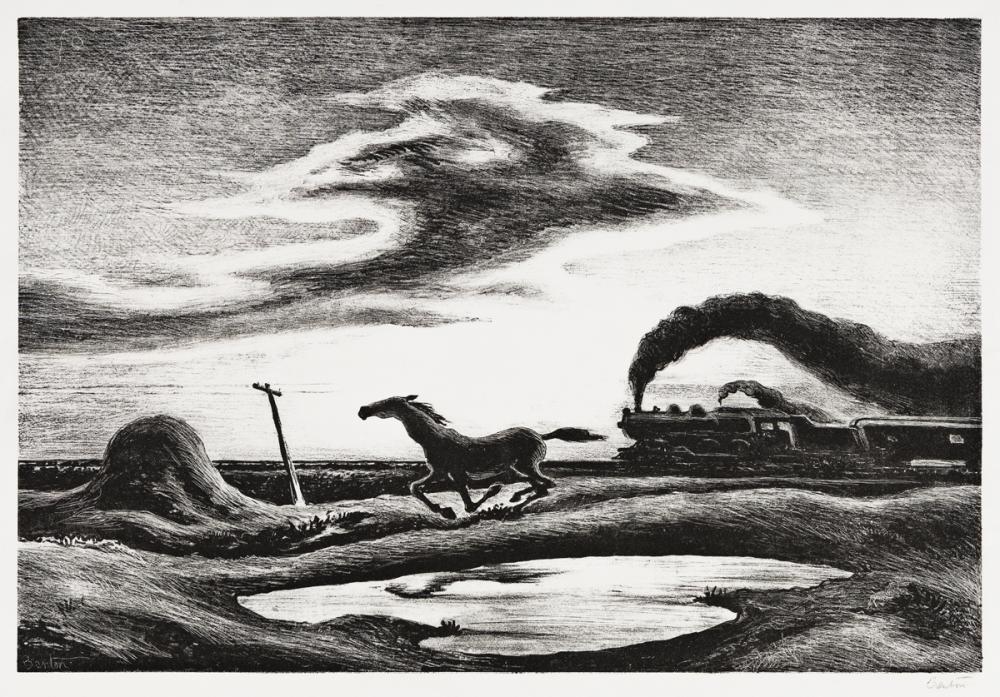
The Race, 1942 by Thomas Hart Benton (1889-1975)

With blunt grace, Denis Johnson navigates the line between realism and the American frontier myth in his perfect novella Train Dreams. In a slim 116 pages, Johnson communicates one man’s life story with a depth and breadth that actually lives up to the book’s blurb’s claim to be an “epic in miniature.”  I read it in one sitting on a Sunday afternoon, occasionally laughing aloud at Johnson’s wry humor, several times moved by the pathos of the narrative, and more than once stunned at the subtle, balanced perfection of Johnson’s prose, which inheres from sentence to paragraph to resonate throughout the structure of the book.

The opening lines hooked me:

In the summer of 1917 Robert Grainier took part in an attempt on the life of a Chinese laborer caught, or anyway accused of, stealing from the company stores of the Spokane International Railway in the Idaho Panhandle.

Three of the railroad gang put the thief under restraint and dragged him up the long bank toward the bridge under construction fifty feet above the Moyea River. A rapid singsong streamed from the Chinaman voluminously. He shipped and twisted like a weasel in a sack, lashing backward with his one free fist at the man lugging him by the neck.

The matter-of-fact violence here complicates everything that follows in many ways, because Grainier it turns out is pretty much that rare thing, a good man, a simple man who tries to make a life in the Idaho Panhandle at the beginning of the 20th century. The rest of the book sees him trying—perhaps not consciously—to somehow amend for the strange near-lynching he abetted.

Grainier works as a day laborer, felling the great forests of the American northwest so that a network of trains can connect the country. Johnson resists the urge to overstate the obvious motifs of expansion and modernity here, instead expressing depictions of America’s industrial growth at a more personal, even psychological level:

Grainier’s experience on the Eleven-Mile Cutoff made him hungry to be around other such massive undertakings, where swarms of men did away with portions of the forest and assembled structures as big as anything going, knitting massive wooden trestles in the air of impassable chasms, always bigger, longer, deeper.

Grainier’s hard work keeps him from his wife and infant daughter, and the separation eventually becomes more severe after a natural calamity, but I won’t dwell on that in this review, because I think the less you know about Train Dreams going in the better. Still, it can’t hurt to share a lovely passage that describes Grainier’s courtship with the woman who would become his wife:

The first kiss plummeted him down a hole and popped him out into a world he thought he could get along in—as if he’d been pulling hard the wrong way and was now turned around headed downstream. They spent the whole afternoon among the daisies kissing. He felt glorious and full of more blood than he was supposed to have in him.

The passage highlights Johnson’s power to move from realism into the metaphysical and back, and it’s this precise navigation of naturalism and the ways that naturalism can tip the human spirit into supernatural experiences that makes Train Dreams such a strong little book. In the strange trajectory of his life, Grainier will be visited by a ghost and a wolf-child, will take flight in a biplane and transport a man shot by a dog, will be tempted by a pageant of pulchritude and discover, most unwittingly, that he is a hermit in the woods. In Johnson’s careful crafting, these events are not material for a grotesque picaresque or a litany of bizarre absurdities, but rather a beautiful, resonant poem-story, a miniature history of America.

Train Dreams is an excellent starting place for those unfamiliar with Johnson’s work, and the book will rest at home on a shelf with Steinbeck’s naturalist evocations or Cormac McCarthy’s Border Trilogy. I have no idea why the folks at FS&G waited almost a decade to publish it (Train Dreams was originally published in a 2002 issue of The Paris Review), but I’m glad they did, and I’m glad the book is out now in trade paperback from Picador, where it should gain a wider audience. Very highly recommended.

[Ed. note: Biblioklept originally published this review in May of 2012. I still haven’t seen the Clint Bentley-directed film adaptation.]

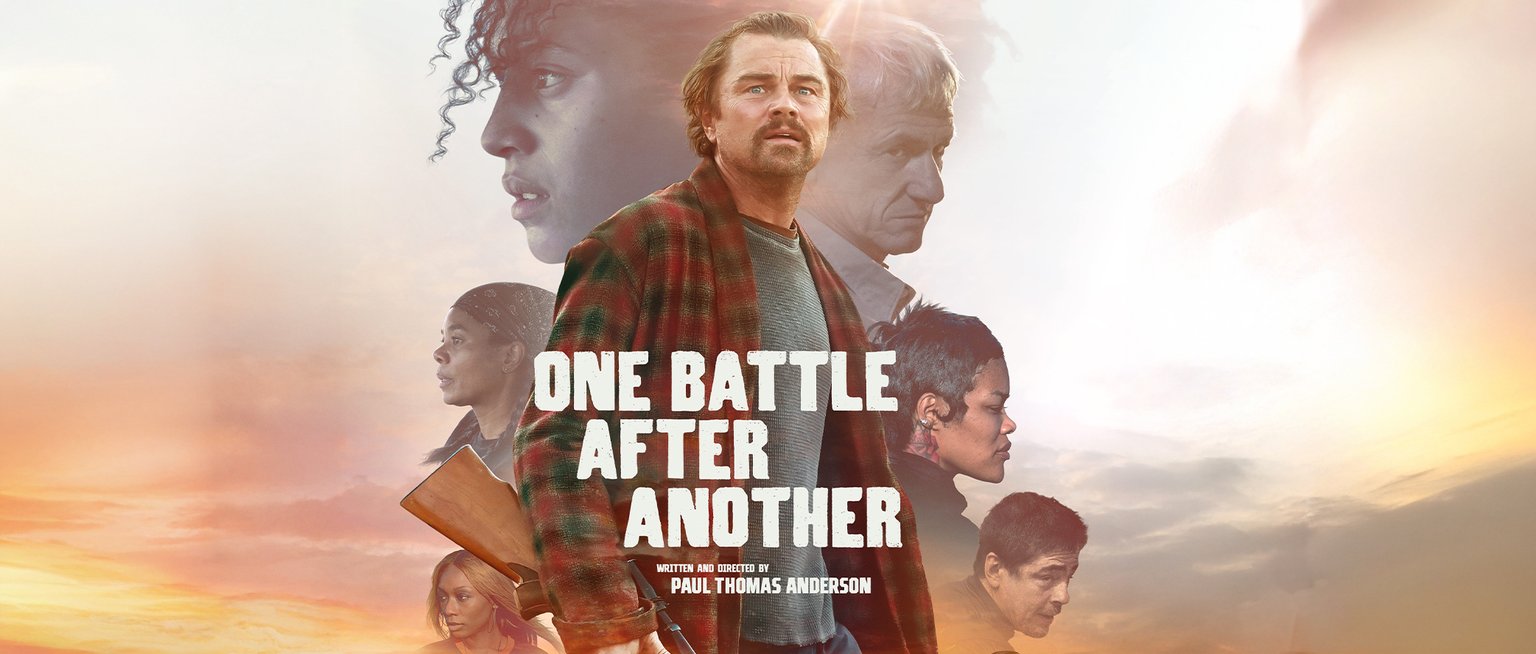
Paul Thomas Anderson’s One Battle After Another is a frenetic, vital reimagining of Thomas Pynchon’s Vineland

Paul Thomas Anderson’s One Battle After Another takes Thomas Pynchon’s 1990 novel Vineland and sets it ablaze, reshaping its abstract paranoia and fractured narrative into something both deliriously immediate and ominously timeless.

The bones of Pynchon’s original are still present: a family broken by state violence; a daughter growing up without a mother; a father caught between shame and reluctant resistance. In PTA’s feverish recasting of Vineland, Zoyd Wheeler becomes Bob Ferguson (Leonardo DiCaprio), a former “Rocket Man” revolutionary burning out the past in a haze of weed smoke. Frenesi Gates is reimagined as Perfidia Beverly Hills (Teyana Taylor), a revolutionary addicted to the sexual thrill of power. Prairie Wheeler morphs into Willa (Chase Infiniti — and like wow jeez that’s a Pynchonian name the young actress has there, isn’t it?). And villainous Brock Vond is warped into Colonel Lockjaw (Sean Penn), a grotesque embodiment of authoritarian menace. Timelines collapse into themselves, Reagan-era dread transposes into our own disturbed now. Vineland is set in 1984; in One Battle After Another, PTA shows that we’ve never really moved on from that dystopian year. PTA condenses Vineland’s sprawling flashbacks and absurd digressions into an action-forward narrative that’s far more linear yet equally dizzying. The result is enthralling.

The film’s plot might be distilled simply from its title. One Battle After Another follows the trajectory of most of Pynchon’s fiction: individual resistance to authoritarian evil. In PTA’s film, that resistance takes the form of the French 75, a loose clandestine revolutionary group to which Bob and his partner Perfidia once belonged. There’s really no retiring for French 75 agents though, and soon Willa is tangled in the same web her parents sought to sunder in their radical actions. Penn’s maniacal Colonel Lockjaw hunts her down. She’s on the run, and so is papa Bob.
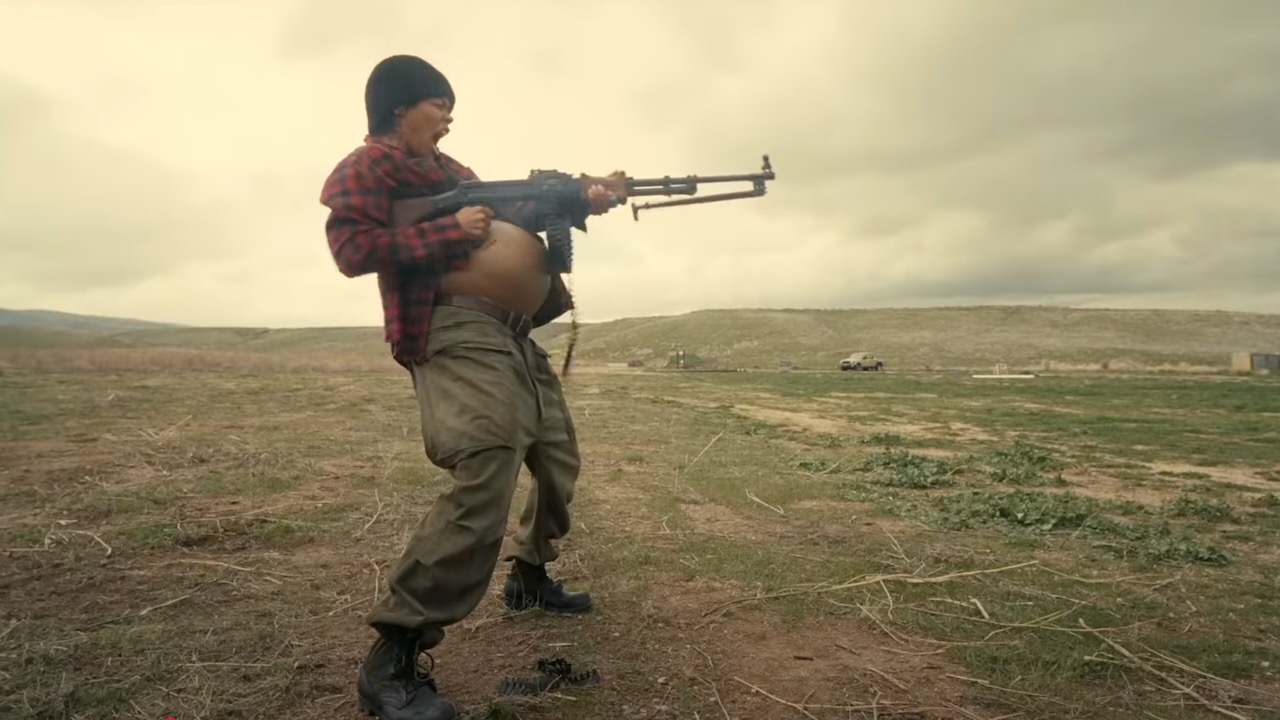
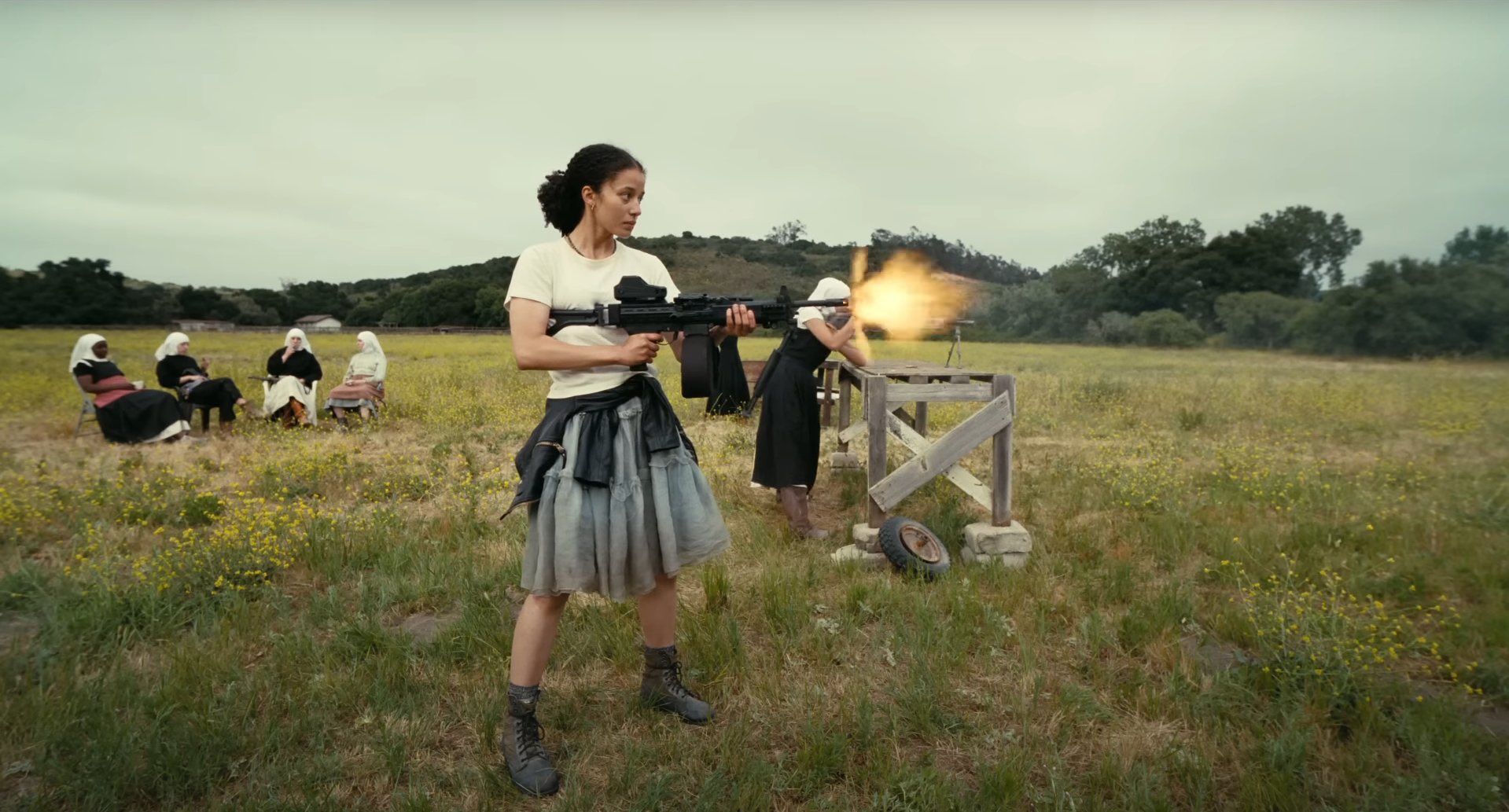
Pynchon’s novels frequently contrast Us vs Them systems — preterite vs. elect; misfits vs. authoritarians; freaks vs. the Man. And like Pynchon’s work, One Battle After Another shows the invisible overlapping and hierarchical confusions these Us/Them systems engender. The French 75’s sympathies directly correlate with the values of the immigrant community in Baktan Cross, the fictional sanctuary city Bob and Willa take refuge in. The de facto leader of these immigrants, Francisco (Benicio Del Toro), aids Bob in his fevered search for Willa. Francisco’s zen calm offers a counterbalance to Bob’s mania. Another Us group are the Sisters of the Brave Beaver (One Battle After another is crammed with Pynchonian vagina jokes), weed-growing nuns who offer Willa a brief safe harbor.
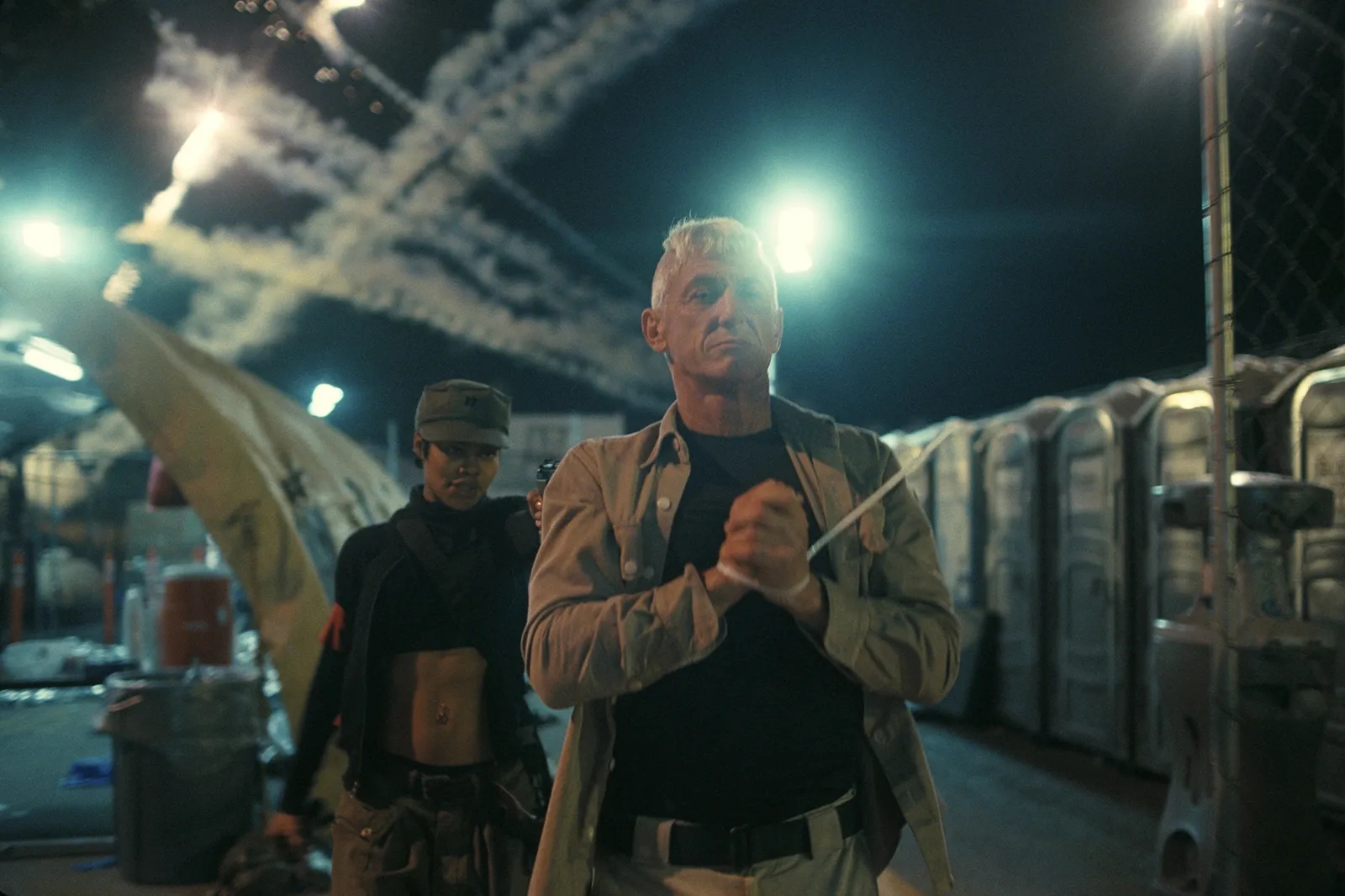
These disparate pockets of rebellion resist the tyranny of the modern racist capitalist system, embodied by Colonel Lockjaw and the military forces he commands (seemingly without any government oversight). We first meet Lockjaw running a migrant detention center — one of many timely PTA updates to Vineland — and his weird, forced, masochistic machismo plays out on the screen with a mix of menace and despair. For all his power and evil though, there’s yet another Them he isn’t part of. That would be the Christmas Adventurers Club, a shadowy cabal of elites on a racist mission to rid the world of “freaks.” Lockjaw would do quite literally anything to become a member of this club; his drive to to become even more Them propels the narrative while showing that Us-Them systems rely on hierarchies to perpetuate oppression.

One Battle After Another zigzags through a whirlwind of absurdity, suffocating paranoia, and frantic action. The film balances chaotic humor with a darker exploration of the emotional impulses that underlie power and attraction. Colonel Lockjaw’s obsessive fixation on Perfidia (arguably the film’s closest connection to Vineland) underscores the irrational power dynamics of obsession and control. PTA frames their relationship—along with Lockjaw’s obsession with Willa—as a twisted mirror reflecting the power imbalances that define both the personal and the political in Us-Them systems. PTA’s films have always explored systems of exploitation that grind people down and the outsiders who try to navigate them; One Battle After Another is, thus far, his most sustained, howling effort in this vein.
The film is gorgeous, too, as fans would expect from PTA. Michael Bauman’s cinematography conveys frenzied energy without sacrificing cohesion or clarity. There are several outstanding set pieces, including a beautiful sequence in which Bob does his best to keep up with a trio of skateboarders traversing rooftops at night, their figures silhouetted against the flames of a riot below. The film’s climactic three-car chase scene is particularly magnificent, its every twist and turn symbolizing not just physical pursuit, but deeper spirals of control, conflict, and paranoia. It made me physical ill. (That’s high praise.)

And while, yes, One Battle After Another is a bona fide action film, it’s still larded with strange little morsels that we’d expect from a PTA film — the image of Lockjaw licking his comb before taking it to his hair, his face contorted in anxious hope, or Bob, in his threadworn bathrobe, shoplifting a pair of cheap sunglasses. (Parenthetically, while the bathrobe is on my mind — Battle plays as a sinister inversion to The Big Lebowski. I will file the pair away for a future double feature.) One of the film’s funniest moments comes from Willa, who, despite being apparently subjugated by Lockjaw, nevertheless delivers the kind of crushing blow that can only come from a teen: “Why is your shirt so tight?” Indeed, Chase Infiniti’s portrayal of Willa is a revelation. In a movie crammed with paranoia and plot twists, she imbues in Willa a kind of moral force. She’s not an anchor exactly, because nothing is steady here. But maybe she’s the string you follow through the labyrinth.

One Battle After Another is almost three hours long, but it never drags, thanks to the tight direction and enthralling plot. Long-time PTA collaborator Jonny Greenwood’s score also keeps the film moving at a quick pace. The score is ever-present — something that usually irritates me in a film — but here the music provides emotional cohesion. It’s also just really fucking pretty.  Frenetic drumming and altered pianos meet up with swelling strings that suggest sirens, banshees. Take “Mean Alley,” for example, which initially greets the ear as if the guitar is out of tune, but then coheres into beautiful dissonance. And although Greenwood’s wall-to-wall score leaves little room for the needle drops we might expect from a PTA joint, the film deploys Tom Petty’s “American Girl” in a moment of transcendent bliss that brought a tear to my eye.

Pynchon has always soundtracked his novels. Pynchonwiki gives close to 400 musical references for Vineland, but I don’t think any of these tracks ended up in One Battle After Another. My giving this data is a weak way of transitioning to the sentence, This is a film inspired by Vineland, not an adaptation of it. And while PTA captures the soul of the book, the vibe, or spirit, or whatever you like to call it, is decidedly different: darker, edgier, uglier. He captures the same strange humor and frustration of Vineland, but it’s amplified here with a chaotic energy that matches our current moment.
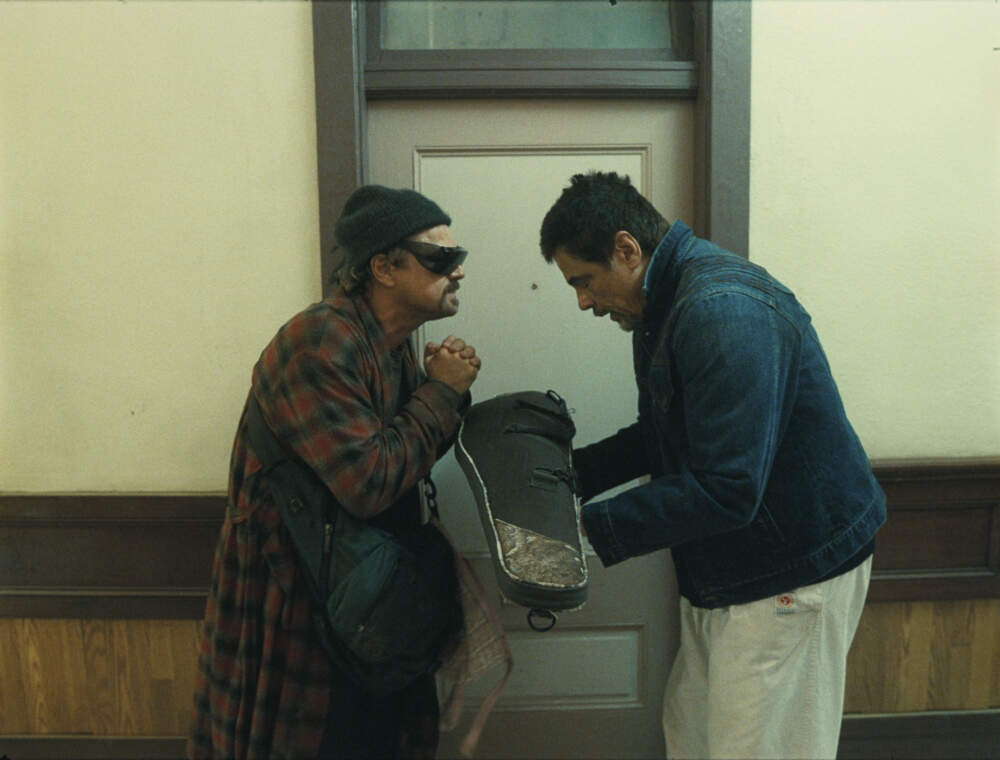
It’s also instructive to compare One Battle After Another to PTA’s earlier Pynchon adaptation, Inherent Vice. While Inherent Vice was a hazy sunsoaked journey through the disorienting aftereffects of the muddled sixties, One Battle After Another feels darker, more urgent, as if the timeline of history has compressed itself into an unyielding present. Both films deal with the fracturing of the American dream, but One Battle After Another does so with a sharper edge, drawing clearer political parallels. In some ways, PTA’s Inherent Vice is closer to Pynchon’s Vineland in tone and theme, less angular, more forgiving.

With both of his Pynchon films, PTA foregrounds a sweet final note, a belief in love as a sustaining force against Them. To borrow my favorite lines from Pynchon’s opus Gravity’s Rainbow: “They are in love. Fuck the war.” In his adaptation of Inherent Vice, PTA pulled a loose thread from the novel to neatly weave back into a prettier picture. He allows Doc Sportello to restore the heroin-addicted musician Coy to his family. One Battle offers a similarly fractured, imperfect restoration of family, a rewriting of rat-sins answered on the ghost of radio waves. He cleans up Pynchon’s messiness, but doesn’t sacrifice the deep danger that underwrites radical love.

One Battle After Another feels dangerously prescient, or, more accurately, a diagnosis of the big ugly now. In PTA’s Inherent Vice, there was an underlying fractured partnership between Us and Them; weirdo Doc Sportello tried to find some kind of brotherhood of man with The Man, Detective Bigfoot. No humanity can be extended to Lockjaw — not even from the club that will refuse him. They are unforgiving of any perceived impurity. The themes of mass surveillance, state violence, and detention resonate deeply in today’s climate. The recent death of Assata Shakur—possibly one inspiration for Perfidia Beverly Hills—adds a haunting layer to the film’s exploration of systemic oppression, the ways in which the state seeks to control and erase voices of resistance. The political urgency is palpable, and will undoubtedly alienate a large section of the genpop normies that Warner Brothers has heavily advertised the film to. Some folks will always root for Them.

But fuck Them. One Battle After Another is a triumph, a dizzying, chaotic masterpiece that never loses its grip on the present—one battle after another, all too real, all too important. See it on the biggest screen you can.

The Trailer for James Franco’s Film Adaptation of As I Lay Dying Is Pretty Unremarkable

All of this seems so terribly ill-advised. The book is great—not Faulkner’s greatest, but it has a linear trajectory that I do think is filmable—but this trailer seems to portray a pale imitation of someone else’s vision of what a Faulkner film might look like (no, I don’t know what that sentence means exactly, other than this film looks like a bad riff on Faulkner).

1984 (1954 BBC Sunday-Night Production)

Road Movie

“Having your book turned into a movie is like seeing your oxen turned into bouillon cubes” — John LeCarre

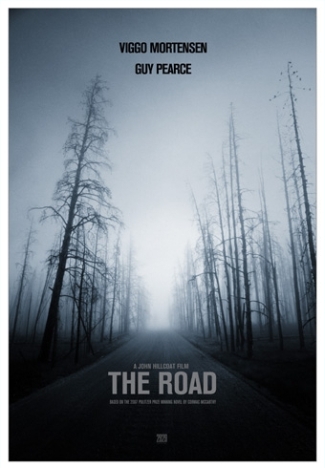
Movies rarely compare favorably to the books from which they are adapted and almost never surpass them. Still, film adaptations of books can be fantastic if handled by the right director–take Mexican director Alfonso Cuarón for example, whose brilliant films Children of Men and Harry Potter and the Prisoner of Azkaban (adaptations of books by P.D James and J.K. Rowling, respectively) convey richly imagined, engrossing worlds. Cuarón’s films join a small stable of adaptations that live up to–if not surpass–the books on which they are based. Most great film adaptations turn good genre fiction into great art. However, great literature doesn’t usually fare so well. Geniuses like Kubrick and Coppola have reconfigured airport reading like Stephen King’s The Shining and Mario Puzo’s The Godfather into cinematic masterpieces, but has anyone ever done justice to Melville or Hemingway or Hawthorne or Fitzgerald (of the four attempts at translating Gatsby to the screen, the 1974 Coppola-produced effort is arguably the best, but consider how short it falls of capturing Fitzgerald’s vision)? Which brings up the question: just how good, bad, or indifferent will the upcoming movie adaptation of Cormac McCarhy’s Pulitzer Prize winner The Road be? We thought we’d navigate the pros and cons here.

What The Road film adaptation has going for it:

The director: Australian director John Hillcoat’s 2005 feature film debut The Proposition captured the bloody violence and moral ambiguity of a world alienated from civilization. We loved the movie, and not enough people have seen it. The tone Hillcoat achieved in The Proposition seems well matched to McCarthy’s grim vision.

The producer: Nick Wechsler’s list of films includes Sex, Lies, and Videotape, The Player, Requiem for a Dream, 25th Hour, and Drugstore Cowboy–so it seems like he knows how to sit back and let a filmmaker create art without trying to, you know, have a massive Hollywood hit.

The leading man: Viggo Mortensen as the father seems like a great choice. Mortensen brought depth to the role he’s most famous for–Aragorn in The Lord of the Rings trilogy–something of a feat when you consider most of his screen time was devoted to scowling, brooding, or chopping up orcs. He was fantastic in the films he did with David Cronenberg, A History of Violence and Eastern Promises (his bathhouse fight scene is unbelievable). Mortensen’s a published author who started his own publishing house, Perceval Press, so he probably understands the literary gravity of The Road.

The story: Anyone who’s read The Road knows that it’s a sad and moving and strangely beautiful take on one of the most hackneyed devices of science fiction: the post-apocalyptic wasteland.

No Country for Old Men: The Coen brothers did a great job with No Country for Old Men.

Potential problem spots for The Road film adaptation:

The cast: We don’t know much about twelve year old Kodi Smit-McPhee who plays the son, but we do know that that is a major role. Let’s hope Kodi is more Jodie, less Jake Lloyd or (shiver) Dakota Fanning. However, Viggo’s had pretty positive things to say about him. Ringers Robert Duvall and Guy Pearce are also in there, but there aren’t too many other speaking parts in the book besides the father and the son, so it’s hard to predict what they’ll be doing–hopefully Hillcoat hasn’t fiddled with the story too much. Charlize Theron is also in the movie. The wife character showed up in a few dreamy flashbacks, but was more of a shadow than a fleshed out character; again, hopefully Hillcoat hasn’t chosen to expand the role to appease a wider demographic.

The story: Some of the best moments of The Road consist of the father’s inner monologues on memory and loss and very few directors can pull off a voice-over successfully (Terrence Malick is the only one who comes to mind right now). Of course, this problem of language is always the problem of movie adaptation.

All the Pretty Horses: Billy Bob Thornton’s leaden 2000 adaptation of the first of McCarthy’s “border trilogy” is pretty boring. I’ll admit that I’ve never finished the book, despite three attempts [ed. note: I finished the “border trilogy” in spring of ’09. Books are far, far, far superior to the film].

No Country for Old Men: Even though the Coens did a great job with No Country for Old Men, the book was still better than the movie–and No Country is, in some ways, McCarthy’s take on a genre novel, the crime procedural. In this sense, the Coens made a smart move, but they still couldn’t convey the depth and meaning of the book–again, much of it delivered via Sheriff Ed Tom Bell’s inner monologues. Although The Road may appear to have genre fiction elements–namely, the tropes of post-apocalyptic sci-fi–to describe it as such would be a severe limitation, as would be to film it in such a manner.

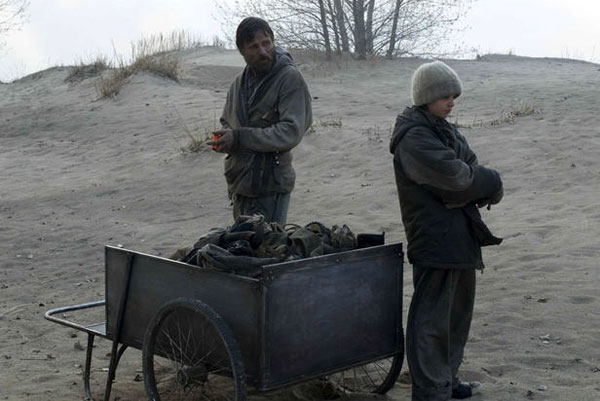
The advance stills: Sure, they’re grim and bleak, but are they grim and bleak enough?

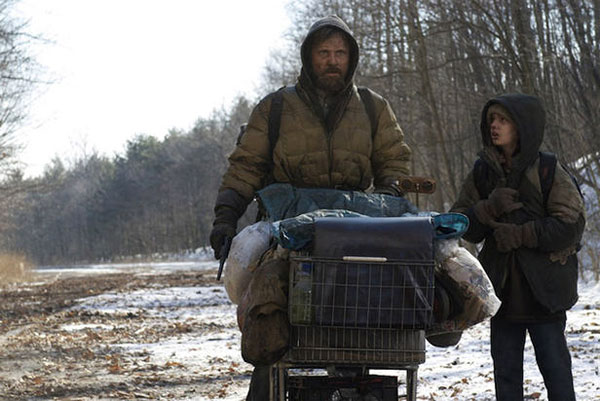
Also, why the stylized cart? If you’ve read the novel, you know what I mean–the cart needs to be a grocery store cart, homeless style! Hang on–

–that’s better! (NB: images link to a gallery of advance images)

Does it seem worth seeing in the theater?

Yes. We’ll be carrying the fire on or around November 26th (and just in time for Thanksgiving!)