Road Movie

“Having your book turned into a movie is like seeing your oxen turned into bouillon cubes” — John LeCarre

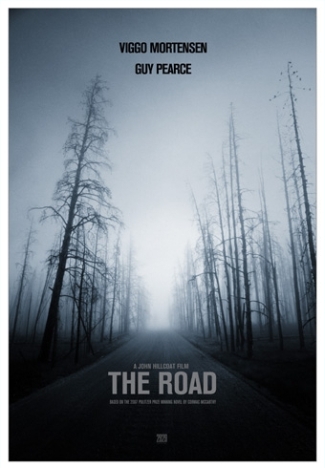
Movies rarely compare favorably to the books from which they are adapted and almost never surpass them. Still, film adaptations of books can be fantastic if handled by the right director–take Mexican director Alfonso Cuarón for example, whose brilliant films Children of Men and Harry Potter and the Prisoner of Azkaban (adaptations of books by P.D James and J.K. Rowling, respectively) convey richly imagined, engrossing worlds. Cuarón’s films join a small stable of adaptations that live up to–if not surpass–the books on which they are based. Most great film adaptations turn good genre fiction into great art. However, great literature doesn’t usually fare so well. Geniuses like Kubrick and Coppola have reconfigured airport reading like Stephen King’s The Shining and Mario Puzo’s The Godfather into cinematic masterpieces, but has anyone ever done justice to Melville or Hemingway or Hawthorne or Fitzgerald (of the four attempts at translating Gatsby to the screen, the 1974 Coppola-produced effort is arguably the best, but consider how short it falls of capturing Fitzgerald’s vision)? Which brings up the question: just how good, bad, or indifferent will the upcoming movie adaptation of Cormac McCarhy’s Pulitzer Prize winner The Road be? We thought we’d navigate the pros and cons here.

What The Road film adaptation has going for it:

The director: Australian director John Hillcoat’s 2005 feature film debut The Proposition captured the bloody violence and moral ambiguity of a world alienated from civilization. We loved the movie, and not enough people have seen it. The tone Hillcoat achieved in The Proposition seems well matched to McCarthy’s grim vision.

The producer: Nick Wechsler’s list of films includes Sex, Lies, and Videotape, The Player, Requiem for a Dream, 25th Hour, and Drugstore Cowboy–so it seems like he knows how to sit back and let a filmmaker create art without trying to, you know, have a massive Hollywood hit.

The leading man: Viggo Mortensen as the father seems like a great choice. Mortensen brought depth to the role he’s most famous for–Aragorn in The Lord of the Rings trilogy–something of a feat when you consider most of his screen time was devoted to scowling, brooding, or chopping up orcs. He was fantastic in the films he did with David Cronenberg, A History of Violence and Eastern Promises (his bathhouse fight scene is unbelievable). Mortensen’s a published author who started his own publishing house, Perceval Press, so he probably understands the literary gravity of The Road.

The story: Anyone who’s read The Road knows that it’s a sad and moving and strangely beautiful take on one of the most hackneyed devices of science fiction: the post-apocalyptic wasteland.

No Country for Old Men: The Coen brothers did a great job with No Country for Old Men.

Potential problem spots for The Road film adaptation:

The cast: We don’t know much about twelve year old Kodi Smit-McPhee who plays the son, but we do know that that is a major role. Let’s hope Kodi is more Jodie, less Jake Lloyd or (shiver) Dakota Fanning. However, Viggo’s had pretty positive things to say about him. Ringers Robert Duvall and Guy Pearce are also in there, but there aren’t too many other speaking parts in the book besides the father and the son, so it’s hard to predict what they’ll be doing–hopefully Hillcoat hasn’t fiddled with the story too much. Charlize Theron is also in the movie. The wife character showed up in a few dreamy flashbacks, but was more of a shadow than a fleshed out character; again, hopefully Hillcoat hasn’t chosen to expand the role to appease a wider demographic.

The story: Some of the best moments of The Road consist of the father’s inner monologues on memory and loss and very few directors can pull off a voice-over successfully (Terrence Malick is the only one who comes to mind right now). Of course, this problem of language is always the problem of movie adaptation.

All the Pretty Horses: Billy Bob Thornton’s leaden 2000 adaptation of the first of McCarthy’s “border trilogy” is pretty boring. I’ll admit that I’ve never finished the book, despite three attempts [ed. note: I finished the “border trilogy” in spring of ’09. Books are far, far, far superior to the film].

No Country for Old Men: Even though the Coens did a great job with No Country for Old Men, the book was still better than the movie–and No Country is, in some ways, McCarthy’s take on a genre novel, the crime procedural. In this sense, the Coens made a smart move, but they still couldn’t convey the depth and meaning of the book–again, much of it delivered via Sheriff Ed Tom Bell’s inner monologues. Although The Road may appear to have genre fiction elements–namely, the tropes of post-apocalyptic sci-fi–to describe it as such would be a severe limitation, as would be to film it in such a manner.

The advance stills: Sure, they’re grim and bleak, but are they grim and bleak enough?
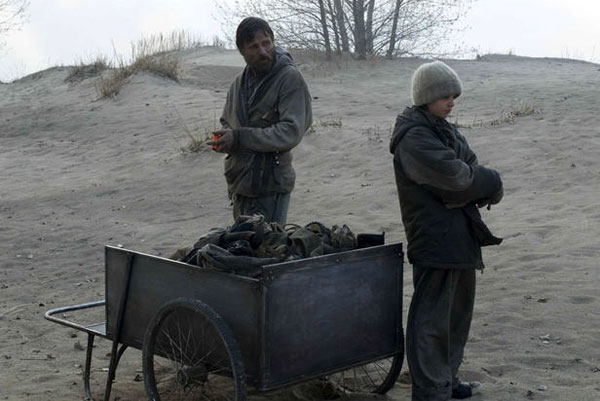
Also, why the stylized cart? If you’ve read the novel, you know what I mean–the cart needs to be a grocery store cart, homeless style! Hang on–
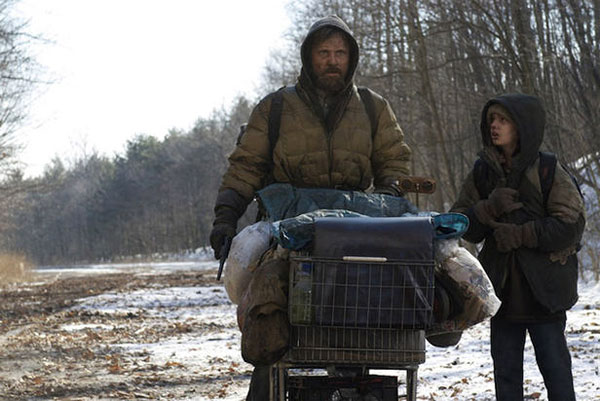
–that’s better! (NB: images link to a gallery of advance images)

Does it seem worth seeing in the theater?

Yes. We’ll be carrying the fire on or around November 26th (and just in time for Thanksgiving!)

Be Kind Rewind

Sweet and silly, Be Kind Rewind, Michel Gondry’s fourth film (fifth if you count his 2005 documentary, Block Party) recounts the adventures of Mike (Mos Def) and his pal Jerry (Jack Black) as they recreate films from memory. When Mr. Fletcher, owner of the Be Kind Rewind video store, goes away for a week to a Fats Waller convention, he leaves Mike in charge of the store. Unfortunately, after a bizarre accident, Jerry becomes magnetized and consequently demagnetizes the store’s entire collection of VHS tapes (no DVDs here, folks). When number-one customer Miss Falewicz (Mia Farrow) asks for Ghostbusters, the pair are forced to create their own version from memory (along with help from local laundress Alma (Melonie Diaz)). Miss Falewicz’s nephew and his friends see the bizarre results and must have more, hence the birth of “sweding“–the process of remaking film favorites. The neighborhood citizens go crazy for the sweded films, clamoring for their own favorites to be made. By the end of the film, the entire neighborhood has moved beyond copying other people’s movies. Instead, they make their own film, the (kinda invented) biography of Fats Waller.

Be Kind Rewind is full of goofy fun laughs, and despite its lighthearted tone it never half-asses–or overplays–handling its dominant themes of creativity and community. Jack Black never overdoes it as Jerry, the zany paranoiac, and Mos Def is fantastic as the slightly anxious, slightly slow Mike (his version of Chris Tucker during the sweding of Rush Hour 2 is worth the price of admission alone). Danny Glover plays Mr. Fletcher poignantly, and the character comes to serve as a kind of elegiac totem for the death of highly-specialized local video shops with knowledgeable, cinephile-employees. Be Kind Rewind is a funny, giving film, and never self-indulgent; it moves the viewer without a trace of schmalz. Plus, it never drags. Highly recommended.

Be Kind Rewind is out on DVD today.

Exterminate All Rational Thought: Burroughs at the Movies

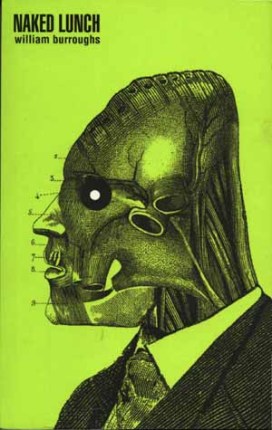
naked-lunch1.jpg

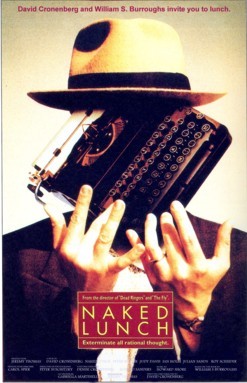
I love Naked Lunch. I love David Cronenberg. Theoretically, I should love David Cronenberg’s film adaptation of William Burrough’s psychosurreal classic. But hey, that’s rational thought for you, right? I didn’t love it in ’93 or ’94, the first time I saw it. Maybe I was too young. Maybe I just didn’t get it (but if that was the case then why did I love the book so much..?) So I watched it again as an undergrad; this was maybe ’99 or ’00. Nope. In fact, I remember thinking “Wow. This is actually pretty bad.” At that point, I was a big Cronenberg fan too. eXistenZ had just come out. eXistenZ is easily my favorite Cronenberg film, and a favorite film in general, and Naked Lunch didn’t hold up well against it or my re-reading of the Burrough’s book. But yet and still, ever the glutton for disappointment, I gave the Naked Lunch movie another shot this weekend, as part of the Biblioklept Summer of Cronenberg Film Festival. Guess what? It’s not a very good movie.

The fault of Cronenberg’s movie is not in failing to adapt the content of Burrough’s book, which is pretty much untranslatable as a narrative movie. Instead, Cronenberg attempts to weld some of the images of Naked Lunch–along with elements of other Burroughs novels such as Nova Express, The Soft Machine, and The Ticket that Exploded–into a cohesive thread using Burroughs’s biography as the overarching frame story. Burroughs’s life story is fascinating–the guy shot his wife in the head, for chrissakes–and lit junkies will love to see characters based on Kerouac and Ginsberg and Paul Bowles–but the end results simply don’t achieve or reflect the spirit of the novel. The bitter, caustic satire of Naked Lunch is almost wholly absent, replaced by wry one-liners from Peter Weller (who woodenly portrays Burroughs’s alter-ego, William Lee (an alter-ego who doesn’t appear in the novel of Naked Lunch at all, incidentally)). Cronenberg seems to underestimate his audience’s capacity for a nonlinear story, taking the loose collection of riffs, routines, and episodes that comprise Naked Lunch, and turning them into a pretty dull meditation on the nature of creativity and the suffering and alienation of the outsider-artist. Worst of all, the audience is asked to identify and sympathize with William Lee–again, this seems to be a negation of the original text.

naked_lunch.jpg

In the end, Cronenberg’s Naked Lunch is just another bad Cronenberg film (see also: his mish-mashed adaptation of J.G. Ballard’s Crash, his boring adaptation of Stephen King’s The Dead Zone). In Naked Lunch, we get the usual Cronenbergian tropes: mechanical objects that become hideously organic, bodily invasion, constant “is this real or is this a dream?” moments, and general dark creepiness. However, they simply don’t work here: Cronenberg is attempting Burroughs-icky resulting only in Cronenberg-icky. Cronenberg’s entire oeuvre is littered with flawed films, but I tend to enjoy them more for their flaws. This one was a no-go though, and I gave it three shots. But, in a way, I believe that Cronenberg deserved three viewings. You never know. Still, I doubt I’ll watch this one again.

If you haven’t seen a Cronenberg film, I suggest starting with Videodrome, A History of Violence, or eXistenZ. He also has a new movie coming out later this year, Eastern Promises starring Naomi Watts. If you haven’t read Burroughs, I suggest starting with Junkie or Queer (or just go ahead and jump into Naked Lunch).

I end with a far better review of Naked Lunch than I’ve provided here, courtesy of The Simpsons. Do you remember that episode where Bart makes a fake driver license (not the one where he’s awarded a real driver license courtesy Mayor Quimby)? And he takes Milhouse and Nelson and Martin on a road trip to the World’s Fair in Knoxville? Well, along the way the boys decide to sneak into an R-rated movie. They leave the theater disappointed; the shot reveals that they’ve just left Naked Lunch. Nelson remarks: “There’s at least two things wrong with that title.” I’ll leave it at that.

Rescue Dawn–Werner Herzog

rescuedawn2.jpg

So my uncle and I went to see Rescue Dawn, the new Werner Herzog film. Rescue Dawn is the true story of Dieter Dengler (not a porn name), an Air Force pilot who crashed his plane during a mission over Laos in 1966. Dengler was captured, held as a POW, and tortured by his captors. Dengler organized and executed a daring escape, leading the other prisoners out of the camp. In 1997 Herzog made a documentary about Dengler’s story called Little Dieter Needs to Fly. I have not seen that film.

My expectations for Rescue Dawn were high–I love Herzog’s films, which mix high adventure with a sense of naturalistic realism and psychological surrealism–and I love Christian Bale, he of American Psycho fame, who plays Dengler. I suppose my expectations were too high, because Rescue Dawn wasn’t nearly as good as I thought it would be. My uncle was also slightly disappointed. It was by no means bad, but it wasn’t nearly as good as its reviews would make it seem; additionally, it’s practically a Hollywood action movie (complete with the big happy ending in front of an assembled audience of cheering extras)–something I wouldn’t have expected from Herzog. Bale is excellent though, as is co-star Steve Zahn, and the setting and pacing of the film make for an exciting afternoon. Then again, so does Missing in Action.

I may be going a little rough on Rescue Dawn–it’s better than 99% of the schlock out there, and in a summer crowded with franchise sequels, I think that moviegoers (i.e. people who go to the movies every week) should go check it out. Chalk my disappointment up to high expectations. Netflix addicted hermits like myself should probably just wait for the DVD.

if…. — Lindsay Anderson

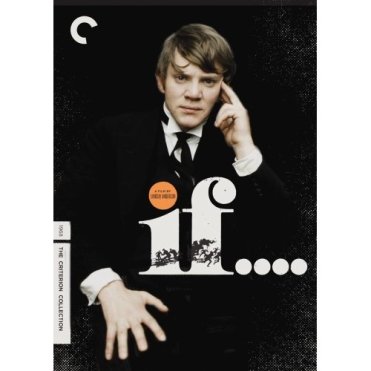
41ahznwegjl_ss500_.jpg

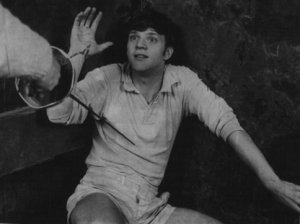
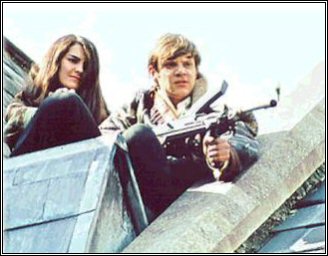
Criterion has finally given Lindsay Anderson‘s 1968 classic if…. a proper DVD release. if…. is one of my all time favorite films. Mick Travis (played with savage aplomb by a very young Malcolm McDowell) leads “The Crusaders,” a band of rebels who defy “The Whips,” the cruel upperclassmen who mete out harsh punishments at their stringent English boarding school. “What I want to know is when do we live?” asks restless Mick. However, the life of individual freedom that he wants to live is so suppressed by the cruel and dominating hierarchy of his school (a microcosm of British society) that he must take liberty by force. In one scene, the Crusaders playfully fence with each other, declaring “Death to all tyrants!” The playfulness quickly slips into violence, as the repressed urges of these would-be revolutionaries flare up. When Mick is cut, he shows his wounded hand and declares with pride “Blood! Real blood!”

if1.jpg

Anderson loads if…. with myriad revolutionary images that foreshadow the film’s shocking ending, at the same time tempering if…. with a surrealist sense of humor that satirizes the inherent dangers in institutionalized education and groupthink in general. if…. is bitingly funny, oddly sexy, and unlike any other film I’ve ever seen. The new edition looks great (much better than my VHS dub) and sounds great, and the commentary track provided by Malcolm McDowell and film critic David Robinson is insightful and surely a must for fans of the film. But who am I kidding, if you’re a fan of this film you’ve already seen the release and listened to the commentary–right?

if.jpg