“Happiness” — Sylvia Townsend Warner

“Happiness”

by

Sylvia Townsend Warner


‘The bathroom’s the awkwardest feature,’ said Mr. Naylor, of Elwes & Sons, house agents, ‘being situated on the ground floor. People don’t like ground-floor bathrooms. You might say, they just won’t hear of them.’

‘No, I suppose not. Yet …’ Lavinia Benton broke off.

‘I know what you were going to say, Mrs. Benton. You were going to say, Why not convert the dressing room upstairs, leaving the bathroom for what one might call a playroom, or a children’s lounge, or a study, if there happened to be no family. Once we’d got the bath out, it could be called ideal for that, being so inordinately large for a bathroom. But then the pipes would have to be carried upstairs. Think of the plumbing, Mrs. Benton! Prohibitive! No buyer would contemplate it, not for this class of residence—it isn’t as if this were one of those old oak jobs. And I understand you don’t want to let the estate in for any extra expense. So there we are, I’m afraid. Back where we started from!’

Mr. Naylor had, in fact, scotched a snake that wasn’t there. Lavinia’s ‘Yet’ had been provoked by the reflection that an increasingly large acreage of southern England was occupied between 7.30 and 8.30 a.m. by people resignedly bathing on ground level. Not so resignedly, either, since there are always buyers for bungalows. Both Mr. Petherick, of Petherick, Petherick & Sampson, and Mr. Cox, of Ransom & Titters, had already explained that Aller Lodge, the late Miss Esther Jeudwine’s brick-built, two-storey residence in sound repair, would have been easy enough to sell if only it had been a bungalow. All a matter of social psychology, thought Lavinia who, as a columnist on superior Women’s Pages, was accustomed to making something out of not much; a mass apprehension of being surprised with no clothes on, which if not primitive, since primitive man had other and more pressing things to be surprised by, must certainly go a long way back, being later reinforced by class distinction—the wealthy are draped, the poor go bare—and Christianity’s insistence on modesty; for though a fakir can be venerable in a light handful of marigolds, an archdeacon can scarcely leave off his gaiters. In short, the discomposure of being surprised with no clothes on is, like the pleasurability of possessing a virgin, one of the things long taken for granted—and really even more of an idée reçue‚ being subscribed to by both sexes alike. Yet here was this mass apprehension, fortified by tradition, smoothed by acceptance, part of the British way of life, suddenly ceasing to function when brought into bungalows, where the hazards that might justify it—housebreakers, mad dogs, cars out of control, voyeurs, private detectives, almost anything, in fact, except the atom bomb—would be much more on the cards. But one must remember that bathrooms being so recent an introduction, public opinion could not have made up its mind about them yet, and was bound to be rather hypothetical.

Lavinia became aware that Mr. Naylor was observing her with sympathy, but at the same time giving little coughs. Of course. The poor man wanted to go.
Continue reading ““Happiness” — Sylvia Townsend Warner”

“Solid Objects” — Virginia Woolf

“Solid Objects”

by

Virginia Woolf


The only thing that moved upon the vast semicircle of the beach was one small black spot. As it came nearer to the ribs and spine of the stranded pilchard boat, it became apparent from a certain tenuity in its blackness that this spot possessed four legs; and moment by moment it became more unmistakable that it was composed of the persons of two young men. Even thus in outline against the sand there was an unmistakable vitality in them; an indescribable vigour in the approach and withdrawal of the bodies, slight though it was, which proclaimed some violent argument issuing from the tiny mouths of the little round heads. This was corroborated on closer view by the repeated lunging of a walking-stick on the right-hand side. “You mean to tell me . . . You actually believe. . .” thus the walking-stick on the right-hand side next the waves seemed to be asserting as it cut long straight stripes upon the sand.

“Politics be damned!” issued clearly from the body on the left-hand side, and, as these words were uttered, the mouths, noses, chins, little moustaches, tweed caps, rough boots, shooting coats, and check stockings of the two speakers became clearer and clearer; the smoke of their pipes went up into the air; nothing was so solid, so living, so hard, red, hirsute and virile as these two bodies for miles and miles of sea and sandhill.
Continue reading ““Solid Objects” — Virginia Woolf”

Read “The Flight of Pigeons from the Palace,” a very short story by Donald Barthelme

“The Flight of Pigeons from the Palace”

by

Donald Barthelme


In the abandoned palazzo, weeds and old blankets filled the rooms. The palazzo was in bad shape. We cleaned the abandoned palazzo for ten years. We scoured the stones. The splendid architecture was furbished and painted. The doors and windows were dealt with. Then we were ready for the show.

The noble and empty spaces were perfect for our purposes. The first act we hired was the amazing Numbered Man. He was numbered from one to thirty-five, and every part moved. And he was genial and polite, despite the stresses to which his difficult métier subjected him. He never failed to say “Hello” and “Goodbye” and “Why not?” We were happy to have him in the show.

Then, the Sulking Lady was obtained. She showed us her back. That was the way she felt. She had always felt that way, she said. She had felt that way since she was four years old.

We obtained other attractions—a Singing Sword and a Stone Eater. Tickets and programs were prepared. Buckets of water were placed about, in case of fire. Silver strings tethered the loud-roaring strong-stinking animals.

The lineup for opening night included:

A startlingly handsome man

A Grand Cham

A tulip craze

The Prime Rate

Edgar Allan Poe

A colored light

We asked ourselves: How can we improve the show?

We auditioned an explosion.

There were a lot of situations where men were being evil to women—dominating them and eating their food. We put those situations in the show.

In the summer of the show, grave robbers appeared in the show. Famous graves were robbed, before your eyes. Winding-sheets were unwound and things best forgotten were remembered. Sad themes were played by the band, bereft of its mind by the death of its tradition. In the soft evening of the show, a troupe of agoutis performed tax evasion atop tall, swaying yellow poles. Before your eyes.

The trapeze artist with whom I had an understanding . . . The moment when she failed to catch me . . .

Did she really try? I can’t recall her ever failing to catch anyone she was really fond of. Her great muscles are too deft for that. Her great muscles at which we gaze through heavy-lidded eyes . . .

We recruited fools for the show. We had spots for a number of fools (and in the big all-fool number that occurs immediately after the second act, some specialties). But fools are hard to find. Usually they don’t like to admit it. We settled for gowks, gulls, mooncalfs. A few babies, boobies, sillies, simps. A barmie was engaged, along with certain dumdums and beefheads. A noodle. When you see them all wandering around, under the colored lights, gibbering and performing miracles, you are surprised.

I put my father in the show, with his cold eyes. His segment was called My Father Concerned about His Liver.

Performances flew thick and fast.

We performed The Sale of the Public Library.

We performed Space Monkeys Approve Appropriations.

We did Theological Novelties and we did Cereal Music (with its raisins of beauty) and we did not neglect Piles of Discarded Women Rising from the Sea.

There was faint applause. The audience huddled together. The people counted their sins.

Scenes of domestic life were put in the show.

We used The Flight of Pigeons from the Palace.

It is difficult to keep the public interested.

The public demands new wonders piled on new wonders.

Often we don’t know where our next marvel is coming from.

The supply of strange ideas is not endless.

The development of new wonders is not like the production of canned goods. Some things appear to be wonders in the beginning, but when you become familiar with them, are not wonderful at all. Sometimes a seventy-five-foot highly paid cacodemon will raise only the tiniest frisson. Some of us have even thought of folding the show—closing it down. That thought has been gliding through the hallways and rehearsal rooms of the show.

The new volcano we have just placed under contract seems very promising . . .

Read “Old Mr. Marblehall,” a short story by Eudora Welty

“Old Mr. Marblehall”

by

Eudora Welty


Old Mr. Marblehall never did anything, never got married until he was sixty. You can see him out taking a walk. Watch and you’ll see how preciously old people come to think they are made—the way they walk, like conspirators, bent over a little, filled with protection. The
y stand long on the corners but more impatiently than anyone, as if they expect traffic to take notice of them, rear up the horses and throw on the brakes, so they can go where they want to go. That’s Mr. Marblehall. He has short white bangs, and a bit of snapdragon in his lapel. He walks with a big polished stick, a present. That’s what people think of him. Everybody says to his face, “So well preserved!” Behind his back they say cheerfully, “One foot in the grave.” He has on his thick, beautiful, glowing coat—tweed, but he looks as gratified as an animal in its own tingling fur. You see, even in summer he wears it, because he is cold all the time. He looks quaintly secretive and prepared for anything, out walking very luxuriously on Catherine Street.

His wife, back at home in the parlor standing up to think, is a large, elongated old woman with electric-looking hair and curly lips. She has spent her life trying to escape from the parlor-like jaws of self-consciousness. Her late marriage has set in upon her nerves like a retriever nosing and puffing through old dead leaves out in the woods. When she walks around the room she looks remote and nebulous, out on the fringe of habitation, and rather as if she must have been cruelly trained—otherwise she couldn’t do actual, immediate things, like answering the telephone or putting on a hat. But she has gone further than you’d think: into club work. Surrounded by other more suitably exclaiming women, she belongs to the Daughters of the American Revolution and the United Daughters of the Confederacy, attending teas. Her long, disquieted figure towering in the candlelight of other women’s houses looks like something accidental. Any occasion, and she dresses her hair like a unicorn horn. She even sings, and is requested to sing. She even writes some of the songs she sings (“O Trees in the Evening”). She has a voice that dizzies other ladies like an organ note, and amuses men like a halloo down the well. It’s full of a hollow wind and echo, winding out through the wavery hope of her mouth. Do people know of her perpetual amazement? Back in safety she wonders, her untidy head trembles in the domestic dark. She remembers how everyone in Natchez will suddenly grow quiet around her. Old Mrs. Marblehall, Mr. Marblehall’s wife: she even goes out in the rain, which Southern women despise above everything, in big neat biscuit-colored galoshes, for which she “ordered off.” She is only looking around—servile, undelighted, sleepy, expensive, tortured Mrs. Marblehall, pinning her mind with a pin to her husband’s diet. She wants to tempt him, she tells him. What would he like best, that he can have?

There is Mr. Marblehall’s ancestral home. It’s not so wonderfully large—it has only four columns—but you always look toward it, the way you always glance into tunnels and see nothing. The river is after it now, and the little back garden has assuredly crumbled away, but the box maze is there on the edge like a trap, to confound the Mississippi River. Deep in the red wall waits the front door—it weighs such a lot, it is perfectly solid, all one piece, black mahogany…. And you see—one of them is always going in it. There is a knocker shaped like a gasping fish on the door. You have every reason in the world to imagine the inside is dark, with old things about. There’s many a big, deathly-looking tapestry, wrinkling and thin, many a sofa shaped like an S. Brocades as tall as the wicked queens in Italian tales stand gathered before the windows. Everything is draped and hooded and shaded, of course, unaffectionate but close. Such rosy lamps! The only sound would be a breath against the prisms, a stirring of the chandelier. It’s like old eye-lids, the house with one of its shutters, in careful working order, slowly opening outward. Then the little son softly comes and stares out like a kitten, with button nose and pointed ears and little fuzz of silky hair running along the top of his head. Continue reading “Read “Old Mr. Marblehall,” a short story by Eudora Welty”

“The Duel That Was Not Fought” — Stephen Crane

“The Duel That Was Not Fought”

by

Stephen Crane


Patsy Tulligan was not as wise as seven owls, but his courage could throw a shadow as long as the steeple of a cathedral. There were men on Cherry Street who had whipped him five times, but they all knew that Patsy would be as ready for the sixth time as if nothing had happened.

Once he and two friends had been away up on Eighth Avenue, far out of their country, and upon their return journey that evening they stopped frequently in saloons until they were as independent of their surroundings as eagles, and cared much less about thirty days on Blackwell’s.

On Lower Sixth Avenue they paused in a saloon where there was a good deal of lamp-glare and polished wood to be seen from the outside, and within, the mellow light shone on much furbished brass and more polished wood. It was a better saloon than they were in the habit of seeing, but they did not mind it. They sat down at one of the little tables that were in a row parallel to the bar and ordered beer. They blinked stolidly at the decorations, the bar-tender, and the other customers. When anything transpired they discussed it with dazzling frankness, and what they said of it was as free as air to the other people in the place.

At midnight there were few people in the saloon. Patsy and his friends still sat drinking. Two well-dressed men were at another table, smoking cigars slowly and swinging back in their chairs. They occupied themselves with themselves in the usual manner, never betraying by a wink of an eyelid that they knew that other folk existed. At another table directly behind Patsy and his companions was a slim little Cuban, with miraculously small feet and hands, and with a youthful touch of down upon his lip. As he lifted his cigarette from time to time his little finger was bended in dainty fashion, and there was a green flash when a huge emerald ring caught the light. The bar-tender came often with his little brass tray. Occasionally Patsy and his two friends quarrelled. Continue reading ““The Duel That Was Not Fought” — Stephen Crane”

“Fans” — Barry Hannah

“Fans”

by

Barry Hannah


Wright’s father, a sportswriter and a hack and a shill for the university team, was sitting next to Milton, who was actually blind but nevertheless a rabid fan, and Loomis Orange, the dwarf who was one of the team’s managers. The bar was out of their brand of beer, and they were a little drunk, though they had come to that hard place together where there seemed nothing, absolutely nothing to say.

The waitress was young. Normally, they would have commented on her and gone on to pursue the topic of women, the perils of booze, or the like. But not now. Of course it was the morning of the big game in Oxford, Mississippi.

Someone opened the door of the bar, and you could see the bright wonderful football morning pouring in with the green trees, the Greek-front buildings, and the yelling frat boys. Wright’s father and Loomis Orange looked up and saw the morning. Loomis Orange smiled, as did Milton, hearing the shouts of the college men. The father did not smile. His son had come in the door, swaying and rolling, with one hand to his chest and his walking stick in the other.

Wright’s father turned to Loomis and said, “Loomis, you are an ugly distorted little toad.”

Loomis dropped his glass of beer.

“What?” the dwarf said.

“I said that you are ugly,” Wright said.

“How could you have said that?” Milton broke in.

Wright’s father said, “Aw, shut up, Milton. You’re just as ugly as he is.”

“What’ve I ever did to you?” cried Milton.

Wright’s father said, “Leave me alone! I’m a writer.”

“You ain’t any kind of writer. You an alcoholic. And your wife is ugly. She’s so skinny she almost ain’t even there!” shouted the dwarf.

People in the bar—seven or eight—looked over as the three men spread, preparing to fight. Wright hesitated at a far table, not comprehending.

His father was standing up.

“Don’t, don’t, don’t,” Wright said. He swayed over toward their table, hitting the floor with his stick, moving tables aside.

The waitress shouted over, “I’m calling the cops!”

Wright pleaded with her: “Don’t, don’t, don’t!”

“Now, please, sit down everybody!” somebody said.

They sat down. Wright’s father looked with hatred at Loomis. Milton was trembling. Wright made his way slowly over to them. The small bar crowd settled back to their drinks and conversation on the weather, the game, traffic, etc. Many of the people talked about J. Edward Toole, whom all of them called simply Jet. The name went with him. He was in the Ole Miss defensive secondary, a handsome figure who was everywhere on the field, the star of the team. Continue reading ““Fans” — Barry Hannah”

“The Brother” — Robert Coover

“The Brother”

by

Robert Coover


right there right there in the middle of the damn field he says he wants to put that thing together him and his buggy ideas and so me I says “how the hell you gonna get it down to the water?” but he just focuses me out sweepin the blue his eyes rollin like they do when he gets het on some new lunatic notion and he says not to worry none about that just would I help him for God’s sake and because he don’t know how he can get it done in time otherwise and though you’d have to be loonier than him to say yes I says I will of course I always would crazy as my brother is I’ve done little else since I was born and my wife she says “I can’t figure it out I can’t sec why you always have to be babyin that old fool he ain’t never done nothin for you God knows and you got enough to do here fields need plowin it’s a bad enough year already my God and now that red-eyed brother of yours wingin around like a damn cloud and not knowin what in the world he’s doin buildin a damn boat in the country my God what next? you’re a damn fool I tell you” but packs me some sandwiches just the same and some sandwiches for my brother Lord knows his wife don’t have no truck with him no more says he can go starve for all she cares she’s fed up ever since the time he made her sit out on a hillside for three whole days rain and everything because he said she’d see God and she didn’t see nothin and in fact she like to die from hunger nothin but berries and his boys too they ain’t so bright neither but at least they come to help him out with his damn boat so it ain’t just the two of us thank God for that and it ain’t no goddamn fishin boat he wants to put up neither in fact it’s the biggest damn thing I ever heard of and for weeks wees I’m tellin you we ain’t doin nothin but cuttin down pine trees and haulin them out to his field which is really pretty high up a hill and my God that’s work lemme tell you and my wife she sighs and says I am really crazy r-e-a-1-l-y crazy and her four months with a child and tryin to do my work and hers too and still when I come home from haulin timbers around all day she’s got enough left to rub my shoulders and the small of my back and fix a hot meal her long black hair pulled to a knot behind her head and hangin marvelously down her back her eyes gentle but very tired my God and I says to my brother I says “look I got a lotta work to do buddy you’ll have to finish this idiot thing yourself I wanna help you all I can you know that but” and he looks off and he says “it don’t matter none your work” and I says “the hell it don’t how you think me and my wife we’re gonna eat I mean where do you think this food comes from you been puttin away man? you can’t eat this goddamn boat out here ready to rot in that bastard sun” and he just sighs long and says “no it just don’t matter” and he sits him down on a rock kinda tired like and stares off and looks like he might even for God’s sake cry and so I go back to bringin wood up to him and he’s already started on the keel and frame God knows how he ever found out to build a damn boat lost in his fog where he is Lord he was twenty when I was born and the first thing I remember was havin to lead him around so he didn’t get kicked by a damn mule him who couldn’t never do nothin in a normal way just a huge oversize fuzzyface boy so anyway I take to gettin up a few hours earlier ever day to do my farmin my wife apt to lose the baby if she should keep pullin around like she was doin then I go to work on the boat until sundown and on and on the days hot and dry and my wife keepin good food in me or else I’d of dropped sure and no matter what I say to try and get out of it my brother he says “you come and help now the rest don’t matter” and we just keep hammerin away and my God the damn thing is big enough for a hundred people and at least I think at least it’s a place to live and not too bad at that at least it’s good for somethin but my wife she just sighs and says no good will come of it and runs her hands through my hair but she don’t ask me to stop helpin no more because she knows it won’t do no good and she’s kinda turned into herself now these days and gettin herself all ready and still we keep workin on that damn thing that damn boat and the days pass and my brother he says we gotta work harder we ain’t got much time and from time to time he gets a coupla neighbors to come over and give a hand them sucked in by the size and the novelty of the thing makin jokes some but they don’t stay around more than a day or two and they go away shakin their heads and swearin under their breath and disgusted they got weaseled into the thing in the first place and me I only get about half my place planted and sec to my stock as much as I can my wife she takes more care of them than I can but at least we won’t starve we say if we just get some rain and finally we get the damn thing done all finished by God and we cover it in and out with pitch and put a kinda fancy roof on it and I come home on that last day and I ain’t never goin back ain’t never gonna let him talk me into nothin again and I’m all smellin of tar and my wife she cries and cries and I says to her not to worry no more I’ll be home all the time and me I’m cryin a little too though she don’t notice just thinkin how she’s had it so lonely and hard and all and for one whole day I just sleep the whole damn day and the rest of the week I work around the farm and one day I get an idea and I go over to my brother’s place and get some pieces of wood left over and whaddaya know? they are all livin on that damn boat there in the middle of nowhere him and his boys and some women and my brother’s wife she’s there too but she’s madder than hell and carpin at him to get outa that damn boat and come home and he says she’s got just one more day and then he’s gonna drug her on the boat but he don’t say it like a threat or nothin more like a fact a plain fact tomorrow he’s gonna drug her on the boat well I ain’t one to get mixed up in domestic quarrels God knows so I grab up the wood and beat it back to my farm and that evenin I make a little cradle a kinda fancy one with little animal figures cut in it and polished down and after supper I give it to my wife as a surprise and she cries and cries and holds me tight and says don’t never go away again and stay close by her and all and I feel so damn good and warm about it all and glad the boat thing is over and we get out a little wine and we decide the baby’s name is gonna be either Nathaniel or Anna and so we drink an extra cup to Nathaniel’s health and we laugh and we sigh and drink one to Anna and my wife she gently fingers the little animal figures and says they’re beautiful and really they ain’t I ain’t much good at that sorta thing but I know what she means and then she says “where did you get the wood?” and I says “it’s left over from the boat” and she don’t say nothin for a moment and then she says “you been over there again today?” and I says “yes just to get the wood” and she says “what’s he doin now he’s got the boat done?” and I says “funny thing they’re all living in the damn thing all except the old lady she’s over there hollerin at him how he’s gettin senile and where does he think he’s sailin to and how if he ain’t afraid of runnin into a octypuss on the way he oughta get back home and him sayin she’s a nut there ain’t no water and her sayin that’s what she’s been tellin him for six months” and my wife she laughs and it’s the happiest laugh I’ve heard from her in half a year and I laugh and we both have another cup-of wine and my wife she says “so he’s just livin on that big thing all by hisself?” and I says “no he’s got his boys on there and some young women who are maybe wives of the boys or somethin I don’t know I ain’t never seen them before and all kinda damn animals and birds and things I ain’t never seen the likes” and my wife she says “animals? what animals?” and I says “oh all kinds I don’t know a whole damn menagerie all clutterin and stinkin up the boat God what a mess” and my wife laughs again and she’s a little silly with the wine and she says “I bet he ain’t got no pigs” and “oh yes I seen them” I says and we laugh thinkin about pigs rootin around in that big tub and she says “I bet he ain’t got no jackdaws” and I says “yes I seen a couple o£ them too or mostly I heard them you couldn’t hardly hear nothin else” and we laugh again thinkin about them crows and his old lady and the pigs and all and my wife she says “I know what he ain’t got I bet he ain’t got no lice” and we both laugh like crazy and when I can I says “oh yes he does less he’s took a bath” and we both laugh til! we’re cryin and we finish off the wine and my wife says “look now I fyiow what he ain’t got he ain’t got no termites” and I says “you’re right I don’t recollect no termites maybe we oughta make him a present” and my wife she holds me close quiet all of a sudden and says “he’s really movin Nathaniel’s really movin” and she puts my hand down on her round belly and the little fella is kickin up a terrific storm and I says kinda anxious “does it hurt? do you think that—?” and “no” she says “it’s good” she says and so I says with my hand on her belly “here’s to you Nathaniel” and we drain what’s left in the bottom of our cups and the next day we wake up in each other’s arms and it’s rainin and than God we say and since it’s rainin real good we stay inside and do things a round the place and we’re happy because the rain has come just in time and in the evenin things smell green and fresh and delicious and it’s still rainin a little but not too hard so I decide to take a walk and I wander over by my brother’s place thinkin I’ll ask him if he’d like to take on some pet termites to go with his collection and there by God is his wife on the boat and I don’t know if he drug her on or if she just finally come by herself but she ain’t sayin nothin which is damn unusual and the boys they ain’t sayin nothin neither and my brother he ain’t sayin nothin they’re just all standin up there on top and gazin off and I holler up at them “nice rain ain’t it?” and my brother he looks down at me standin there in the rain and still he don’t say nothin but he raises his hand kinda funny like and then puts it back on the rail and I decide not to say nothin about the termites and it’s startin to rain a little harder again so I turn away and go back home and I tell my wife about what happened and my wife she just laughs and says “they’re all crazy he’s finally got them all crazy” and she’s cooked me up a special pastry with £rcsh meat and so we forget about them but by God the next day the rain’s still comin down harder than ever and water’s beginnin to stand around in places and after a week of rain I can see the crops is pretty well ruined and I’m havin trouble keepin my stock fed and my wife she’s cryin and talkin about our bad luck that we might as well of built a damn boat as plant all them crops and still we don’t figure things out I mean it just don’t come to our minds not even when the rain keeps spillin down like a ocean dumped upsidedown and now water is beginnin to stand around in big pools really big ones and water up to the ankles around the house and Icakin in and pretty soon the whole damn house is gettin fulla water and I keep sayin maybe we oughta go use my brother’s boat till this blows over but my wife she says “never” and then she starts in cryin again so finally I says to her I says “we can’t be so proud I’ll go ask him” and so I set out in the storm and I can hardly see where I’m goin and I slip up to my neck in places and finally I get to where the boat is and I holler up and my brother he comes out and he looks down at where I am and he don’t say nothin that bastard he just looks at me and I shout up at him I says “hey is it all right for me and my wife to come over until this thing blows over?” and still he don’t say a damn word he just raises his hand in that same sillyass way and I holler “hey you stupid sonuvabitch I’m soakin wet goddamn it and my house is fulla water and my wife she’s about to have a kid and she’s apt to get sick all wet and cold to the bone and all I’m askin you—” and right then right while I’m still talkin he turns around and he goes back in the boat and I can’t hardly believe it me his brother but he don’t come back out and I push up under the boat and I beat on it with my fists and scream at him and call him ever name I can think up and I shout for his boys and for his wife and for anybody inside and nobody comes out “Gowdamn you” I cry out at the top of my lungs and half sobbin and sick and then feelin too beat out to do anythin more I turn around and head back for home but the rain is thunderin down like mad now and in places I gotta swim and I can’t make it no further and I recollect a hill nearby and I head for it and when I get to it I climb up on top of it and it feels good to be on land again even if it is soggy and greasy and I vomit and retch there awhile and move further up and the next thing I know I’m wakin up the rain still in my face and the water halfway up the hill toward me and I look cut and I can see my brother’s boat is fioatin and I wave at it but I don’t see nobody wave back and then I quick look out towards my own place and all I can see is the top of it and of a sudden I’m scared scared about my wife and I go tearin for the house swimmin most all the way and cryin and shoutin and the rain still comin down like crazy and so now well now I’m back here on the hill again what little there is left of it and I’m figurin maybe I got a day left if the rain keeps comin and it don’t show no signs of stoppin and I can’t see my brother’s boat no more gone just water how how did he know? that bastard and yet I gotta hand it to him it’s not hard to see who’s crazy around here I can’t see my house no more I just left my wife inside where I found her I couldn’t hardly stand to look at her the way she was

“Municipal Noir,” a very short tale by Hob Broun

“Municipal Noir”

by

Hob Broun

from Cardinal Numbers


MADRID, IN NEBRASKA’S SOUTHWEST corner, in the wide terraced plain below the Platte, had a Hog & Hominy Fest annually until 1978. There are three taverns in the town, two hardware stores, a Boys’ Club, a pistol range, and Strunk Fabrication, where crèche figures and baptismal fonts are made by a system of injection molding.

IN August of 1977, Ron Maddox was planning a future there. He had come to his wife’s country from North Dakota. Ron’s Pythagoras ABM Silo Group Commander, Lieutenant Benkelman, had been the best man at the wedding in Minot. Bonnie was expecting a child, but she wasn’t pregnant yet.

IT was only the fact of having once received a Visible Man anatomy doll for Christmas that prepared Kallinger for what he was to find all over the kitchen of Unit No. 6 at the mobile home park just off the county blacktop midway between Madrid and La Paz. Interim Coroner Perk Feed had so little to work with that even a preliminary finding seemed unlikely. Feed’s right leg was some two and one quarter inches shorter than his left, due to a fraternity initiation.

WAS Fran the kind of woman who would go all the way to Yankton for bridgework? Why had Lute Strunk rotated his best acres into sorghum? His CB handle was “Fledermaus,” and some said he had peculiar ideas about Jews.

AT 9:15 a.m. on Friday, Miss Clara Musil reported that her collection of little glass animals had been vandalized by a one-armed man. The light-blue hatchback had been abandoned next to the Elks Hall. Both Reverend and Mrs. LaFollette were treated for hyperventilation.

KALLINGER, at the subsequent awards dinner, wearing a strap-in-the-back “Go ’Huskers” baseball cap, refused to eat his portion of tapioca pudding until someone had tasted it first, and later proposed a curious toast “to Negro banking interests.”

“HE wanted the best of both worlds,” said a bureau insider.

Donna, Benkelman’s estranged wife, disagrees. Living in San Diego now, she has legally adopted Fran’s two sons and works as a commercial illustrator.

“Gas spectrometry is fine. Fiber analysis is fine. But people want a good, human story, and in this case they didn’t get it.”

SUSPICION of multiple sodomy focused on a “drifter” with a history of bronchiectasis. Someone had caused Jud Musil’s feed troughs to be infected with hog cholera. These were theories congruent with mutual distrust.

“We lacked a fallback position,” one resident later observed. “Pictures just didn’t tell the story.”

AND then on a crisp October morning, during the final hour of Ingo Feed’s Stop & Swap radio show, a strangely insistent man phoned in to offer his entire collection of bat-wing fans in exchange for “the global freezing design.”

BY now people were beginning to ask hard questions about the investigative reporter in their midst. Complicitous terrorist supplying atrocity photos to clients in Melbourne, Rome, Pernambuco, and Dubai? Semiliterate impostor becalmed in a delusional world of Mod Squad reruns?

OVER treacherous, ice-glazed roads, normally temperate, circumspect farm families drove the forty-five miles to Arbeiter Mall so they could dine at a Polynesian restaurant. Owner Gus Triandos would boast once too often about his acquaintance with high-level research. The baby back ribs were moist, tender, imaginatively sauced.

TRIAL proceedings, convened at the county seat of Bogota, began the first week of the new year under the guidance of Judge Pangloss LaFollette, no relation.

Dr. Shah, for the prosecution, explained that, as an “outsider,” he’d had little success in convincing the authorities, even in the face of corroborative evidence from a degreed caseworker, that the dozens of cigarette burns on the chest were cause for alarm. Dr. Zweig, for the defense, described Ron as “a man without qualities.” Fran, according to the testimony of a Chicago psychic, was operating a barge on the Loire.

“QUITE simply, there are no words to describe what Mrs. Maddox has already paid in suffering,” said a friend of the family.

BONNIE appeared each day in the same oyster-gray ensemble, occupied the same front-row seat. Her only change of expression, a slight moue disarranging normally serene features, came as a result of Kallinger’s breakdown on the stand, his admission that “I never learned to hit the curveball.”

THE jury, perhaps overly sequestered, imposed its inability to reach a verdict.

img_9613

“Detective Novel” — Robert Walser

“Detective Novel”

by

Robert Walser

translated by Tom Whalen


HE PRETENDED to possess technical expertise. Anyway, the title seemed quite brilliant. I resolved to learn more and started reading him, but he left much to be desired. Both he and his author lacked a certain finesse. He seemed to have no place to call home. How can I cuddle up to someone who isn’t comfortable with himself? His sentences were laborious paths for those who tread on them. I remember far more beautiful rambles and gladly admit this, since I gain by this admission. He was viewed quite kindly. An attempt to create interesting situations was discovered with delight. Already the first chapter stretched out to the most accommodating length imaginable. Each paragraph elicited from me a grateful yawn. By the way, I think the time of the detective novel is over. The puzzling disappearance of refined, charming people doesn’t seem very fresh these days. Authors have operated more than enough with chemicals and the like. I did my best to succumb to his charms, but alas I failed in this endeavor. Perhaps I lack the openness, I said, smiling at one of those persons (I mean myself) unsympathetic to some new releases. In fact, I find it aggravating to say yes to everything. In the course of the events he let me gaze into a Russian female. It may be that I’m expressing myself a bit sloppily here. All in all, for what he was, I found him unable to live up to himself. I hold his father responsible that I’m pained by his existence. My contemporaries may note his innocuousness. But can a detective novel be innocuous? Doesn’t he fail when, instead of arousing suspense, he allows us to be bored in his presence? Ambitious lackey, it would be best if you vanished. That you were published was your misfortune. Whoever reads you pities you. Whoever investigates you has to laugh at you, though, alas, alas, you’re innocent! In any case, you’re not what you should be. What you could be if things had turned out right you aren’t, because things didn’t turn out right. Fare thee well, unwarranted detective novel.

Read “55 Miles to the Gas Pump,” a very short horror story by Annie Proulx

“55 Miles to the Gas Pump”

by

Annie Proulx


Rancher Croom in handmade boots and filthy hat, that walleyed cattleman, stray hairs like the curling fiddle string ends, that warm-handed, quick-foot dancer on splintery boards or down the cellar stairs to a rack of bottles of his own strange beer, yeasty, cloudy, bursting out in garlands of foam, Rancher Croom at night galloping drunk over the dark plain, turning off at a place he knows to arrive at a canyon brink where he dismounts and looks down on tumbled rock, waits, then steps out, parting the air with his last roar, sleeves surging up, windmill arms, jeans riding over boot tops, but before he hits he rises again to the top of the cliff like a cork in a bucket of milk.

Mrs. Croom on the roof with a saw cutting a hole into the attic where she has not been for twelve years thanks to old Croom’s padlocks and warnings, whets to her desire, and the sweat flies as she exchanges the saw for a chisel and hammer until a ragged slab peak is free and she can see inside: just as she thought: the corpses of Mr. Croom’s paramours – she recognizes them from their photographs in the paper: MISSING WOMAN – some desiccated as jerky and much the same color, some moldy from lying beneath roof leaks, and, all of them used hard, covered with tarry handprints, the marks of boot heels, some bright blue with remnants of paint used on the shutters years ago, one wrapped in newspaper nipple to knee.

When you live a long way out you make your own fun.

“By the Numbers” — Hob Broun

“By the Numbers”

by

Hob Broun


[1]

THEY WORKED AT THE enclosed mall in King of Prussia. They wore plastic nametags, the corporate logo above a deep groove accommodating a Dymo label. Jenelle for the record store, Courtney for the bookstore. They had received reprimands for lateness.

[2]

Dinner is interesting. The plastic bag doesn’t melt in the boiling water. You cut off the top with scissors and lobster Newburg comes out.

From the paper: “Dartmouth Warnell, 19, of North Philadelphia, while attempting to escape from police custody, was shot and killed in the parking lot of the Afro-American Cultural Museum. A warrant for driving-while-suspended had been outstanding.”

The table is a phone company cable spool which occasionally insinuates a splinter. The
VCR format is unchic: Beta. The movie from the rental store traces an anchorwoman who finally turns into a werewolf on the air. They’ve seen it before.

[3]

Saturdays there are special events at the mall. It could be a ho-ho banjo band in red vests and sleeve garters. Or a begonia club. Or a cat show. There might be Cub Scouts all over the place. Everyone seems to put in the extra effort on a Saturday. Their jaws ache from smiling.

[4]

Courtney and Jenelle together in a bath. Pubic hair is ugly, but they’re afraid to shave. Many products for the hair, each based on a wholesome foodstuff. Plastic bottles bobbing.

J: I wish my toes were long and thin like yours.

[4A]

Courtney and Jenelle in a stall shower, embracing in soap foam. Why they’re late all the time. Mist.

[4B]

Courtney and Jenelle washing clothes by the Orinoco. (Black-and-white, dubbed.)

C: Why can’t I get my skirts as bright as yours?

J: You’re not beating them hard enough.

Rising smoke in the distance, music of chain saws. Continue reading ““By the Numbers” — Hob Broun”

“Ghosts” — Robert Walser

“Ghosts”

by

Robert Walser

translated by Tom Whalen


I don’t know if it can be to my advantage to review a kind of dime novel in which, as far as I can remember, there stood in a pretty little town a haunted tower.

In my opinion ghosts are very modern. It seems to me it’s become fashionable to believe, with a certain persistent willfulness, in inexplicable appearances.

One must admit this takes courage. As for me, I lived temporarily, if I dare say so straight out, in a bright, wide, two-windowed room. One night I awoke in bed and saw, on one of the armchairs or stools that came with the room, someone sitting.

Something nonexistent was existent, for when I had gone nearer to inspect or examine the place, the something (undoubtedly I was dealing with a ghost here) had evaporated.

To return to my little booklet in which, among other things, a young woman danced: it’s been quite some time since I perused this work, which dealt mainly with an ingenious Hans who, in all innocence and innocuousness, pulled off, as it were, a stroke of genius.

The landscape seemed to me delightfully sketched; the subject matter revolved as much around money as around love. A little river that stretched around the town the author had charmingly entrusted to blab mysterious things. The brooklet in this regard proved to be immensely talented, since it busily burbled and babbled night and day.

Attentively I listened in on the engaging story. Roles were swapped, young sophisticated girls sat in the pleasing interiors of music stores, into which one glanced in passing.

Hans proved to be a complications-disentangler.

I like to imagine my up-to-the-minute diction as tabloidish. I hope this will be judged kindly.

A beautiful woman sat interestingly ghostlike, I mean conspicuously thin, thus in fashion, at a window. Hans bestowed upon her his interest. In his eyes lay so much justifiable or baseless melancholy that the woman leapt up in bewilderment.

These and similar events occurred in the little volume whose author I don’t name because he hardly wishes it. There are little books we read as if we’re eating something delicious. We quickly forget them. After a certain amount of time, perhaps we recall them again. They’re like people we’re capable of loving because they’re not difficult. I also wish this for what I have written here.

“The Challenge” — Jorge Luis Borges

“The Challenge”

by

Jorge Luis Borges

Translated by d by Norman Thomas di Giovanni


All over the Argentine runs a story that may belong to legend or to history or (which may be just another way of saying it belongs to legend) to both things at once. Its best recorded versions are to be found in the unjustly forgotten novels about outlaws and desperadoes written in the last century by Eduardo Gutiérrez; among its oral versions, the first one I heard came from a neighborhood of Buenos Aires bounded by a penitentiary, a river, and a cemetery, and nicknamed Tierra del Fuego. The hero of this version was Juan Muraña, a wagon driver and knife fighter to whom are attributed all the stories of daring that still survive in what were once the outskirts of the city’s Northside. That first version was quite simple. A man from the Stockyards or from Barracas, knowing about Muraña’s reputation (but never having laid eyes on him), sets out all the way across town from the Southside to take him on. He picks the fight in a corner saloon, and the two move into the street to have it out. Each is wounded, but in the end Muraña slashes the other man’s face and tells him, “I’m letting you live so you’ll come back looking for me again.”

What impressed itself in my mind about the duel was that it had no ulterior motive. In conversation thereafter (my friends know this only too well), I grew fond of retelling the anecdote. Around 1927, I wrote it down, giving it the deliberately laconic title “Men Fought.” Years later, this same anecdote helped me work out a lucky story—though hardly a good one—called “Streetcorner Man.” Then, in 1950, Adolfo Bioy-Casares and I made use of it again to plot a film script that the producers turned down and that would have been called On the Outer Edge. It was about hard-bitten men like Muraña who lived on the outskirts of Buenos Aires before the turn of the century. I thought, after such extensive labors, that I had said farewell to the story of the disinterested duel. Then, this year, out in Chivilcoy, I came across a far better version. I hope this is the true one, although since fate seems to take pleasure in a thing’s happening many times over, both may very well be authentic. Two quite bad stories and a script that I still think of as good came out of the poorer first version; out of the second, which is complete and perfect, nothing can come. Without working in metaphors or details of local color, I shall tell it now as it was told to me. The story took place to the west, in the district of Chivilcoy, sometime back in the 1870’s. Continue reading ““The Challenge” — Jorge Luis Borges”

Read “Love on the Bon-Dieu,” an Easter story by Kate Chopin

“Love on the Bon-Dieu”

by

Kate Chopin

from Bayou Folk (1894)


Upon the pleasant veranda of Père Antoine’s cottage, that adjoined the church, a young girl had long been seated, awaiting his return. It was the eve of Easter Sunday, and since early afternoon the priest had been engaged in hearing the confessions of those who wished to make their Easters the following day. The girl did not seem impatient at his delay; on the contrary, it was very restful to her to lie back in the big chair she had found there, and peep through the thick curtain of vines at the people who occasionally passed along the village street.

She was slender, with a frailness that indicated lack of wholesome and plentiful nourishment. A pathetic, uneasy look was in her gray eyes, and even faintly stamped her features, which were fine and delicate. In lieu of a hat, a barege veil covered her light brown and abundant hair. She wore a coarse white cotton “josie,” and a blue calico skirt that only half concealed her tattered shoes.

As she sat there, she held carefully in her lap a parcel of eggs securely fastened in a red bandana handkerchief.

Twice already a handsome, stalwart young man in quest of the priest had entered the yard, and penetrated to where she sat. At first they had exchanged the uncompromising “howdy” of strangers, and nothing more. The second time, finding the priest still absent, he hesitated to go at once. Instead, he stood upon the step, and narrowing his brown eyes, gazed beyond the river, off towards the west, where a murky streak of mist was spreading across the sun.

“It look like mo’ rain,” he remarked, slowly and carelessly.

“We done had ’bout ‘nough,” she replied, in much the same tone.

“It’s no chance to thin out the cotton,” he went on.

“An’ the Bon-Dieu,” she resumed, “it’s on’y to-day you can cross him on foot.”

“You live yonda on the Bon-Dieu, donc?” he asked, looking at her for the first time since he had spoken.

“Yas, by Nid d’Hibout, m’sieur.” Continue reading “Read “Love on the Bon-Dieu,” an Easter story by Kate Chopin”

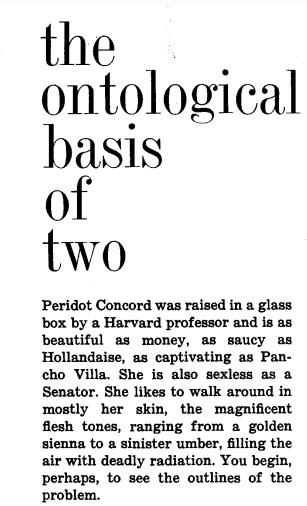
Read Donald Barthelme’s uncollected short story “The Ontological Basis of Two”

Donald Barthelme published a short story called “The Ontological Basis of Two” under the pseudonym “Michael Houston” in the June, 1963 issue of Cavalier, a “men’s” magazine. In her biography Donald Barthelme: The Genesis of a Cool Sound, Barthelme’s ex-wife Helen Moore Barthelme writes,

…Don had with him the June issue of Cavalier. In it was a story he had written the previous December and submitted to Playboy. But “killing my hopes of a warm winter,” the story was turned down. He then submitted it under a pseudonym to a Playboy-styled magazine, Cavalier…

The story was “The Ontological Basis of Two,” and it appeared under the name of Michael Houston, a pseudonym he had used for Forum. A parody of B.F. Skinner’s Walden Two, it is an ironical tale of a girl–Peridot Concord– “who was raised in a glass box by a Harvard Professor.” He says of Peridot that because she inhabited the box until her fourth year, she “is as healthy and natural as a shrub.” Although she is free of the inhibitions of appearing nude that beset the narrator and everyone else, four years in the box have also left her “lacking in basic carnality.

The story remains uncollected, but you can read “The Ontological Basis of Two” online thanks to Jessamyn West’s fantastic Barthelme page.

Here’s the opening paragraph of the story:

Read “Mamsell Fredrika,” a haunted Christmas tale by Selma Lagerlöf

“Mamsell Fredrika”

by

Selma Lagerlöf

translated by

Pauline Bancroft Flach


It was Christmas night, a real Christmas night.

The goblins raised the mountain roofs on lofty gold pillars and celebrated the midwinter festival. The brownies danced around the Christmas porridge in new red caps. Old gods wandered about the heavens in gray storm cloaks, and in the Österhaninge graveyard stood the horse of Hel. He pawed with his hoof on the frozen ground; he was marking out the place for a new grave.

Not very far away, at the old manor of Årsta, Mamsell Fredrika was lying asleep. Årsta is, as every one knows, an old haunted castle, but Mamsell Fredrika slept a calm, quiet sleep. She was old now and tired out after many weary days of work and many long journeys,— she had almost traveled round the world,—therefore she had returned to the home of her childhood to find rest.

Outside the castle sounded in the night a bold fanfare. Death mounted on a gray charger had ridden up to the castle gate. His wide scarlet cloak and his hat’s proud plumes fluttered in the night wind. The stern knight sought to win an adoring heart, therefore he appeared in unusual magnificence. It is of no avail, Sir Knight, of no avail! The gate is closed, and the lady of your heart asleep. You must seek a better occasion and a more suitable hour. Watch for her when she goes to early mass, stern Sir Knight, watch for her on the church-road! Continue reading “Read “Mamsell Fredrika,” a haunted Christmas tale by Selma Lagerlöf”

Read “A Man and Some Others,” a tale by Stephen Crane

“A Man and Some Others”

by

Stephen Crane


I

Dark mesquit spread from horizon to horizon. There was no house or horseman from which a mind could evolve a city or a crowd. The world was declared to be a desert and unpeopled. Sometimes, however, on days when no heat-mist arose, a blue shape, dun, of the substance of a specter’s veil, appeared in the southwest, and a pondering sheep-herder might remember that there were mountains.

In the silence of these plains the sudden and childish banging of a tin pan could have made an iron-nerved man leap into the air. The sky was ever flawless; the manoeuvring of clouds was an unknown pageant; but at times a sheep-herder could see, miles away, the long, white streamers of dust rising from the feet of another’s flock, and the interest became intense.

Bill was arduously cooking his dinner, bending over the fire and toiling like a blacksmith. A movement, a flash of strange colour, perhaps, off in the bushes, caused him suddenly to turn his head. Presently he arose, and, shading his eyes with his hand, stood motionless and gazing. He perceived at last a Mexican sheep-herder winding through the brush toward his camp.

“Hello!” shouted Bill.

The Mexican made no answer, but came steadily forward until he was within some twenty yards. There he paused, and, folding his arms, drew himself up in the manner affected by the villain in the play. His serape muffled the lower part of his face, and his great sombrero shaded his brow. Being unexpected and also silent, he had something of the quality of an apparition; moreover, it was clearly his intention to be mystic and sinister. Continue reading “Read “A Man and Some Others,” a tale by Stephen Crane”