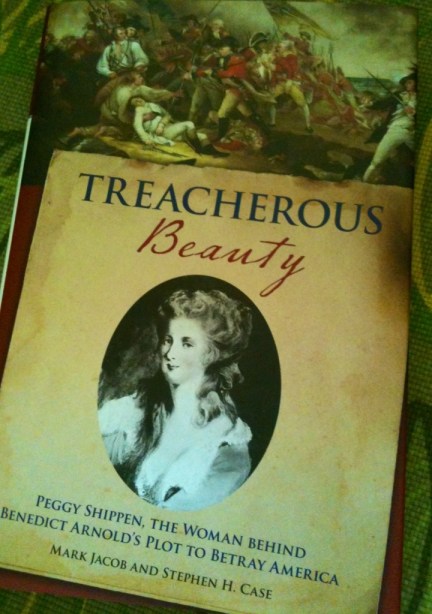
Treacherous Beauty (Book Acquired, 7.30.2012)


20120809-104800.jpg

Treacherous Beauty by Mark Jacob and Stephen H. Case. Blurb—

Histories of the Revolutionary War have long honored heroines such as Betsy Ross, Abigail Adams, and Molly Pitcher. Now, more than two centuries later, comes the first biography of one of the war’s most remarkable women, a beautiful Philadelphia society girl named Peggy Shippen. While war was raging between Britain and its rebellious colonists, Peggy befriended a suave British officer and later married a crippled revolutionary general twice her age. At age 19, she brought these two men together in a treasonous plot that, had it succeeded, might have turned George Washington into a prisoner and changed the course of the war.

Peggy Shippen was Mrs. Benedict Arnold.


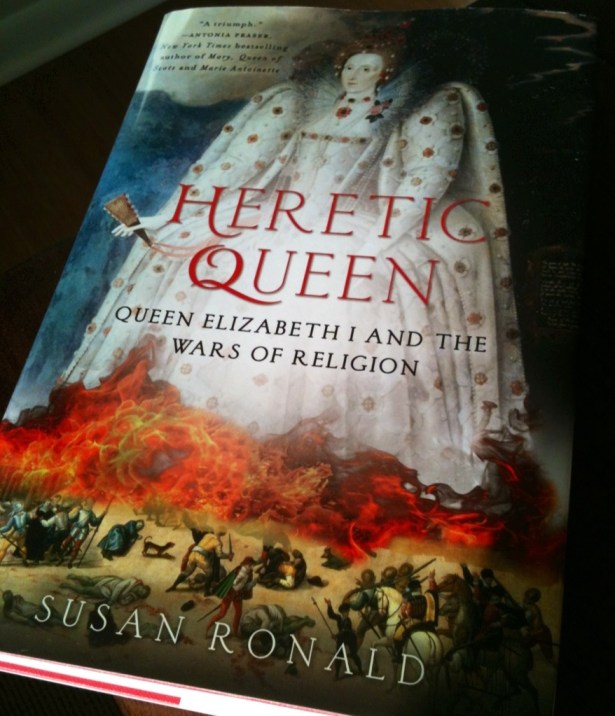
Heretic Queen (Book Acquired, 7.23.2012)


20120724-194358.jpg

Susan Ronald’s Heretic Queen is new in hardback from Macmillan. Their blurb:

Elizabeth’s 1558 coronation procession was met with an extravagant outpouring of love. Only twenty-five years old, the young queen saw herself as their Protestant savior, aiming to provide the nation with new hope, prosperity, and independence from the foreign influence that had plagued her sister Mary’s reign. Given the scars of the Reformation, Elizabeth would need all of the powers of diplomacy and tact she could summon.


Extravagant, witty, and hot-tempered, Elizabeth was the ultimate tyrant. Yet at the outset, in religious matters, she was unfathomably tolerant for her day. “There is only one Christ, Jesus, one faith,” Elizabeth once proclaimed. “All else is a dispute over trifles.” Heretic Queen is the highly personal, untold story of how Queen Elizabeth I secured the future of England as a world power. Susan Ronald paints the queen as a complex character whose apparent indecision was really a political tool that she wielded with great aplomb.


“Have I ever mentioned that Michelangelo practically never took a bath in his life, by the way?” — A Riff from David Markson’s Wittgenstein’s Mistress

A riff on Michelangelo from David Markson’s novel Wittgenstein’s Mistress (the ellipses indicate my edit, not Markson’s):

Have I ever mentioned that Michelangelo practically never took a bath in his life, by the way?

And even wore his boots to bed?

On my honor, it is a well known item in the history of art that Michelangelo was not somebody one would particularly wish to sit too close to.

Which on second thought could very well change one’s view as to why all of those Medici kept telling him don’t bother to get up, as a matter of fact.

. . .

I have just wrapped my head into a towel.

Having gone out for some greens, for a wet salad, this would be because of.

And in the meantime the more I have thought about it, the more sorry I have gotten about what I said.

I mean about Michelangelo, not about Herodotus.

Certainly I would have found it more than agreeable to shake Michelangelo’s hand, no matter how the pope or Louis Pasteur might have felt about this.

In fact I would have been excited just to see the hand that had taken away superfluous material in the way that Michelangelo had taken it away.

Actually, I would have been pleased to tell Michelangelo how fond I am of his sentence that I once underlined, too.

Perhaps I have not mentioned having once underlined a sentence by Michelangelo.

I once underlined a sentence by Michelangelo.

This was a sentence that Michelangelo once wrote in a letter, when he had lived almost seventy-five years.

You will say that I am old and mad, was what Michelangelo wrote, but I answer that there is no better way of being sane and free from anxiety than by being mad.

On my honor, Michelangelo once wrote that.

As a matter of fact I am next to positive I would have liked Michelangelo.

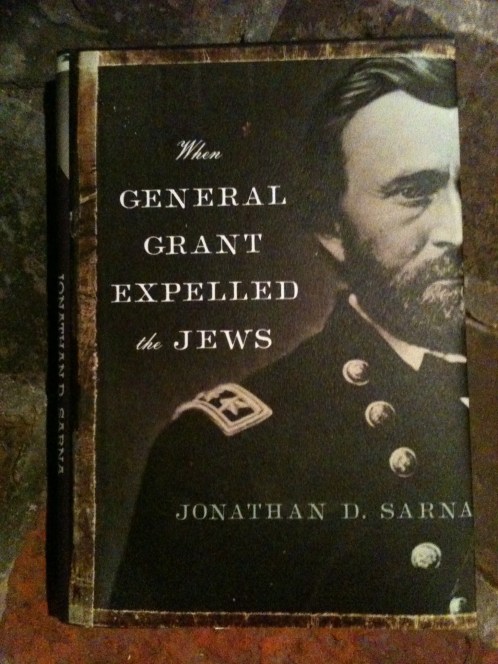
When General Grant Expelled the Jews (Book Acquired, 3.06.2012)

20120309-183304.jpg

When General Grant Expelled the Jews is new from historian Jonathan D. Sarna (and Shocken books). From Harold Holzer’s review at The Washington Post:

. . . no historian has been able to fully understand — much less justify — why, on Dec. 17, 1862, Grant issued his notorious General Orders No. 11 deporting Jewish citizens. “The Jews, as a class violating every regulation of trade,” went the chilling text, “. . . are hereby expelled from [his command in the West] within twenty-four hours.” Those returning would be “held in confinement until an opportunity occurs of sending them out as prisoners.” Just two weeks before Abraham Lincoln was scheduled to extend freedom to one minority group with the Emancipation Proclamation, his most promising general thus initiated a virtual pogrom against another.

In the end, as the gifted and resourceful historian Jonathan D. Sarna points out in this compelling page-turner, General Orders No. 11 uprooted fewer than 100 Jews. But for a few weeks, he suggests, it terrorized and infuriated the Union’s entire Jewish population. It also inspired one of the community’s first effective lobbying campaigns. Jewish newspapers compared Grant to Haman, the infamous vizier of Persia in the Book of Esther. A delegation of Jewish leaders traveled to the White House to protest directly to the president, who quickly but quietly had the order revoked, eager to right a wrong but reluctant to humiliate a valuable military commander. As Lincoln carefully put it, “I do not like to hear a class or nationality condemned on account of a few sinners.” He never mentioned the episode publicly.

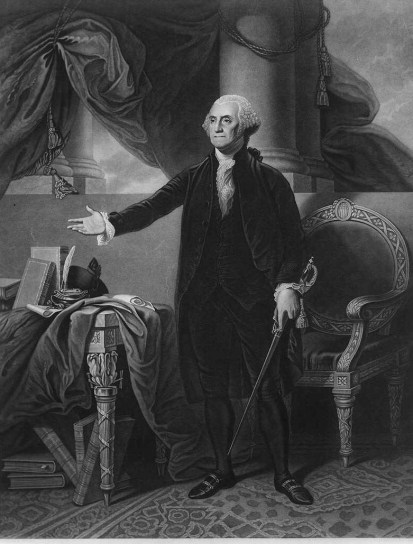
George Washington Was A Biblioklept

George Washington was a biblioklept. MobyLives hipped us to Ed Pilkington’s Guardian article. From the article:

Founder of a nation, trouncer of the English, God-fearing family man: all in all, George Washington has enjoyed a pretty decent reputation. Until now, that is.

The hero who crossed the Delaware river may not have been quite so squeaky clean when it came to borrowing library books.

The New York Society Library, the city’s only lender of books at the time of Washington’s presidency, has revealed that the first American president took out two volumes and pointedly failed to return them.

At today’s prices, adjusted for inflation, he would face a late fine of $300,000.

The library’s ledgers show that Washington took out the books on 5 October 1789, some five months into his presidency at a time when New York was still the capital. They were an essay on international affairs called Law of Nations and the twelfth volume of a 14-volume collection of debates from the English House of Commons.

The ledger simply referred to the borrower as “President” in quill pen, and had no return date.

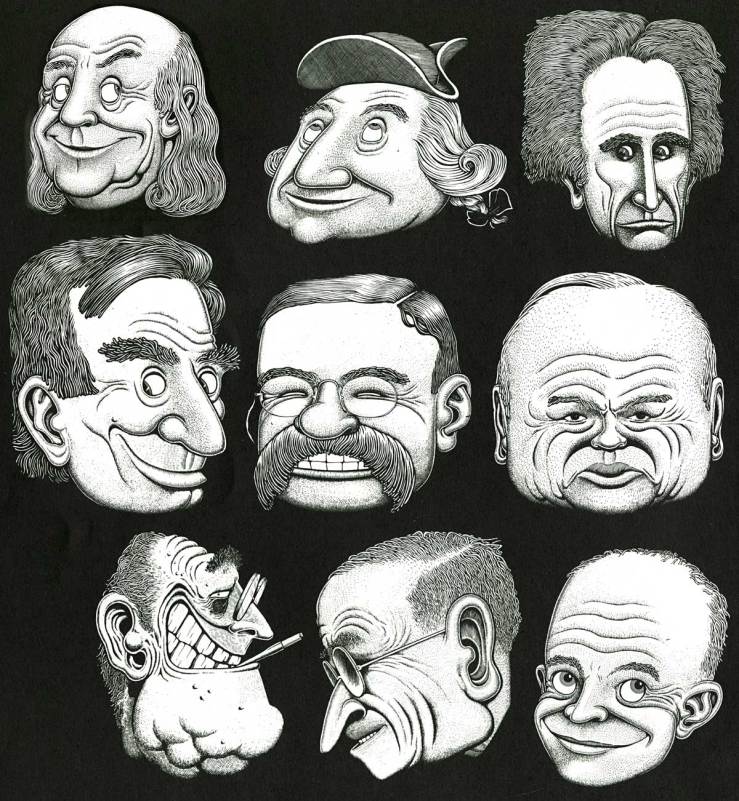
Happy President’s Day from Basil Wolverton

Book Acquired, 2.08.2012—D.H. Lawrence’s Apocalypse

20120209-145955.jpg

I need another book like I need a hole in the head, but, when I’ve had a stressful day at work, I like to browse the huge, labyrinthine used bookstore conveniently located just over a mile from my house. I don’t know how I wound up browsing D.H. Lawrence books, but Apocalypse stood out—first for its name, and second because, in a section of literally hundreds and hundreds of Lawrence volumes, it seemed to be the only one. Five minutes with the thing and I knew I was going to pick it up. It’s essentially a long essay on the Book of Revelation—and the concept of apocalypse and end-of-the-world in general.

Lawrence’s Studies in Classic American Literature is a seminal volume for me, one I return to repeatedly—but I’ve never made it through one of his novels; I even found his short fiction tedious. Anyway, read a huge chunk of this last night. More to come.

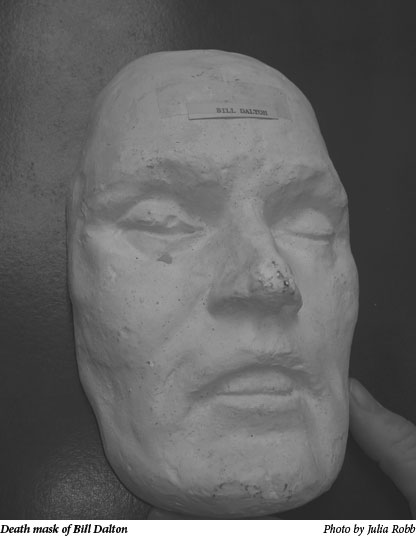
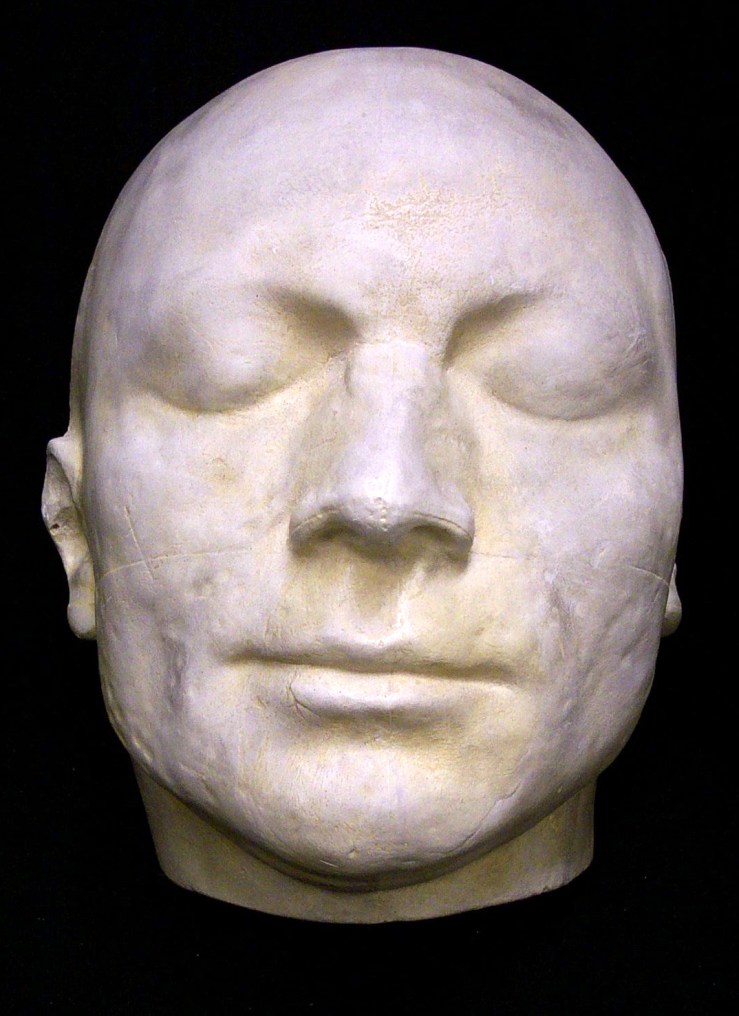
Bill Dalton’s Death Mask

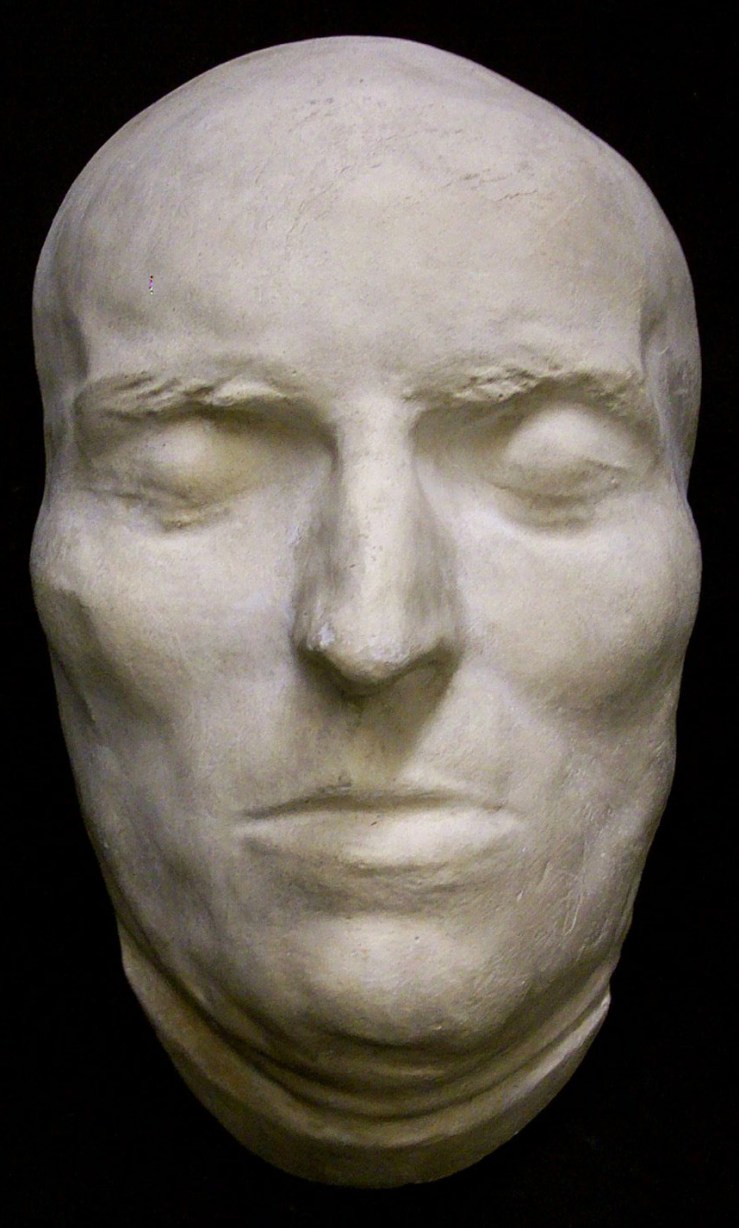
Friedrich Schiller’s Death Mask

“The Discharged Soldier” — William Wordsworth

Drawing of Adrian Jones by Michael Fay

In Section IV of his Prelude, William Wordsworth evokes the most moving encounter with a veteran of war that I have ever read. At first reticent to be anything but a voyeur, the narrator (Wordsworth, in all likelihood), slips “into the shade/ Of a thick hawthorn” to spy on the “meagre man” with a “ghastly” mouth “in military garb” resting on a “mile-stone.” As the poor ex-soldier, “Companionless,” begins to issue “low muttered sounds, as if of pain / Or some uneasy though,” the narrator shakes his “heart’s specious cowardice” and hails the veteran as a human being, asking for his story. It turns out that the guy is slowly—and with great difficulty—returning to his “native home.” Wordsworth takes the veteran to a nearby friend’s house for companionship and rest, before returning to his own home in a contemplative mood. Full text of  “The Discharged Soldier”—

No living thing appeared in earth or air,
And, save the flowing water’s peaceful voice,
Sound there was none–but, lo! an uncouth shape,
Shown by a sudden turning of the road,
So near that, slipping back into the shade
Of a thick hawthorn, I could mark him well, 390
Myself unseen. He was of stature tall,
A span above man’s common measure, tall,
Stiff, lank, and upright; a more meagre man
Was never seen before by night or day.
Long were his arms, pallid his hands; his mouth
Looked ghastly in the moonlight: from behind,
A mile-stone propped him; I could also ken
That he was clothed in military garb,
Though faded, yet entire. Companionless,
No dog attending, by no staff sustained, 400
He stood, and in his very dress appeared
A desolation, a simplicity,
To which the trappings of a gaudy world
Make a strange back-ground. From his lips, ere long,
Issued low muttered sounds, as if of pain
Or some uneasy thought; yet still his form
Kept the same awful steadiness–at his feet
His shadow lay, and moved not. From self-blame
Not wholly free, I watched him thus; at length
Subduing my heart’s specious cowardice, 410
I left the shady nook where I had stood
And hailed him. Slowly from his resting-place
He rose, and with a lean and wasted arm
In measured gesture lifted to his head
Returned my salutation; then resumed
His station as before; and when I asked
His history, the veteran, in reply,
Was neither slow nor eager; but, unmoved,
And with a quiet uncomplaining voice,
A stately air of mild indifference, 420
He told in few plain words a soldier’s tale–
That in the Tropic Islands he had served,
Whence he had landed scarcely three weeks past;
That on his landing he had been dismissed,
And now was travelling towards his native home.
This heard, I said, in pity, “Come with me.”
He stooped, and straightway from the ground took up
An oaken staff by me yet unobserved–
A staff which must have dropped from his slack hand
And lay till now neglected in the grass. 430
Though weak his step and cautious, he appeared
To travel without pain, and I beheld,
With an astonishment but ill suppressed,
His ghostly figure moving at my side;
Nor could I, while we journeyed thus, forbear
To turn from present hardships to the past,
And speak of war, battle, and pestilence,
Sprinkling this talk with questions, better spared,
On what he might himself have seen or felt.
He all the while was in demeanour calm, 440
Concise in answer; solemn and sublime
He might have seemed, but that in all he said
There was a strange half-absence, as of one
Knowing too well the importance of his theme,
But feeling it no longer. Our discourse
Soon ended, and together on we passed
In silence through a wood gloomy and still.
Up-turning, then, along an open field,
We reached a cottage. At the door I knocked,
And earnestly to charitable care 450
Commended him as a poor friendless man,
Belated and by sickness overcome.
Assured that now the traveller would repose
In comfort, I entreated that henceforth
He would not linger in the public ways,
But ask for timely furtherance and help
Such as his state required. At this reproof,
With the same ghastly mildness in his look,
He said, “My trust is in the God of Heaven,
And in the eye of him who passes me!” 460

The cottage door was speedily unbarred,
And now the soldier touched his hat once more
With his lean hand, and in a faltering voice,
Whose tone bespake reviving interests
Till then unfelt, he thanked me; I returned
The farewell blessing of the patient man,
And so we parted. Back I cast a look,
And lingered near the door a little space,
Then sought with quiet heart my distant home.

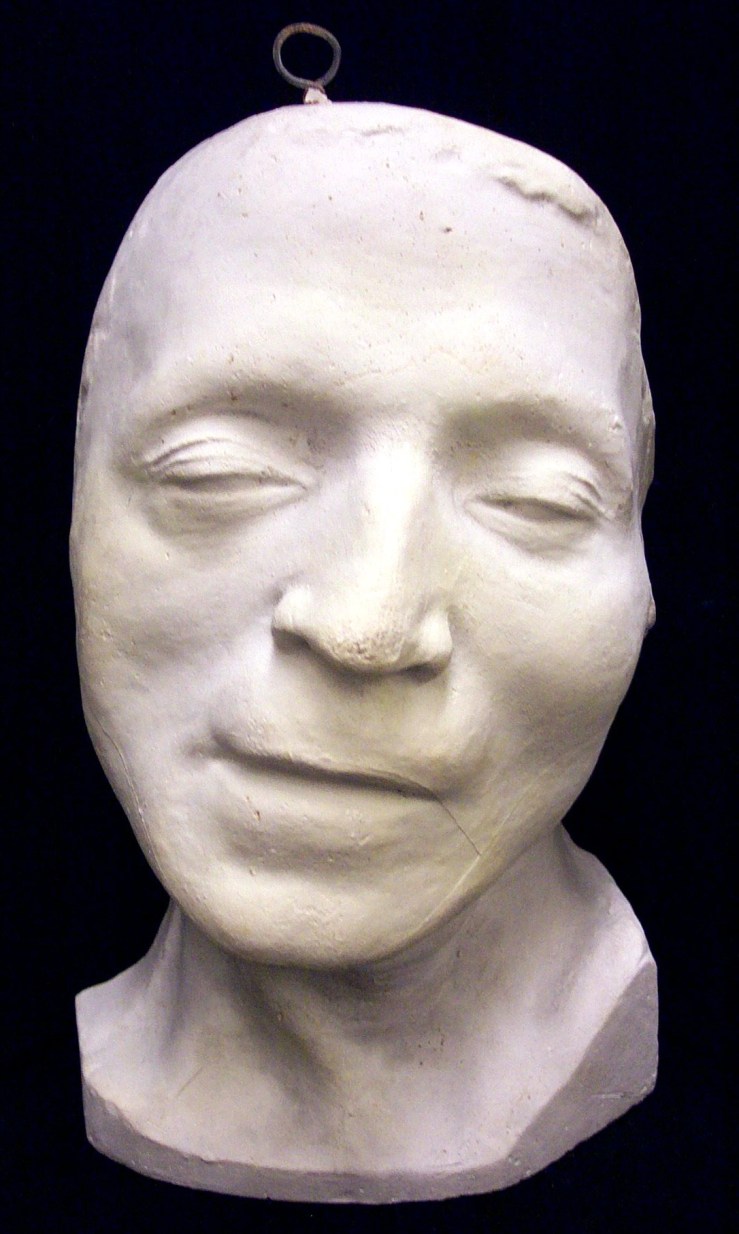
Jean-Paul Marat’s Death Mask

The Sopranos Debate Christopher Columbus’s Cultural Legacy (NSFW)

Also, Howard Zinn on Columbus Day.

[Editorial note: Yeah. We know we posted this last year. We still like it though].

Disraeli’s Death Mask

Robespierre’s Death Mask

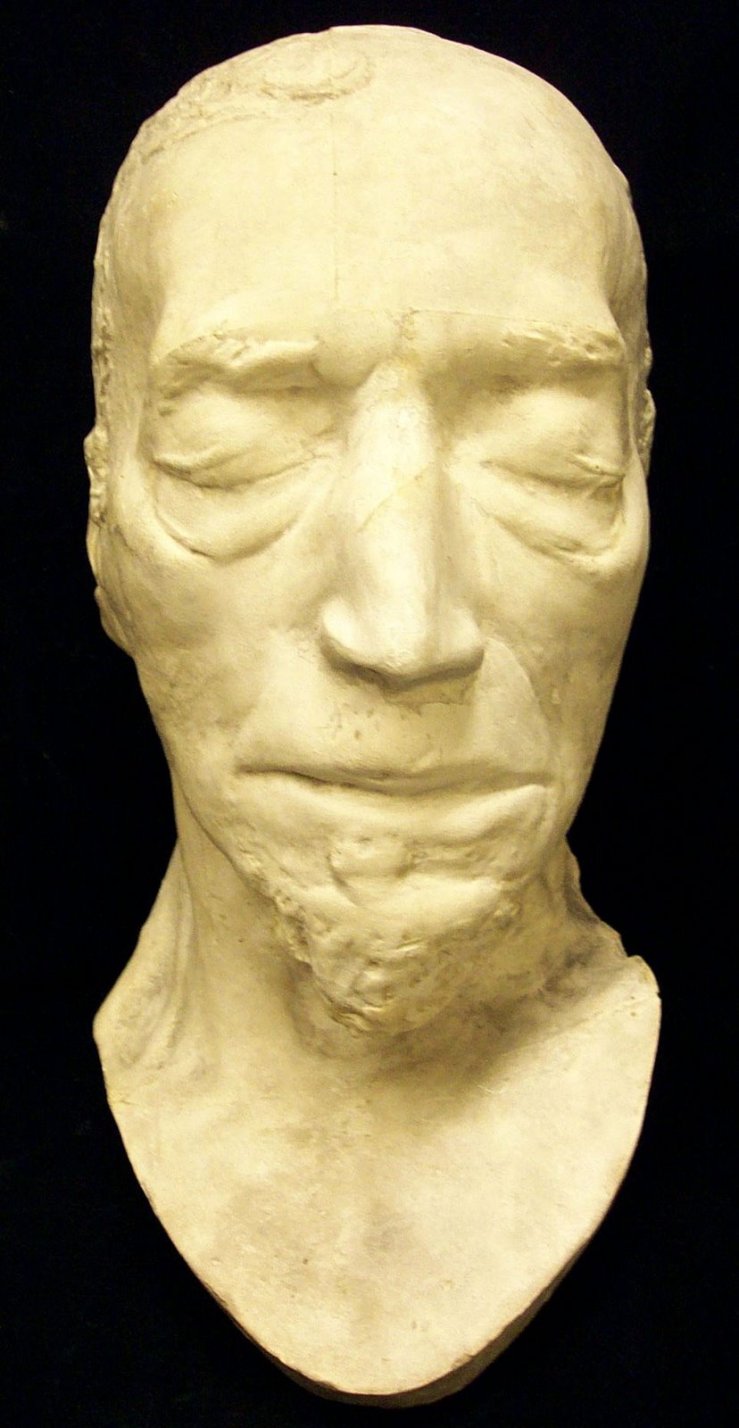
Ned Kelly’s Death Mask

“It Is Easy to Separate the Historical from the Legendary” — A Passage from Erich Auerbach’s Mimesis

Erich Auerbach parses the structure of history and legend and points out why writing history is such a messy, challenging job. From “Odysseus’ Scar,” the first chapter of his epic work of literary criticism Mimesis

Homer remains within the legendary with all his material, whereas the material of the Old Testament comes closer and closer to history as the narrative proceeds; in the stories of David the historical report predominates. Here too, much that is legendary still remains, as for example the story of David and Goliath; but much—and the most essential—consists in things which the narrators knew from their own experience or from firsthand testimony. Now the difference between legend and history is in most cases easily perceived by a reasonably experienced reader. It is a difficult matter, requiring careful historical and philological training, to distinguish the true from the synthetic or the biased in a historical presentation; but it is easy to separate the historical from the legendary in general. Their structure is different. Even where the legendary does not immediately betray itself by elements of the miraculous, by the repetition of well-known standard motives, typical patterns and themes, through neglect of clear details of time and place, and the like, it is generally quickly recognizable by its composition. It runs far too smoothly. All cross-currents, all friction, all that is casual, secondary to the main events and themes, everything unresolved, truncated, and uncertain, which confuses the clear progress of the action and the simple orientation of the actors, has disappeared. The historical event which we witness, or learn from the testimony of those who witnessed it, runs much more variously, contradictorily, and confusedly; not until it has produced results in a definite domain are we able, with their help, to classify it to a certain extent; and how often the order to which we think we have attained becomes doubtful again, how often we ask ourselves if the data before us have not led us to a far too simple classification of the original events! Legend arranges its material in a simple and straightforward way; it detaches it from its contemporary historical context, so that the latter will not confuse it; it knows only clearly outlined men who act from few and simple motives and the continuity of whose feelings and actions remains uninterrupted. In the legends of martyrs, for example, a stiff-necked and fanatical persecutor stands over against an equally stiff-necked and fanatical victim; and a situation so complicated—that is to say, so real and historical—as that in which the “persecutor” Pliny finds himself in his celebrated letter to Trajan on the subject of the Christians, is unfit for legend. And that is still a comparatively simple case. Let the reader think of the history which we are ourselves witnessing; anyone who, for example, evaluates the behavior of individual men and groups of men at the time of the rise of National Socialism in Germany, or the behavior of individual peoples and states before and during the last war, will feel how difficult it is to represent historical themes in general, and how unfit they are for legend; the historical comprises a great number of contradictory motives in each individual, a hesitation and ambiguous groping on the part of groups; only seldom (as in the last war) does a more or less plain situation, comparatively simple to describe, arise, and even such a situation is subject to division below the surface, is indeed almost constantly in danger of losing its simplicity; and the motives of all the interested parties are so complex that the slogans of propaganda can be composed only through the crudest simplification—with the result that friend and foe alike can often employ the same ones. To write history is so difficult that most historians are forced to make concessions to the technique of legend.

In Brief — New Books from Gabrielle Hamilton, Meg Howrey, and Frances Stonor Saunders

The memoir-in-food is something of a cliché at this point, but Gabrielle Hamilton’s new book Blood, Bones & Butter came with enough accolades (including a glowing blurb from Anthony Bourdain) and positive early reviews (like Kakutani’s at The NYT) for me to spend a few hours thumbing through it. Much has been made of Hamilton’s writing bona fides (an MFA in fiction writing from University of Michigan), and while she can put a sentence together without relying on the stock phrases and tropes that lard most memoirs these days, that skill wouldn’t really matter if she didn’t have a tale to tell. Blood, Bones & Butter follows a strange culinary career (it’s subtitled The Inadvertent Education of a Reluctant Chef), complete with drug abuse, theft, and, of course cooking. Only I wish there was more cooking, more time in the kitchen, the butcher’s, the market. Instead, Hamilton seems to channel her (often mean-spirited) energy on her family; her parents’ divorce hangs over the narrative like a Greek tragedy, and her own attitude toward her husband is bizarre, to say the least. The results are mixed, but fans of food-writing à la Bourdain’s Kitchen Confidential will likely enjoy Blood, Bones & Butter. New in hardback from Random House.

Meg Howrey’s new novel Blind Sight tells the story of Luke Prescott, a bright, introspective seventeen year old obsessed with brain biology. Raised by a hippie mother and two half-sisters, Luke gets the opportunity to the summer before college with his estranged father, a famous television star. In Los Angeles, Luke gets to know his father better, sorting out the difference between public persona and private truth; this process in turn leads Luke to re-evaluate his own sense of identity. There’s also some pot-smoking and sex. Howrey moves the narrative between Luke’s first-person voice (in the past tense) to a third person present tense narrator. At times this disjunction seems like a lazy shorthand to allow the reader to see something Luke can’t see (or doesn’t want the reader to see), but it works nicely on the whole, underlining the gaps between truth and belief that the novel seeks to explore. Blind Sight is new in hardback from Pantheon.

In The Woman Who Shot Mussolini, Frances Stonor Saunders plays historical detective, reconstructing the story of Violet Gibson, who fired on Mussolini in April of 1926 (she grazed his nose). Gibson, the daughter of the Lord Chancellor of Ireland, was 50 when she shot Mussolini, and perhaps more than a little crazy. She was almost lynched after shooting Il Duce, but the not-so-benevolent dictator pardoned her, and she was quickly returned to England, where she spent the rest of her life in an insane asylum. Saunders’s book explores whether Gibson’s attack was the motivation of an insane woman or part of a bigger conspiracy theory, illustrating her mystery with poignant black and white photos. And although Saunders focuses on the little-known Gibson, she works to draw parallels between the would-be assassin and Mussolini. Saunders’s exploration of an otherwise unremarked upon episode balances historical scholarship with the pacing and rhythm of an historical thriller. New in trade paperback edition from Picador.