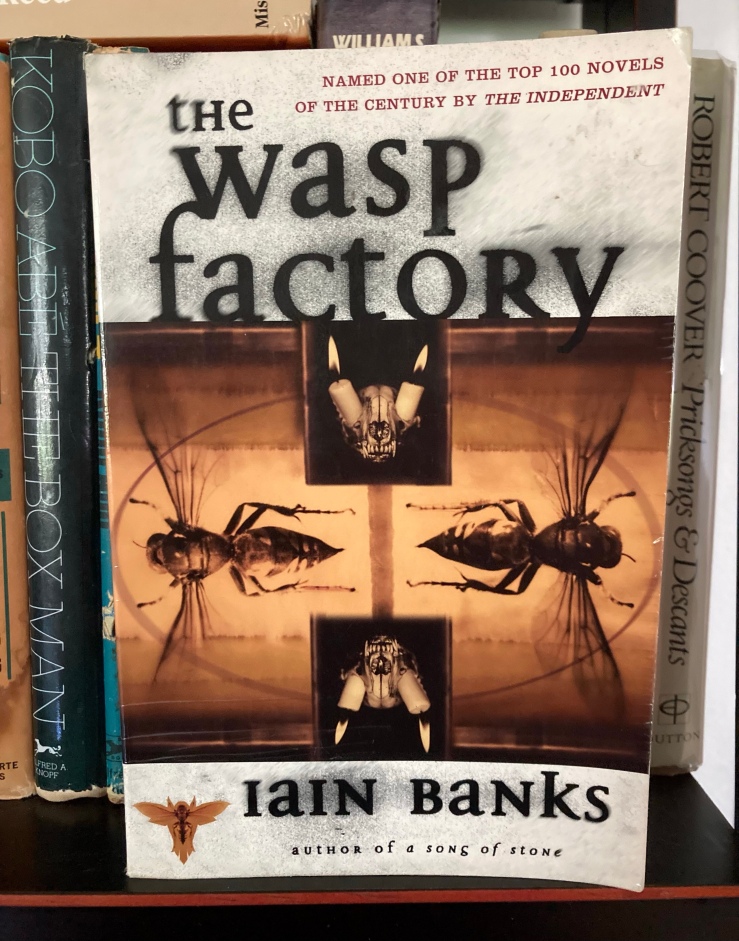
Selections from One-Star Amazon Reviews of Iain Bank’s novel The Wasp Factory

[Editorial note: The following citations come from one-star Amazon reviews of Iain Bank’s novel The Wasp Factory (which I thought was great). More one-star Amazon reviews.]


Crap

drivel

childish

twaddle

well written

I am baffled

absolute tosh

talented author

load of rubbish

Science function.

an unusual story

Distastful content

mild teenage drivel

making me feel sick

positively disgusting

This book is diseased.

potential to be terrific

supposed great author

had to delete this book

I am missing something

is self indulgent and nasty

I had not hear of Iain Banks

I read this almost to the end

sticking their heads on poles

making me feel physically sick

sitting in a a bar with half drunks

I am a high school English teacher

Deeply distasteful dystopian drivel

an ugly Freudian post-modern sack

I hated this book and wish I never read it

soul destroying book makes me feel icky

Woof ! Creepy ! I read 2 pages … no more.

a skilled writer delivering pointless awfulness

At the top of the list of worst books I’ve ever read.

The characters had absolutely no redeeming features

I thought it would be a horror tale that would be great for Halloween

I couldn’t relate to any of the characters in the story. As a matter of fact, I didn’t like any of them.

well written, well constructed and kept me gripped page by page – but it was a loathsome experience

a sordid study of a grubby psychopathic personality of no merit or interest at all

I ordered this product and ended up with a Cuban poetry book. :(

I would burn my copy if I could. Unfortunately, it is electronic,

I bought it because it’s a story about psychopath. Well its not!

Miserable characters, childish writing, and pointless violence

Perhaps reading should expose us to such things but

I like mysteries, including murder mysteries, but

I’ve rarely had this negative reaction to a book

there are enough crazies in the real world

easily the worst book I have ever read

gratuitous tripe sweeps nation

I’m stupider for having read it

why am I reading this horror

I absolutely hated this book.

Found it a thoroughly book

violent, mad and depraved

Misogynistic, pretentious

This book is simply BAD

im glas i only bought one

I ploughed diligently

difficult to empathise

lacklustre last chapter

don’t waist your time

contains sick cruelty

blowing up animals

vulgar and uncouth

our book group

our Book Group

excellent prose

Drunks beware!

Poorly written

straight fiction

twisted mind

Well written

book club

unpleasant

I feel used.

I hate it!

Enjoy.

Blog about some recent reading

A few weeks ago, I picked up Anthony Kerrigan’s translation of Miguel de Unamuno’s Abel Sanchez and Other Stories based on its cover and the blurb on its back. I wound up reading the shortest of the three tales, “The Madness of Dr. Montarco,” that night. The story’s plot is somewhat simple: A doctor moves to a new town and resumes his bad habit of writing fiction. He slowly goes insane as his readers (and patients) query him about the meaning of his stories, and he’s eventually committed to an asylum. The tale’s style evokes Edgar Allan Poe’s paranoia and finds an echo in Roberto Bolaño’s horror/comedy fits. The novella that makes up the bulk of the collection is Abel Sanchez, a Cain-Abel story that features one of literature’s greatest haters, a doctor named Joaquin who grows to hate his figurative brother, the painter Abel. Sad and funny, this 1917 novella feels contemporary with Kafka and points towards the existentialist novels of Albert Camus. (I’m saving the last tale, “Saint Manuel Bueno, Martyr,” for a later day.)

I’m near the end of Iain Banks’s second novel, Walking on Glass (1985), which so far follows three separate narrative tracks: one focusing on an art student pining after an enigmatic beauty; one following an apparent paranoid-schizophrenic who believes himself to be a secret agent of some sort from another galaxy, imprisoned on earth; and one revolving around a fantastical castle where two opposing warriors, trapped in ancient bodies, play bizarre table top games while they try to solve an unsolvable riddle. I should finish later tonight, I think, and while there are some wonderful and funny passages, I’m not sure if Banks will stick the landing here. My gut tells me his debut novel The Wasp Factory is a stronger effort.

I’ve been soaking in Sorokin lately, thanks to his American translator Max Lawton, with whom I’ve been conducting an email-based interview over the past few months. Max had kindly shared some of his manuscripts with me, including an earlier draft of the story collection published as Red Pyramid. I’ve found myself going through the collection again now that it’s in print from NYRB—skipping around a bit (but as usual with most story collections, likely leaving at least one tale for the future.)

I very much enjoyed Gerhard Rühm’s Cake & Prostheses (in translation by Alexander Booth)—sexy, surreal, silly, and profound. Lovely little thought experiments and longer meditations into the weird.

I really enjoyed Debbie Urbanski’s debut novel After World. The novel’s “plot,” such as it is, addresses the end of the world: Or not the end of the world, but the end of the world of humans: Or the beginning of a new world, where consciousness might maybe could who the fuck actually can say be uploaded to a virtual after world. After World is a pastiche of forms, but dominated by the narrator [storyworker] ad39-393a-7fbc whose task is to reimagine the life of Sen Anon, one of the final humans to live and die on earth—and the last human to be archived/translated/transported into the Digital Human Archive Project. This ark will carry humanity…somewhere. [storyworker] ad39-393a-7fbc creates Sen’s archive through a number of sources, including drones, cameras, Sen’s own diary, and a host of ancillary materials. [storyworker] ad39-393a-7fbc also crafts the story, drawing explicitly on the tropes and forms of dystopian and post-apocalyptic literature. After World is thus explicitly and formally metatextual; [storyworker] ad39-393a-7fbc archives the life of Sen Anon, last witness to the old world and Urbanski archives the dystopian and post-apocalyptic pop narratives that populate bestseller lists and serve as the basis for Hollywood hits. [storyworker] ad39-393a-7fbc namechecks a number of these authors and novels, including Octavia Butler, Margaret Atwood, and Ann Leckie, while Sen Anon holds tight to two keystone texts: Mark Z. Danielewski’s House of Leaves and Emily St. John Mandel’s Station Eleven. But the end-of-the-world novel it most reminded me of was David Markson’s Wittgenstein’s Mistress. Even as it works to a truly human finale, Urbanski’s novel is spare: post-postmodern, post-apocalyptic, and post-YA. Good stuff.

Speaking of: Carole Masso’s 1991 novel Ava also strongly reminded me of Markson’s Wittgenstein’s Mistress. Its controlling intelligence is the titular Ava, dying too young of cancer. The novel is an elliptical assemblage of quips, quotes, observations, dream thoughts, and other lovely sad beautiful bits. Masso creates a feeling, not a story; or rather a story felt, intuited through fragmented language, experienced.

I continue to pick my way through Frederick Karl’s American Fictions. He is going to make me buy Joseph McElroy’s 1974 novel Lookout Cartridge. 

Have a weird Xmas (Blog about books acquired in Dec. 2023)

Maybe an hour ago, browsing in a used bookstore, I opened a worn and some might say dirty copy of Iain Banks’s 1985 novel Walking on Glass. The very first page of this old book was inscribed with the following:

Have a weird Xmas ’90

                 John

This copy of Iain Banks’s 1985 novel Walking on Glass—a 1990 Abacus trade paperback printed in London, the embossing on its cover yellowed by wear on its cover and back near its spine—this particular copy was addressed to no named person, its inscription signed by a name so anonymous we apply it to unidentified cadavers and prostitute clients.

I take myself to be the unidentified person being addressed by the identified generic John, wishing me weird wellness, a ghost of Xmas past.

Earlier this year I made the tragic mistake of not pulling the trigger on first-edition hardbacks of Banks’s first two novels, The Wasp Factory and Walking on Glass. I hadn’t read Banks at that point, and my familiarity with his work came almost entirely of his proximity to the J.G. Ballard titles I routinely perused. I ended up reading and loving The Wasp Factory this summer (reviewed it here), and the blurb on the back of Walking on Glass promising further perversions intrigues me too, of course.

Today, I also came across a first-edition, first-U.S.-printing of Roberto Bolaño’s opus 2666It was marked at a third of the original cover price and has never been read. I could not leave it behind.

I actually traded some books in today, including my trade paperback of Alasdair Gray’s Poor Things. I had recently reread the novel in anticipation of Yorgos Lanthimos’ film adaptation, and, during that reread, oddly came across an inexpensive pristine first edition of the novel while browsing for something else. Maybe a week or two after finding that hardback of Poor Things, I found a hardback first edition of Gray’s 1990 novel Something Leather. Unlike Poor Things, which features lots of art and typographic adventures, Something Leather is pretty standard (apart from a few chapter heading illustrations)—but it does have a lovely cover under its cover:

Maybe a week after that, I was browsing with my son, who wanted a collection of Harlan Ellison short stories. I was shocked that we couldn’t find any—I had given away two mass market collections to some students maybe seven or eight years ago in a purge. Apparently a lot of it is out of print, but a “greatest hits” collection is coming out this spring. Anyway, I ended up finding hardback editions of Robert Coover’s Whatever Happened to Gloomy Gus of the Chicago Bears? Denis Johnson’s novel Fiskadaro. 

The Johnson is a British edition, Chatto & Windus, and while it’s hardly my favorite novel by him, I found its form too attractive to pass (and it was, like, cheaper than a beer in the same bookstore). I also picked up a book by Lewis Nordan, a slim collection of short stories called Welcome to the Arrow-Catcher Fair. I picked it up because I love those horrid lovely wonderful gross stylish Vintage Contemporaries editions, and then acquired it based on the blurb, which compared it to Flannery O’Connor, Ellen Gilchrist, and Harry Crews. Here it is next to my Vintage Contemporaries copy of Denis Johnson’ Fiskadaro:

I hope you have a weird Xmas. And I hope that John, wherever they are, has a weird Xmas too.

Iain Banks’s The Wasp Factory is an abject coming-of-age novel narrated by a teenage psychopath

Frank Cauldhame, the narrator of Iain Banks’s 1984 debut novel The Wasp Factory, is a teenage psychopath. Frank lives with his eccentric father on an island in rural Scotland. He is an unregistered person with “no birth certificate, no National Insurance number,” nothing to officially prove his existence. He enjoys this unofficial existence, patrolling his island, which he protects through various rituals.

One of these rituals is to construct and maintain “Sacrifice Poles,” and when we first meet Frank, he is “making the rounds” of these talismans: “One of the Poles held a rat head with two dragonflies, the other a seagull and two mice.” Frank has to keep plenty of dead animals on hand for his ritual defenses, and he kills them by slingshot, air-gun, explosives, and even an improvised flamethrower. (Readers sensitive to depictions of animal cruelty, or just cruelty in general, may wish to avoid The Wasp Factory.)

Another of Frank’s rituals consists of sacrificing a live wasp to the titular Wasp Factory (“beautiful and deadly and perfect,” in our narrator’s words). Frank has devised the Wasp Factory as a bizarre death trap built from “the face of the old clock which used to hang over the door of the Royal Bank of Scotland in Porteneil.” Once introduced to the Factory, the poor wasp can fall prey to one of a dozen different deaths, including the Boiling Pool, the Spider’s Parlour, the Acid Pit, or even “the rather jocularly named Gents (where the instrument of ending is [Frank’s] own urine, usually quite fresh).”

Frank’s urine becomes an important motif in The Wasp Factory. We learn fairly early that he is a “unique eunuch,” supposed victim of a dog bite accident that has left him forever unmanned (and deeply misogynistic). Our lad must piss sitting down, a shame he accepts with a hateful forbearance. Urine flows throughout the novel, an abject magical potion.

Indeed, Frank’s rituals frequently call for the most abject residues and excretions for the magic to work. Consider the Naming Ceremony he performs for a new weapon he’s purchased:

I smeared the metal, rubber and plastic of the new device with earwax, snot, blood, urine, belly-button fluff and toenail cheese, christened it by firing the empty sling at a wingless wasp crawling on the face of the Factory, and also fired it at my bared foot, raising a bruise.

Parts of me thought all this was nonsense, but they were in a tiny minority. The rest of me knew this sort of thing worked. It gave me power, it made me part of what I own and where I am. It makes me feel good.

Were it not for the animal cruelty, Frank’s rituals, no matter how abject, might be the stuff of antic children’s games–playing war, building dams, shooting pellets at cans, and so forth. But the ritualized animal murders are part and parcel of Frank’s most sadistic crimes. He is a serial killer.

Frank confesses his crimes early in The Wasp Factory, and the Scribner trade paperback edition uses his confession as copy on the back of the book to entice would-be readers, so I don’t think I’ll spoil much by sharing it:

Two years after I killed Blyth I murdered my young brother Paul, for quite different reasons than I’d disposed of Blyth, and then a year after that I did for my young cousin Esmerelda, more or less on a whim.

That’s my score to date. I haven’t killed anybody for years, and don’t intend to ever again.

It was just a stage I was going through.

The punchline there at the end is indicative of the dark humor that pervades The Wasp Factory. The edition I’m quoting includes blurbs from negative reviews as well, again highlighting Banks’s mordant glee with the monster he’s conjured. “Rubbish!” declares The Times of London; “There’s nothing to force you, having been warned, to read it; nor do I recommend it,” warns The Scotsman.

Elsewhere, Banks’s humor is earthier, as when Frank recounts some of the early days of his homeschooling at the hands of his ex-hippy chemist father:

For years I believed Pathos was one of the Three Musketeers, Fellatio was a character in Hamlet, Vitreous a town in China, and that the Irish peasants had to tread the peat to make Guinness.

There’s also a sweet streak to the book as well as Frank himself, who, despite his psychotic behavior, is a genuinely caring person at times. His relationship to his only friend, a dwarf named Jamie, is damn near tender; Frank perches Jamie on his shoulders so that the latter can better see the awful punk bands at the local pub.

Frank also cares deeply for his older brother Eric. In the first line of the novel, we learn that Eric has “escaped”; we soon learn he’s escaped from a psychiatric ward he’d been sent to after terrorizing the town folk. Eric’s insane crimes also involve animal cruelty: burning local dogs; force-feeding children worms.

The plot of The Wasp Factory is actually quite simple: What will happen when Eric comes home? Banks keeps the pot boiling through a series of phone calls Eric makes to Frank. We come to see that while Frank might be a psychopath, he is not insane in the way that his older brother is. (A late reveal in the novel that explains the cause of Eric’s insanity is one of the most disgusting pieces of prose I’ve ever read (I write this in admiration.)) In the meantime, Frank attempts to break into the office door that his father has always kept locked.

These twin plots—prodigal son coming home, daddy’s secret locked door—drive the action of The Wasp Factory (oh, and Frank’s basement is full of explosive cordite, too). The book’s real weight comes not from the plot, but from Frank’s narration. He’s a perceptive intelligence, and tuning into his voice is by turns mesmerizing and horrifying.

Not everyone will enjoy The Wasp Factory, as I’ve tried to make as clear as possible in this review. To borrow from The Scotsman, “There’s nothing to force you, having been warned, to read it.” And even admirers may find the twist ending a bit dated and the final moments of Frank’s deep reflection a bit rushed. But Banks does give the reader a conclusion, when it might have been so much easier to leave his characters (and readers) in a noncommittal fuzz of ambiguity. There’s a point of view here, even if it disturbs. The Wasp Factory is a truly fucked up coming-of-age novel, an abject anti-Huckleberry Finn whose narrator makes Holden Caulfield seem perfectly well adjusted. Not for everyone, but I loved it. Recommended.