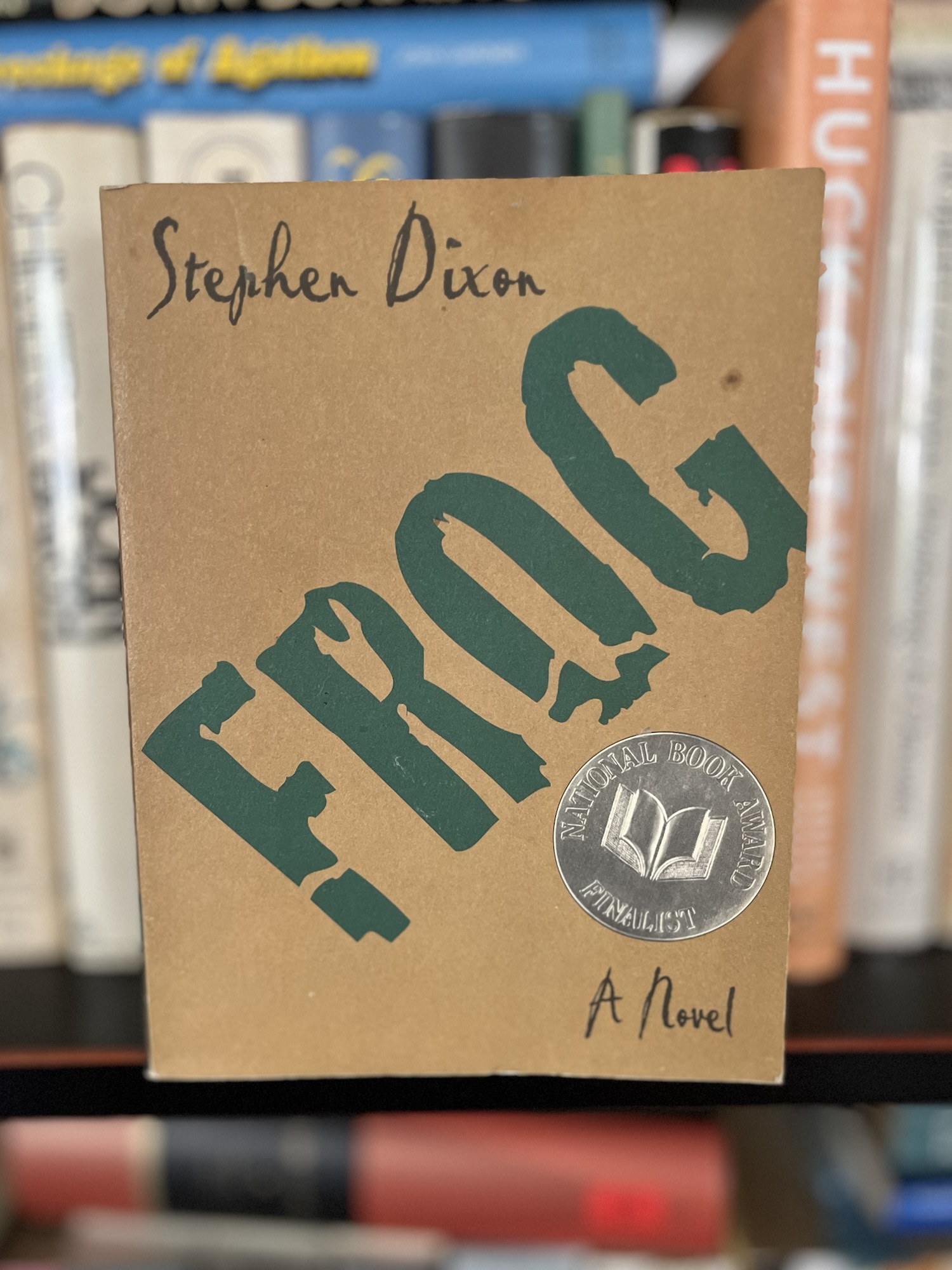
873 words from Stephen Dixon’s 1991 novel Frog, followed by 469 words on Stephen Dixon’s 1991 novel Frog

Here are 873 words from Stephen Dixon’s long looping loopy lucid antilaconic 1991 novel Frog; the words are a segment of the ninth chapter, “Frog’s Brother”:

Alex was the only passenger on the freighter. His father’s patient called his son in England and asked as a favor to the man who’s treated his family’s teeth for forty years if he could take Alex aboard free. Alex was in London then, wanted to get back home, had little money, could have borrowed plane or ocean liner fare from his parents or Jerry, wanted the experience of being on a freighter during a long crossing. Though he got free passage, he asked to work without pay at any job the captain wanted him to. He’ll clean latrines, even, he said in his last letter to Howard. Anything the lowest-grade seaman does, just to get the full feel of it and perhaps seaman’s papers for a paid trip later. He was a newsman turned fiction writer. Two months after the ship disappeared a parcel of manuscripts arrived at their parents’ apartment from England by surface mail. Maybe the manuscripts he didn’t much care about. Maybe the ones he cared most about he took with him on the ship. Howard read the stories and vignettes soon after and then some of them every three or four years till about ten years ago. He never found them very good, but Alex was just starting. Two diaries and some oriental figurines in the parcel also, and lots of letters from his parents, brothers, friends. He’d traveled around the world. Saved up for three years to do it. Did it for a year. A prostitute in a dilapidated hut in a small village outside Bangkok. Why’s that experience come to mind first? It was in a letter to Howard, not the diaries. He searched the diaries for it, thinking an elaboration of it might be interesting, revealing, sexually exciting. She was fourteen years old. That made Alex sad. She asked him to marry her. She said she’d be devoted, would learn to cook and make love American, bear him many children if he wanted, all boys if he wanted (she knew how), would return to grade school. He gave her his silver ID bracelet, pleaded with her to give up prostitution. Then he did it a third time with her the same day and came back the next. Talk about hypocrisy! he said. What’s the trick of turning a customer into a suitor? he asked. But one who’ll be good to her and an adequate provider. If he knew, he’d give it to her. Sent her a pearl necklace from Manila. If he got a venereal disease from her he’d worry more about her than himself. He might go back for her before he leaves for India, or send for her once he gets back to America, and maybe even marry her when she comes of age. Keep this between them just in case it does happen. Taught English to Malaysian businessmen for a month. Met two old men in New Guinea—Canadians—who were living the primitive jungle life. They were good friends of his till they tried to drug and rape him. He’s afraid he had to kick them both in the balls to get out of there and then steal their canoe to get back to town. Fell in love with a witch. Read Proust’s Remembrances in five nearly sleepless days, an experience that’s left him dreaming of the books every night for the last six weeks. A Goan fortuneteller told him his trip would end badly. He said to go home by plane, don’t sail. Remind him when the time comes, for the man wouldn’t take any money. Had a fifteen-year-old girl in Nairobi. What can he tell Howard?—he likes young girls. It’s more than just the way their hair blows and breasts point and bellybuttons dimple and thighs are so even. Maybe it’s because of all the girls who barely let him pet them when he was a teenager. Rode a camel through part of the Sahara. Ate lizard, locusts, grasshoppers, grubs. Never felt very Jewish before till he started hitting all the old synagogues and Jewish cemeteries he could find in the Orient and Middle East. Wait’ll he gets to Poland and Prague and also tries to look the old families up. He’s afraid it’s converted him, but not to the point of wearing a skullcap. Hitchhiked with a sixteen-year-old sabra through Turkey and Yugoslavia, though she might have been younger. When she had to go back she said she thinks he got her pregnant—her device wasn’t put in right a few times, she was so new at it. He told her he’s heard that one before, but if she has the baby and the calendrical configurations fix it as his, or just if she still says it is, he’ll love and provide for it, adopt it if she wishes and take it to America with or without her or emigrate to Israel if she prefers, marry her if that’s what she wants—she’s quite striking and clever and potentially very artistic and smart. He’s written what he thinks is fairly decent work recently, he said in his last letter. He’s glad he’s found something he wants to do for the next twenty to thirty years, has Howard?

The titular “Frog’s Brother” is Alex. (“Frog,” by the way, is “Howard,” the protagonist of Frog.) Alex’s freighter goes missing in the North Atlantic; the ship is never recovered nor are lifeboats. No bodies. The only evidence of the disaster is absence.

In this absence, Frog imagines and reimagines Alex’s death at sea in different looping cycles; these reimaginings are also framed within Frog’s attempt to accurately recall his receiving the news that his brother Alex is lost at sea–was it by phone, that he received this awful news? in his other brother’s apartment? what were the specific conditions of this heartbreak?

Imagining and then reimagining the specific details of a horrifying, horrible, horrendous event is the rhetorical gist of Dixon’s 1995 follow-up to Frog, Interstate, a fucked-up eight-way riff on the narrator’s daughter’s murder by way of random highway violence.

I have read around 120 of Fog’s near 800 pages, and many of those pages feature the same rhetorical and narratological techniques or repetitions with differences that were so off-centered in Interstate: fraying phrases, looping tics, paranoid passages. In the absence of the one thing, Dixon’s narrators pony up iteration after iteration, something after something. But the narrators know that there’s not enough somethings to ever even come close to approximating everything. The iterations sharpen and highlight the beauty of the absence’s abyss.

That abyss was real, or true, or True, for Stephen Dixon, whose brother “Jimmy, a magazine writer, died in 1960 when the freighter he was on in the North Atlantic disappeared,” as the New York Times reported in Dixon’s 2019 obituary. The Times obituary continued: “Mr. Dixon felt that he was continuing his brother’s work. Jimmy Dixon had a short story published after his death.” If Jimmy Dixon was prototype to Alex Frogbrother, what are we to make of the fantastic paraphrase of his letters, above? The passage reads like a bizarre failed adventure tale, something we might expect from William T. Vollmann, who, with his heart of gold, tried to “free” sex workers. It’s also quite queasy when it comes to sex (a constant I’ve noticed in Dixon): “What can he tell Howard?—he likes young girls,” our narrator flatly, grossly reports.

The saddest and realest bit might be this though, the admission that “Howard read the stories and vignettes soon after and then some of them every three or four years till about ten years ago. He never found them very good, but Alex was just starting.” But Alex was just starting. The last bit of the section, “He’s glad he’s found something he wants to do for the next twenty to thirty years, has Howard?” seems both boon and curse, a door that opens and shuts simultaneously, cursing our Stephen Dixon, our Frog, to write write write write write write write write write…



Eight notes on Stephen Dixon’s novel Interstate

1,  It upset me deeply, reading Stephen Dixon’s 1995 novel Interstate. It fucked me up a little bit, and then a little bit more, addicted to reading it as I was over two weeks in a new year.

2,  What is it about, Stephen Dixon’s 1995 novel Interstate? I mean, you probably won’t like it, but that wasn’t the stupid rhetorical question that led this point. (And also but maybe like, you will like it.) Interstate was a finalist for the 1995 National Book Award. It didn’t win. The NBA’s website’s one-sentence summary fucks up: “In the author’s first novel since Frog, a Finalist for the National Book Award, a father mentally replays, in eight variations, the shooting of his daughters on an interstate highway.”

3,  There is (or is it are?) one too many esses in the NBA’s summary of Stephen Dixon’s 1995 novel Interstate—there are two daughters, plural, but only one is shot, and shot tragically, awfully, fatally—and really, as its variations play out, it’s not entirely clear if anyone was shot, if anyone was even on the highway, if anyone was even real. Are all the so-called events of the novel simply (there’s no simply about it) in the narrator’s imagination? “…but there I go again, the world’s easiest and most desirable copy out, the dream,” muses the narrator at one point. Not even a dream though, it’s all just words.

4,  It’s all “just” words, and if someone told me they read and hated Stephen Dixon’s 1995 novel Interstate, I’d shrug and ask if they made it all the way through all the words and still hated it. If someone told me that they made it all the way through Interstate and found it to be a strange and unappealing writing experiment, I’d mildly agree with them, and then tell them that I loved that particular flavor and if they didn’t like that particular flavor, well, cool.

5,  If someone read all the words in Stephen Dixon’s 1995 novel Interstate and concluded that it seemed like an ambitious and highly-achieved creative writing exercise — writing experiment, rather — I’d likely initially agree and then hedge a bit before mumbling something like, I don’t think it was an exercise or experiment on the author Stephen Dixon’s part. It might make for experimental reading, but I think he absolutely knew what he was doing; this wasn’t practice or exercise — it was the real thing.

6, I have, thus far, done a lousy job, not even really a job, of describing the force of language in Stephen Dixon’s 1995 novel Interstate. Normally I’d crib a few choice passages—and to be clear, Interstate s fat and juicy with choice passages—but we are talking about long, twisty, tangled passages, sentences that go on for pages, sentences that find the predicate verb sundered for a few paragraphs from its eventual object, sentences that move us through thought, how divergent thought can be how, how imprecise, indirect, yet still sharp and often painful. An easy, lazy comparison would be to liken Dixon’s paragraphs to Thomas Bernhard’s (although Dixon denied the influence, much like William Gaddis did in his final novel)—there’s a different flavor here but our guys are working in a similar mode. (Think too of László Krasznahorkai or Gabriel García Márquez or Faulkner or Mauro Javier Cárdenas or any number of practitioners of the long paragraph). John Domini, in his contemporary review in the Portland Oregonian (reprinted in his excellent collection The Sea-God’s Herb) does a better job of describing Dixon’s style than I can do:

Characters talk themselves through backwaters of memory (sometimes creating comic relief) or sail into dreamy what-ifs, all in order to put off some looming and drear inevitability. In conversation, one may mention an important insight that he or she has to share, then spiral away through a half-dozen distractions before revealing what matters. The format feels like a natural fit to the shuttered claustrophobia of worry and loss. So do the jam-packed paragraphs, sometimes running several pages without a break. Better still, these blocks of talky phrasing flicker with light, even (every now and again) with happier possibilities.”

(Maybe I just wanted to quote that lovely phrase of Domini’s, “blocks of talky phrasing flicker with light.”)

7,  “Better still, these blocks of talky phrasing flicker with light, even (every now and again) with happier possibilities,” Domini wrote of Stephen Dixon’s 1995 novel Interstate. The last of Dixon’s eight Interstates is an unexpected gift — a happy ending, or, rather a banal ending, a plain ending, an ending without tragedy or comedy or epic heroism. An ending where everyone gets to bed in time to fit in a little light reading before shuteye. It sounds hokey when I write it out, but there’s nothing trite about the conclusion. The reader purchases this moment of catharsis from all the terror (and horrifying comedy, which I’ve neglected in this riff and will continue to neglect) — the reader purchases the cathartic conclusion from the preceding horror.

8,  I wonder how I might have reacted to Stephen Dixon’s 1995 novel Interstate if I had read it, say, when it was first published, back when I was a junior in high school. Or how would I have reacted to it ten years after that, not yet a parent? (And writing these thoughts out now, I realize that, more than anything by Bernhard or Krasznahorkai or Faulkner or the other Dixon I’ve read, Interstate most reminds me of (at least at this moment that I write) of Frank Capra’s 1946 film It’s a Wonderful Life. I’ve watched It’s a Wonderful Life once a year for the past four decades, finding it strangely different every few years — first baffling and even a bit scary, then boring, then exasperating, infuriating even, then schmaltzy, sentimental, ludicrous, and then magical, endearing, heartbreaking, perfect–I’ve veered off course, where was I?) I wonder how being a parent has colored my psychic engagement with the novel Interstate? I was not so much manipulated by the tragedy of losing a child through violent, chaotic, meaningless death but rather the more banal tragedy the novel repeatedly engages — losing a child through half-neglect, through half-listening, through selfishness, through an inability to focus on now — not really so much losing a child but losing out on connections, memories, time you’ll never get back. It fucked me up, Interstate, and I don’t think I’d like to go down its road again — but I loved it. Very highly recommended.

Nonjoke | From Stephen Dixon’s Interstate

A passage from Stephen Dixon’s novel Interstate


So you go with the doctor to the room Julie’s in and the doctor says, right outside it—door closed, no little window in it, legs so weak while you walked that the doctor had to hold your arm, you said “I think I’m going to fall, grab me,” and he did, while you walked you thought “It’s like an execution I’m going to, mine, hanging, shooting, injection, gas; fear, weakness, feeling you want to heave,” sign on the door saying “Do Not Enter, Medical Staff Only, Permission Required”—“She’s in there on the bed. It’s not really a bed, we call it something else, but for our purposes we’ll call it that.” “What do you call it normally, meaning the technical calling—the word, you know?” and he says “‘Bed’ will do.” “But I’d like to know, if you don’t mind. I’m not sure why, peculiar reasons probably, but just, could you?” “An examination table, that’s all it is, but now it’s made up to look like a bed—sheets, a pillow.” “For under her head.” “Under her head, yes.” “You’re giving me a lot of your time, I’m sorry.” “It’s okay, what I do.” “I’ve been thinking of her head, only before, I think, on a pillow when she was alive. Everybody’s sure she’s dead?” He nods. “Then I’ll see her in there. I mean, I would, of course, if she were alive, but I’m saying for now.” You put your hand on the door. It has no knob or bar, only needs a push. Which side of the room will the bed be? The left, you guess. But it’s a table, so may be in the middle. “Yell for me, ‘Dr. Wilkie,’ if all of a sudden you need assistance. Or if you want, I’ll come in with you.” “You’ve seen her?” “Uh-huh.” “No, I want to see her alone.” “I can go in and leave when you want. Or with a flick of your finger, if you can’t speak, or point to the door.” “Nah, I want it to be now just me and her. ‘Me and she’ sounds better but it’s ‘me and her, me and her.’ Meaning, they go together, correctly, though in that case it could be ‘she and I’ for all I know. Why do I bring these things up? Delaying.” “No matter what, I won’t budge from here unless there’s an emergency I’m absolutely needed for. Chances of that are minimal, and I’ve asked another doctor to fill in for me. But you never know.” “You never know,” you say. “And I suppose I should go in now, get it over with. Somehow I imagine her in the middle of the room on that table-bed, head on the left side of it, so, perpendicular to us,” and you show with your hands in a T what you mean. “I believe that’s the way it is.” “So there. And all my life, you know, I’ve been getting things over with—no window in the room, probably.” “None.” “Lots of lights, some side tables with instruments and things on them, and so on. In fact, there’s a standard joke, a running one, rather, around my household—no, it’s no time for lines or jokes. This isn’t one, what I was about to say, but might sound like it. I haven’t told you it yet?” “If you mean now or before, not that I know of.” “I think I’ve told everyone else in the world. I have so few things to say. Of interest. Though it always had a serious degree to it. Side. It borders. Straddles.” “Go on, tell me if it’ll help relax and prepare you for going inside. Remember, here and now, anything you do or say is okay.” “Right, better I feel that way, relaxed, prepared, so I don’t crash first thing on seeing her, my dear kid, truly the dearest little girl-child-kid there ever was,” and you start crying and you cry and say “Everybody says ‘ever was,’ I bet, everybody, in a situation like this, and I should stop all this kind of talk. Just saying it, of course I know what it’ll do, so I have to wonder if I didn’t say it just to go to pieces and delay some more my going in. There,” patting yourself under the eyes, tears, “these goddamn these. Stop, stop, stop,” slapping your cheeks. “But my nonjoke. Nonintended for one, the something I was going to say and will probably say it that I said might sound like a joke, and other times it could be. Now it’s just a fact. An insight into me. So I’m telling it as an illustration of my always wanting to get things over with—trips, books, days, work, housecleaning, even sex sometimes. Cooking, quick, quick, quick. A joke to everyone I know, I can tell you, as if work to get rid of to clear yourself for the real or more important work, stuff that’s killing you for you to do and which turns out to be the same thing, get rid of it, clear yourself for something else, and so on. So say it. Or do it. My hand’s on the door again but I’m not pushing it even a quarter-inch. I can’t seem to get in there. Whyever why? The example’s this. That I want on my tombstone for it to read—Rather, that I want my epitaph to say on my tombstone, chiseled in—Rather, for ‘tombstone’ sounds so Western western—in other words, fake—that I want my head-or footstone—my gravestone epitaph to say, you know, under my name, birth and death dates—anywhere on the stone—‘So, I got it over with.’ Just that. You see the point; message is clear, isn’t it? It’s not funny now. Of course, nothing is, goes without saying, and long way I told the story, end of it was dead before I got there,” dropping your head, crying again, hand off the door. “This is too hard. Impossible. Why does it have to be? Her, I mean. I know, old question, but couldn’t this all somehow be a wake-up dream? All that’s done-before crap too, everybody must say it in a situation like this, and especially to you, true?” “But any other time your epitaph line would be humorous. I understand that. You got it over with—you’re a man who likes getting things over with, and the big thing, the biggest, life, you’re saying in this fictitious epitaph, you did.” “Maybe it was ‘Well, I finally got it over with’ what I told my wife and friends countless—endless amounts—countless times. Or no ‘well,’ but a ‘finally.’ So just ‘I finally’—and no ‘so’ either, so just i finally got it over with.’ I think that’s it. It is. Anyway, what’s the damn difference? One of those. And I should get it over with, finally. I know I have to see her, I want to.” “You’re right when you imply I know how difficult it is,” he says. “I’ve been through this with plenty of other people.” “Other fathers? But ones who adore their kids? Love them, adore them, worship them; if there was one word for those three, then that?” “Fathers, mothers, husbands, children for their sisters or brothers—everyone close.” “Okay. You close your eyes, you hold your breath, you push open the door and walk in. That’s all you have to do, just those.” You do them, push the door shut behind you without turning around, let your breath out and smell; nothing unusual, something medicinal; and open your eyes.

Blog about some recent reading

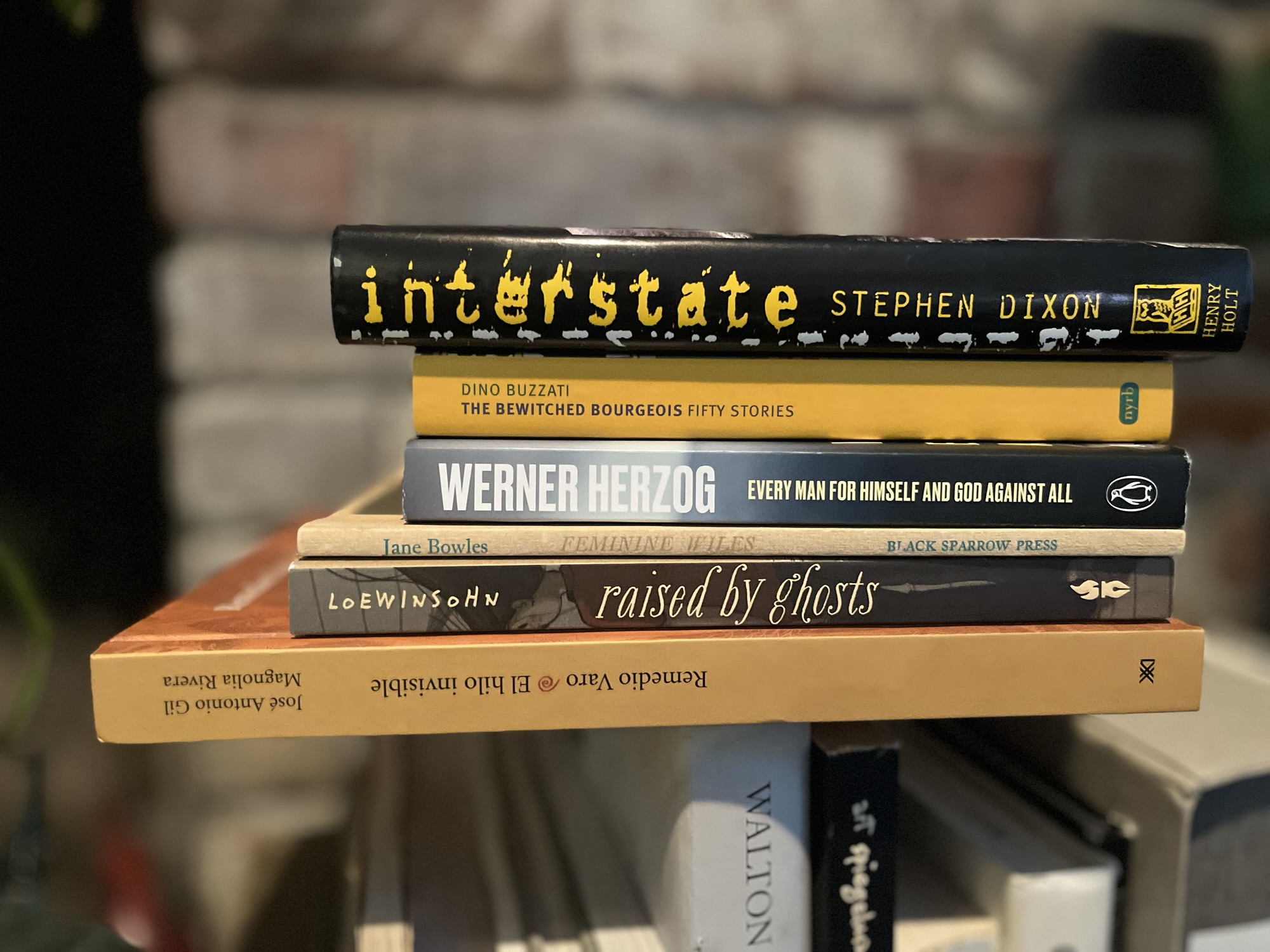
What an interesting few weeks it’s been! Here’s (some of) what I’ve been reading so far this year:

I’m in the middle of Stephen Dixon’s novel Interstate. It is a devastating, ugly, addictive, beautiful novel; I have no idea if it is “good” or not but I love it. I can’t really think of a single person I know (in real life) I could recommend it to. We played cards with some friends and one of them asked about what I was reading, and I said a novel called Interstate by this guy Stephen Dixon, and she asked of course What’s it about? and I said something, Well, this guy’s driving on the interstate with his daughters and two guys in a van pull up along side him and start shooting at them, killing his younger daughter–this happens in like, the first few paragraphs–and then we see how this event destroys his life–but then Dixon repeats the initial scenario like seven more times with different (but all really tragic so far) outcomes–and it’s written in this addictive vocal style that might be really off-putting to many readers, and it also makes really fascinating use of the coordinating conjunction for, which may just be a verbal tic –and it’s also really funny at times? I am not trying to sell this novel to anyone but I love it.

My reading experience of Briana Loewinsohn’s graphic novel Raised by Ghosts was kinda sorta the opposite of Dixon’s Interstate in that after I finished it I immediately pressed it on my wife and then my kids and then texted some of my oldest friends about it (oldest in the previous clause should be understood to modify the friendship, not the actual friend’s years–although we’re all getting older). We’re all getting older, all the time, and Raised by Ghosts provoked an aged nostalgia in me. I’m about half a year older than Loewinsohn and so much of her semi-autobiographical novel resonated with me. She gets everything right about what it was like to be a little bit of a weirdo at school in the nineties. There’s this wonderful passage on how important it was to get a handwritten note from a friend; there’s a page that’s nothing but a notebook page filled with band names; there’s a marvelous scene where our hero loses her shit watching You’re a Good Man, Charlie Brown. I should have a proper review this week or next, but great stuff. (The whole family loved it, by the way.)

I’ve been reading a collection of Dino Buzzati short stories translated by Lawrence Venuti; my technique is to read one of the shorter stories when I feel a bit of dread or anxiety from, like, reading something else. (The collection is called The Bewitched Bourgeois by the way.) I’ve enjoyed reading them, and have especially enjoyed allowing myself to read them at random instead of following the collection’s chronological trajectory. Very Kafka, very Borges, but also very original.

Not in the picture above, but I’ve also been working my way through a digital copy of Vladimir Sorokin’s short story collection Dispatches from the District Committee, in translation by Max Lawton (and illustrated by Gregory Klassen). Great gross stuff.

I picked up a collection of Jane Bowles’ sketches, letters, and other ephemera a few weeks ago–I love her stuff, but really it was that these were contained in the somewhat-rare Black Sparrow Press edition Feminine Wiles. I’m pretty sure all of the stuff here is collected in My Sister’s Hand in Mine, but I’ve enjoyed dipping into this one more. It’s slim, not bulky, but that bulky boy’s around her (My Sister’s) if I need him.

My uncle sent me a copy of Werner Herzog’s 2022 memoir Every Man for Himself and God Against All for Christmas (in translation by Michael Hofmann). I devoured the first few chapters and then a colleague hipped me to the fact that there’s an audiobook of Herzog reading his memoir (available on Spotify and other platforms) — so on my commute I’ve been listening to him read his own memoir, which is just amazing. Like fucking amazing. Hearing him say phrases like “the escapades of Christopher Robin, Winnie-the-Pooh, Piglet, and Eeyore” or that “chipmunks…have something consoling about them” is surreal. There are like fifty insane things that happen in every chapter, and if Dwight Garner of the failing New York Times attested that he didn’t “believe a word” of the memoir, I take the opposite tack. Everything is true, everything is permitted.

Finally, I can’t really say I’ve been “reading” Remedios Varo: El hilo invisible by Jose Antonio Gil and Magnolia Rivera. My grasp of Spanish cannot graspingly grasp too much of the Spanish (although my iPhone’s picture-text-translate thing works fine when I’m really curious), but the book is a lovely visual catalog of not just one of my favorite artist’s works (including many pieces I haven’t seen before), but also documents her visual influences. I picked it up at the Museo de Arte Moderno in Mexico City back in January, still floating on the high of seeing many of Varo’s lovely paintings there that afternoon.

Stephen Dixon’s Interstate (Book acquired, 27 Jan. 2025)

I finally broke down and bought a copy of Stephen Dixon’s 1995 novel Interstate via an online bookseller; I’d been trying to pick up a used copy of it or his novel Frog for a while now, after devouring 1988’s Garbage last year. I was able to get a signed first edition for less than the novel’s original price listing, which is maybe a little depressing? The novel has eight sections; I read the first last night, in something like a trance. Here is the novel’s first paragraph:

He’s in the car with the two kids, driving on the Interstate when a car pulls up on his side and stays even with his for a while and he looks at it and the guy next to the driver of what’s a minivan signals him to roll down his window. He raises his forehead in an expression “What’s up?” but the guy, through an open window, makes motions again to roll down his window and then sticks his hand out his window and points down at the back of Nat’s car, and he says “My wheel, something wrong with it?” and the guy shakes his head and cups his hands over his mouth as if he wants to say something to him. He lowers his window, slows down a little while he does it, van staying alongside him, kids are playing some kid card game in back though strapped in, and when the window’s rolled almost all the way down and the hand he used is back on the steering wheel, the guy in the car sticks a gun out the window and points it at his head. “What? What the hell you doing,” he says, “you crazy?” and the guy’s laughing but still pointing, so’s the driver laughing, and he says “What is this? What I do, what do you want?” and the guy puts his free hand behind his ear and says “What, what, what? Can’t hear ya,” with the driver laughing even harder now, and he says “I said what do you want from me?” and the guy says “Just to scare you, that’s all, you know, and you’re scared, right?—look at the sucker, scared shitless,” and he says “Yeah, okay, very, so put it away,” and the kids start screaming, probably just took their eyes off the card game and saw what was happening, or one did and the other followed, or they just heard him and looked or had been screaming all the time and he didn’t hear them, but he doesn’t look at them through the rearview, no time, just concentrates on the gun and guy holding it and thinking what to do and thinks “Lose them,” and floors the gas pedal and gets ahead of the van but it pulls even with him and when he keeps flooring it stays even with him and even gets a little ahead and comes back with the guy still pointing the gun out the window and now grinning at him, driver’s in hysterics and slapping the dashboard, things seem to be so funny, and he thinks “Should I roll the window up or keep it down, for rolling it up the guy might take it the wrong way and shoot, if he’s got bullets in there,” and he looks around, no other cars on their side of the Interstate except way in the distance front and behind, no police cars coming the other way or parked as far as he can see on the median strip, and he yells “Kids, get down, duck, stop screaming, do what Daddy says,” and sees them in the rearview staring at the van and screaming and he shouts “I said get down, now, now, unbuckle yourselves, and shut up, your screaming’s making me not think,” and slows down and rolls the window up and van slows down till it’s alongside him, the guy holding the gun out and one time slapping the driver’s free hand with his, and then the guy points the gun at the backseat with the kids ducked down in it and crying, maybe on the floor, maybe on the seat, for he can’t see them, and he swerves to the slow lane and the van gets beside him in the middle lane, and then he pulls onto the shoulder, stops, shifts quickly and drives in reverse on it bumping over some clumps, and the van goes on but much slower and from about a hundred and then two and three and four hundred feet away the guy steadies his gun arm with his other hand and aims at his car and he yells “Kids, stay down,” for both are now looking out the back, maybe because of the bumping and sudden going in reverse, and bullets go through the windshield. He screams in pain, glass in his head and a bullet through his hand, yells “Girls, you all right?” for there’s screaming from in back but only one of them, and his oldest daughter says “Daddy, Julie’s not moving, Daddy, she’s bleeding, Daddy, I don’t see her breathing, I think she’s dead.”