The Rumpus interviews Tao Lin. Topics include social media in literature, suicide, Jonathan Franzen (not really (but sort of)), as well as his new novel Richard Yates (read our review here). Lin answers plenty of questions about Richard Yates, including why he put an index in the book, why and how he named his protagonists, and why he named the book Richard Yates. Here’s Lin on book theft as a marketing tool–
Stephen Elliott: What if your books were shoplifted?
Tao Lin: I’m okay with that.
I think giving away free books and having more readers will benefit the publisher, because 1 free book will cause like 10 people discussing it, which over time will change into like 50 or something. Some of those will buy it. Eventually the 1 free book’s like $1.50 cost will be offset, gradually more and more, by the effects of that 1 free book on people buying it.
I very much enjoyed the process of interdicting the culture. I’m older; I have a great love of the English parlance. I can’t stand dipshit, tattooed, lacquered, varnished, depilatoried younger people talking their stupid shit, stage-sighing, saying “It’s like, I’m like, whatever,” and talking in horrible clichés, rolling their eyes when they disapprove of something. I saw that the culture was pandering more and more to this kid demographic. And in the course of driving from here to there, I began to see more and more billboards for vile misogynistic horror films, white-trash reality-TV shows, neck-biting fucked-up vampire flicks, and stoned-out teenage-boy pratfall comedies. Bad drama, bad comedy, that portrayed life preposterously, frivolously, and ironically, and that got to me. So I would drive here, there, and elsewhere through residential neighborhoods in order to avoid billboards. Since I wasn’t married and had no more in-law commitments, and was starting over again in a new locale, I developed strong friendships with male colleagues where we share the common goal of work and earning money, and I became fixated on women in my late 50s more than I’ve ever been fixated on women in my woman-fixated fucking life. My time in the dark felt productive rather than reductive, and the rest of the chronology, you know from the book. And I’m comfortable living in this manner, which people find hard to believe that I’m happy. It’s a gas. It’s a gas.
AVC: You’ve talked elsewhere about the modern dilemma of separating the real from the virtual. How does something like Twitter confuse the issue?
WG: More and more, I think the thing our descendants will find most quaint and old-fashioned about us is the trouble we still take to make that distinction, between the virtual and the “real.” I think that will seem sort of Victorian to them, because I think we’re already losing the need to make the distinction, and I don’t see that as necessarily a bad thing. That doesn’t fill me with the panic it fills some people with. The back-and-forth [of Twitter] is the same back-and-forth we’re having right now in a telephone conversation, and it’s very much like the back-and-forth that Victorian English people had with their three mail deliveries a day. Except that with a medium like Twitter, it’s simultaneously public, in large part. It becomes a communal activity. I don’t see it as a new activity, inherently. I think it’s something we’ve had equivalents of for forever, but the completely post-geographical way in which we’re able to do it is new. And it must be changing it somehow. I actually don’t think we can know what emergent technologies are doing to us while they’re doing it to us. In fact, I don’t think we know yet what broadcast television did to us, although it obviously did lots. I don’t think we’re far enough away from it yet to really get a handle on it. We get these things, I think they start changing us right away, we don’t notice we’re changing. Our perception of the whole thing shifts, and then we’re in the new way of doing things, and we take it for granted.
MIL: It seems many avant-garde works rely on a single conceit. “Tristam Shandy” used lies, “Motherless Brooklyn” used a tourettic narrator. Must avant-garde literature have a single mechanism to be intelligible to its readers?
TM: What’s the conceit of “Finnegans Wake” then? I’m not sure “Tristram Shandy” has a single conceit. I suppose there’s an inversion of the ‘Life and Adventures of’ tradition into ‘The Life and Opinions of—plus an obvious refusal of certain narrative conventions, for example in Tristram’s inability to get himself born for the first third of his own book. But Shakespeare’s “Hamlet” is equally full of such refusals: it subverts just about every dramatic convention that it purports to buy into. I’m suspicious of the term ‘avant-garde’. I think it should be restricted to its strict historical designation: Futurists, Dadaists, Surrealists etc. “Tristram Shandy” and “Motherless Brooklyn” aren’t avant-garde novels; they’re novels. And very good ones too!
Spanish-language blog La fortaleza de la soledad has republished The Paris Review’s interview with Jonathan Lethem. Cool interview–Lethem talks about his hippie parents, going to school with Bret Easton Ellis, explains why William Gibson is the new Thomas Pynchon, and discusses his novels at length. From the interview —
I felt I ought to thrive on my fate as an outsider. Being a paperback writer was meant to be part of that. I really, genuinely wanted to be published in shabby pocket-sized editions and be neglected—and then discovered and vindicated when I was fifty. To honor, by doing so, Charles Willeford and Philip K. Dick and Patricia Highsmith and Thomas Disch, these exiles within their own culture. I felt that was the only honorable path.
At a in a reading in Hackney, England, two days ago, Bret Easton Ellis dissed the late great David Foster Wallace:
Question: David Foster Wallace – as an American writer, what is your opinion now that he has died?
Answer: Is it too soon? It’s too soon right? Well I don’t rate him. The journalism is pedestrian, the stories scattered and full of that Mid-Western faux-sentimentality and Infinite Jest is unreadable. His life story and his battle with depression however is really quite touching . . .
Via HTMLGIANT, via The Howling Fantods. The discussion at HTMLGIANT’s comment section is pretty great right now (see our own comment thread below for comments detailing HTMLGIANT readers who claim that BEE’s quote is misrepresented/mistranscribed), with a few commentators bringing up an interview in which DFW said the following about BEE:
I think it’s a kind of black cynicism about today’s world that Ellis and certain others depend on for their readership. Look, if the contemporary condition is hopelessly shitty, insipid, materialistic, emotionally retarded, sadomasochistic, and stupid, then I (or any writer) can get away with slapping together stories with characters who are stupid, vapid, emotionally retarded, which is easy, because these sorts of characters require no development. With descriptions that are simply lists of brand-name consumer products. Where stupid people say insipid stuff to each other. If what’s always distinguished bad writing—flat characters, a narrative world that’s cliched and not recognizably human, etc.—is also a description of today’s world, then bad writing becomes an ingenious mimesis of a bad world. If readers simply believe the world is stupid and shallow and mean, then Ellis can write a mean shallow stupid novel that becomes a mordant deadpan commentary on the badness of everything. Look man, we’d probably most of us agree that these are dark times, and stupid ones, but do we need fiction that does nothing but dramatize how dark and stupid everything is? In dark times, the definition of good art would seem to be art that locates and applies CPR to those elements of what’s human and magical that still live and glow despite the times’ darkness. Really good fiction could have as dark a worldview as it wished, but it’d find a way both to depict this world and to illuminate the possibilities for being alive and human in it. You can defend “Psycho” as being a sort of performative digest of late-eighties social problems, but it’s no more than that.
The AV Club interviews author China Miéville about his new book, Kraken. From the interview:
Kraken is a very undisciplined book. That’s a gamble. If it doesn’t come off, it’s disastrous. But there are pleasures, I think, to a meandering lack of discipline that you can’t get the other way, and vice versa. You gain something and you lose something. My second book, Perdido Street Station, was the one that a lot of people really, really liked, and it was tremendously sort of rumbustious and ill-disciplined. I feel like I’ve been getting increasingly disciplined since then, and some readers seem to miss that kind of amiable chaos. What I wanted to do with Kraken is tap into what you’ve kindly called an eruption. I wanted to indulge that. It does have a very different feel than The City & The City. It obviously won’t work for everyone, but I always think about books like—and I don’t mean this hubristically—Gravity’s Rainbow. If Gravity’s Rainbow is anything, it’s kind of this dreamlike meander. The idea of saying to Pynchon, “You know, you need to tighten this up,” it would destroy it. Kraken was an effort to tap into that same kind of pleasurable ramble. In some ways, Kraken is more like Perdido, whereas The City & The City was a departure. It’s the kind of thing I’d like to do a lot more of. In some ways, this was getting back to what I was better known for.
Adam Langer’s newest novel, The Thieves of Manhattan hits bookstores across the country this week. It’s a smart, funny hybrid that blends and bends genres with startling results. Adam was kind enough to talk to Biblioklept over a series of emails about his new book, truth vs stuff that actually happened, literary hoaxes, and being mistaken for the author of The Magicians. You can read more about Adam Langer at his website, including info on his previous novels Crossing California, The Washington Story, and Ellington Boulevard, and his memoir My Father’s Bonus March.The Thieves of Manhattan is available from Spiegel & Grau.
Biblioklept: Your new novel (or novel-posing-as-memoir-posing-as-novel-posing-as-memoir . . .) The Thieves of Manhattan is about a con game, a literary hoax, and the problems of art and truth, love and theft. It’s also a send-up of the publishing industry and a clever adventure story with a noir flavor and a self-referential sense of humor. I want to talk about all of that, but let’s begin with your protagonist, Ian Minot, a barista with literary aspirations. Early in the novel, he attends a Manhattan party crammed with literary types, most of whom he thinks are poseurs and hacks. At the same time, under his bitterness, we sense that he’d love to be a part of that world. How much of Ian’s experiences correlate to your own with the publishing world? How much hyperbole is in your satire?
Adam Langer: Looking back on writing Thieves, it’s sometimes hard for me to remember exactly where the reality ends and the satirical hyperbole begins. At some point, fact and fiction fuses in my mind, which is, of course, one of the themes of the book. On the one hand, it’s totally true that, as an editor of Book Magazine, I attended many a literary wingding in which actual events described at the book took place. Yes, just as Francine Prose happily greets our hero until she realizes she has confused him with someone else, I too was happily greeted by Ms. Prose until she realized that she thought I was Lev Grossman (Argh). On the other hand, though, a majority of Ian’s experiences and Ian’s biography emerge completely from my imagination—my resumé has a lot of odd items on it, but New York barista isn’t one of them. I liken this experience of melding the actual with the fanciful to one of those live action/animation movies like Who Framed Roger Rabbit? or Mary Poppins, in which the two coexist to create another reality.
B: At the beginning of Thieves, Ian is writing “small,” realistic, character-based stories that no one wants to read. He enters into a literary con with a man named Roth to produce a big adventure story that they will sell as a memoir–as “true,” despite how improbable and fantastical it is. Thieves is in many ways an analysis on our modern obsession for true stories (and the way that “truth” can unravel). Why do people demand truth–even when it might not be what they really want from a narrative?
AL: I think we, or at least speaking for myself, I do want truth from a narrative. When I read a book or see a movie, I do want it to resonate; I want it to either connect with my viewpoints or to challenge them and make me rethink them; I don’t like when my BS-o-meter is constantly going off. But I think people often get bogged down when they confuse Truth with Stuff That Actually Happened. Tim O’Brien has an awesome essay on this topic that kind of blew my mind when I was in college. As for me, I’d much rather read a story of space aliens or baboons or Elizabeth Barrett Browning’s dog that rang true than a self-aggrandizing purportedly-true memoir or celebrity autobiography. There’s a line in Steve Toltz’s A Fraction of the Whole, which I quite liked–”If someone said to me, ‘I’ve got this great story to tell you, and every word of it is an absolute lie!’ I’d be on the edge of my seat.” That line has stuck with me. Also, more prosaically, in the publishing industry, there’s a perception that, with the decline of traditional book coverage, a good novel isn’t enough anymore, that the author needs a compelling biography as well. Ian certainly has this perception and part of his frustration is that he assumes his lack of success is directly related to his lack of an interesting autobiography. He later learns he was wrong regarding just about all of his
perceptions.
B: In his recent book Reality Hunger, David Shields makes a point similar to yours that audiences “get bogged down when they confuse Truth with Stuff That Actually Happened.” Shields also calls for the extinction of the “novelly novel” or the “novel qua novel” — he wants hybrid or “remix” novels. Thieves strikes me as such a novel, clearly in its treatment of memoir vs. novel, but also in its self-aware incorporation of genre fiction tropes from adventure stories and crime noir. Had you tried your hand at crime fiction or adventure tales before Thieves? Were there any difficulties you faced in crafting your hoax story?
AL: I haven’t read Reality Hunger, but my sense is that Shields is probably a lot more dogmatic in his views than I am. I’m not particularly interested in rendering any particular literary form “extinct,” except maybe the genre of Manifestoes That Declare Certain Literary Forms Extinct. I’m a fan of novelly novels just as I am a fan of remix novels or hybrid novels. I love writers who experiment with form and writers who hew to the “well-made-novel” and haven’t advanced past the 19th Century. Though Thieves probably does fit the definition of hybrid or remix, I don’t think that’s all I’ll be writing from now on. As for crime fiction, I’ve dabbled. In fact, the first novel I wrote after moving to New York in 2000 was a thriller of sorts set in the publishing world and concerned a research assistant to a crime novelist who becomes chief suspect once that novelist disappears. It had a lot of problems, and I haven’t taken it out of the drawer in about nine years. Although I have other crime/genre fiction ideas, I think my tastes and skills tend more towards character-based, comic social novels. But putting together the hoax plot was really a blast or a hoot or something like that. It was really incredible fun to try. Normally, when I’m writing, I read certain books to inspire me; while writing Thieves, I was religiously doing New York Times crossword puzzles.
B: Speaking of crossed-words, your narrator Ian uses a rhetorical device that will stand out to many readers: he substitutes the names of famous authors, alter-egos, and literary characters for words he associates them with–so, sex becomes “chinaski,” after Bukowski’s stand-in, a bed becomes a “proust,” a thick head of hair becomes a “chabon,” and so on. How did you come up with this idea?
AL: Well, it seemed to me that so many thrillers I’ve read are filled with jargon, whether hard-boiled patois or technical procedural details, that I thought my narrator needed his own lingo. At the same time, the lingo worked for me because it established Ian’s mindset, one completely immersed in the contemporary literary universe. Before I even started Thieves, I heard this voice that spoke in this literary slang, much of which I didn’t wind up using because I didn’t want to overdose on it. The idea of the slang is that it should be understandable in context without anyone needing to understand or even care about what is being referenced.
B: There is an “answer key,” though–a glossary at the end. Was that your idea? Or was that a publisher’s or editor’s inclusion?
AL: My idea, and I was just having fun with the glossary. I don’t like when readers can flip to the last page and see how it turns out. So, my previous books have featured glossaries, an index, and in the case of Ellington Boulevard, song lyrics.
B: Like you, I’m a big fan of literary hoaxes–so one of my favorite passages in Thieves was a detailed list of various literary forgeries and hoaxes, many of which I’d never heard of, like Li-Hung Chang or the works of Emanuel Morgan and Anne Knish. How much of Thieves was born of your interest in literary hoaxes, and how much research did you do along the way?
AL:: I’ve always been fascinated by literary hoaxes and, while editing Thieves, I was reading as many as I could including the titles you mention, as well as watching great literary hoax movies such as Orson Welles’s F For Fakeand Forbidden Lies, the documentary about Norma Khouri, and some awesome YouTube footage of “Margaret B. Jones.” I was slightly disheartened to note how many literary hoaxes have been forgotten. My personal favorites are the Diary of a Young Lady of Fashion in 1764-5 by Madalen King Hall aka Cleone Knox, an incredibly fun read, and the poems of the fictional “Ern Malley,” who has some great turns of phrase no matter how nonsensical. I have no idea what “I am still the black swan of trespass on alien waters” means, but man, it sounds cool.
B: While we’re on literary hoaxes, one of my favorite things about Thieves is that both Clifford Irving and Laura Albert (aka JT LeRoy) blurb it, and then, in the plot, a hoaxer agrees to blurb Ian’s book. How did the Albert/LeRoy blurb come about?
AL: I actually take a very active part in soliciting blurbs for my books, which is partially related to control freakishness and partially related to the fact that, as an author, I much prefer hearing from other writers than from editors, publicists or agents. Clifford Irving’s was the first blurb I got for the book, and getting it was remarkably simple. I found his agent, wrote her a letter that she forwarded to him. We had a very gentlemanly correspondence. I sent him the book and he provided a very generous endorsement. As for Laura, we were introduced via a mutual friend and, after I sent her a galley of the book, we traded dozens of e-mails back and forth and had a number of hilarious, wild and profane telephone conversations. She’s a lot of fun to talk to and correspond with.
My initial idea was to have writers blurb as their alter egos or writer characters in their books—Steven King would write as Jack Torrance, Gary Shteyngart would write as Jerry Shteynfarb, Michael Chabon would write as Grady Tripp, and so on. But I was advised that this would be confusing and most readers who got the joke would think that the blurbs were fake.
B: Have you ever stolen a book?
AL: When I was about eleven, I shoplifted a copy of Arthur C. Clarke’s Fountains of Paradise from Rosen’s Drug Store on Devon Avenue a few blocks away from my house in Chicago. But I felt guilty about it, so the next day, I actually wound up sneaking it back.
Michael Wiley is a mystery writer and professor of British Romantic literature and culture at the University of North Florida. He’s published academic volumes about geography and migration in Romantic literature, but we spoke to him about the latest edition in his detective series, The Bad Kitty Lounge. Dr. Wiley was kind enough to talk to us via email about ambiguity and resolution in mystery fiction, giving readers what they want, and the prospects of Wordsworth with a Glock. The Bad Kitty Lounge is available new in hardcover from Minotuar/St. Martin’s. Read more press at Michael Wiley’s website.
Biblioklept: Your new novel The Bad Kitty Lounge picks up with P.I. Joe Kozmarski, the protagonist from your first novel The Last Striptease; both books are set in Chicago. When you were working on Striptease did you envision it as the beginning of a series?
Michael Wiley: I did. To tell the truth, The Last Striptease catches the story already in motion. I wrote an earlier Joe Kozmarski manuscript that I called Little Girl Lost, almost got published, and then tucked into a box, where it remains. I liked the character and the settings well enough that I wrote a new manuscript, which became The Last Striptease. I had set Little Girl Lost in August and Last Striptease in September, so when I started writing The Bad Kitty Lounge I decided to set it in October and aim for a series that covers each month of the year. There’s no great logic to aiming for a twelve-book series, but it seems as good of a number as any.
B: There’s a tradition in detective fiction of recurring characters (Chandler’s Marlowe comes immediately to mind). When you are writing these books, do you consciously follow or inject tropes of mystery and crime fiction? How important is it to give mystery readers what they want?
MW: It’s always important to give readers what they want. But readers might not know what they want until a book gives it to them. In genre fiction and mysteries and thrillers in particular, conventions matter, but if a writer sticks too closely to conventions the result is cliché. The key isn’t to ignore the conventions but to finesse them, use them in new ways, invert or subvert them. The best mysteries, I think, are recognizable in form but still manage to surprise us and give us great unanticipated pleasures. Before Chandler’s Marlowe, there’s Arthur Conan Doyle’s Sherlock Holmes, and before Holmes, there’s Poe’s Dupin. Each of the greats has reinvented the form in big ways and has given readers what they’ve always wanted without knowing that they’ve wanted it. The rest of us innovate where we can.
B: Sometimes though it seems that writers who experiment too much with genre conventions can subvert, invert, or innovate in ways that trample on some of the great pleasures of mysteries and thrillers. I’m thinking explicitly about novels like Jonathan Lethem’s Gun, with Occasional Music, which weds PK Dick with hard boiled noir, or Thomas Pynchon’s recent exercise Inherent Vice. Such books prize ambiguity, which leads to a shaggy dog story. There’s certainly a pleasure in reading them but many of us read mysteries because Dupin or Sherlock Holmes or Marlowe (or whomever) actually solves the case. How important do you think it is to give mystery readers an answer or solution? What place does ambiguity have in your detective fiction?
MW: Right. Most of the best mystery writing right now includes at least some ambiguity, though. I’ve been reading and re-reading James Lee Burke’s Dave Robicheaux books lately, and while each of them solves a case at hand, we never have the sense that Robicheaux has restored a proper order to the universe. Just the opposite: we know that the universe is deeply screwed up and that Robicheaux is as much a part of the problem as he is part of the solution. Aside from that, some of Burke’s villains pop up again in later books even after we’re sure that Robicheaux has put them to rest.
My own books resolve crimes. At the end, we know who did what and when and why. But my books are also full of moral ambiguity. Some of the guilty parties don’t get punished. Some of the innocent parties do. Good people sometimes do bad things for either good or bad reasons. Bad people sometimes do good things. We get answers but we don’t necessarily like them.
B: I realize that I may have been putting carts before horses with some of these questions–can you tell us a little bit about the plot of The Bad Kitty Lounge?
MW: I like carts before horses. Here’s a synopsis that I wrote for the book flap:
Greg Samuelson, an unassuming bookkeeper, has hired Joe Kozmarski to dig up dirt on his wife and her lover Eric Stone. But now Samuelson has taken matters into his own hands. It looks like he’s torched Stone’s Mercedes, killed his boss, and then shot himself, all in the space of an hour. The police think they know how to put together this ugly puzzle. But as Kozmarski discovers, nothing’s ever simple. Eric Stone wants to hire Kozmarski to clear Samuelson. Samuelson’s dead boss, known as the Virginity Nun, has a saintly reputation but a red-hot past. And a gang led by an aging 1960s radical shows up in Kozmarski’s office with a backpack full of payoff money, warning him to turn a blind eye to murder. At the same time, Kozmarski is working things out with his ex-wife, Corrine, his new partner, Lucinda Juarez, and his live-in nephew, Jason. If the bad guys don’t do Kozmarski in, his family might.
In short, it’s a gritty hardboiled mystery set in Chicago. If your sense of humor runs the way mine does, it has some laughs. Booklist Magazine calls it “howlingly funny.” That may be overstating the case, but I appreciate the compliment.
B: Books critics must always be forgiven hyperbole, positive and negative.
You’re a professor of English literature; specifically, you’re an expert on the British Romantic poets. You might tire of this question–and forgive me if so–but do elements of British Romanticism find their way, consciously or not, into your detective fiction? It seems like a detective’s mission would be at odds with the spirit of Keats’s Negative Capability.
MW: From my perspective, it’s easier to deal with the positive hyperbolic criticism than the negative.
I once told an editor jokingly that I planned to write a mystery featuring William Wordsworth with a Glock. To my surprise, the editor was enthusiastic. I suppose there’s a market for these books. Abe Lincoln: Vampire Hunter has been doing well, and Pride and Prejudice and Zombies was a hit.
I mostly think of my day job as a British Romanticist as being separate from my night job as a writer of pulp fiction, but I know that that the two intersect and inform each other. Wordsworth and Raymond Chandler are two of the great English-language locodescriptive writers, and they’ve both influenced my handling of place. William Blake deals with ideas of innocence and experience, good and evil, and heaven and hell in ways that no noir writer has ever surpassed. And Lord Byron is great for moral ambiguity, as is S.T. Coleridge though in different ways.
So, I’ll probably get to that Wordsworth-with-a-Glock manuscript sooner or later.
B: Wordsworth with a Glock sounds great. Then you could write John Keats Vs. The Lamia; make it a graphic novel. Or just a screenplay. For now though, is the next Kozmarski book already in the works?
MW: I see a series here. My friend Kelli Stanley has set mysteries in ancient Rome. She calls them “Roman Noir.” I’ll just add a “tic” and I’ll have “Romantic Noir.” In the meantime, Joe Kozmarski will ride again. St. Martin’s Minotaur has said that they want to publish the third in the series. It’s done, it’s called A Bad Night’s Sleep, and it’s the best one yet. It should be out in 2011.
B: You teach full time and have a family–how do you make time to write? What advice could you give to young writers who want to develop that kind of discipline?
There’s never enough time in the day — or the week or the year — to write a book. There are thousands of excuses for doing something else, and nearly all of the excuses are good. I accept these facts and then write anyway. I write in the morning before breakfast if I can, or write in the evenings after the kids are in bed. I write in between. And when I’m not writing, I’m often thinking about plot, characters, and setting.
I draw from my own experience when I give advice, which is very simply (and annoyingly) this: “Just write.” Writing seems to me to be more of an act of will than of discipline. Don’t spend time worrying that you’re not writing enough; don’t spend time thinking about the act of writing (unless that’s the subject of your short story or novel) — Spend your time writing. Tell your story. Then revise it. Then think of another story and tell it. Oh, and when you’re not telling or revising or thinking of new details for your story, read other people’s stories and learn from them. That seems important too: others have told better stories than I’ll ever tell. I can learn from them. We all can.
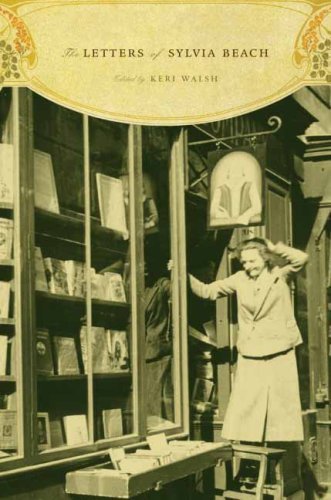
Keri Walsh’s new book The Letters of Sylvia Beach sheds light on one of modern literature’s most fascinating figures. Sylvia Beach was the nexus point for the ex-pat/Lost Generation/Modernist scene in the first half of the twentieth century. Along with her partner Adrienne Monnier, Beach ran the Left Bank bookstore Shakespeare & Company until the Nazi occupation of Paris in 1941. She was the first publisher of Joyce’s Ulysses, she translated Paul Valéry into English, and she was close friends to a good many great writers, including William Carlos Williams, Ezra Pound, H.D., and Ernest Hemingway. Walsh’s book compiles Beach’s letters, revealing a woman who cared deeply about literature and art, who was funny and sincere, and who loved her famous (and not so famous) friends dearly. Over a series of emails, we talked to Dr. Walsh about The Letters of Sylvia Beach, which is out now from Columbia UP. Keri Walsh teachers 20th Century British and Irish Literature at Claremont McKenna College in Los Angeles.
Biblioklept: How did you get interested in Sylvia Beach?
Keri Walsh: I got interested in Sylvia Beach in the same way that many English-speaking visitors to Paris do: when I stumbled upon the Shakespeare and Company bookstore in Paris. Of course, the current bookstore is its own entity: it’s not the direct descendant of Beach’s. It was founded after the Second World War by George Whitman, and it’s been there so long that it’s now legendary in its own right. Today it’s run by Whitman’s daughter, Sylvia Beach Whitman. The shop preserves many of the qualities of Beach’s original: the whimsicality, the friendliness, the sense of being a gathering place for expats. So it was easy to fall in love with it and to want to learn more about its origins.
Sylvia Beach grew up in Princeton, New Jersey. Beach’s father was minister of the Presbyterian Church just up the street from the university campus. I didn’t know that when I began my Ph.D. studies in the English department there. I was delighted to learn that Firestone library, where I worked every day, owned a vast collection of Sylvia Beach’s letters, photographs, books, and belongings. They even had the original “Shakespeare and Company” sign that had hung in front of her store. I started to read through her letters, beginning with the ones she wrote as a teenager. Even then she was always reading. I was charmed by how funny she was, and how resourceful. She could talk her friends into just about anything– including smuggling illegal copies of Ulysses into the United States.
Her correspondents were so illustrious that I was surprised to learn that her letters had never been published. Because she wrote to Gertrude Stein, Ernest Hemingway, H.D. and others, I hoped that this volume might make a contribution to the study of modernist literary culture. But I also wanted to share Beach’s story for its own sake, because she was so fascinating and endearing. I had a hunch that there would be other readers like me who wanted to know more about Beach, and about the sensibility that informed Shakespeare and Company. I thought about all the people who love modernist Paris and independent bookstores. Beach is a kindred spirit for bookworms, expatriates, bohemians, bluestockings, francophiles and salonnieres of all stripes.
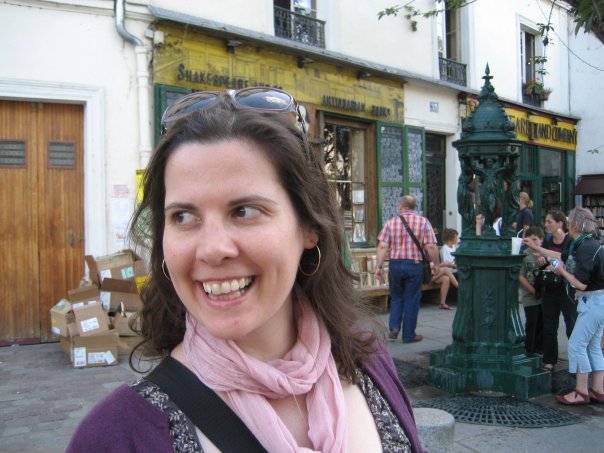
Keri Walsh at Shakespeare and Company, Paris
B: You mention Sylvia Beach Whitman. I’ve read that she’s an ancestor of Walt Whitman–is that true?
KW: About Sylvia Beach Whitman and the Whitman connection– I don’t know. But I do know that the original Sylvia Beach had a Whitman connection, and she was proud of it. An aunt of hers had visited Whitman and asked permission to dig some manuscripts out of his trash bin. Sylvia had these on display in her shop. She writes in her memoir of “several little manuscripts of Walt Whitman scribbled on the backs of letters. These were the gift of the poet to my Aunt Agnes Orbison. Aunt Agnes, when she was a student at Bryn Mawr, had gone with her friend Alys Smith to Camden to visit Walt Whitman . . ..Manuscripts were strewn all over the floor, and some of them . . . were in the waste-paper basket. She got up the courage to draw out a few of these scribblings, mostly on the backs of letters addressed to Walt Whitman, Esq., and asked if she might keep them. “Certainly, my dear,” he replied. And that’s how our family got its Whitman manuscripts” (20).
B: Can you tell us a bit about Beach’s involvement in smuggling copies of Ulysses into the States?
KW: As for the smuggling of Ulysses, Beach tells us in her memoir Shakespeare and Company that some of Hemingway’s friends in Toronto smuggled copies to the Ulysses subscribers underneath their clothes. The original edition of Ulysses was paid for by subscribers in advance, so when Ulysses was banned in the US, it wasn’t a matter of getting copies into bookstores, it was a matter of getting them to the people who’d already bought them. Beach’s letters show us that she relied on her old friend Marion Peter to do some of the smuggling, receiving the books in non-descript looking parcels and forwarding them on to the subscribers in America. “You were such an angel to take all that trouble bootlegging for me!” she wrote to Marion Peter in 1923, a characteristically Sylvia-esque joke at the height of Prohibition to her eminently respectable friend.
B: In Beach’s letters, she comes across as both a friend and a fan to many of the authors to whom she writes. At times, there seems to be a tension there–there’s a late letter to Ezra Pound (#188), for example, where she seems almost ironically deferential; there’s a letter to Hemingway (#211) where she apologizes ahead of time for early “references to [his] domestic life” in her memoir Shakespeare and Company that “should be deleted.” How important was Beach to these writers, and how important were they to her? What was the response to her memoir?
KW: It must have been hard to know what to say to Pound in the years after the Second World War. His politics during the conflict had been abominable, and his mental health was precarious to say the least. Beach was a tactful person who disliked turning her back on anyone, so I think she struck a compromise, holding Pound at a distance but remaining polite. Beginning in the early 1930s her letters register her discomfort with his attraction to Italian fascism. In 1931 Beach wrote to Hemingway that “Ezra Pound is making us a visit, and an Italian tried to stick a stiletto into him during a soiree given in his honor at the Brasserie de l’Odeon. I think people should control themselves better” (134-5). You’re right to pick up on that ironic deference in the later letters. Perhaps it was her way of “handling” Pound: “Do tell me what the “factual error” was in my piece. Not the color of your shirt, I hope. I could swear it was blue. But I know how inaccurate I am. Adrienne is in despair over it” (214).
Her relationships varied, but as a general pattern her relationships with women like Bryher, H.D., and Adrienne Monnier were deep and mutual. One gets the sense that Joyce was more important to her than she was to him. Beach and Hemingway were genuine kindred spirits in the 1920s, and they retained a fond regard for each other throughout their lives. I think that by the 1950s Beach felt less certain about her friendship with Hemingway, wondering whether this cultural icon and Nobel Prize-winning writer still had time for her. But it was a gesture of thoughtfulness on her part to write to him wondering how much of his private story she could share in her memoir. And he responded with implicit trust in her judgment, telling her that anything she wrote would be OK.
One of my favorite Hemingway moments to come out of the Sylvia Beach archives nicely demonstrates their mutual understanding. Beach recorded on Hemingway’s Shakespeare and Company bill of 1934 that “Hemingway read Wyndham Lewis’s article ‘The Dumb Ox in Life and Letters’ and punched a vase of tulips on the table. Paid SB 1500 fr damages. SB returned 500 fr.” (“The Dumb Ox” was, of course, Lewis’s famously unflattering study of Hemingway’s writing).
B: You mention that “One gets the sense that Joyce was more important to her than she was to him.” There’s a letter published in the volume that Beach never actually sent to Joyce that is extremely angry and shows that, at least to some extent, she felt hurt by Joyce’s treatment of her–that she felt used. The letter also reveals the economic difficulties faced by writers and publishers alike, and perhaps hints that Joyce was more mercenary than he would have liked his public to know. To what extent was Beach merely a bank to Joyce?
KW: That letter is remarkable, isn’t it, because it shows the deep resentment Beach eventually felt toward Joyce. But more characteristically, especially in the early 1920s when they were working together on the publication of Ulysses, Beach was indulgent about the privileges of genius. To an extent that amazes me, she welcomed his incursions on her goodwill. She loved his writing, and she made a conscious decision to serve him and his art. This attitude was probably integral to her success. A less devoted, tenacious, and flexible person would simply not have been able to get Ulysses into print. But their intense and one-sided relationship proved unsustainable as his needs escalated and her resources diminished during the Depression.
Beach wasn’t the only one who put Joyce ahead of her own needs: Harriet Weaver, Paul Léon, Samuel Beckett, and Eugene Jolas were similarly devoted. Now, ideally, Joyce would have repaid these personal debts with magnanimity and grace. Sometimes he did. And sometimes he didn’t. In her recent piece on Beach’s letters in the London Times, Jeanette Winterson expresses the frustration that Beach admirers often feel:
“Joyce’s gigantic ego nearly ruined her. He took her cash, let her take all the risks on his (at the time) unpublishable book, and later reneged on the letter and the spirit of their agreements, simply reselling to Random House when he was famous enough to do so.”
But whatever his weaknesses of character, we have to remember that Beach indulged them. She was moved by Joyce’s work ethic in spite of his wretched health, the fact that he was terribly short of funds, and that he always seemed overmatched by circumstance. Her letters give us a glimpse into the sufferings he endured with his eye surgeries, for instance, and it’s harrowing reading. No, they never patched things up, but Beach remained loyal to Joyce’s family after his death, and she was a careful guardian of his legacy.
B: Beach lived with her partner Adrienne Monnier for years. To what extent were they “out” among Paris society, their literary friends, and their family?
KW: Most people who knew them accepted Beach and Monnier as a couple. Paris in the 1920s was tolerant of alternative lifestyles. As George Orwell put it in “Inside the Whale,” “for a time, the populace had grown so hardened to artists that gruff-voiced lesbians in corduroy breeches and young men in Grecian or medieval costume could walk the streets without attracting a glance.”
Beach was considered a member of the Monnier family and spent weekends and summers at Monnier’s parents’ home in Rocfoin. In Women of the Left Bank, Shari Benstock offers an insightful analysis of their relationship. She notes that Beach and Monnier’s relationship differed from Gertude Stein and Alice Toklas’s in its mutuality, and in its refusal of butch/femme roles or the model of heterosexual marriage. “Perhaps because both partners were strong feminists,” says Benstock, their relationship was characterized by: “an egalitarianism unusual in either homosexual or heterosexual relationships of the period. It was not marked by self-destructive behavior, neither was it given to self-indulgence. Indeed, this union might well serve as an alternative model to the more popular view of Paris lesbian experience… (210-211).”
Of course, then, as now, intolerance could rear its head at any time. I came across one patently homophobic response to Beach and Monnier’s relationship. It came from William Carlos Williams’ Autobiography. He wrote of Monnier: “She enjoyed the thought, she said, of pigs screaming as they were being slaughtered, a contempt for the animal—a woman toward whom it was strange to see the mannishly dressed Sylvia so violently drawn” (93). I think he misunderstood Monnier’s sense of humor, and the fun she had shocking the sensibilities of Americans.
B: Have you ever stolen a book?
KW: Hmm . . . does picking up novels left behind on planes count?
This isn’t a theft, but it did feel like a piece of good luck: while editing Beach’s letters, I wanted a copy of her translation of Henri Michaux’s A Barbarian in Asia. I ordered one though a second-hand bookstore online, and when it arrived, I found that it was inscribed with the name of Sylvia Beach’s Ulysses-bootlegger friend Marion Peter. It was the copy Beach had sent to her as a gift when it came out in 1949.
If you missed this morning’s interview on NPR with Dave Tompkins on his new book How to Wreck a Nice Beach (Melville House) you can listen to it here. Tompkins discusses national defense, A Clockwork Orange, Kraftwerk, hip-hop, and autotune. Good stuff.
ReadRollShow‘s Dave Weich interviews Sam Lipsyte. Great little short clips, perfect for internet viewing. They have three up so far, all embedded below–
Dennis Johnson, along with wife Valerie Merians, heads Melville House Publishing, an independent book house putting out some of the best stuff on the market today. They also have a bookstore in Brooklyn that regularly hosts all kinds of neat literary-type events. Melville House is the outgrowth of Johnson’s literary blog MobyLives, an insightful source of reportage on the literary world today. In 2007, the Association of American Publishers awarded Melville House the Miriam Bass Award for Creativity in Independent Publishing and in 2009 The Village Voice declared Melville House “The Best Small Press of the Year.” I talked to Johnson by phone last week and he answered my questions with patience and humor. We discussed how Johnson finds the marvelous books he publishes, translation, novellas, and upcoming releases from Melville House. After the interview he was kind enough to ask me about my own blog and offer me some encouraging words. Just a few days after our talk it was announced that one of Melville House’s recent publications, The Confessions of Noa Weber by Gail Hareven had won the 2010 Best Translated Book Award for fiction.
Biblioklept: I want to begin by congratulating Melville House on Hans Fallada’s novel,Every Man Dies Alone. It’s done really well both critically and commercially. The book is something of a “recovered classic,” published just last year for the first time in English. Can you tell us a little bit about how Melville House came to publish the book?
Dennis Johnson: Well, it was a search it’s a real saga about hunting down that book. I’m always interested in finding material from that part of the world and that time of history because I think a good deal of very good literature was lost between the two wars. And it’s just writing that I like a lot. So a friend of mine, the fashion designer Diane von Furstenberg had family that came through that part of the world at that time and I asked her if she had any recommendations and she told me I should look into Hans Fallada, who I’d never heard of. So I tracked down a couple of his titles that had been translated–because he was a bestselling writer here in the 1930s–and it took a while but I found some of those books which had been out of print for a long time and I really loved them. And then, von Furstenberg told me that his best one had never been translated. That was Every Man Dies Alone. And so we set about going after it and acquiring it. And, at that point, once we’d discovered it, it was pretty easy sailing. But tracking down his stuff that had been translated and finding out more about him was really kind of a fun bit of detective work.
B: Did Michael Hoffman translate it specifically for Melville House?
DJ: Well, there’s a couple of things you can do. You can find the translator, or you can reprint things that have been translated already, if you think it’s already a good translation–that’s a less expensive way to do a translated book. So for example, with the Fallada, I bought some old translations of his other books and published them simultaneously with the new translation of Every Man. There was, you know, there was no old translation to buy. But two of his other books, two great books, one called The Drinker and one called Little Man, What Now? I thought were pretty well translated so we just bought those old translations. They were out of print, they were available [for publication].
B: It seems like a lot of the books you guys put out are–I don’t know how to put it–recovered classics or cult books or just books that English-reading audiences just aren’t necessarily exposed to. Is that purposeful with Melville House?
DJ: I think we have a fairly mixed list. The names you were citing a minute ago . . . Balestrini, he’s only been translated once, I think, thirty or forty years ago. But he’s a very prominent writer in Italy. And it wasn’t exactly a “discovery,” it was just someone that we thought American audiences should know about. Imre Kertész on the other hand is extremely famous, he’s a Nobel Prize winner and he’s published by Knopf. We were thrilled when he wanted to come to Melville House. So, you know, some of these writers are here, some are not. We publish some well known writers, some very obscure writers. We try to mix it up. You know, there’ s no rule, just good literature.
DJ: Well, we originally had a series called just the Art of the Novella. It’s classics, many of them translated, classics from around the world, lots of European classics, and some of those are new translations that we did it, some are old translations that we reprinted. And that series did really, really well and people really seemed to love it so we decided that we would do a contemporary version of that series and try to mix it up the same way. And so the new series has new discoveries in it, some old reprints, things from around the world, we’re expanding beyond Europe and Russia, we’ve got a native Japanese author named Banana Yoshimoto in it coming out, we’ve got African writers, South American writers . . . It’s been off to a very good launch. I think we’ve done about fourteen or fifteen books in that series so far and it’s going really well. You know, it’s very hard to publish translation in the United States. It doesn’t . . . it doesn’t sell. It’s hard to keep it in store for a long time. And it’s expensive to do translated books because you have to pay your translator. In the Contemporary series we often use new translations because it’s new work that’s never been translated before and that can get very expensive because you’ve got two authors, you know, you have to pay the author, the translator, and that’s why a lot of people are cutting back on doing translations. But we wanted to keep doing translations and we had to figure out a way to keep doing it and one idea we had was, if we had this series of short novels . . . well, one, they’re just cheaper to do, they cost less to buy from another publisher, they cost less to make because they’re less paper and they cost less to translate because they’re shorter. And you know, you pay by how long. So, it suddenly became a more economical way for us to publish translated books. The booksellers, they like the Contemporary series. They get the whole series and they keep it in the store. So, for example, we’re about to do a deal with a new book store in Fort Greene called Greenlight where they would do a whole wall of these books. Other stores do a spin-rack of these books. And they just keep them. And what usually happens with new books is you just get a few weeks in the bookstore and if it doesn’t sell they return it. And so we would get really creamed on the translated work because it wouldn’t have very long in the store and it’s hard to get publicity for them and then they just didn’t have enough time to sell. But, if they’re taking the whole series and keeping them on display, forever, well, then these books have a real chance of surviving. So there were a lot of good reasons for us to do a Contemporary series. And in the end, the reason was that it allowed us to keep doing really good, serious, translated work.
B: What do you think about “rock star” writers like Haruki Murakami and Roberto Bolaño whose English translations sell very well? Does that help the prospects of translated books at all?
DJ: Well, every year there are one or two books that are translated that do very well. But they’re the exception to the rule. At any given point in the year, you look at the New York Times bestseller list for fiction, there’s almost never a translated book on it. Or if there is, it’s some, you know, Scandinavian murder mystery or something. It’s very rare it’s a serious work of literature. So I would say those writers are the exception to the rule. But it’s certainly does help those of us selling translated fiction to be able to point to those things. It encourages booksellers to give us a chance.
B: Can you tell us a little bit about upcoming titles and authors you’re excited about?
DJ: We’re doing Wolf among Wolves in May. And we’re doing the paperback for Every Man Dies Alone at the end of this month, as a matter of fact. So those are two that I’m really excited about. We have some really great nonfiction coming out. We just published a book about North Korea called The Cleanest Race. It’s about understanding North Korea through its propaganda. It’s got a lot of really wild art showing the propaganda posters and movie stills and things. And then we’ve got some novels coming out, one from a young British writer named Lee Rourke. It’s the first novel. It’s called The Canaland I think it’s one of the very best novels we’ve ever published. It’s generating a lot of excitement. We’re doing another one with Kertész next year, which is a big novel called Fiasco. He wrote a trilogy years ago about his experience in the camps. What was he, fifteen or something, when he was sent to Auschwitz-Birkenau, working in a Nazi factory trying to turn coal into gasoline? And he wrote a novel called Fatelessnessabout that and another one called Kaddish for an Unborn Child. And Knopf published Kaddish and Fatelessness but they never published Fiasco. So we’re really excited about that.
B: Something I enjoy about MobyLives is your perspective as a publisher covering real news about book selling.
DJ: Thanks. It’s a labor of love. If you look at the historic arc of the website, you can see that we became more informed by being a publisher. I wasn’t a publisher when I started it and it was much more general-interest reader kind of thing. I try to get help. I try to make the staff here participate, I think it makes it a little more wide-ranging.
B: So, have you ever stolen a book?
DJ: Sure, yeah. I used to steal a lot of books from my brother. I remember stealing Gore Vidal’s Burr. My big brother’s a lot older than me and he left the house when I was a kid and I remember stealing a lot of his books. So Burr yeah, a novel Vidal wrote about Aaron Burr. Fantastic book. I still have it. He hasn’t asked for it back. I don’t think he knows.
Driving to work this morning in the dark dolorous haze appropriate to a post-Super Bowl Monday, I was more than a little surprised to catch Steve Innskeep interview Don DeLillo on Morning Edition. If you missed the interview, which focuses on DeLillo’s latest, Point Omega, you can listen to it or download it from Morning Edition‘s site. The usually-taciturn DeLillo is particularly reflective, even generous in this interview. “I guess my work all these years has been about living in dangerous times” he says, “and part of this danger has been what the media reports, and how it changes our perceptions.” It’s also kinda strange to hear his voice, which seems frailer and more awkward than I would have imagined. Very cool interview.
The Wall Street Journal has published an interview with Don DeLillo where the reclusivish author discusses the genesis of his new novella, Point Omega. From the interview:
The Wall Street Journal: How did this book evolve?
Don DeLillo: The idea began in the same place where the novel begins — in the sixth floor gallery at the Museum of Modern Art — and at the same time, summer of 2006. I wandered in and there was “24 Hour Psycho,” which I found very interesting to watch and to think about. In fact, I returned two or three times after that, and by the third visit I was fairly certain I wanted to write something about it — the idea of time and motion and the sense of self-conscious seeing, because everything happens in such slow motion and because the imagery is somewhat familiar from the movie itself. I began to wonder about such things, about how we see and what we see, and what we miss seeing when we’re looking at things in a more conventional format. And I decided finally that I wasn’t going to risk writing a piece of nonfiction because I’m not a philosopher or a physicist and I could not study time in the matter that seemed to be warranted. So I placed a character in the gallery and began from there.
The Wall Street Journal seems to be on a streak when it comes to interviewing authors who typically avoid interviews–Cormac McCarthy talked with the financial magazine late last year. Maybe we should scour their archives more closely–who knows, maybe there’s a secret Salinger interview stashed away somewhere.

 Adam Langer’s newest novel, The Thieves of Manhattan hits bookstores across the country this week. It’s a smart, funny hybrid that blends and bends genres with startling results. Adam was kind enough to talk to Biblioklept over a series of emails about his new book, truth vs stuff that actually happened, literary hoaxes, and being mistaken for the author of The Magicians. You can read more about Adam Langer at his
  AL: I think we, or at least speaking for myself, I do want truth from a narrative. When I read a book or see a movie, I do want it to resonate; I want it to either connect with my viewpoints or to challenge them and make me rethink them; I don’t like when my BS-o-meter is constantly going off. But I think people often get bogged down when they confuse Truth with Stuff That Actually Happened. Tim O’Brien has an awesome essay on this topic that kind of blew my mind when I was in college. As for me, I’d much rather read a story of space aliens or baboons or Elizabeth Barrett Browning’s dog that rang true than a self-aggrandizing purportedly-true memoir or celebrity autobiography. There’s a line in Steve Toltz’s A Fraction of the Whole, which I quite liked–”If someone said to me, ‘I’ve got this great story to tell you, and every word of it is an absolute lie!’ I’d be on the edge of my seat.” That line has stuck with me. Also, more prosaically, in the publishing industry, there’s a perception that, with the decline of traditional book coverage, a good novel isn’t enough anymore, that the author needs a compelling biography as well. Ian certainly has this perception and part of his frustration is that he assumes his lack of success is directly related to his lack of an interesting autobiography. He later learns he was wrong regarding just about all of his
 Michael Wiley is a mystery writer and professor of British Romantic literature and culture at the University of North Florida. He’s published academic volumes about geography and migration in Romantic literature, but we spoke to him about the latest edition in his detective series, The Bad Kitty Lounge. Dr. Wiley was kind enough to talk to us via email about ambiguity and resolution in mystery fiction, giving readers what they want, and the prospects of Wordsworth with a Glock. The Bad Kitty Lounge is available new in hardcover from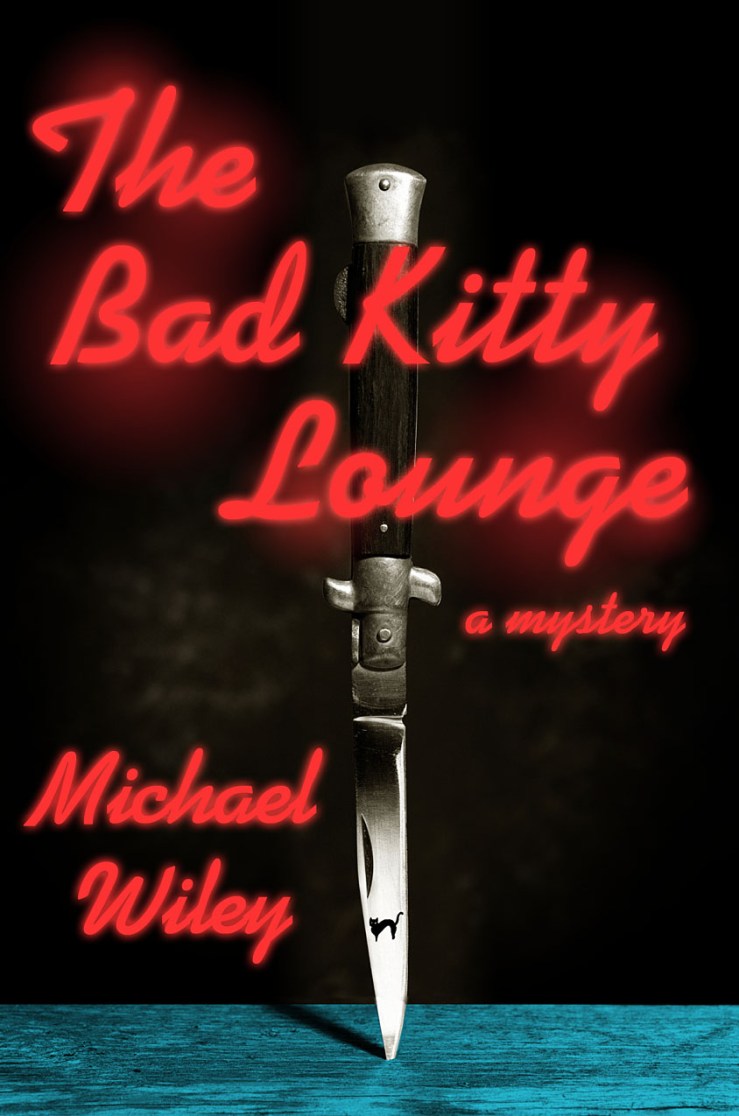
 If you missed this morning’s interview on NPR with Dave Tompkins on his new book How to Wreck a Nice Beach (

 Biblioklept