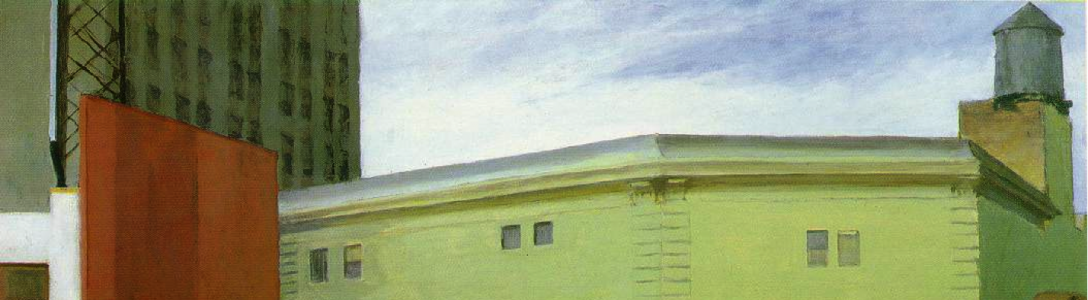
Read “The Raid,” John Steinbeck’s story of labor and violence

“The Raid”

by

John Steinbeck


I

It was dark in the little California town when the two men stepped from the lunch car and strode arrogantly through the back streets. The air was full of the sweet smell of fermenting fruit from the packing plants. High over the corners, blue arc lights swung in the wind and put moving shadows of telephone wires on the ground. The old wooden buildings were silent and resting. The dirty windows dismally reflected the street lights.

The two men were about the same size, but one was much older than the other. Their hair was cropped, they wore blue jeans. The older man had on a peajacket, while the younger wore a blue turtle-neck sweater. As they swung down the dark street, footsteps echoed back loudly from the wooden buildings. The younger man began to whistle Come to Me My Melancholy Baby. He stopped abruptly. “I wish that damn tune would get out of my head. It’s been going all day. It’s an old tune, too.”

His companion turned toward him. “You’re scared, Root. Tell the truth. You’re scared as hell.”

They were passing under one of the blue street lights. Root’s face put on its toughest look, the eyes squinted, the mouth went crooked and bitter. “No, I ain’t scared.” They were out of the light. His face relaxed again. “I wish I knew the ropes better. You been out before, Dick. You know what to expect. But I ain’t ever been out.”

“The way to learn is to do,” Dick quoted sententiously. “You never really learn nothing from books.”

They crossed a railroad track. A block tower up the line a little was starred with green lights. “It’s awful dark,” said Root. “I wonder if the moon will come up later. Usually does when it’s so dark. You going to make the first speech, Dick?”

“No, you make it. I had more experience than you. I’ll watch them while you talk and then I can smack them where I know they bite. Know what you’re going to say?”

“Sure I do. I got it all in my head, every word. I wrote it out and learned it. I heard guys tell how they got up and couldn’t think of a thing to say, and then all of a sudden they just started in like it was somebody else, and the words came out like water out of a hydrant. Big Mike Sheane said it was like that with him. But I wasn’t taking no chances, so I wrote it out.”

A train hooted mournfully, and in a moment it rounded a bend and pushed its terrible light down the track. The lighted coaches rattled past. Dick turned to watch it go by. “Not many people on that one,” he said with satisfaction. “Didn’t you say your old man worked on the railroad?”

Root tried to keep the bitterness out of his voice. “Sure, he works on the road. He’s a brakeman. He kicked me out when he found out what I was doing. He was scared he’d lose his job. He couldn’t see. I talked to him, but he just couldn’t see. He kicked me right out.” Root’s voice was lonely. Suddenly he realized how he had weakened and how he sounded homesick. “That’s the trouble with them,” he went on harshly. “They can’t see beyond their jobs. They can’t see what’s happening to them. They hang on to their chains.”

“Save it,” said Dick. “That’s good stuff. Is that part of your speech?”

“No, but I guess I’ll put it in if you say it’s good.”

The street lights were fewer now. A line of locust trees grew along the road, for the town was beginning to thin and the country took control. Along the unpaved road there were a few little houses with ill-kept gardens.

“Jesus! It’s dark,” Root said again. “I wonder if there’ll be any trouble. It’s a good night to get away if anything happens.”

Dick snorted into the collar of his peajacket. They walked along in silence for awhile.

“Do you think you’d try to get away, Dick?” Root asked.

“No, by God! It’s against orders. If anything happens we got to stick. You’re just a kid. I guess you’d run if I let you!”

Root blustered: “You think you’re hell on wheels just because you been out a few times. You’d think you was a hundred to hear you talk.”

“I’m dry behind the ears, anyway,” said Dick.

Root walked with his head down. He said softly, “Dick, are you sure you wouldn’t run? Are you sure you could just stand there and take it?”

“Of course I’m sure. I’ve done it before. It’s the orders, ain’t it? Why, it’s good publicity.” He peered through the darkness at Root. “What makes you ask, kid? You scared you’ll run? If you’re scared you got no business here.”

Root shivered. “Listen, Dick, you’re a good guy. You won’t tell nobody what I say, will you? I never been tried. How do I know what I’ll do if somebody smacks me in the face with a club? How can anybody tell what he’d do? I don’t think I’d run. I’d try not to run.”

“All right, kid. Let it go at that. But you try running, and I’ll turn your name in. We got no place for yellow bastards. You remember that, kid.”

“Oh, lay off that kid stuff. You’re running that in the ground.”

The locust trees grew closer together as they went. The wind rustled gently in the leaves. A dog growled in one of the yards as the men went by. A light fog began to drift down through the air, and the stars were swallowed in it. “You sure you got everything ready?” Dick asked. “Got the lamps? Got the lit’ature? I left all that to you.”

“I did it all this afternoon,” said Root. “I didn’t put the posters up yet, but I got them in a box out there.”

“Got oil in the lamps?”

“They had plenty in. Say, Dick, I guess some bastard has squealed, don’t you?”

“Sure. Somebody always squeals.”

“Well you didn’t hear nothing about no raid, did you?”

“How the hell would I hear. You think they’d come and tell me they was going to knock my can off? Get hold of yourself, Root. You got the pants scared off you. You’re going to make me nervous if you don’t cut it out.” Continue reading “Read “The Raid,” John Steinbeck’s story of labor and violence”
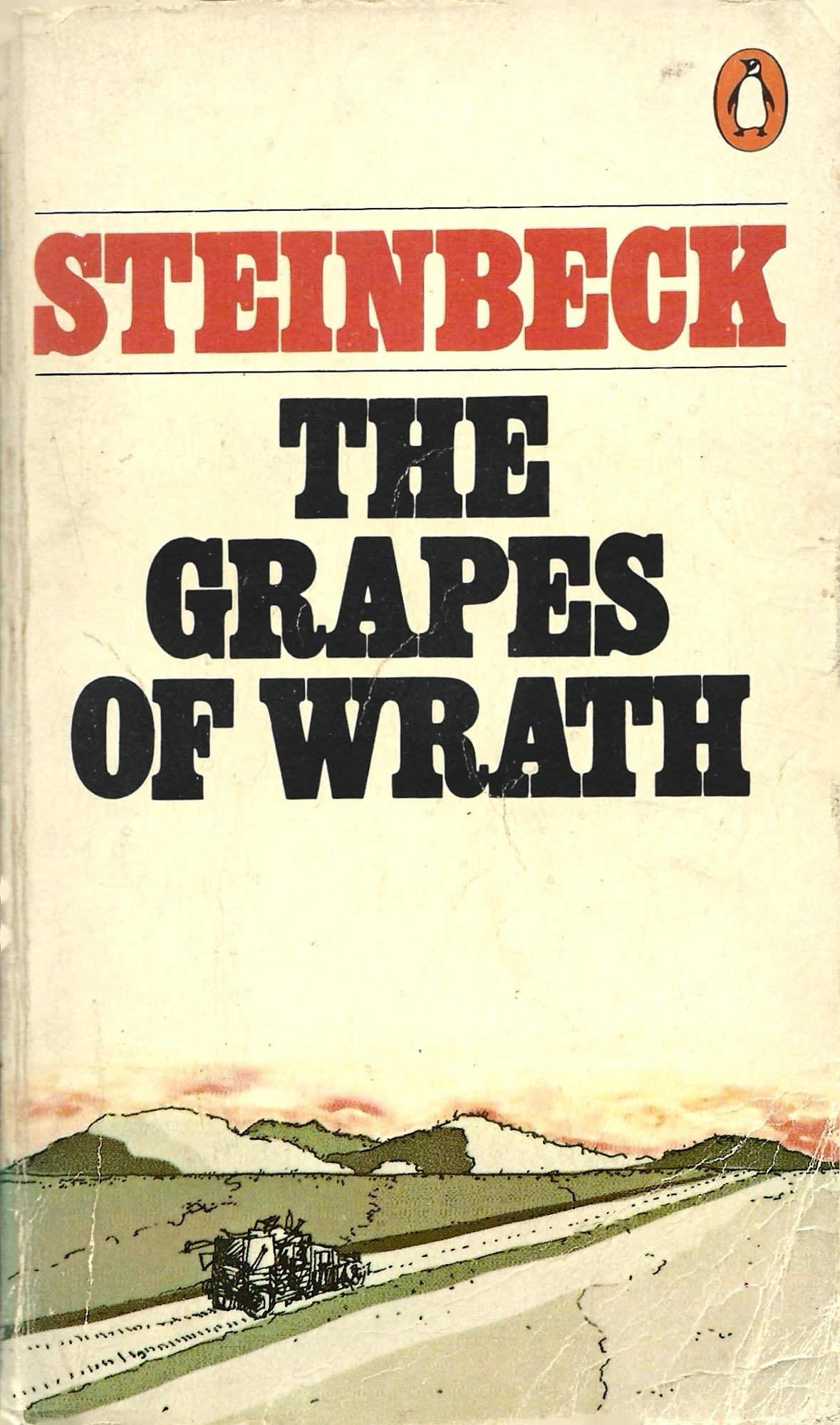
Mass-market Monday | John Steinbeck’s The Grapes of Wrath

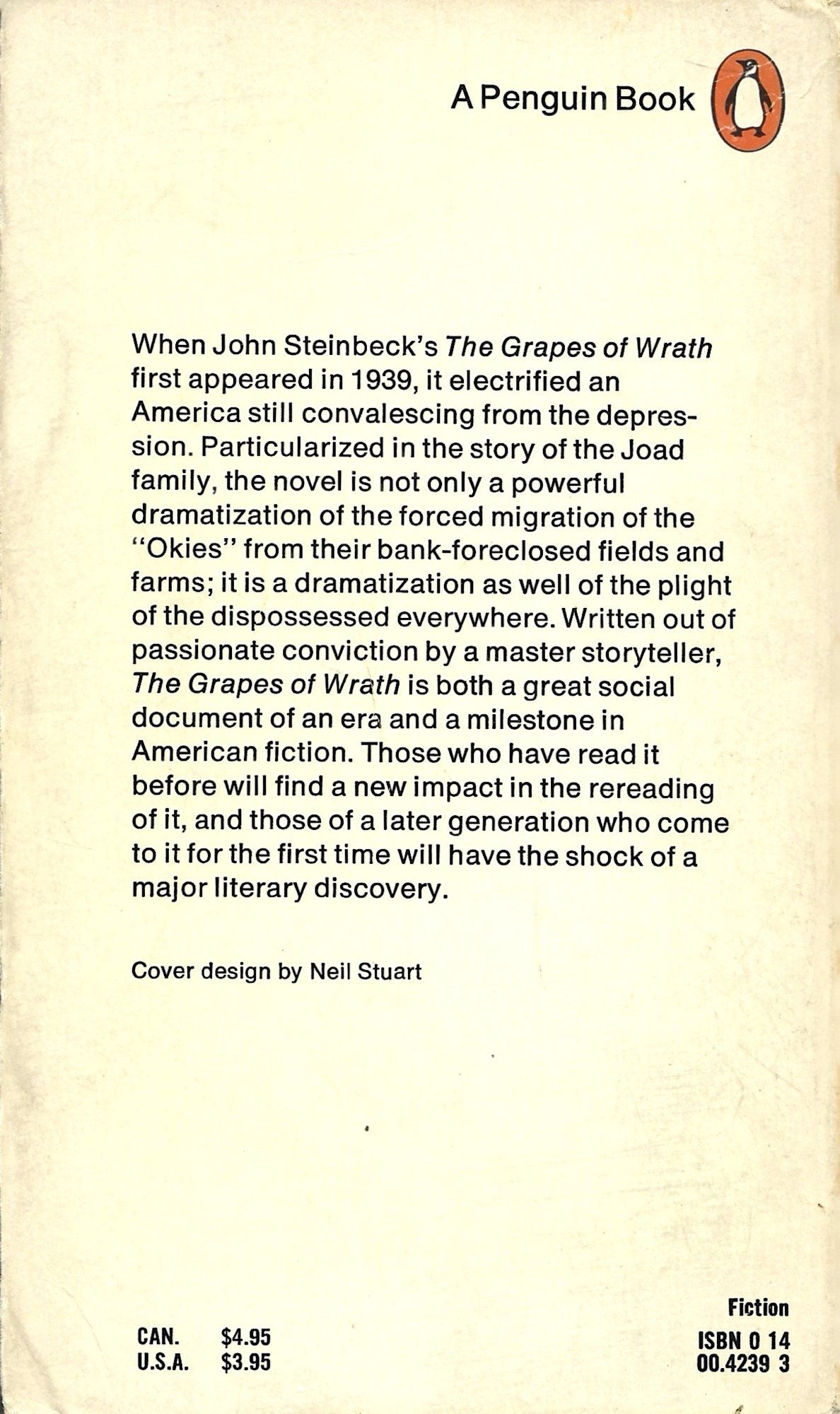
The Grapes of Wrath, John Steinbeck, 1939. Penguin Books (1979). Cover design by Neil Stuart. 502 pages.

While it is not fair to call The Grapes of Wrath underrated I think it continues to be under-read. There’s something corny and beautiful I love in Steinbeck’s prose, and while the novel is not without its problems, it remains a sympathetic and convincing depiction of people — laborers — resisting the dehumanizing machinations of capital. Here is Chapter Twenty-One, one of the many stand-alone intercalary vignettes that flesh out the Joad’s saga–


The moving, questing people were migrants now. Those families which had lived on a little piece of land, who had lived and died on forty acres, had eaten or starved on the produce of forty acres, had now the whole West to rove in. And they scampered about, looking for work; and the highways were streams of people, and the ditch banks were lines of people. Behind them more were coming. The great highways streamed with moving people. There in the Middle- and Southwest had lived a simple agrarian folk who had not changed with industry, who had not formed with machines or known the power and danger of machines in private hands. They had not grown up in the paradoxes of industry. Their senses were still sharp to the ridiculousness of the industrial life.

And then suddenly the machines pushed them out and they swarmed on the highways. The movement changed them; the highways, the camps along the road, the fear of hunger and the hunger itself, changed them. The children without dinner changed them, the endless moving changed them. They were migrants. And the hostility changed them, welded them, united them—hostility that made the little towns group and arm as though to repel an invader, squads with pick handles, clerks and storekeepers with shotguns, guarding the world against their own people.

In the West there was panic when the migrants multiplied on the highways. Men of property were terrified for their property. Men who had never been hungry saw the eyes of the hungry. Men who had never wanted anything very much saw the flare of want in the eyes of the migrants. And the men of the towns and of the soft suburban country gathered to defend themselves; and they reassured themselves that they were good and the invaders bad, as a man must do before he fights. They said, These goddamned Okies are dirty and ignorant. They’re degenerate, sexual maniacs. These goddamned Okies are thieves. They’ll steal anything. They’ve got no sense of property rights.

And the latter was true, for how can a man without property know the ache of ownership? And the defending people said, They bring disease, they’re filthy. We can’t have them in the schools. They’re strangers. How’d you like to have your sister go out with one of ’em?

The local people whipped themselves into a mold of cruelty. Then they formed units, squads, and armed them—armed them with clubs, with gas, with guns. We own the country. We can’t let these Okies get out of hand. And the men who were armed did not own the land, but they thought they did. And the clerks who drilled at night owned nothing, and the little storekeepers possessed only a drawerful of debts. But even a debt is something, even a job is something. The clerk thought, I get fifteen dollars a week. S’pose a goddamn Okie would work for twelve? And the little storekeeper thought, How could I compete with a debtless man?

And the migrants streamed in on the highways and their hunger was in their eyes, and their need was in their eyes. They had no argument, no system, nothing but their numbers and their needs. When there was work for a man, ten men fought for it—fought with a low wage. If that fella’ll work for thirty cents, I’ll work for twenty-five.

If he’ll take twenty-five, I’ll do it for twenty.

No, me, I’m hungry. I’ll work for fifteen. I’ll work for food. The kids. You ought to see them. Little boils, like, comin’ out, an’ they can’t run aroun’. Give ’em some windfall fruit, an’ they bloated up. Me. I’ll work for a little piece of meat.

And this was good, for wages went down and prices stayed up. The great owners were glad and they sent out more handbills to bring more people in. And wages went down and prices stayed up. And pretty soon now we’ll have serfs again.

And now the great owners and the companies invented a new method. A great owner bought a cannery. And when the peaches and the pears were ripe he cut the price of fruit below the cost of raising it. And as cannery owner he paid himself a low price for the fruit and kept the price of canned goods up and took his profit. And the little farmers who owned no canneries lost their farms, and they were taken by the great owners, the banks, and the companies who also owned the canneries. As time went on, there were fewer farms. The little farmers moved into town for a while and exhausted their credit, exhausted their friends, their relatives. And then they too went on the highways. And the roads were crowded with men ravenous for work, murderous for work.

And the companies, the banks worked at their own doom and they did not know it. The fields were fruitful, and starving men moved on the roads. The granaries were full and the children of the poor grew up rachitic, and the pustules of pellagra swelled on their sides. The great companies did not know that the line between hunger and anger is a thin line. And money that might have gone to wages went for gas, for guns, for agents and spies, for blacklists, for drilling. On the highways the people moved like ants and searched for work, for food. And the anger began to ferment.

Mass-market Monday | John Steinbeck’s In Dubious Battle

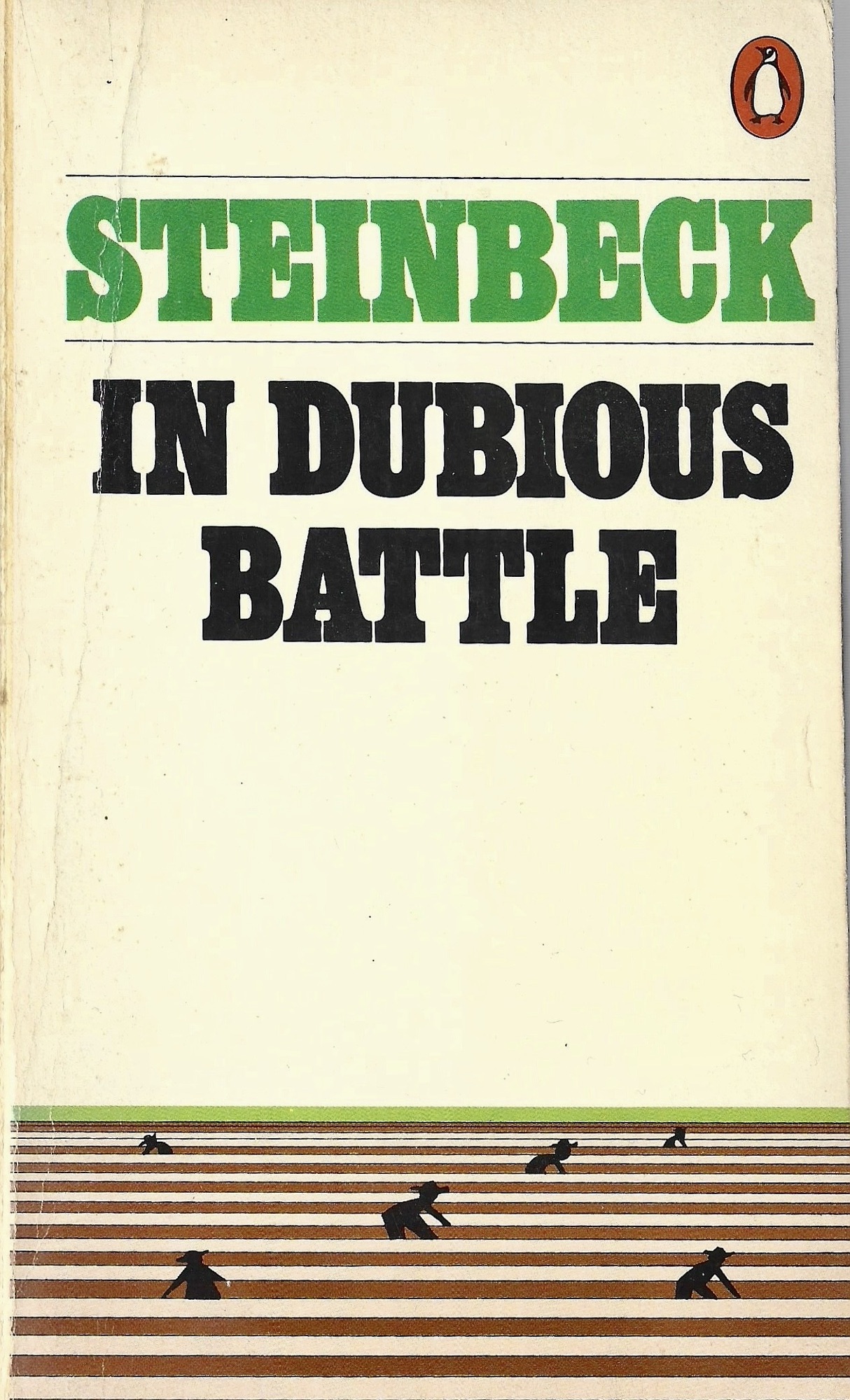
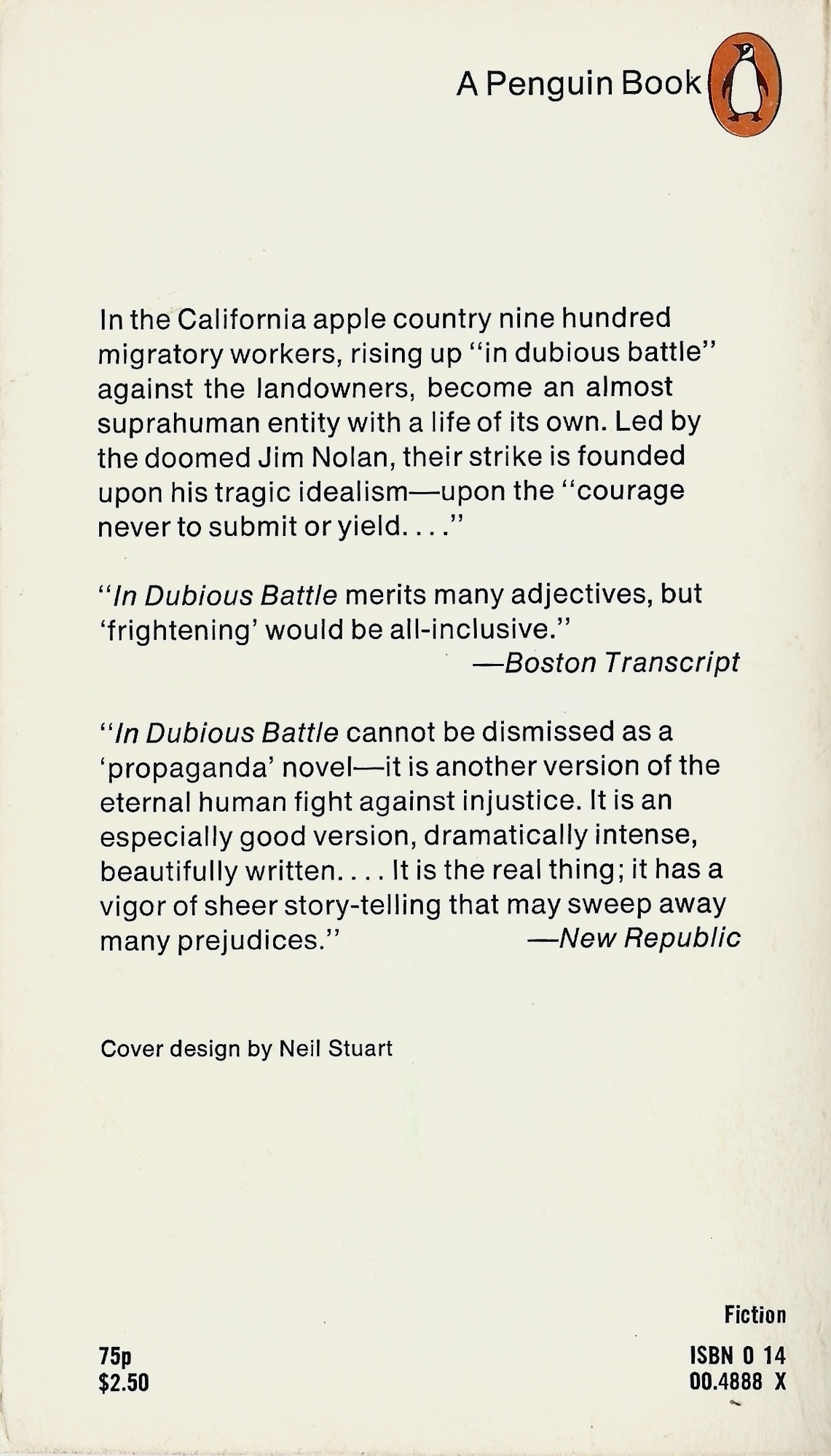
In Dubious Battle, John Steinbeck. Penguin Books (1979). Cover design by Neil Stuart. 313 pages.

John Steinbeck’s underrated and under-read novel In Dubious Battle seems like a good Labor Day mass-market pick. Perhaps Steinbeck’s most radical novel, In Dubious Battle details the fight for better working conditions during the Great Depression in California’s fruit orchards. The hero is young Jim Nolan who joins a labor strike organized by the Communist Party (one of the Party’s officials is named Harry Nilson). Jim is taken under the wing of the veteran organizer Mac McLeod; the pair drive a plot that focuses on the sometimes violent conflict between the workers and the landowners, who use the police and hired thugs to attempt to break the strike. Steinbeck, as is often the case with his serious novels, caps In Dubious Battle with a devastating conclusion, the final line a howl that does not end, its dash carrying the battle into the future, our own future: “Comrades! He didn’t want nothing for himself—“

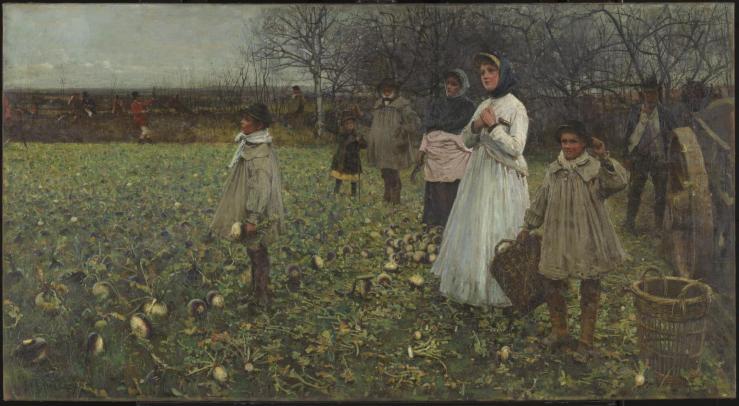
Toil and Pleasure — John Robertson Reid

Toil and Pleasure, 1879 by John Robertson Reid (1851-1926)

Labor — Will Barnet

“The Ludlow Massacre” — Woody Guthrie

Read Howard Zinn on The Ludlow Massacre. Happy Labor Day!