“Egotism; Or, The Bosom Serpent” — Nathaniel Hawthorne

 “Egotism; Or, The Bosom Serpent” — Nathaniel Hawthorne

“Here he comes!” shouted the boys along the street. “Here comes the man with a snake in his bosom!”

This outcry, saluting Herkimer’s ears as he was about to enter the iron gate of the Elliston mansion, made him pause. It was not without a shudder that he found himself on the point of meeting his former acquaintance, whom he had known in the glory of youth, and whom now after an interval of five years, he was to find the victim either of a diseased fancy or a horrible physical misfortune.

“A snake in his bosom!” repeated the young sculptor to himself. “It must be he. No second man on earth has such a bosom friend. And now, my poor Rosina, Heaven grant me wisdom to discharge my errand aright! Woman’s faith must be strong indeed since thine has not yet failed.”

Thus musing, he took his stand at the entrance of the gate and waited until the personage so singularly announced should make his appearance. After an instant or two he beheld the figure of a lean man, of unwholesome look, with glittering eyes and long black hair, who seemed to imitate the motion of a snake; for, instead of walking straight forward with open front, he undulated along the pavement in a curved line. It may be too fanciful to say that something, either in his moral or material aspect, suggested the idea that a miracle had been wrought by transforming a serpent into a man, but so imperfectly that the snaky nature was yet hidden, and scarcely hidden, under the mere outward guise of humanity. Herkimer remarked that his complexion had a greenish tinge over its sickly white, reminding him of a species of marble out of which he had once wrought a head of Envy, with her snaky locks.

The wretched being approached the gate, but, instead of entering, stopped short and fixed the glitter of his eye full upon the compassionate yet steady countenance of the sculptor.

“It gnaws me! It gnaws me!” he exclaimed.

And then there was an audible hiss, but whether it came from the apparent lunatic’s own lips, or was the real hiss of a serpent, might admit of a discussion. At all events, it made Herkimer shudder to his heart’s core.

“Do you know me, George Herkimer?” asked the snake-possessed.

Herkimer did know him; but it demanded all the intimate and practical acquaintance with the human face, acquired by modelling actual likenesses in clay, to recognize the features of Roderick Elliston in the visage that now met the sculptor’s gaze. Yet it was he. It added nothing to the wonder to reflect that the once brilliant young man had undergone this odious and fearful change during the no more than five brief years of Herkimer’s abode at Florence. The possibility of such a transformation being granted, it was as easy to conceive it effected in a moment as in an age. Inexpressibly shocked and startled, it was still the keenest pang when Herkimer remembered that the fate of his cousin Rosina, the ideal of gentle womanhood, was indissolubly interwoven with that of a being whom Providence seemed to have unhumanized. Continue reading ““Egotism; Or, The Bosom Serpent” — Nathaniel Hawthorne”

“The journal of a human heart for a single day in ordinary circumstances” and other ideas from Nathaniel Hawthorne’s Note-Books


  1. A young man and girl meet together, each in search of a person to be known by some particular sign. They watch and wait a great while for that person to pass. At last some casual circumstance discloses that each is the one that the other is waiting for. Moral,–that what we need for our happiness is often close at hand, if we knew but how to seek for it.
  2. The journal of a human heart for a single day in ordinary circumstances. The lights and shadows that flit across it; its internal vicissitudes.
  3. Distrust to be thus exemplified: Various good and desirable things to be presented to a young man, and offered to his acceptance,–as a friend, a wife, a fortune; but he to refuse them all, suspecting that it is merely a delusion. Yet all to be real, and he to be told so, when too late.
  4. A man tries to be happy in love; he cannot sincerely give his heart, and the affair seems all a dream. In domestic life, the same; in politics, a seeming patriot; but still he is sincere, and all seems like a theatre.
  5. An old man, on a summer day, sits on a hill-top, or on the observatory of his house, and sees the sun’s light pass from one object to another connected with the events of his past life,–as the school-house, the place where his wife lived in her maidenhood,–its setting beams falling on the churchyard.
  6. An idle man’s pleasures and occupations and thoughts during a day spent by the seashore: among them, that of sitting on the top of a cliff, and throwing stones at his own shadow, far below.
  7. A blind man to set forth on a walk through ways unknown to him, and to trust to the guidance of anybody who will take the trouble; the different characters who would undertake it: some mischievous, some well-meaning, but incapable; perhaps one blind man undertakes to lead another. At last, possibly, he rejects all guidance, and blunders on by himself.

Notations from Nathaniel Hawthorne’s American Note-Books.

“An article on fire, on smoke” and Other Ideas from Nathaniel Hawthorne’s Note-Books

  1. An article on fire, on smoke. Diseases of the mind and soul,–even more common than bodily diseases.
  2. Tarleton, of the Revolution, is said to have been one of the two handsomest men in Europe,–the Prince of Wales, afterwards George IV., being the other. Some authorities, however, have represented him as ungainly in person and rough in manners. Tarleton was originally bred for the law, but quitted law for the army early in life. He was son to a mayor of Liverpool, born in 1754, of ancient family. He wrote his own memoirs after returning from America. Afterwards in Parliament. Never afterwards distinguished in arms. Created baronet in 1818, and died childless in 1833. Thought he was not sufficiently honored among more modern heroes. Lost part of his right hand in battle of Guilford Court House. A man of pleasure in England.
  3. It would be a good idea for a painter to paint a picture of a great actor, representing him in several different characters of one scene,–Iago and Othello, for instance.
  4. A description of a young lady who had formerly been insane, and now felt the approach of a new fit of madness. She had been out to ride, had exerted herself much, and had been very vivacious. On her return, she sat down in a thoughtful and despondent attitude, looking very sad, but one of the loveliest objects that ever were seen. The family spoke to her, but she made no answer, nor took the least notice; but still sat like a statue in her chair,–a statue of melancholy and beauty. At last they led her away to her chamber.
  5. Observation. The effect of morning sunshine on the wet grass, on sloping and swelling land, between the spectator and the sun at some distance, as across a lawn. It diffused a dim brilliancy over the whole surface of the field. The mists, slow-rising farther off, part resting on the earth, the remainder of the column already ascending so high that you doubt whether to call it a fog or a cloud.

Notations from Nathaniel Hawthorne’s American Note-Books.


“There Is Evil in Every Human Heart” and Seven Other Story Ideas from Nathaniel Hawthorne’s Note-Books

  1. Our body to be possessed by two different spirits; so that half of the visage shall express one mood, and the other half another.
  2. An old English sea-captain desires to have a fast-sailing ship, to keep a good table, and to sail between the tropics without making land.
  3. A rich man left by will his mansion and estate to a poor couple. They remove into it, and find there a darksome servant, whom they are forbidden by will to turn away. He becomes a torment to them; and, in the finale, he turns out to be the former master of the estate.
  4. Two persons to be expecting some occurrence, and watching for the two principal actors in it, and to find that the occurrence is even then passing, and that they themselves are the two actors.
  5. There is evil in every human heart, which may remain latent, perhaps, through the whole of life; but circumstances may rouse it to activity. To imagine such circumstances. A woman, tempted to be false to her husband, apparently through mere whim,–or a young man to feel an instinctive thirst for blood, and to commit murder. This appetite may be traced in the popularity of criminal trials. The appetite might be observed first in a child, and then traced upwards, manifesting itself in crimes suited to every stage of life.
  6. The good deeds in an evil life,–the generous, noble, and excellent actions done by people habitually wicked,–to ask what is to become of them.
  7. A satirical article might be made out of the idea of an imaginary museum, containing such articles as Aaron’s rod, the petticoat of General Hawion, the pistol with which Benton shot Jackson,–and then a diorama, consisting of political or other scenes, or done in wax-work. The idea to be wrought out and extended. Perhaps it might be the museum of a deceased old man.
  8. An article might be made respecting various kinds of ruin,–ruin as regards property,–ruin of health,–ruin of habits, as drunkenness and all kinds of debauchery,–ruin of character, while prosperous in other respects,–ruin of the soul. Ruin, perhaps, might be personified as a demon, seizing its victims by various holds.

Notations from Nathaniel Hawthorne’s American Note-Books.

Ten Notes from Nathaniel Hawthorne’s Note-Books

  1. Anciently, when long-buried bodies were found undecayed in the grave, a species of sanctity was attributed to them.
  2. Some chimneys of ancient halls used to be swept by having a culverin fired up them.
  3. At Leith, in 1711, a glass bottle was blown of the capacity of two English bushels.
  4. The buff and blue of the Union were adopted by Fox and the Whig party in England. The Prince of Wales wore them.
  5. In 1621, a Mr. Copinger left a certain charity, an almhouse, of which four poor persons were to partake, after the death of his eldest son and his wife. It was a tenement and yard. The parson, headboroughs, and his five other sons were to appoint the persons. At the time specified, however, all but one of his sons were dead; and he was in such poor circumstances that he obtained the benefit of the charity for himself, as one of the four.
  6. A town clerk arranges the publishments that are given in, according to his own judgment.
  7. To make a story from Robert Raikes seeing dirty children at play, in the streets of London, and inquiring of a woman about them. She tells him that on Sundays, when they were not employed, they were a great deal worse, making the streets like hell; playing at church, etc. He was therefore induced to employ women at a shilling to teach them on Sundays, and thus Sunday-schools were established.
  8. To represent the different departments of the United States government by village functionaries. The War Department by watchmen, the law by constables, the merchants by a variety store, etc.
  9. At the accession of Bloody Mary, a man, coming into a house, sounded three times with his mouth, as with a trumpet, and then made proclamation to the family. A bonfire was built, and little children were made to carry wood to it, that they might remember the circumstance in old age. Meat and drink were provided at the bonfires.
  10. To describe a boyish combat with snowballs, and the victorious leader to have a statue of snow erected to him. A satire on ambition and fame to be made out of this idea. It might be a child’s story.

Notations from Nathaniel Hawthorne’s American Note-Books


“A picnic party in the woods” / September 28, 1841 Journal Entry from Nathaniel Hawthorne

A picnic party in the woods, yesterday, in honor of little Frank Dana’s birthday, he being six years old. I strolled out, after dinner, with Mr. Bradford, and in a lonesome glade we met the apparition of an Indian chief, dressed in appropriate costume of blanket, feathers, and paint, and armed with a musket. Almost at the same time, a young gypsy fortune-teller came from among the trees, and proposed to tell my fortune. While she was doing this, the goddess Diana let fly an arrow, and hit me smartly in the hand. The fortune-teller and goddess were in fine contrast, Diana being a blonde, fair, quiet, with a moderate composure; and the gypsy (O. G.) a bright, vivacious, dark-haired, rich-complexioned damsel,–both of them very pretty, at least pretty enough to make fifteen years enchanting. Accompanied by these denizens of the wild wood, we went onward, and came to a company of fantastic figures, arranged in a ring for a dance or a game. There was a Swiss girl, an Indian squaw, a negro of the Jim Crow order, one or two foresters, and several people in Christian attire, besides children of all ages. Then followed childish games, in which the grown people took part with mirth enough,–while I, whose nature it is to be a mere spectator both of sport and serious business, lay under the trees and looked on. Meanwhile, Mr. Emerson and Miss Fuller, who arrived an hour or two before, came forth into the little glade where we were assembled. Here followed much talk. The ceremonies of the day concluded with a cold collation of cakes and fruit. All was pleasant enough,–an excellent piece of work,–“would’t were done!” It has left a fantastic impression on my memory, this intermingling of wild and fabulous characters with real and homely ones, in the secluded nook of the woods. I remember them, with the sunlight breaking through overshadowing branches, and they appearing and disappearing confusedly,–perhaps starting out of the earth; as if the every-day laws of nature were suspended for this particular occasion. There were the children, too, laughing and sporting about, as if they were at home among such strange shapes,–and anon bursting into loud uproar of lamentation, when the rude gambols of the merry archers chanced to overturn them. And apart, with a shrewd, Yankee observation of the scene, stands our friend Orange, a thick-set, sturdy figure, enjoying the fun well enough, yet, rather laughing with a perception of its nonsensicalness than at all entering into the spirit of the thing.

This morning I have been helping to gather apples. The principal farm labors at this time are ploughing for winter rye, and breaking up the greensward for next year’s crop of potatoes, gathering squashes, and not much else, except such year-round employments as milking. The crop of rye, to be sure, is in process of being threshed, at odd intervals.

I ought to have mentioned among the diverse and incongruous growths of the picnic party our two Spanish boys from Manilla,–Lucas, with his heavy features and almost mulatto complexion; and José, slighter, with rather a feminine face,–not a gay, girlish one, but grave, reserved, eying you sometimes with an earnest but secret expression, and causing you to question what sort of person he is.

From a September 28, 1841 journal entry in Nathaniel Hawthorne’s American Note-Books.

“The Gorgon’s Head” by Nathaniel Hawthorne

“The Gorgon’s Head” by Nathaniel Hawthorne

PERSEUS was the son of Danaë, who was the daughter of a king. And when Perseus was a very little boy, some wicked people put his mother and himself into a chest, and set them afloat upon the sea. The wind blew freshly, and drove the chest away from the shore, and the uneasy billows, tossed it up and down; while Danaë clasped her child closely to her bosom, and dreaded that some big wave would dash its foamy crest over them both. The chest sailed on, however, and neither sank nor was upset; until, when night was coming, it floated so near an island that it got entangled in a fisherman’s nets, and was drawn out high and dry upon the sand. The island was called Seriphus, and it was reigned over by King Polydectes, who happened to be the fisherman’s brother.

This fisherman, I am glad to tell you, was an exceedingly humane and upright man. He showed great kindness to Danaë and her little boy; and continued to befriend them, until Perseus had grown to be a handsome youth, very strong and active, and skilful in the use of arms. Long before this time, King Polydectes had seen the two strangers–the mother and her child–who had come to his dominions in a floating chest. As he was not good and kind, like his brother the fisherman, but extremely wicked, he resolved to send Perseus on a dangerous enterprise, in which he would probably he killed, and then to do some great mischief to Danaë herself. So this bad-hearted king spent a long while in considering what was the most dangerous thing that a young man could possibly undertake to perform. At last, having hit upon an enterprise that promised to turn out as fatally as be desired, he sent for the youthful Perseus.

The young man came to the palace, and found the king sitting upon his throne. Continue reading ““The Gorgon’s Head” by Nathaniel Hawthorne”

Four Story Ideas from Nathaniel Hawthorne’s Note-Books

  1. A girl’s lover to be slain and buried in her flower-garden, and the earth levelled over him. That particular spot, which she happens to plant with some peculiar variety of flowers, produces them of admirable splendor, beauty, and perfume; and she delights, with an indescribable impulse, to wear them in her bosom, and scent her chamber with them. Thus the classic fantasy would be realized, of dead people transformed to flowers.
  2. Objects seen by a magic-lantern reversed. A street, or other location, might be presented, where there would be opportunity to bring forward all objects of worldly interest, and thus much pleasant satire might be the result.
  3. A missionary to the heathen in a great city, to describe his labors in the manner of a foreign mission.
  4. To show the effect of gratified revenge. As an instance, merely, suppose a woman sues her lover for breach of promise, and gets the money by instalments, through a long series of years. At last, when the miserable victim were utterly trodden down, the triumpher would have become a very devil of evil passions,–they having overgrown his whole nature; so that a far greater evil would have come upon himself than on his victim.

Facts, Questions, and Images from Nathaniel Hawthorne’s Note-Books

  1. The Abyssinians, after dressing their hair, sleep with their heads in a forked stick, in order not to discompose it.
  2. At the battle of Edge Hill, October 23, 1642, Captain John Smith, a soldier of note, Captain Lieutenant to Lord James Stuart’s horse, with only a groom, attacked a Parliament officer, three cuirassiers, and three arquebusiers, and rescued the royal standard, which they had taken and were guarding. Was this the Virginian Smith?
  3. Stephen Gowans supposed that the bodies of Adam and Eve were clothed in robes of light, which vanished after their sin.
  4. Lord Chancellor Clare, towards the close of his life, went to a village church, where he might not be known, to partake of the Sacrament.
  5. In the tenth century, mechanism of organs so clumsy, that one in Westminster Abbey, with four hundred pipes, required twenty-six bellows and seventy stout men. First organ ever known in Europe received by King Pepin, from the Emperor Constantine, in 757. Water boiling was kept in a reservoir under the pipes; and, the keys being struck, the valves opened, and steam rushed through with noise. The secret of working them thus is now lost. Then came bellows organs, first used by Louis le Débonnaire.
  6. After the siege of Antwerp, the children played marbles in the streets with grape and cannon shot.
  7. A shell, in falling, buries itself in the earth, and, when it explodes, a large pit is made by the earth being blown about in all directions,–large enough, sometimes, to hold three or four cart-loads of earth. The holes are circular.
  8. A French artillery-man being buried in his military cloak on the ramparts, a shell exploded, and unburied him.
  9. In the Netherlands, to form hedges, young trees are interwoven into a sort of lattice-work; and, in time, they grow together at the point of junction, so that the fence is all of one piece.

From Nathaniel Hawthorne’s American Note-Books.


Salem, August 31, 1836 — Nathaniel Hawthorne

Salem, August 31, 1836.–A walk, yesterday, down to the shore, near the hospital. Standing on the old grassy battery, that forms a semicircle, and looking seaward. The sun not a great way above the horizon, yet so far as to give a very golden brightness, when it shone out. Clouds in the vicinity of the sun, and nearly all the rest of the sky covered with clouds in masses, not a gray uniformity of cloud. A fresh breeze blowing from land seaward. If it had been blowing from the sea, it would have raised it in heavy billows, and caused it to dash high against the rocks. But now its surface was not all commoved with billows; there was only roughness enough to take off the gleam, and give it the aspect of iron after cooling. The clouds above added to the black appearance. A few sea-birds were flitting over the water, only visible at moments, when they turned their white bosoms towards me,–as if they were then first created. The sunshine had a singular effect. The clouds would interpose in such a manner that some objects were shaded from it, while others were strongly illuminated. Some of the islands lay in the shade, dark and gloomy, while others were bright and favored spots. The white light-house was sometimes very cheerfully marked. There was a schooner about a mile from the shore, at anchor, laden apparently with lumber. The sea all about her had the black, iron aspect which I have described; but the vessel herself was alight. Hull, masts, and spars were all gilded, and the rigging was made of golden threads. A small white streak of foam breaking around the bows, which ware towards the wind. The shadowiness of the clouds overhead made the effect of the sunlight strange, where it fell.

From Nathaniel Hawthorne’s American Note-Books.


Borges Riff/Borges Anxiety

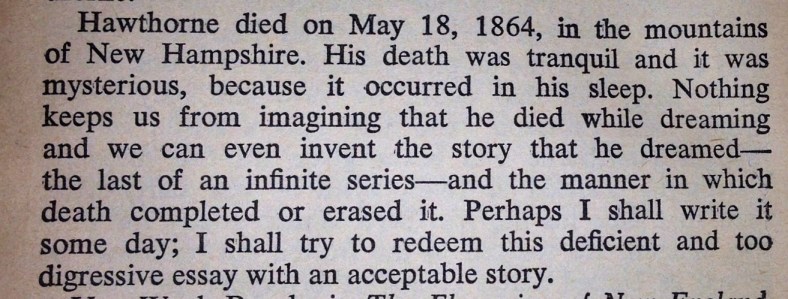
borgesscan
Art by Roman Muradov

1. Jorge Luis Borges is 115 today.

2. I’ve shared clips from my scattered readings of Borges on this blog (receiving the occasional takedown notice as well)—but I’ve never mustered the energy to try to say anything about him or describe his writing or try to situate it or analyze it or anything—

3. Because that’s what Borges does: He situates, analyzes, condenses, clarifies, expands, complicates, archives, curates, cultivates, teaches, improves literature.

4. And he does it in a way that makes following him with my own mealy mottled words seem superfluous (or maybe futile is the word I want—although I think Borges is unrelentingly positive and futile is such an ugly word).

5. I read a book of Borges’ essays this summer, a collection entitled Other Inquisitions. I read most of it in the Great Smoky Mountains, where the crisp morning air was perfect for Borges. Or for me to read Borges. It was lovely.

6. I wanted to write about Borges’ book—or, rather, and more exactly, I wanted to have written Borges’ book.

7. In one essay—I’ve put the book aside for now and can’t recall exactly which essay (maybe on FitzGerald and Omar Khayyam?); nor will I go look; if I had it out I’d only cite it, recycle it here; the book would kill this riff immediately, put a stake through its heart—Borges suggests that “A great writer creates his precursors.” — This, years, decades before Harold Bloom makes a career out of the same notion.

8. And Borges’ essays are a canon-making: His own canon–the formation and creation of his own precursors: Whitman, Kafka, DeQuincey, Carlyle, Becher, Valery, Wilde, Poe, Hawthorne…

9. The shock I experienced reading Borges’ essay on Nathaniel Hawthorne. That Borges had set about to riff on Hawthorne’s Note-Books, the same note-books I’d been reading since the early spring, the same note-books that seemed and still seem so generative to me, so full of entire worlds, so rich, so much fuller and richer than Hawthorne’s novels or his stories, so full in their singularity and off-focus, these notes, these Borgesian notes. Oh and that Borges had written the essay that I wished I could write!

10. Borges, who never wrote a novel, whose entire work might be some kind of postmodern novel.

11. Borges, whose short stories often seem like pretexts to an essay he’d like to write—and here pretext is not the right word, again—-so maybe the short stories, so many of them so brilliant, act as some kind of surface text that illuminates and yet simultaneously hides an essay underneath.

12. The great joy of reading Borges: We read through Borges: Borges the librarian grants us access to so many minds. We get to share his perceptions, read over his shoulder, or maybe through his glasses—we get to glance over his annotations, his notes. But that’s not accurate—he’s so much more lucid than that scatter-shot image suggests, even when he’s at his most Borgesian, which is to say his most labyrinthine, mirrored, winding, forking, decentering and recentering, deferring, echoing, prefiguring…

13. I’ve written more than I intended to and have yet barely edged into all the thicket of anxieties that guard Borges’ oeuvre from poseurs like myself. It’s enough to know that his works exist, will exist.

Six Figments from Nathaniel Hawthorne’s Note-Books

  1. A blind man on a dark night carried a torch, in order that people might see him, and not run against him, and direct him how to avoid dangers.
  2. To picture a child’s (one of four or five years old) reminiscences at sunset of a long summer’s day,–his first awakening, his studies, his sports, his little fits of passion, perhaps a whipping, etc.
  3. The blind man’s walk.
  4. To picture a virtuous family, the different members examples of virtuous dispositions in their way; then introduce a vicious person, and trace out the relations that arise between him and them, and the manner in which all are affected.
  5. A man to flatter himself with the idea that he would not be guilty of some certain wickedness,–as, for instance, to yield to the personal temptations of the Devil,–yet to find, ultimately, that he was at that very time committing that same wickedness.
  6. What would a man do, if he were compelled to live always in the sultry heat of society, and could never bathe himself in cool solitude?

Notations from Nathaniel Hawthorne’s American Note-Books.


Eight Notes from Nathaniel Hawthorne’s Note-Books

  1. Would it not be wiser for people to rejoice at all that they now sorrow for, and vice versa? To put on bridal garments at funerals, and mourning at weddings? For their friends to condole with them when they attained riches and honor, as only so much care added?
  2. If in a village it were a custom to hang a funeral garland or other token of death on a house where some one had died, and there to let it remain till a death occurred elsewhere, and then to hang that same garland over the other house, it would have, methinks, a strong effect.
  3. No fountain so small but that Heaven may be imaged in its bosom.
  4. Fame! Some very humble persons in a town may be said to possess it,–as, the penny-post, the town-crier, the constable,–and they are known to everybody; while many richer, more intellectual, worthier persons are unknown by the majority of their fellow-citizens. Something analogous in the world at large.
  5. The ideas of people in general are not raised higher than the roofs of the houses. All their interests extend over the earth’s surface in a layer of that thickness. The meeting-house steeple reaches out of their sphere.
  6. Nobody will use other people’s experience, nor have any of his own till it is too late to use it.
  7. Two lovers to plan the building of a pleasure-house on a certain spot of ground, but various seeming accidents prevent it. Once they find a group of miserable children there; once it is the scene where crime is plotted; at last the dead body of one of the lovers or of a dear friend is found there; and, instead of a pleasure-house, they build a marble tomb. The moral,–that there is no place on earth fit for the site of a pleasure-house, because there is no spot that may not have been saddened by human grief, stained by crime, or hallowed by death. It might be three friends who plan it, instead of two lovers; and the dearest one dies.
  8. Comfort for childless people. A married couple with ten children have been the means of bringing about ten funerals.

Notations from Nathaniel Hawthorne’s American Note-Books.

Borges Citation (Hawthorne)

20130731-180920.jpg

“The Ambitious Guest” — Nathaniel Hawthorne

“The Ambitious Guest” by Nathaniel Hawthorne

One September night a family had gathered round their hearth and piled it high with the driftwood of mountain-streams, the dry cones of the pine, and the splintered ruins of great trees that had come crashing down the precipice. Up the chimney roared the fire, and brightened the room with its broad blaze. The faces of the father and mother had a sober gladness; the children laughed. The eldest daughter was the image of Happiness at seventeen, and the aged grandmother, who sat knitting in the warmest place, was the image of Happiness grown old. They had found the “herb heart’s-ease” in the bleakest spot of all New England. This family were situated in the Notch of the White Hills, where the wind was sharp throughout the year and pitilessly cold in the winter, giving their cottage all its fresh inclemency before it descended on the valley of the Saco. They dwelt in a cold spot and a dangerous one, for a mountain towered above their heads so steep that the stones would often rumble down its sides and startle them at midnight.

The daughter had just uttered some simple jest that filled them all with mirth, when the wind came through the Notch and seemed to pause before their cottage, rattling the door with a sound of wailing and lamentation before it passed into the valley. For a moment it saddened them, though there was nothing unusual in the tones. But the family were glad again when they perceived that the latch was lifted by some traveller whose footsteps had been unheard amid the dreary blast which heralded his approach and wailed as he was entering and went moaning away from the door.

Though they dwelt in such a solitude, these people held daily converse with the world. The romantic pass of the Notch is a great artery through which the life-blood of internal commerce is continually throbbing between Maine on one side and the Green Mountains and the shores of the St. Lawrence on the other. The stage-coach always drew up before the door of the cottage. The wayfarer with no companion but his staff paused here to exchange a word, that the sense of loneliness might not utterly overcome him ere he could pass through the cleft of the mountain or reach the first house in the valley. And here the teamster on his way to Portland market would put up for the night, and, if a bachelor, might sit an hour beyond the usual bedtime and steal a kiss from the mountain-maid at parting. It was one of those primitive taverns where the traveller pays only for food and lodging, but meets with a homely kindness beyond all price. When the footsteps were heard, therefore, between the outer door and the inner one, the whole family rose up, grandmother, children and all, as if about to welcome some one who belonged to them, and whose fate was linked with theirs. Continue reading ““The Ambitious Guest” — Nathaniel Hawthorne”

“Hawthorne” — Charles Ives

“Hawthorne” by Charles Ives

from Essays Before a Sonata

The substance of Hawthorne is so dripping wet with the supernatural, the phantasmal, the mystical—so surcharged with adventures, from the deeper picturesque to the illusive fantastic, one unconsciously finds oneself thinking of him as a poet of greater imaginative impulse than Emerson or Thoreau. He was not a greater poet possibly than they—but a greater artist. Not only the character of his substance, but the care in his manner throws his workmanship, in contrast to theirs, into a kind of bas-relief. Like Poe he quite naturally and unconsciously reaches out over his subject to his reader. His mesmerism seeks to mesmerize us—beyond Zenobia’s sister. But he is too great an artist to show his hand “in getting his audience,” as Poe and Tschaikowsky occasionally do. His intellectual muscles are too strong to let him become over-influenced, as Ravel and Stravinsky seem to be by the morbidly fascinating—a kind of false beauty obtained by artistic monotony. However, we cannot but feel that he would weave his spell over us—as would the Grimms and Aesop. We feel as much under magic as the “Enchanted Frog.” This is part of the artist’s business. The effect is a part of his art-effort in its inception. Emerson’s substance and even his manner has little to do with a designed effect—his thunderbolts or delicate fragments are flashed out regardless—they may knock us down or just spatter us—it matters little to him—but Hawthorne is more considerate; that is, he is more artistic, as men say.

Hawthorne may be more noticeably indigenous or may have more local color, perhaps more national color than his Concord contemporaries. But the work of anyone who is somewhat more interested in psychology than in transcendental philosophy, will weave itself around individuals and their personalities. If the same anyone happens to live in Salem, his work is likely to be colored by the Salem wharves and Salem witches. If the same anyone happens to live in the “Old Manse” near the Concord Battle Bridge, he is likely “of a rainy day to betake himself to the huge garret,” the secrets of which he wonders at, “but is too reverent of their dust and cobwebs to disturb.” He is likely to “bow below the shriveled canvas of an old (Puritan) clergyman in wig and gown—the parish priest of a century ago—a friend of Whitefield.” He is likely to come under the spell of this reverend Ghost who haunts the “Manse” and as it rains and darkens and the sky glooms through the dusty attic windows, he is likely “to muse deeply and wonderingly upon the humiliating fact that the works of man’s intellect decay like those of his hands” … “that thought grows moldy,” and as the garret is in Massachusetts, the “thought” and the “mold” are likely to be quite native. When the same anyone puts his poetry into novels rather than essays, he is likely to have more to say about the life around him—about the inherited mystery of the town—than a poet of philosophy is. Continue reading ““Hawthorne” — Charles Ives”

Six Ideas and Images from Nathaniel Hawthorne’s Note-Books

  1. In an old London newspaper, 1678, there is an advertisement, among other goods at auction, of a black girl, about fifteen years old, to be sold.
  2. We sometimes congratulate ourselves at the moment of waking from a troubled dream: it may be so the moment after death.
  3. The race of mankind to be swept away, leaving all their cities and works. Then another human pair to be placed in the world, with native intelligence like Adam and Eve, but knowing nothing of their predecessors or of their own nature and destiny. They, perhaps, to be described as working out this knowledge by their sympathy with what they saw, and by their own feelings.
  4. A singular fact, that, when man is a brute, he is the most sensual and loathsome of all brutes.
  5. A snake taken into a man’s stomach and nourished there from fifteen years to thirty-five, tormenting him most horribly. A type of envy or some other evil passion.
  6. A sketch illustrating the imperfect compensations which time makes for its devastations on the person,–giving a wreath of laurel while it causes baldness, honors for infirmities, wealth for a broken constitution,–and at last, when a man has everything that seems desirable, death seizes him. To contrast the man who has thus reached the summit of ambition with the ambitious youth.

Notations from Nathaniel Hawthorne’s American Note-Books.