Nine Notes from Nathaniel Hawthorne’s Note-Books

  1. The elephant is not particularly sagacious in the wild state, but becomes so when tamed. The fox directly the contrary, and likewise the wolf.
  2. A modern Jewish adage,–“Let a man clothe himself beneath his ability, his children according to his ability, and his wife above his ability.”
  3. It is said of the eagle, that, in however long a flight, he is never seen to clap his wings to his sides. He seems to govern his movements by the inclination of his wings and tail to the wind, as a ship is propelled by the action of the wind on her sails.
  4. In old country-houses in England, instead of glass for windows, they used wicker, or fine strips of oak disposed checkerwise. Horn was also used. The windows of princes and great noblemen were of crystal; those of Studley Castle, Holinshed says, of beryl. There were seldom chimneys; and they cooked their meats by a fire made against an iron back in the great hall. Houses, often of gentry, were built of a heavy timber frame, filled up with lath and plaster. People slept on rough mats or straw pallets, with a round log for a pillow; seldom better beds than a mattress, with a sack of chaff for a pillow.
  5. In this dismal chamber FAME was won. (Salem, Union Street.)
  6. Those who are very difficult in choosing wives seem as if they would take none of Nature’s ready-made works, but want a woman manufactured particularly to their order.
  7. A council of the passengers in a street: called by somebody to decide upon some points important to him.
  8. Every individual has a place to fill in the world, and is important, in some respects, whether he chooses to be so or not.
  9. Merry, “in merry England,” does not mean mirthful; but is corrupted from an old Teutonic word signifying famous or renowned.

Notations from Nathaniel Hawthorne’s American Note-Books

Eight Ideas from Nathaniel Hawthorne’s Note-Books

  1. A man, perhaps with a persuasion that he shall make his fortune by some singular means, and with an eager longing so to do, while digging or boring for water, to strike upon a salt-spring.
  2. To have one event operate in several places,–as, for example, if a man’s head were to be cut off in one town, men’s heads to drop off in several towns.
  3. Follow out the fantasy of a man taking his life by instalments, instead of at one payment,–say ten years of life alternately with ten years of suspended animation.
  4. Sentiments in a foreign language, which merely convey the sentiment without retaining to the reader any graces of style or harmony of sound, have somewhat of the charm of thoughts in one’s own mind that have not yet been put into words. No possible words that we might adapt to them could realize the unshaped beauty that they appear to possess. This is the reason that translations are never satisfactory,–and less so, I should think, to one who cannot than to one who can pronounce the language.
  5. A person to be writing a tale, and to find that it shapes itself against his intentions; that the characters act otherwise than he thought; that unforeseen events occur; and a catastrophe comes which he strives in vain to avert. It might shadow forth his own fate,–he having made himself one of the personages.
  6. It is a singular thing, that, at the distance, say, of five feet, the work of the greatest dunce looks just as well as that of the greatest genius,–that little space being all the distance between genius and stupidity.
  7. Mrs. Sigourney says, after Coleridge, that “poetry has been its own exceeding great reward.” For the writing, perhaps; but would it be so for the reading?
  8. Four precepts: To break off customs; to shake off spirits ill-disposed; to meditate on youth; to do nothing against one’s genius.

—Notations from Nathaniel Hawthorne’s American Note-Books(See also: Ten ideas and then Twenty ideas from Nathaniel Hawthorne’s Note-Books).

“The Seven Vagabonds” — Nathaniel Hawthorne

“The Seven Vagabonds” — Nathaniel Hawthorne

Rambling on foot in the spring of my life and the summer of the year, I came one afternoon to a point which gave me the choice of three directions. Straight before me the main road extended its dusty length to Boston; on the left a branch went toward the sea, and would have lengthened my journey a trifle of twenty or thirty miles, while by the right-hand path I might have gone over hills and lakes to Canada, visiting in my way the celebrated town of Stamford. On a level spot of grass at the foot of the guide-post appeared an object which, though locomotive on a different principle, reminded me of Gulliver’s portable mansion among the Brobdignags. It was a huge covered wagon—or, more properly, a small house on wheels—with a door on one side and a window shaded by green blinds on the other. Two horses munching provender out of the baskets which muzzled them were fastened near the vehicle. A delectable sound of music proceeded from the interior, and I immediately conjectured that this was some itinerant show halting at the confluence of the roads to intercept such idle travellers as myself. A shower had long been climbing up the western sky, and now hung so blackly over my onward path that it was a point of wisdom to seek shelter here.

“Halloo! Who stands guard here? Is the doorkeeper asleep?” cried I, approaching a ladder of two or three steps which was let down from the wagon.

The music ceased at my summons, and there appeared at the door, not the sort of figure that I had mentally assigned to the wandering showman, but a most respectable old personage whom I was sorry to have addressed in so free a style. He wore a snuff-colored coat and small-clothes, with white top-boots, and exhibited the mild dignity of aspect and manner which may often be noticed in aged schoolmasters, and sometimes in deacons, selectmen or other potentates of that kind. A small piece of silver was my passport within his premises, where I found only one other person, hereafter to be described.

“This is a dull day for business,” said the old gentleman as he ushered me in; “but I merely tarry here to refresh the cattle, being bound for the camp-meeting at Stamford.” Continue reading ““The Seven Vagabonds” — Nathaniel Hawthorne”

“Hawthorne and His Mosses” — Herman Melville

“Hawthorne and His Mosses” by Herman Melville

A papered chamber in a fine old farm-house–a mile from any other dwelling, and dipped to the eaves in foliage–surrounded by mountains, old woods, and Indian ponds,–this, surely is the place to write of Hawthorne. Some charm is in this northern air, for love and duty seem both impelling to the task. A man of a deep and noble nature has seized me in this seclusion. His wild, witch voice rings through me; or, in softer cadences, I seem to hear it in the songs of the hill-side birds, that sing in the larch trees at my window.

Would that all excellent books were foundlings, without father or mother, that so it might be, we could glorify them, without including their ostensible authors. Nor would any true man take exception to this;–least of all, he who writes,–“When the Artist rises high enough to achieve the Beautiful, the symbol by which he makes it perceptible to mortal senses becomes of little value in his eyes, while his spirit possesses itself in the enjoyment of the reality.”

But more than this, I know not what would be the right name to put on the title-page of an excellent book, but this I feel, that the names of all fine authors are fictitious ones, far more than that of Junius,–simply standing, as they do, for the mystical, ever-eluding Spirit of all Beauty, which ubiquitously possesses men of genius. Purely imaginative as this fancy may appear, it nevertheless seems to receive some warranty from the fact, that on a personal interview no great author has ever come up to the idea of his reader. But that dust of which our bodies are composed, how can it fitly express the nobler intelligences among us? With reverence be it spoken, that not even in the case of one deemed more than man, not even in our Saviour, did his visible frame betoken anything of the augustness of the nature within. Else, how could those Jewish eyewitnesses fail to see heaven in his glance.

It is curious, how a man may travel along a country road, and yet miss the grandest, or sweetest of prospects, by reason of an intervening hedge, so like all other hedges, as in no way to hint of the wide landscape beyond. So has it been with me concerning the enchanting landscape in the soul of this Hawthorne, this most excellent Man of Mosses. His “Old Manse” has been written now four years, but I never read it till a day or two since. I had seen it in the book-stores–heard of it often–even had it recommended to me by a tasteful friend, as a rare, quiet book, perhaps too deserving of popularity to be popular. But there are so many books called “excellent,” and so much unpopular merit, that amid the thick stir of other things, the hint of my tasteful friend was disregarded; and for four years the Mosses on the Old Manse never refreshed me with their perennial green. It may be, however, that all this while, the book, like wine, was only improving in flavor and body. At any rate, it so chanced that this long procrastination eventuated in a happy result. At breakfast the other day, a mountain girl, a cousin of mine, who for the last two weeks has every morning helped me to strawberries and raspberries,–which like the roses and pearls in the fairy-tale, seemed to fall into the saucer from those strawberry-beds her cheeks,–this delightful crature, this charming Cherry says to me–“I see you spend your mornings in the hay-mow; and yesterday I found there ‘Dwight’s Travels in New England’. Now I have something far better than that,–something more congenial to our summer on these hills. Take these raspberries, and then I will give you some moss.”–“Moss!” said I–“Yes, and you must take it to the barn with you, and good-bye to ‘Dwight.'” Continue reading ““Hawthorne and His Mosses” — Herman Melville”

“Sir Arthur Aston had his brains beaten out with his own wooden leg” (Nathaniel Hawthorne)

October 22d.—At a dinner-party at Mr. Holland’s last evening, a gentleman, in instance of Charles Dickens’s unweariability, said that during some theatrical performances in Liverpool he acted in play and farce, spent the rest of the night making speeches, feasting, and drinking at table, and ended at seven o’clock in the morning by jumping leap-frog over the backs of the whole company.

In Moore’s diary he mentions a beautiful Guernsey lily having been given to his wife, and says that the flower was originally from Guernsey. A ship from there had been wrecked on the coast of Japan, having many of the lilies on board, and the next year the flowers appeared,—springing up, I suppose, on the wave-beaten strand.

Wishing to send a letter to a dead man, who may be supposed to have gone to Tophet,—throw it into the fire.

Sir Arthur Aston had his brains beaten out with his own wooden leg, at the storming of Tredagh in Ireland by Cromwell.

In the county of Cheshire, many centuries ago, there lived a half-idiot, named Nixon, who had the gift of prophecy, and made many predictions about places, families, and important public events, since fulfilled. He seems to have fallen into fits of insensibility previous to uttering his prophecies.

The family of Mainwaring (pronounced Mannering), of Bromborough, had an ass’s head for a crest.

“Richard Dawson, being sick of the plague, and perceiving he must die, rose out of his bed and made his grave, and caused his nephew to cast straw into the grave, which was not far from the house, and went and laid him down in the said grave, and caused clothes to be laid upon him, and so departed out of this world. This he did because he was a strong man, and heavier than his said nephew and a serving-wench were able to bury. He died about the 24th of August. Thus was I credibly told he did, 1625.” This was in the township of Malpas, recorded in the parish register.

At Bickley Hall, taken down a few years ago, used to be shown the room where the body of the Earl of Leicester was laid for a whole twelvemonth,—1659 to 1660,—he having been kept unburied all that time, owing to a dispute which of his heirs should pay his funeral expenses.

—Nathaniel Hawthorne’s journal entry of October 22nd, 1853; collected in Passages from the English Note-Books.


Ten Ideas from Nathaniel Hawthorne’s Note-Books

  1. A tree, tall and venerable, to be said by tradition to have been the staff of some famous man, who happened to thrust it into the ground, where it took root.
  2. A fellow without money, having a hundred and seventy miles to go, fastened a chain and padlock to his legs, and lay down to sleep in a field. He was apprehended, and carried gratis to a jail in the town whither he desired to go.
  3. An old volume in a large library,–every one to be afraid to unclasp and open it, because it was said to be a book of magic.
  4. A ghost seen by moonlight; when the moon was out, it would shine and melt through the airy substance of the ghost, as through a cloud.
  5. A scold and a blockhead,–brimstone and wood,–a good match.
  6. To make one’s own reflection in a mirror the subject of a story.
  7. In a dream to wander to some place where may be heard the complaints of all the miserable on earth.
  8. Some common quality or circumstance that should bring together people the most unlike in all other respects, and make a brotherhood and sisterhood of them,–the rich and the proud finding themselves in the same category with the mean and the despised.
  9. A person to consider himself as the prime mover of certain remarkable events, but to discover that his actions have not contributed in the least thereto. Another person to be the cause, without suspecting it.
  10. A person or family long desires some particular good. At last it comes in such profusion as to be the great pest of their lives.

—Notations from Nathaniel Hawthorne’s American Note-Books. (See also: Twenty ideas from Nathaniel Hawthorne’s Note-Books)

Hawthorne Anecdote

I was sent for to the police court the other morning, in the case of an American sailor accused of robbing a shipmate at sea. A large room, with a great coal-fire burning on one side, and above it the portrait of Mr. Rushton, deceased, a magistrate of many years’ continuance. A long table, with chairs, and a witness-box. One of the borough magistrates, a merchant of the city, sat at the head of the table, with paper and pen and ink before him; but the real judge was the clerk of the court, whose professional knowledge and experience governed all the proceedings. In the short time while I was waiting, two cases were tried, in the first of which the prisoner was discharged. The second case was of a woman,—a thin, sallow, hard-looking, careworn, rather young woman,—for stealing a pair of slippers out of a shop: The trial occupied five minutes or less, and she was sentenced to twenty-one days’ imprisonment,—whereupon, without speaking, she looked up wildly first into one policeman’s face, then into another’s, at the same time wringing her hands with no theatric gesture, but because her torment took this outward shape,—and was led away. The Yankee sailor was then brought up,—an intelligent, but ruffian-like fellow,—and as the case was out of the jurisdiction of the English magistrates, and as it was not worth while to get him sent over to America for trial, he was forthwith discharged. He stole a comforter.

If mankind were all intellect, they would be continually changing, so that one age would be entirely unlike another. The great conservative is the heart, which remains the same in all ages; so that commonplaces of a thousand years’ standing are as effective as ever.

–From the January 6th, 1854 entry of Nathaniel Hawthorne’s English note-books.

“Drowne’s Wooden Image” — Nathaniel Hawthorne

“Drowne’s Wooden Image” — Nathaniel Hawthorne

One sunshiny morning, in the good old times of the town of Boston, a young carver in wood, well known by the name of Drowne, stood contemplating a large oaken log, which it was his purpose to convert into the figure-head of a vessel. And while he discussed within his own mind what sort of shape or similitude it were well to bestow upon this excellent piece of timber, there came into Drowne’s workshop a certain Captain Hunnewell, owner and commander of the good brig called the Cynosure, which had just returned from her first voyage to Fayal.

“Ah! that will do, Drowne, that will do!” cried the jolly captain, tapping the log with his rattan. “I bespeak this very piece of oak for the figure-head of the Cynosure. She has shown herself the sweetest craft that ever floated, and I mean to decorate her prow with the handsomest image that the skill of man can cut out of timber. And, Drowne, you are the fellow to execute it.”

“You give me more credit than I deserve, Captain Hunnewell,” said the carver, modestly, yet as one conscious of eminence in his art. “But, for the sake of the good brig, I stand ready to do my best. And which of these designs do you prefer? Here,”—pointing to a staring, half-length figure, in a white wig and scarlet coat,—”here is an excellent model, the likeness of our gracious king. Here is the valiant Admiral Vernon. Or, if you prefer a female figure, what say you to Britannia with the trident?”

“All very fine, Drowne; all very fine,” answered the mariner. “But as nothing like the brig ever swam the ocean, so I am determined she shall have such a figure-head as old Neptune never saw in his life. And what is more, as there is a secret in the matter, you must pledge your credit not to betray it.”

“Certainly,” said Drowne, marvelling, however, what possible mystery there could be in reference to an affair so open, of necessity, to the inspection of all the world as the figure-head of a vessel. “You may depend, captain, on my being as secret as the nature of the case will permit.”

Captain Hunnewell then took Drowne by the button, and communicated his wishes in so low a tone that it would be unmannerly to repeat what was evidently intended for the carver’s private ear. We shall, therefore, take the opportunity to give the reader a few desirable particulars about Drowne himself.

He was the first American who is known to have attempted—in a very humble line, it is true—that art in which we can now reckon so many names already distinguished, or rising to distinction. From his earliest boyhood he had exhibited a knack—for it would be too proud a word to call it genius—a knack, therefore, for the imitation of the human figure in whatever material came most readily to hand. The snows of a New England winter had often supplied him with a species of marble as dazzingly white, at least, as the Parian or the Carrara, and if less durable, yet sufficiently so to correspond with any claims to permanent existence possessed by the boy’s frozen statues. Yet they won admiration from maturer judges than his school-fellows, and were indeed, remarkably clever, though destitute of the native warmth that might have made the snow melt beneath his hand. As he advanced in life, the young man adopted pine and oak as eligible materials for the display of his skill, which now began to bring him a return of solid silver as well as the empty praise that had been an apt reward enough for his productions of evanescent snow. He became noted for carving ornamental pump heads, and wooden urns for gate posts, and decorations, more grotesque than fanciful, for mantelpieces. No apothecary would have deemed himself in the way of obtaining custom without setting up a gilded mortar, if not a head of Galen or Hippocrates, from the skilful hand of Drowne. Continue reading ““Drowne’s Wooden Image” — Nathaniel Hawthorne”

Twenty Ideas from Nathaniel Hawthorne’s Note-Books

1. A hint of a story,–some incident which should bring on a general war; and the chief actor in the incident to have something corresponding to the mischief he had caused.

2. A sketch to be given of a modern reformer,–a type of the extreme doctrines on the subject of slaves, cold water, and other such topics. He goes about the streets haranguing most eloquently, and is on the point of making many converts, when his labors are suddenly interrupted by the appearance of the keeper of a mad-house, whence he has escaped. Much may be made of this idea.

3. A change from a gay young girl to an old woman; the melancholy events, the effects of which have clustered around her character, and gradually imbued it with their influence, till she becomes a lover of sick-chambers, taking pleasure in receiving dying breaths and in laying out the dead; also having her mind full of funeral reminiscences, and possessing more acquaintances beneath the burial turf than above it.

4. A well-concerted train of events to be thrown into confusion by some misplaced circumstance, unsuspected till the catastrophe, yet exerting its influence from beginning to end.

5. On the common, at dusk, after a salute from two field-pieces, the smoke lay long and heavily on the ground, without much spreading beyond the original space over which it had gushed from the guns. It was about the height of a man. The evening clear, but with an autumnal chill.

6. The world is so sad and solemn, that things meant in jest are liable, by an overpowering influence, to become dreadful earnest,–gayly dressed fantasies turning to ghostly and black-clad images of themselves.

7. A story, the hero of which is to be represented as naturally capable of deep and strong passion, and looking forward to the time when he shall feel passionate love, which is to be the great event of his existence. But it so chances that he never falls in love, and although he gives up the expectation of so doing, and marries calmly, yet it is somewhat sadly, with sentiments merely of esteem for his bride. The lady might be one who had loved him early in life, but whom then, in his expectation of passionate love, he had scorned.

8. The scene of a story or sketch to be laid within the light of a street-lantern; the time, when the lamp is near going out; and the catastrophe to be simultaneous with the last flickering gleam.

9. The peculiar weariness and depression of spirits which is felt after a day wasted in turning over a magazine or other light miscellany, different from the state of the mind after severe study; because there has been no excitement, no difficulties to be overcome, but the spirits have evaporated insensibly.

10. To represent the process by which sober truth gradually strips off all the beautiful draperies with which imagination has enveloped a beloved object, till from an angel she turns out to be a merely ordinary woman. This to be done without caricature, perhaps with a quiet humor interfused, but the prevailing impression to be a sad one. The story might consist of the various alterations in the feelings of the absent lover, caused by successive events that display the true character of his mistress; and the catastrophe should take place at their meeting, when he finds himself equally disappointed in her person; or the whole spirit of the thing may here be reproduced.

11. Two persons might be bitter enemies through life, and mutually cause the ruin of one another, and of all that were dear to them. Finally, meeting at the funeral of a grandchild, the offspring of a son and daughter married without their consent,–and who, as well as the child, had been the victims of their hatred,–they might discover that the supposed ground of the quarrel was altogether a mistake, and then be wofully reconciled.

12. Two persons, by mutual agreement, to make their wills in each other’s favor, then to wait impatiently for one another’s death, and both to be informed of the desired event at the same time. Both, in most joyous sorrow, hasten to be present at the funeral, meet, and find themselves both hoaxed.

13. The story of a man, cold and hard-hearted, and acknowledging no brotherhood with mankind. At his death they might try to dig him a grave, but, at a little space beneath the ground, strike upon a rock, as if the earth refused to receive the unnatural son into her bosom. Then they would put him into an old sepulchre, where the coffins and corpses were all turned to dust, and so he would be alone. Then the body would petrify; and he having died in some characteristic act and expression, he would seem, through endless ages of death, to repel society as in life, and no one would be buried in that tomb forever.

14. Canon transformed to church-bells.

15. A person, even before middle age, may become musty and faded among the people with whom he has grown up from childhood; but, by migrating to a new place, he appears fresh with the effect of youth, which may be communicated from the impressions of others to his own feelings.

16. In an old house, a mysterious knocking might be heard on the wall, where had formerly been a door-way, now bricked up.

17. It might be stated, as the closing circumstance of a tale, that the body of one of the characters had been petrified, and still existed in that state.

18. A young man to win the love of a girl, without any serious intentions, and to find that in that love, which might have been the greatest blessing of his life, he had conjured up a spirit of mischief which pursued him throughout his whole career,–and this without any revengeful purposes on the part of the deserted girl.

19. Two lovers, or other persons, on the most private business, to appoint a meeting in what they supposed to be a place of the utmost solitude, and to find it thronged with people.

20. Some treasure or other thing to be buried, and a tree planted directly over the spot, so as to embrace it with its roots.

From Nathaniel Hawthorne’s American Note-Books.

“The Prophetic Pictures” — Nathaniel Hawthorne

“The Prophetic Pictures” by Nathaniel Hawthorne

“But this painter!” cried Walter Ludlow, with animation. “He not only excels in his peculiar art, but possesses vast acquirements in all other learning and science. He talks Hebrew with Dr. Mather and gives lectures in anatomy to Dr. Boylston. In a word, he will meet the best-instructed man among us on his own ground. Moreover, he is a polished gentleman, a citizen of the world—yes, a true cosmopolite; for he will speak like a native of each clime and country on the globe, except our own forests, whither he is now going. Nor is all this what I most admire in him.”

“Indeed!” said Elinor, who had listened with a women’s interest to the description of such a man. “Yet this is admirable enough.”

“Surely it is,” replied her lover, “but far less so than his natural gift of adapting himself to every variety of character, insomuch that all men—and all women too, Elinor—shall find a mirror of themselves in this wonderful painter. But the greatest wonder is yet to be told.”

“Nay, if he have more wonderful attributes than these,” said Elinor, laughing, “Boston is a perilous abode for the poor gentleman. Are you telling me of a painter, or a wizard?” Continue reading ““The Prophetic Pictures” — Nathaniel Hawthorne”

“Chippings with a Chisel” — Nathaniel Hawthorne

“Chippings with a Chisel” by Nathaniel Hawthorne

Passing a summer several years since at Edgartown, on the island of Martha’s Vineyard, I became acquainted with a certain carver of tombstones who had travelled and voyaged thither from the interior of Massachusetts in search of professional employment. The speculation had turned out so successful that my friend expected to transmute slate and marble into silver and gold to the amount of at least a thousand dollars during the few months of his sojourn at Nantucket and the Vineyard. The secluded life and the simple and primitive spirit which still characterizes the inhabitants of those islands, especially of Martha’s Vineyard, insure their dead friends a longer and dearer remembrance than the daily novelty and revolving bustle of the world can elsewhere afford to beings of the past. Yet, while every family is anxious to erect a memorial to its departed members, the untainted breath of Ocean bestows such health and length of days upon the people of the isles as would cause a melancholy dearth of business to a resident artist in that line. His own monument, recording his decease by starvation, would probably be an early specimen of his skill. Gravestones, therefore, have generally been an article of imported merchandise.

In my walks through the burial-ground of Edgartown—where the dead have lain so long that the soil, once enriched by their decay, has returned to its original barrenness—in that ancient burial-ground I noticed much variety of monumental sculpture. The elder stones, dated a century back or more, have borders elaborately carved with flowers and are adorned with a multiplicity of death’s-heads, crossbones, scythes, hour-glasses, and other lugubrious emblems of mortality, with here and there a winged cherub to direct the mourner’s spirit upward. These productions of Gothic taste must have been quite beyond the colonial skill of the day, and were probably carved in London and brought across the ocean to commemorate the defunct worthies of this lonely isle. The more recent monuments are mere slabs of slate in the ordinary style, without any superfluous flourishes to set off the bald inscriptions. But others—and those far the most impressive both to my taste and feelings—were roughly hewn from the gray rocks of the island, evidently by the unskilled hands of surviving friends and relatives. On some there were merely the initials of a name; some were inscribed with misspelt prose or rhyme, in deep letters which the moss and wintry rain of many years had not been able to obliterate. These, these were graves where loved ones slept. It is an old theme of satire, the falsehood and vanity of monumental eulogies; but when affection and sorrow grave the letters with their own painful labor, then we may be sure that they copy from the record on their hearts. Continue reading ““Chippings with a Chisel” — Nathaniel Hawthorne”

“Mrs. Bullfrog” — Nathaniel Hawthorne

“Mrs. Bullfrog” by Nathaniel Hawthorne

It makes me melancholy to see how like fools some very sensible people act in the matter of choosing wives. They perplex their judgments by a most undue attention to little niceties of personal appearance, habits, disposition, and other trifles which concern nobody but the lady herself. An unhappy gentleman, resolving to wed nothing short of perfection, keeps his heart and hand till both get so old and withered that no tolerable woman will accept them. Now this is the very height of absurdity. A kind Providence has so skilfully adapted sex to sex and the mass of individuals to each other, that, with certain obvious exceptions, any male and female may be moderately happy in the married state. The true rule is to ascertain that the match is fundamentally a good one, and then to take it for granted that all minor objections, should there be such, will vanish, if you let them alone. Only put yourself beyond hazard as to the real basis of matrimonial bliss, and it is scarcely to be imagined what miracles, in the way of recognizing smaller incongruities, connubial love will effect.

For my own part I freely confess that, in my bachelorship, I was precisely such an over-curious simpleton as I now advise the reader not to be. My early habits had gifted me with a feminine sensibility and too exquisite refinement. I was the accomplished graduate of a dry goods store, where, by dint of ministering to the whims of fine ladies, and suiting silken hose to delicate limbs, and handling satins, ribbons, chintzes calicoes, tapes, gauze, and cambric needles, I grew up a very ladylike sort of a gentleman. It is not assuming too much to affirm that the ladies themselves were hardly so ladylike as Thomas Bullfrog. So painfully acute was my sense of female imperfection, and such varied excellence did I require in the woman whom I could love, that there was an awful risk of my getting no wife at all, or of being driven to perpetrate matrimony with my own image in the looking-glass. Besides the fundamental principle already hinted at, I demanded the fresh bloom of youth, pearly teeth, glossy ringlets, and the whole list of lovely items, with the utmost delicacy of habits and sentiments, a silken texture of mind, and, above all, a virgin heart. In a word, if a young angel just from paradise, yet dressed in earthly fashion, had come and offered me her hand, it is by no means certain that I should have taken it. There was every chance of my becoming a most miserable old bachelor, when, by the best luck in the world, I made a journey into another state, and was smitten by, and smote again, and wooed, won, and married, the present Mrs. Bullfrog, all in the space of a fortnight. Owing to these extempore measures, I not only gave my bride credit for certain perfections which have not as yet come to light, but also overlooked a few trifling defects, which, however, glimmered on my perception long before the close of the honeymoon. Yet, as there was no mistake about the fundamental principle aforesaid, I soon learned, as will be seen, to estimate Mrs. Bullfrog’s deficiencies and superfluities at exactly their proper value.

The same morning that Mrs. Bullfrog and I came together as a unit, we took two seats in the stage-coach and began our journey towards my place of business. There being no other passengers, we were as much alone and as free to give vent to our raptures as if I had hired a hack for the matrimonial jaunt. My bride looked charmingly in a green silk calash and riding habit of pelisse cloth; and whenever her red lips parted with a smile, each tooth appeared like an inestimable pearl. Such was my passionate warmth that—we had rattled out of the village, gentle reader, and were lonely as Adam and Eve in paradise—I plead guilty to no less freedom than a kiss. The gentle eye of Mrs. Bullfrog scarcely rebuked me for the profanation. Emboldened by her indulgence, I threw back the calash from her polished brow, and suffered my fingers, white and delicate as her own, to stray among those dark and glossy curls which realized my daydreams of rich hair. Continue reading ““Mrs. Bullfrog” — Nathaniel Hawthorne”

A Riff on Nathaniel Hawthorne’s Tale “The Birth-Mark”

  1. Nathaniel Hawthorne’s tale “The Birth-Mark” — or is it “The Birthmark”? — has been a favorite story of mine for years despite (or maybe because of) its being so damn symbolically overdetermined.
  2. You can read the story online.

  3. Or perhaps you want a quick summary—a refresher—okay:

Aylmer, “a man of science,” has this totally hot wife Georgiana—only she’s got a birthmark on her cheek, a small red mark that resembles a tiny hand—and it drives our scientist mad—so mad that he determines to make her perfect by removing the mark. Tragic ending ensues.

  1. One of the reasons I like “The Birth-Mark” so much is that it so clearly limns the futility of idealism.
  • Aylmer’s driving desire for mastery over Nature (echoing Shelley’s Frankenstein): the desire to “lay his hand on the secret creative force and perhaps make new worlds.”

  • The word “God” does not appear in “The Birth-Mark.”

  • But of course gods and creators are repeatedly invoked.

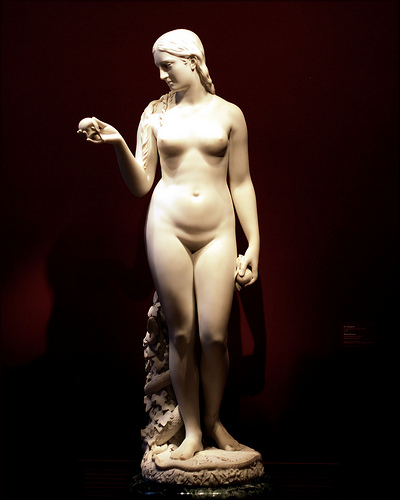
  • One such creator is Hawthorne’s friend Hiram Powers, whose sculpture Eve Tempted is invoked (invoking that other creator, the one who made a garden . . . )

  • powers eve
    Eve Tempted, Hiram Powers
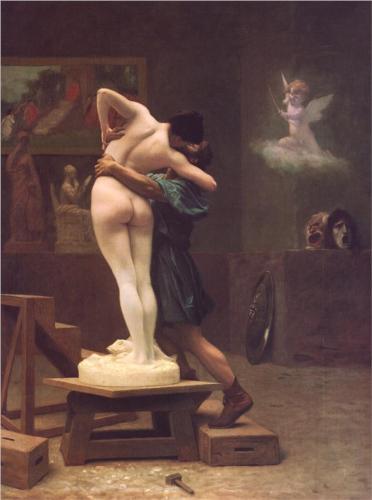
    1. And Pygmalion—
    pygmalion-and-galatea-1.jpg!Blog
    Pygmalion and Galate, Jean-Leon Gerome

    Aylmer, having convinced his wife that he’ll erase her mark: “Even Pygmalion, when his sculptured woman assumed life, felt not greater ecstasy than mine will be!”

    1. Aylmer’s plan is shameful. It’s based on an obsessive misreading of the symbolism of his wife’s birthmark. We’re told that Aylmer “select[s] it as the symbol of his wife’s liability to sin, sorrow, decay, and death, Aylmer’s sombre imagination was not long in rendering the birthmark a frightful object, causing him more trouble and horror than ever Georgiana’s beauty, whether of soul or sense, had given him delight.”

    He’s a very poor reader. His judgments are overawed by idealism.

    1. Georgiana asks him: “Cannot you remove this little, little mark, which I cover with the tips of two small fingers?”

    On one level, Georgiana is offering her husband the opportunity to play doctor with her, to get rid of the mark that’s driving him mad—but I think there’s an ironic second meaning at work here as well. I think she’s suggesting that he remove his perception of the mark, his reading of the mark. That he change his attitude.

    1. Hawthorne’s homeboy Herman Melville, in his big book Moby-Dick, has Ishmael point out—in a simple, charming, homey way—that there is no simply no ideal purity available to us:

    We felt very nice and snug, the more so since it was so chilly out of doors; indeed out of bed-clothes too, seeing that there was no fire in the room. The more so, I say, because truly to enjoy bodily warmth, some small part of you must be cold, for there is no quality in this world that is not what it is merely by contrast. Nothing exists in itself. If you flatter yourself that you are all over comfortable, and have been so a long time, then you cannot be said to be comfortable any more.

    13. Actually, even though we’re told he’s brilliant, it turns out that Aylmer is not the transcendent scientist he’d like to be. In a scene that almost edges into comedy (just a dab to give this tragedy dimension), Georgiana reads

    a large folio from her husband’s own hand, in which he had recorded every experiment of his scientific career, its original aim, the methods adopted for its development, and its final success or failure, with the circumstances to which either event was attributable. The book, in truth, was both the history and emblem of his ardent, ambitious, imaginative, yet practical and laborious life. He handled physical details as if there were nothing beyond them; yet spiritualized them all, and redeemed himself from materialism by his strong and eager aspiration towards the infinite. In his grasp the veriest clod of earth assumed a soul. Georgiana, as she read, reverenced Aylmer and loved him more profoundly than ever, but with a less entire dependence on his judgment than heretofore. Much as he had accomplished, she could not but observe that his most splendid successes were almost invariably failures, if compared with the ideal at which he aimed. His brightest diamonds were the merest pebbles, and felt to be so by himself, in comparison with the inestimable gems which lay hidden beyond his reach. The volume, rich with achievements that had won renown for its author, was yet as melancholy a record as ever mortal hand had penned. It was the sad confession and continual exemplification of the shortcomings of the composite man, the spirit burdened with clay and working in matter, and of the despair that assails the higher nature at finding itself so miserably thwarted by the earthly part. Perhaps every man of genius in whatever sphere might recognize the image of his own experience in Aylmer’s journal.

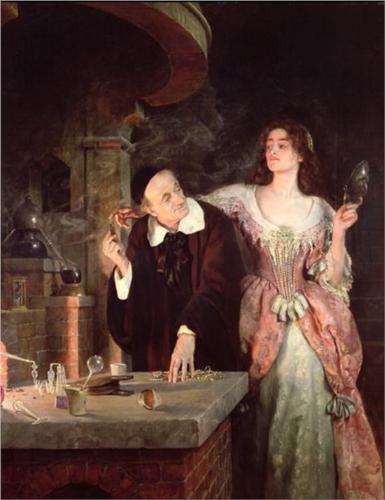
    1. I should clarify, perhaps, that Georgiana reads the journal as she waits out Aylmer’s experiments in his laboratory.
    The Laboratory, John Collier
    The Laboratory, John Collier
    1. Oh, gosh, I almost forgot—there’s a third player in this piece, Aminadab, Aylmer’s manservant/lab assistant, who’s described throughout the text (usually by Aylmer) as “clod,” “man of clay,” “human machine,” “earthly mass,” “thing of the senses” — he’s the pure-material to contrast Aylmer’s (would-be) pure-spirit. Although he’s not described as hunchbacked I can’t help but see him that way, this Igor to a Hollywood Frankenstein. And he laughs.

    2. Aminadab laughs at Aylmer’s folly. Here is the conclusion of this story:

    Alas! it was too true! The fatal hand had grappled with the mystery of life, and was the bond by which an angelic spirit kept itself in union with a mortal frame. As the last crimson tint of the birthmark—that sole token of human imperfection—faded from her cheek, the parting breath of the now perfect woman passed into the atmosphere, and her soul, lingering a moment near her husband, took its heavenward flight. Then a hoarse, chuckling laugh was heard again! Thus ever does the gross fatality of earth exult in its invariable triumph over the immortal essence which, in this dim sphere of half development, demands the completeness of a higher state. Yet, had Alymer reached a profounder wisdom, he need not thus have flung away the happiness which would have woven his mortal life of the selfsame texture with the celestial. The momentary circumstance was too strong for him; he failed to look beyond the shadowy scope of time, and, living once for all in eternity, to find the perfect future in the present.

    17. I won’t comment any further on the story, other than to suggest that the final two lines—in bold above—seem perfectly sensible and wonderfully wise to me. I think Wittgenstein may have been approaching a similar idea some eighty years later in his Tractatus Logico-Philosophicus:

    Death is not an event in life: we do not live to experience death. If we take eternity to mean not infinite temporal duration but timelessness, then eternal life belongs to those who live in the present. Our life has no end in the way in which our visual field has no limits.

    “The Hollow of the Three Hills” — Nathaniel Hawthorne

    “The Hollow of the Three Hills” by Nathaniel Hawthorne

    In those strange old times when fantastic dreams and madmen’s reveries were realized among the actual circumstances of life, two persons met together at an appointed hour and place. One was a lady graceful in form and fair of feature, though pale and troubled and smitten with an untimely blight in what should have been the fullest bloom of her years; the other was an ancient and meanly-dressed woman of ill-favored aspect, and so withered, shrunken and decrepit that even the space since she began to decay must have exceeded the ordinary term of human existence. In the spot where they encountered no mortal could observe them. Three little hills stood near each other, and down in the midst of them sunk a hollow basin almost mathematically circular, two or three hundred feet in breadth and of such depth that a stately cedar might but just be visible above the sides. Dwarf pines were numerous upon the hills and partly fringed the outer verge of the intermediate hollow, within which there was nothing but the brown grass of October and here and there a tree-trunk that had fallen long ago and lay mouldering with no green successor from its roots. One of these masses of decaying wood, formerly a majestic oak, rested close beside a pool of green and sluggish water at the bottom of the basin. Such scenes as this (so gray tradition tells) were once the resort of a power of evil and his plighted subjects, and here at midnight or on the dim verge of evening they were said to stand round the mantling pool disturbing its putrid waters in the performance of an impious baptismal rite. The chill beauty of an autumnal sunset was now gilding the three hill-tops, whence a paler tint stole down their sides into the hollow. Continue reading ““The Hollow of the Three Hills” — Nathaniel Hawthorne”

    “Wakefield” — Nathaniel Hawthorne

    “Wakefield” by Nathaniel Hawthorne

    In some old magazine or newspaper, I recollect a story, told as truth, of a man – let us call him Wakefield – who absented himself for a long time, from his wife. The fact, thus abstractedly is not very uncommon, nor – without a proper distinction of circumstances – to be condemned either as naughty or nonsensical. Howbeit, this, though far from the most aggravated, is perhaps the strangest instance, on record, of marital delinquency; and, moreover, as remarkable a freak as may be found in the whole list of human oddities. The wedded couple lived in London. The man, under presence of going a journey, took lodgings in the next street to his own house, and there, unheard of by his wife or friends, and without the shadow of a reason for such self-banishment, dwelt upwards of twenty years. During that period, he beheld his home every day, and frequently the forlorn Mrs. Wakefield. And after so great a gap in his matrimonial felicity – when his death was reckoned certain, his estate settled, his name dismissed from memory, and his wife, long, long ago, resigned to her autumnal widowhood – he entered the door one evening, quietly, as from a day’s absence, and became a loving spouse till death.

    This outline is all that I remember. But the incident, though of the purest originality, unexampled, and probably never to be repeated, is one, I think, which appeals to the general sympathies of mankind. We know, each for himself, that none of us would perpetrate such a folly, yet feel as if some other might. To my own contemplations, at least, it has often recurred, always wonder, but with a sense that the story must be true, and a conception of its hero’s character. Whenever any subject so forcibly affects the mind, time is well spent in thinking of it. If the reader choose, let him do his own meditation; or if he prefer to ramble with me through the twenty years of Wakefield’s vagary, I bid him welcome; trusting that there will be a pervading spirit and a moral, even should we fail to find them, done up neatly, and condensed into the final sentence. Thought has always its efficacy, and every striking incident its moral. Continue reading ““Wakefield” — Nathaniel Hawthorne”

    Read Nathaniel Hawthorne’s Short Story “The Christmas Banquet”

    “The Christmas Banquet,” a tale from Nathaniel Hawthorne (from Mosses from an Old Manse):

    “I HAVE HERE attempted,” said Roderick, unfolding a few sheets of manuscript, as he sat with Rosina and the sculptor in the summer-house–“I have attempted to seize hold of a personage who glides past me, occasionally, in my walk through life. My former sad experience, as you know, has gifted me with some degree of insight into the gloomy mysteries of the human heart, through which I have wandered like one astray in a dark cavern, with his torch fast flickering to extinction. But this man–this class of men–is a hopeless puzzle.”

    “Well, but propound him,” said the sculptor. “Let us have an idea of him, to begin with.”

    “Why, indeed,” replied Roderick, “he is such a being as I could conceive you to carve out of marble, and some yet unrealized perfection of human science to endow with an exquisite mockery of intellect; but still there lacks the last inestimable touch of a divine Creator. He looks like a man, and, perchance, like a better specimen of man than you ordinarily meet. You might esteem him wise–he is capable of cultivation and refinement, and has at least an external conscience–but the demands that spirit makes upon spirit, are precisely those to which he cannot respond. When, at last, you come close to him, you find him chill and unsubstantial–a mere vapor.”

    Continue reading “Read Nathaniel Hawthorne’s Short Story “The Christmas Banquet””

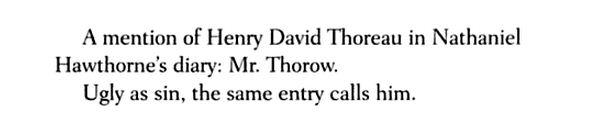
    Nathaniel Hawthorne Insults Henry David Thoreau, as Related by David Markson

    dmvp