
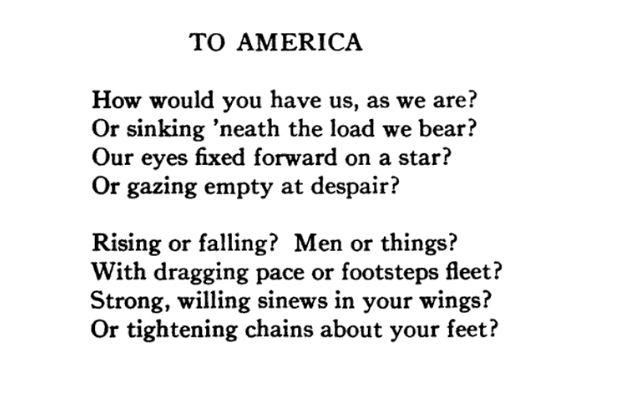
Tag: Poetry
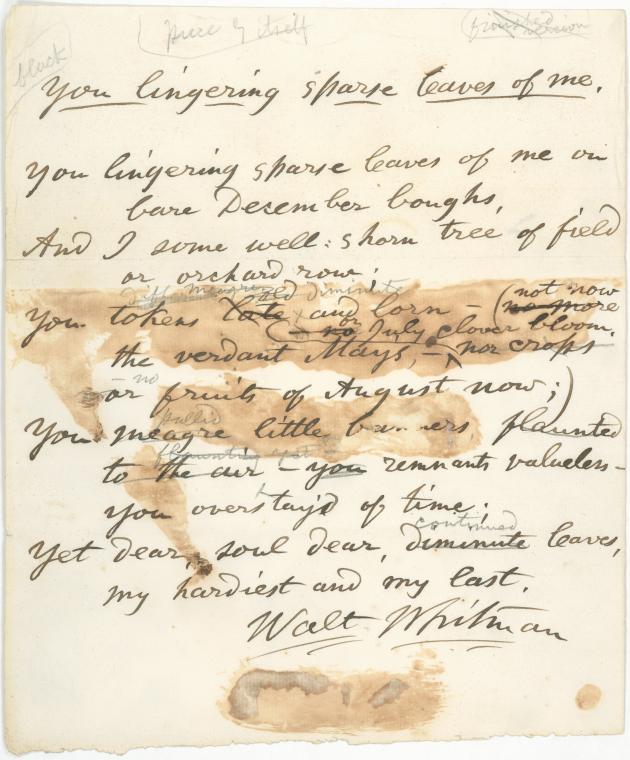
You lingering sparse leaves of me | Walt Whitman
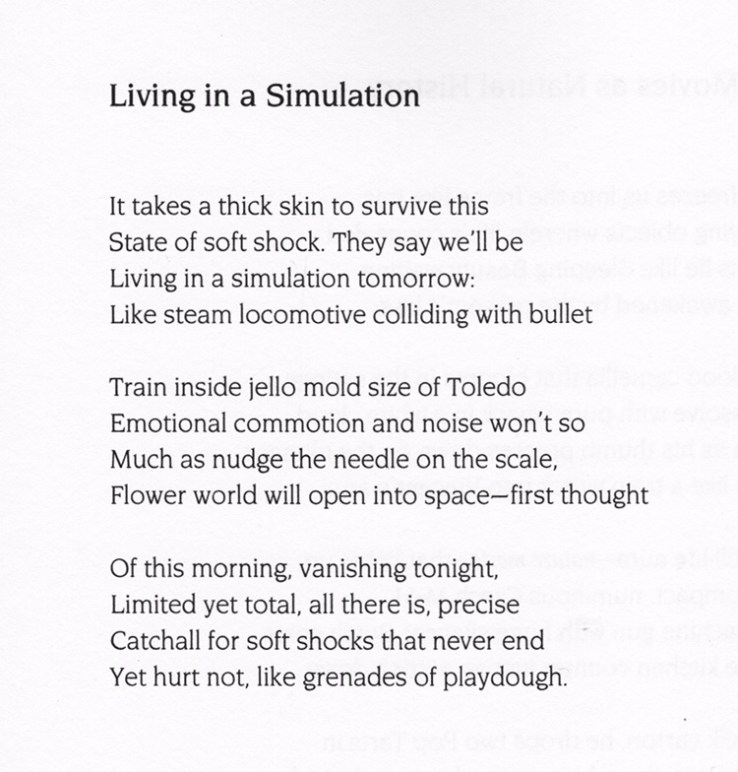
“Living in a Simulation” — Tom Clark
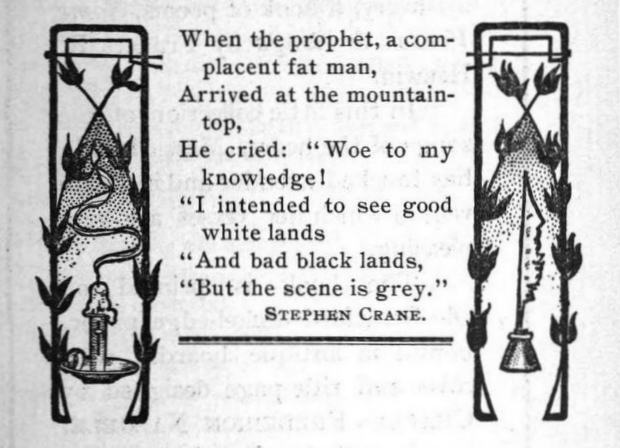
The scene is grey (Stephen Crane)
Read “P’s Correspondence,” a short story by Nathaniel Hawthorne
“P’s Correspondence”
by
Nathaniel Hawthorne
MY UNFORTUNATE FRIEND P. has lost the thread of his life, by the interposition of long intervals of partially disordered reason. The past and present are jumbled together in his mind, in a manner often productive of curious results; and which will be better understood after a perusal of the following letter, than from any description that I could give. The poor fellow, without once stirring from the little white-washed, iron-grated room, to which he alludes in his first paragraph, is nevertheless a great traveller, and meets, in his wanderings, a variety of personages who have long ceased to be visible to any eye save his own. In my opinion, all this is not so much a delusion, as a partly wilful and partly involuntary sport of the imagination, to which his disease has imparted such morbid energy that he beholds these spectral scenes and characters with no less distinctness than a play upon the stage, and with somewhat more of illusive credence. Many of his letters are in my possession, some based upon the same vagary as the present one, and others upon hypotheses not a whit short of it in absurdity. The whole form a series of correspondence, which, should fate seasonably remove my poor friend from what is to him a world of moonshine, I promise myself a pious pleasure in editing for the public eye. P. had always a hankering after literary reputation, and has made more than one unsuccessful effort to achieve it. It would not be a little odd, if, after missing his object while seeking it by the light of reason, he should prove to have stumbled upon it in his misty excursions beyond the limits of sanity.
LONDON, February 29, 1845.
MY DEAR FRIEND:
Old associations cling to the mind with astonishing tenacity. Daily custom grows up about us like a stone-wall, and consolidates itself into almost as material an entity as mankind’s strongest architecture. It is sometimes a serious question with me, whether ideas be not really visible and tangible, and endowed with all the other qualities of matter. Sitting as I do, at this moment, in my hired apartment, writing beside the hearth, over which hangs a print of Queen Victoria–listening to the muffled roar of the world’s metropolis, and with a window at but five paces distant, through which, whenever I please, I can gaze out on actual London–with all this positive certainty, as to my whereabouts, what kind of notion, do you think, is just now perplexing my brain? Why–would you believe it?–that, all this time, I am still an inhabitant of that wearisome little chamber,–that whitewashed little chamber–that little chamber with its one small window, across which, from some inscrutable reason of taste or convenience, my landlord had placed a row of iron bars–that same little chamber, in short, whither your kindness has so often brought you to visit me! Will no length of time, or breadth of space, enfranchise me from that unlovely abode? I travel, but it seems to be like the snail, with my house upon my head. Ah, well! I am verging, I suppose, on that period of life when present scenes and events make but feeble impressions, in comparison with those of yore; so that I must reconcile myself to be more and more the prisoner of Memory, who merely lets me hop about a little, with her chain around my leg.
My letters of introduction have been of the utmost service, enabling me to make the acquaintance of several distinguished characters, who, until now, have seemed as remote from the sphere of my personal intercourse as the wits of Queen Anne’s time, or Ben Jonson’s compotators at the Mermaid. One of the first of which I availed myself, was the letter to Lord Byron. I found his lordship looking much older than I had anticipated; although–considering his former irregularities of life, and the various wear and tear of his constitution–not older than a man on the verge of sixty reasonably may look. But I had invested his earthly frame, in my imagination, with the poet’s spiritual immortality. He wears a brown wig, very luxuriantly curled, and extending down over his forehead. The expression of his eyes is concealed by spectacles. His early tendency to obesity having increased, Lord Byron is now enormously fat; so fat as to give the impression of a person quite overladen with his own flesh, and without sufficient vigor to diffuse his personal life through the great mass of corporeal substance, which weighs upon him so cruelly. You gaze at the mortal heap; and, while it fills your eye with what purports to be Byron, you murmur within yourself–“For Heaven’s sake, where is he?” Were I disposed to be caustic, I might consider this mass of earthly matter as the symbol, in a material shape, of those evil habits and carnal vices which unspiritualize man’s nature, and clog up his avenues of communication with the better life. But this would be too harsh; and besides, Lord Byron’s morals have been improving, while his outward man has swollen to such unconscionable circumference. Would that he were leaner; for, though he did me the honor to present his hand, yet it was so puffed out with alien substance, that I could not feel as if I had touched the hand that wrote Childe Harold.
On my entrance, his lordship apologized for not rising to receive me, on the sufficient plea that the gout, for several years past, had taken up its constant residence in his right foot; which, accordingly, was swathed in many rolls of flannel, and deposited upon a cushion. The other foot was hidden in the drapery of his chair. Do you recollect whether Byron’s right or left foot was the deformed one? Continue reading “Read “P’s Correspondence,” a short story by Nathaniel Hawthorne”
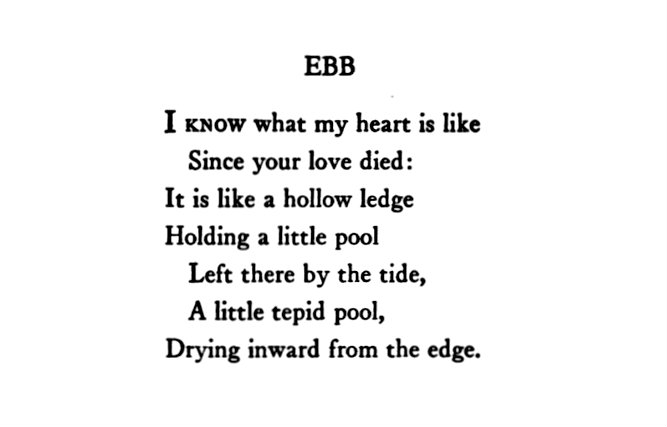
“Ebb” — Edna St. Vincent Millay
“River Rhyme” — William Carlos Williams

“Christmas Eve” — Anne Sexton
“Christmas Eve” by Anne Sexton
Oh sharp diamond, my mother!
I could not count the cost
of all your faces, your moods-
that present that I lost.
Sweet girl, my deathbed,
my jewel-fingered lady,
your portrait flickered all night
by the bulbs of the tree.
Your face as calm as the moon
over a mannered sea,
presided at the family reunion,
the twelve grandchildren
you used to wear on your wrist,
a three-months-old baby,
a fat check you never wrote,
the red-haired toddler who danced the twist,
your aging daughters, each one a wife,
each one talking to the family cook,
each one avoiding your portrait,
each one aping your life.
Later, after the party,
after the house went to bed,
I sat up drinking the Christmas brandy,
watching your picture,
letting the tree move in and out of focus.
The bulbs vibrated.
They were a halo over your forehead.
Then they were a beehive,
blue, yellow, green, red;
each with its own juice, each hot and alive
stinging your face. But you did not move.
I continued to watch, forcing myself,
waiting, inexhaustible, thirty-five.
I wanted your eyes, like the shadows
of two small birds, to change.
But they did not age.
The smile that gathered me in, all wit,
all charm, was invincible.
Hour after hour I looked at your face
but I could not pull the roots out of it.
Then I watched how the sun hit your red sweater, your withered neck,
your badly painted flesh-pink skin.
You who led me by the nose, I saw you as you were.
Then I thought of your body
as one thinks of murder-
Then I said Mary-
Mary, Mary, forgive me
and then I touched a present for the child,
the last I bred before your death;
and then I touched my breast
and then I touched the floor
and then my breast again as if,
somehow, it were one of yours
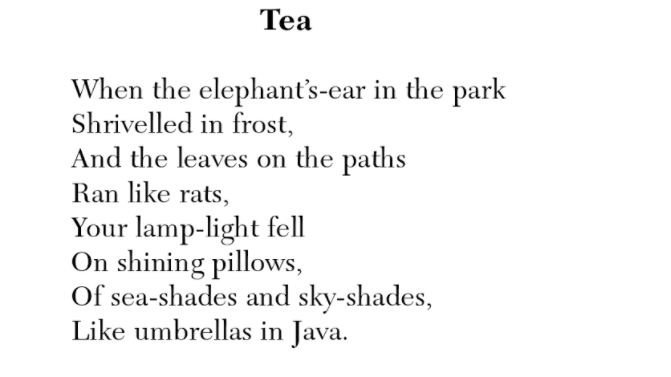
“Tea” — Wallace Stevens
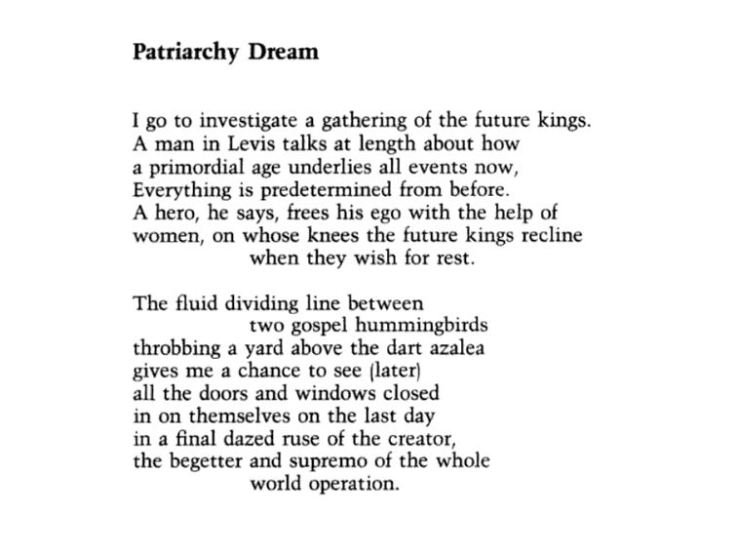
“Patriarchy Dream” — Tom Clark
“Marriage” — William Carlos Williams

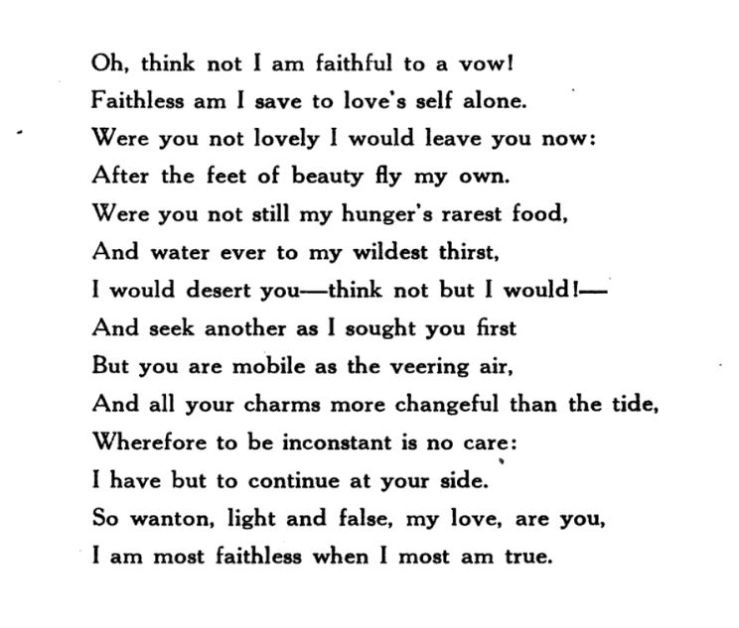
“Oh, think not I am faithful to a vow!” — Edna St. Vincent Millay
“October” — May Swenson
“October”
by
May Swenson
1
A smudge for the horizon
that, on a clear day, shows
the hard edge of hills and
buildings on the other coast.
Anchored boats all head one way:
north, where the wind comes from.
You can see the storm inflating
out of the west. A dark hole
in gray cloud twirls, widens,
while white rips multiply
on the water far out.
Wet tousled yellow leaves,
thick on the slate terrace.
The jay’s hoarse cry. He’s
stumbling in the air,
too soaked to fly.
2
Knuckles of the rain
on the roof,
chuckles into the drain-
pipe, spatters on
the leaves that litter
the grass. Melancholy
morning, the tide full
in the bay, an overflowing
bowl. At least, no wind,
no roughness in the sky,
its gray face bedraggled
by its tears.
3
Peeling a pear, I remember
my daddy’s hand. His thumb
(the one that got nipped by the saw,
lacked a nail) fit into
the cored hollow of the slippery
half his knife skinned so neatly.
Dad would pare the fruit from our
orchard in the fall, while Mother
boiled the jars, prepared for
“putting up.” Dad used to darn
our socks when we were small,
and cut our hair and toenails.
Sunday mornings, in pajamas, we’d
take turns in his lap. He’d help
bathe us sometimes. Dad could do
anything. He built our dining table,
chairs, the buffet, the bay window
seat, my little desk of cherry wood
where I wrote my first poems. That
day at the shop, splitting panel
boards on the electric saw (oh, I
can hear the screech of it now,
the whirling blade that sliced
my daddy’s thumb), he received the mar
that, long after, in his coffin,
distinguished his skilled hand.
4
I sit with braided fingers
and closed eyes
in a span of late sunlight.
The spokes are closing.
It is fall: warm milk of light,
though from an aging breast.
I do not mean to pray.
The posture for thanks or
supplication is the same
as for weariness or relief.
But I am glad for the luck
of light. Surely it is godly,
that it makes all things
begin, and appear, and become
actual to each other.
Light that’s sucked into
the eye, warming the brain
with wires of color.
Light that hatched life
out of the cold egg of earth.
5
Dark wild honey, the lion’s
eye color, you brought home
from a country store.
Tastes of the work of shaggy
bees on strong weeds,
their midsummer bloom.
My brain’s electric circuit
glows, like the lion’s iris
that, concentrated, vibrates
while seeming not to move.
Thick transparent amber
you brought home,
the sweet that burns.
6
“The very hairs of your head
are numbered,” said the words
in my head, as the haircutter
snipped and cut, my round head
a newel poked out of the tent
top’s slippery sheet, while my
hairs’ straight rays rained
down, making pattern on the neat
vacant cosmos of my lap. And
maybe it was those tiny flies,
phantoms of my aging eyes, seen
out of the sides floating (that,
when you turn to find them
full face, always dissolve) but
I saw, I think, minuscule,
marked in clearest ink, Hairs
#9001 and #9002 fall, the cut-off
ends streaking little comets,
till they tumbled to confuse
with all the others in their
fizzled heaps, in canyons of my
lap. And what keeps asking
in my head now that, brushed off
and finished, I’m walking
in the street, is how can those
numbers remain all the way through,
and all along the length of every
hair, and even before each one
is grown, apparently, through
my scalp? For, if the hairs of my
head are numbered, it means
no more and no less of them
have ever, or will ever be.
In my head, now cool and light,
thoughts, phantom white flies,
take a fling: This discovery
can apply to everything.
7
Now and then, a red leaf riding
the slow flow of gray water.
From the bridge, see far into
the woods, now that limbs are bare,
ground thick-littered. See,
along the scarcely gliding stream,
the blanched, diminished, ragged
swamp and woods the sun still
spills into. Stand still, stare
hard into bramble and tangle,
past leaning broken trunks,
sprawled roots exposed. Will
something move?—some vision
come to outline? Yes, there—
deep in—a dark bird hangs
in the thicket, stretches a wing.
Reversing his perch, he says one
“Chuck.” His shoulder-patch
that should be red looks gray.
This old redwing has decided to
stay, this year, not join the
strenuous migration. Better here,
in the familiar, to fade.
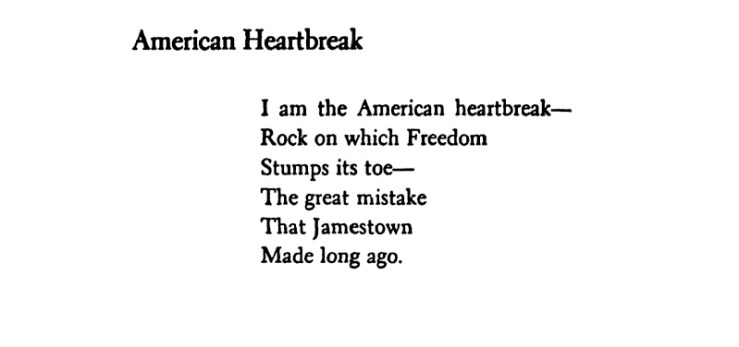
“American Heartbreak” — Langston Hughes
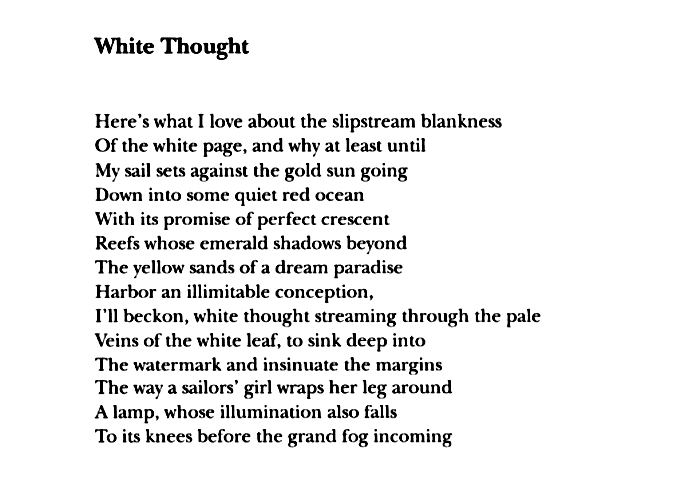
“White Thought” — Tom Clark
“Drink” — William Carlos Williams

“The Modest Achievement” — William Carlos Williams

 Biblioklept