“One need not be a chamber to be haunted” — Emily Dickinson

ghosts

“Prelude to Another Drink” — Malcolm Lowry

ml

“The air is the only true conscience, do you understand me?” (Thomas Bernhard)

We came out of the larch wood, making for the village and beyond into the deep forest. I was leading the way. The painter followed me, all the time I had the sense he’s about to lay into me, he’ll attack me from behind. I don’t know what prompted me to think that way, but I was unable to lose the fear that was oozing out of me. From time to time I picked up a word he was saying, it was completely incomprehensible to me, I couldn’t answer him when he asked me something, because really he was only asking himself. He growled at me: “Kindly stop when I ask you a question!” I stopped. “Come here!” he commanded. Suddenly I realized (it was in his tone, and I felt only I was in a position to realize this) the resemblance to his brother, the assistant. He said: “The air is the only true conscience, do you understand me?” I replied: “I don’t understand you.”—“The air, I say, is the only true science!” he repeated. I still didn’t understand, but nodded anyway. He said: “The gesture of the air, the great aerial gesture, you understand. The nightmarish sweat of fear, that’s the air.” I told him that was a great thought. In my opinion it was even poetry, to me what he had just said was the distillation of all memory, of all possibility. “Poetry is nothing!” he said. “Poetry as you understand it is nothing. Poetry as the world understands it, as the poetry hound understands it, is nothing. No, this poetry is nothing! The poetry that I have in mind is something else. If you meant that poetry, then you’d be right. Then I’d have to embrace you!” I said: “What is your poetry?”—“My poetry isn’t my poetry. But if you mean my poetry, then I’ll have to admit I’m unable to offer you a description of it. You see, my poetry, which is the only poetry, and therefore also the only truth, just as much as the only truth that I find in the air, which I feel in the air, which is the air, this poetry of mine is always generated at the center of its own thought, which is all its own. This poetry is momentary, is instantaneous. And therefore it isn’t. It is my poetry.”—“Yes,” I said, “it is your poetry.” I had understood nothing of what he had said. “Let’s go on,” he said, “it’s cold. The cold is eating into the center of my brain. If only you knew how far the cold had already advanced into my brain. The insatiable cold, the cold that insists on its bloody nourishment of cells, that insists on my brain, on everything that could make anything, could become anything. You see,” he said, “the brain, the skull and the brain within it, are an incredible irresponsibility, a dilettantism, a lethal dilettantism, that’s what I want to say. One’s forces are attacked, the cold bites into my forces, into my human forces, into the lofty muscle power of reason. It’s this ancient tourism of cold, billions of years old, this exploitative and pernicious tourism, that penetrates my brain, the entry of frost … There is,” he said, “no longer the category of ‘secret,’ it doesn’t exist, everything is just frigor mortis. I see the cold, I can write it down, I can dictate it, it’s killing me …” In the village, he popped into the abattoir. He said: “Cold is one of the great A-truths, the greatest of all the A-truths, and therefore it is all truths rolled into one. Truth is always a process of extermination, you must understand. Truth leads downhill, points downhill, truth is always an abyss. Untruth is a climbing, an up, untruth is no death, as truth is death, untruth is no abyss, but untruth is not A-truth, you understand: the great infirmities do not approach us from outside, the great infirmities have been within us, surprisingly, for millions of years …” He says, staring through the open abattoir doors: “There it is clearly in front of you, broken open, sliced apart. And there’s the scream as well, of course! If you listen, you’ll catch the scream as well. You will still hear the scream, even though the facility for the production of the scream is dead, is severed, chopped up, ripped open. The vocal cords have been rendered, but the scream is still there! It’s a grotesque realization that the vocal cords have been smashed, chopped up, sliced apart, and the scream is still there. That the scream is always there. Even if all the vocal cords have been chopped up and sliced apart, are dead, all the vocal cords in the world, all the vocal cords of all the worlds, all the imaginations, all the vocal cords of every creature, the scream is always there, is always still there, the scream cannot be chopped up, cannot be cut through, the scream is the only eternal thing, the only infinite thing, the only ineradicable thing, the only constant thing … The lesson of humanity and inhumanity and human opinions, and of the great human silence, the lesson of the great memory protocol of the great being, should all be tackled through the abattoir! Schoolchildren should not be brought to heated classrooms, they should be made to attend abattoirs; it is only from abattoirs that I expect understanding of the world and of the world’s bloody life. Our teachers should do their work in abattoirs. Not read from books, but swing hammers, wield saws, and apply knives … Reading should be taught from the coiled intestines, and not from useless lines in books … The word ‘nectar’ should be traded in forthwith for the word ‘blood’ … You see,” said the painter, “the abattoir is the only essentially philosophical venue. The abattoir is the classroom and the lecture hall. The only wisdom is abattoir wisdom! A-truth, truth, untruth, all added up come to the vast abattoir immatriculation, which I would like to make compulsory for humans, for new humans, and those tempted to become humans. Knowledge in the world is not abattoir knowledge, and it lacks thoroughness. The abattoir makes possible a radical philosophy of thoroughness.” We had gone into the slaughterhouse. “Let’s go,” said the painter, “in me the smell of blood turns into the extraordinary, the smell of blood is the only parity. Let’s go, otherwise I should have to uproot the possibility of new intellectual disciplines from my own thinking materiality, and I don’t have the strength for that.” He took large steps, and said: “The beast bleeds for the human, and knows it. Meanwhile the human doesn’t bleed for the beast, and doesn’t know it. The human is the incomplete beast, the beast could be fully human. Do you understand what I mean: the one is disproportionate to the other, the one is massively dark to the other. Neither is for the other. Neither excludes the other.”

From Thomas Bernhard’s novel Frost.

“The Tea Shop” — Ezra Pound

ezra

“Leda and the Swan” — W.B. Yeats

leda

“She” — Tom Clark

she

“Key West” — Charles Olson

key west

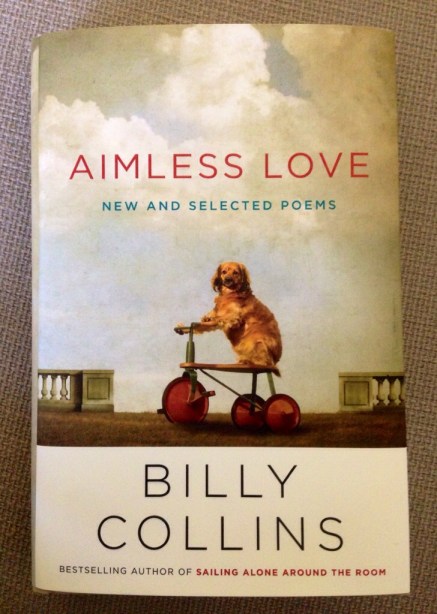
Billy Collins’s Aimless Love (Book Acquired, 10.08.2013)

20131013-093256.jpg

Aimless of Love, new from Billy Collins this month. Blurb:

From the two-term Poet Laureate of the United States Billy Collins comes his first compilation of new and selected poems in twelve years. Aimless Love combines more than fifty new poems with selections from four previous books—Nine Horses, The Trouble with Poetry, Ballistics, and Horoscopes for the Dead. Collins’s unmistakable voice, which brings together plain speech with imaginative surprise, is clearly heard on every page, reminding us how he has managed to enrich the tapestry of contemporary poetry and greatly expand its audience. His work is featured in top literary magazines such as The New YorkerPoetry, and The Atlantic, and he sells out reading venues all across the country. Appearing regularly in The Best American Poetryseries, his poems appeal to readers and live audiences far and wide and have been translated into more than a dozen languages. By turns playful, ironic, and serious, Collins’s poetry captures the nuances of everyday life while leading the reader into zones of inspired wonder. In the poet’s own words, he hopes that his poems “begin in Kansas and end in Oz.” Touching on the themes of love, loss, joy, and poetry itself, these poems showcase the best work of this “poet of plenitude, irony, and Augustan grace” (The New Yorker).

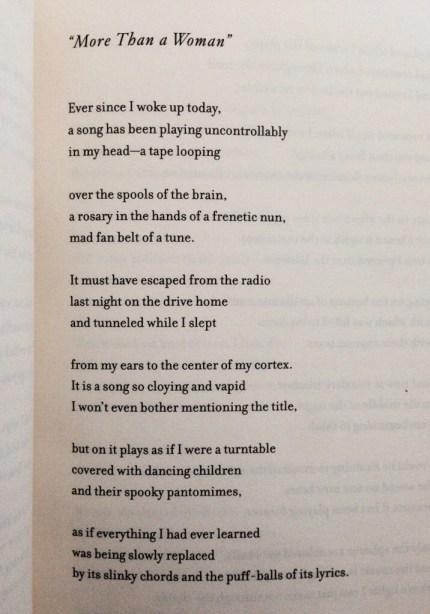
Sample:
20131013-093309.jpg


“A Lesson for This Sunday” — Derek Walcott

“A Lesson for This Sunday” by Derek Walcott

The growing idleness of summer grass
With its frail kites of furious butterflies
Requests the lemonade of simple praise
In scansion gentler than my hammock swings
And rituals no more upsetting than a
Black maid shaking linen as she sings
The plain notes of some Protestant hosanna—
Since I lie idling from the thought in things—

Or so they should, until I hear the cries
Of two small children hunting yellow wings,
Who break my Sabbath with the thought of sin.
Brother and sister, with a common pin,
Frowning like serious lepidopterists.
The little surgeon pierces the thin eyes.
Crouched on plump haunches, as a mantis prays
She shrieks to eviscerate its abdomen.
The lesson is the same. The maid removes
Both prodigies from their interest in science.
The girl, in lemon frock, begins to scream
As the maimed, teetering thing attempts its flight.
She is herself a thing of summery light,
Frail as a flower in this blue August air,
Not marked for some late grief that cannot speak.

The mind swings inward on itself in fear
Swayed towards nausea from each normal sign.
Heredity of cruelty everywhere,
And everywhere the frocks of summer torn,
The long look back to see where choice is born,
As summer grass sways to the scythe’s design.

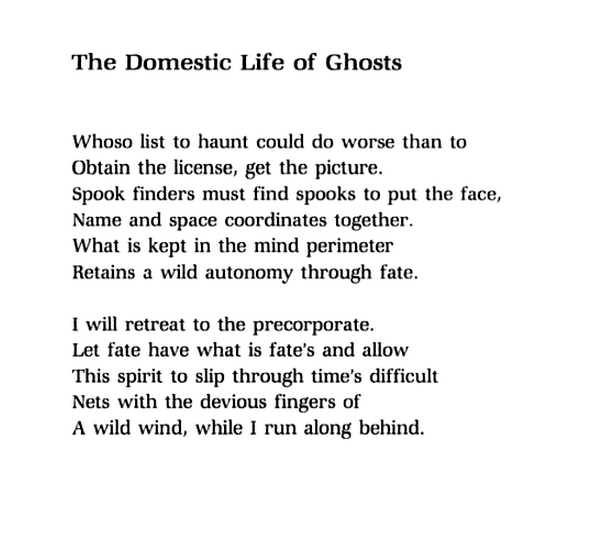
“The Domestic Life of Ghosts” — Tom Clark

tc

“October” — Tom Clark

october

“Lines” — William Carlos Williams

lines

“Terminator Too” — Tom Clark

“Terminator Too” by Tom Clark—

Poetry, Wordsworth
wrote, will have no
easy time of it when
the discriminating

powers of the mind
are so blunted that
all voluntary
exertion dies, and

the general
public is reduced
to a state of near
savage torpor, morose,

stuporous, with
no attention span
whatsoever; nor will
the tranquil rustling

of the lyric, drowned out
by the heavy, dull
coagulation
of persons in cities,

where a uniformity
of occupations breeds
cravings for sensation
which hourly visual

communication of
instant intelligence
gratifies like crazy,
likely survive this age.

“I lost a world the other day” — Emily Dickinson

Capture

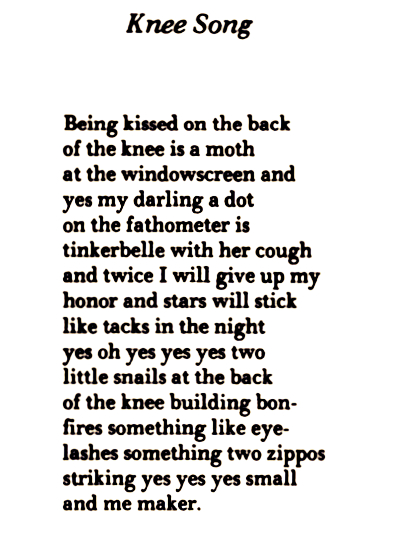
“Knee Song” — Anne Sexton

sexton

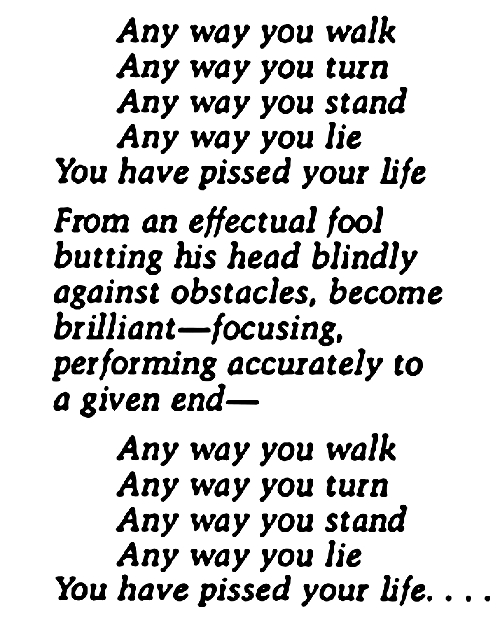
“Character Is Fate” — Tom Clark

Capture

“Beckett’s Theory of Comedy” — Anne Carson

btc