
Tag: Poetry
Billy Collins’s Aimless Love (Book Acquired, 10.08.2013)
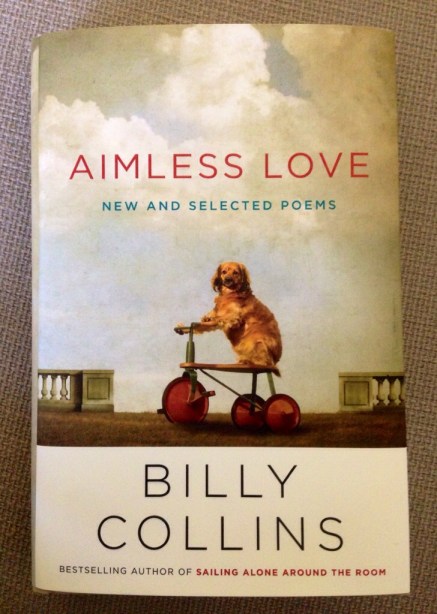
Aimless of Love, new from Billy Collins this month. Blurb:
From the two-term Poet Laureate of the United States Billy Collins comes his first compilation of new and selected poems in twelve years. Aimless Love combines more than fifty new poems with selections from four previous books—Nine Horses, The Trouble with Poetry, Ballistics, and Horoscopes for the Dead. Collins’s unmistakable voice, which brings together plain speech with imaginative surprise, is clearly heard on every page, reminding us how he has managed to enrich the tapestry of contemporary poetry and greatly expand its audience. His work is featured in top literary magazines such as The New Yorker, Poetry, and The Atlantic, and he sells out reading venues all across the country. Appearing regularly in The Best American Poetryseries, his poems appeal to readers and live audiences far and wide and have been translated into more than a dozen languages. By turns playful, ironic, and serious, Collins’s poetry captures the nuances of everyday life while leading the reader into zones of inspired wonder. In the poet’s own words, he hopes that his poems “begin in Kansas and end in Oz.” Touching on the themes of love, loss, joy, and poetry itself, these poems showcase the best work of this “poet of plenitude, irony, and Augustan grace” (The New Yorker).
Sample:
“A Lesson for This Sunday” — Derek Walcott
“A Lesson for This Sunday” by Derek Walcott
The growing idleness of summer grass
With its frail kites of furious butterflies
Requests the lemonade of simple praise
In scansion gentler than my hammock swings
And rituals no more upsetting than a
Black maid shaking linen as she sings
The plain notes of some Protestant hosanna—
Since I lie idling from the thought in things—Or so they should, until I hear the cries
Of two small children hunting yellow wings,
Who break my Sabbath with the thought of sin.
Brother and sister, with a common pin,
Frowning like serious lepidopterists.
The little surgeon pierces the thin eyes.
Crouched on plump haunches, as a mantis prays
She shrieks to eviscerate its abdomen.
The lesson is the same. The maid removes
Both prodigies from their interest in science.
The girl, in lemon frock, begins to scream
As the maimed, teetering thing attempts its flight.
She is herself a thing of summery light,
Frail as a flower in this blue August air,
Not marked for some late grief that cannot speak.The mind swings inward on itself in fear
Swayed towards nausea from each normal sign.
Heredity of cruelty everywhere,
And everywhere the frocks of summer torn,
The long look back to see where choice is born,
As summer grass sways to the scythe’s design.
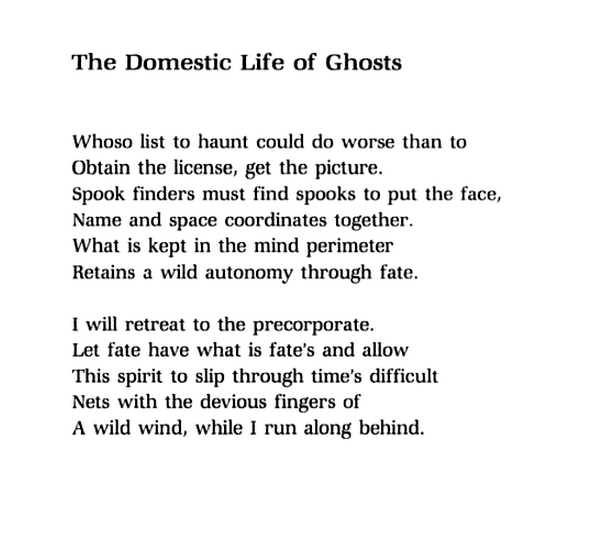
“The Domestic Life of Ghosts” — Tom Clark
“October” — Tom Clark

“Lines” — William Carlos Williams

“Terminator Too” — Tom Clark
“Terminator Too” by Tom Clark—
Poetry, Wordsworth
wrote, will have no
easy time of it when
the discriminatingpowers of the mind
are so blunted that
all voluntary
exertion dies, andthe general
public is reduced
to a state of near
savage torpor, morose,stuporous, with
no attention span
whatsoever; nor will
the tranquil rustlingof the lyric, drowned out
by the heavy, dull
coagulation
of persons in cities,where a uniformity
of occupations breeds
cravings for sensation
which hourly visualcommunication of
instant intelligence
gratifies like crazy,
likely survive this age.
“I lost a world the other day” — Emily Dickinson

“Knee Song” — Anne Sexton
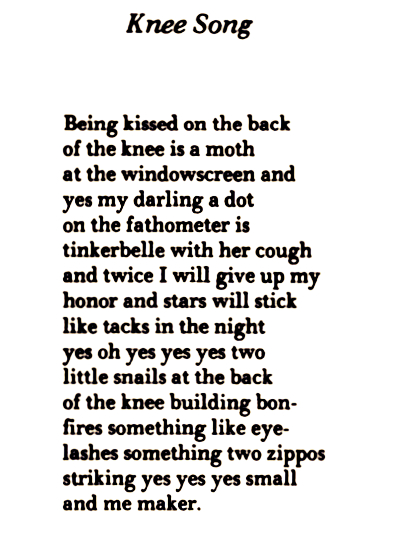
“Character Is Fate” — Tom Clark

“Beckett’s Theory of Comedy” — Anne Carson

“Après le Bain” — William Carlos Williams
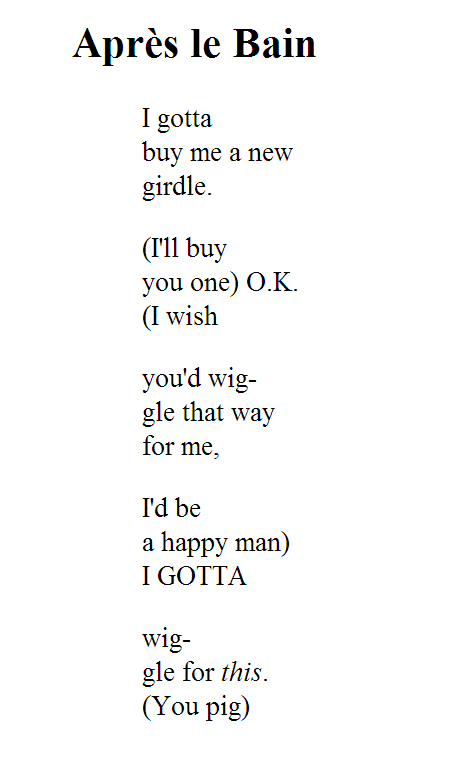
“You Have Pissed Your Life” — William Carlos Williams
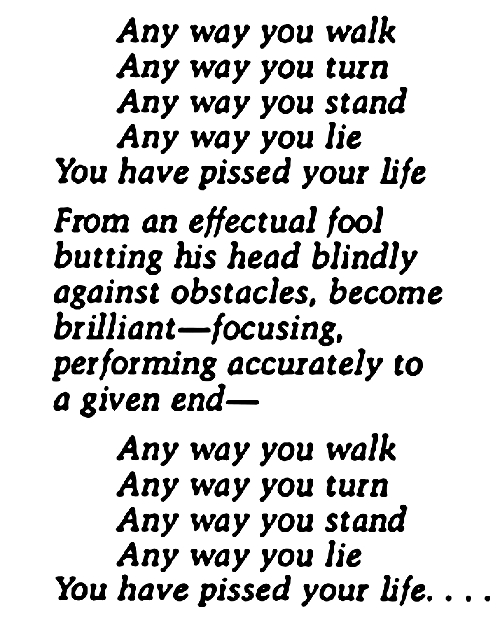
“The Retirement of Superman” — Tom Clark
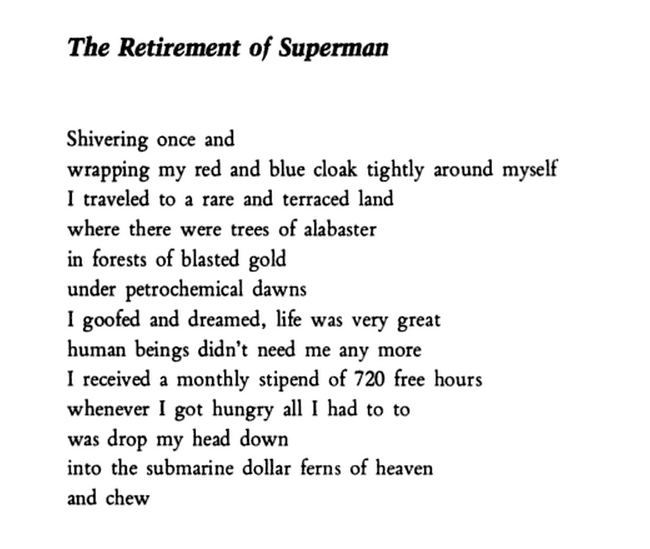
“A Drinking Song” — W.B. Yeats
“The Man Who Was Killed” — Denis Johnson
“Abu Al-Anbas’ Donkey” – Eliot Weinberger

 Biblioklept