“Thanksgiving” — Kenneth Koch

“Thanksgiving”

by

Kenneth Koch


What’s sweeter than at the end of a summer’s day
To suddenly drift away
From the green match-wrappers in an opened pocketbook
And be part of the boards in a tavern?

A tavern made of new wood.
There’s an orange-red sun in the sky
And a redskin is hunting for you underneath ladders of timber.
I will buy this tavern. Will you buy this tavern? I do.

In the Indian camp there’s an awful dismay.
Do they know us as we know they
Know us or will know us, I mean a—
I mean a hostile force, the month of May.

How whitely the springtime is blossoming,
Ugh! all around us!
It is the brilliant Indian time of year
When the sweetest Indians mate with the sweetest others.

But I fear the white men, I fear
The rent apple blossom and discarded feathers
And the scalp lying secretly on the ground
Like an unoffending nose!

But we’ve destroyed all that. With shocking guns.
Peter Stuyvesant, Johnny Appleseed, Aaron Copeland.
We’ve destroyed all that. Come,
Do you believe right was on either side?

How would you like to be living in an Indian America,
With feathers dressing every head? We’d eat buffalo hump
For Thanksgiving dinner. Everyone is in a tribe.
A girl from the Bep Tribe can’t marry a brave from the Bap tribe. Is that democracy?
And then those dreary evenings around the campfires
Listening to the Chief! If there were a New York
It would be a city of tents, and what do you suppose
Our art and poetry would be like? For the community! the tribe!
No beautiful modern abstract pictures, no mad incomprehensible
Free lovable poems! And our moral sense! tribal.
If you would like to be living in an Indian America
Why not subscribe to the newspaper, Indian America?

In Wisconsin, Ben, I stand, I walk up and down and try to decide.

Is this country getting any better or has it gotten?
If the Indian New York is bad, what about our white New York?
Dirty, unwholesome, the filthy appendage to a vast ammunition works, I hate it!
Disgusting rectangular garbage dump sending its fumes up to suffocate the sky—
Foo, what fumes! and the scaly white complexion of her citizens.
There’s hell in every firm handshake, and stifled rage in every look.
If you do find somewhere to lie down, it’s a dirty inspected corner,
And there are newspapers and forums and the stinking breath of Broadway
To investigate what it feels like to be a source of stench
And nothing else. And if one does go away,
It is always here, waiting, for one to come back. And one does come back,
As one does come back to the bathroom, and to a fine suffering.

Where else would I find such ardent and grateful spirits
Inspired and wasted and using and used by this horrible city,
New York, New York? Can the Pilgrims’ Thanksgiving dinner really compare to it?
And the Puritans? And the single-minded ankle-divided Indians?
No, nothing can compare to it! So it’s here we speak from the heart
And it’s rotting so fast that what we say
Fades like the last of a summer’s day.
Rot which makes us as prolific as the sun on white unfastened clouds.
“hist whist” — e.e. cummings

“hist whist”

by

e.e. cummings


hist      whist
little ghostthings
tip-toe
twinkle-toe
little twitchy
witches and tingling
goblins
hob-a-nob     hob-a-nob
little hoppy happy
toad in tweeds
tweeds
little itchy mousies
with scuttling
eyes    rustle and run     and
hidehidehide
whisk
whisk     look out for the old woman
with the wart on her nose
what she’ll do to yer
nobody knows
for she knows the devil     ooch
the devil     ouch
the devil
ach     the great
green
dancing
devil
devil
devil
devil
        wheeEEE

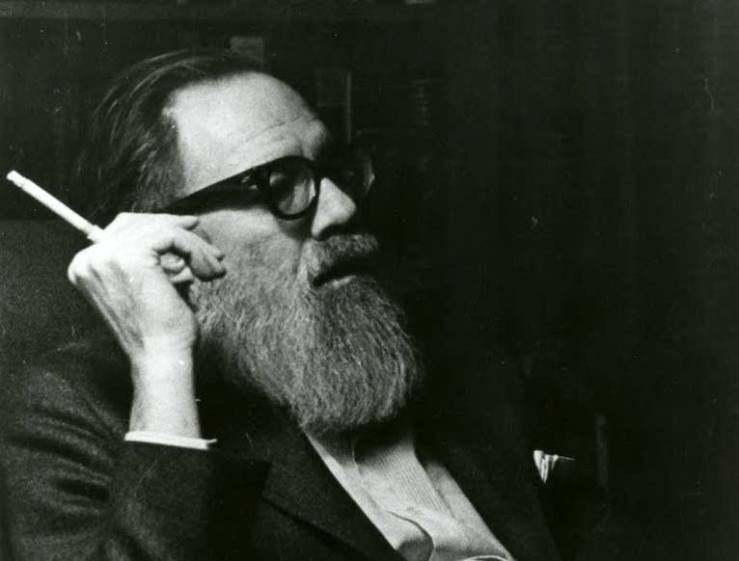
“What do we make of the Mr. Bones voice, the minstrel voice, as employed in Berryman’s most successful work, much of it written during the high period of the civil rights movement?” | Rick Moody on John Berryman

What do we make of the Mr. Bones voice, the minstrel voice, as employed in Berryman’s most successful work, much of it written during the high period of the civil rights movement? What do we make of Henry’s agonized dream life in our own times of crisis? And what of the author? And why is the Poetry Foundation assigning a review of Berryman’s letters, today, when they could instead review a new volume by an African American poet?

There is, it is fair to say, a stomach churning that goes with this assignment. Should I not properly imagine that I, a middle-aged white writer of privilege, am, however inadvertently, being conscripted into this review such that I might avoid rocking the boat on a now-contested figure of 20th-century confessional literature when some helping of opprobrium appears more than justifiable? Let me be plain. In the present context, it is impossible to read Berryman’s magnum opus without the keenest discontent about the use of dialect. Berryman’s conduct as a man, as a father, as a husband, as a professor, as indicated in his work and in his biography, is very often difficult to bear witness to, even at a 50-year remove. The tide has shifted so dramatically in 2020 that it is hard to know why it is a public service to review the volume at hand.

These are the third and fourth paragraphs of Rick Moody’s essay “Unspeakably Miserable For the Most Part,” published this week at the Poetry Foundation. Ostensibly a review of the new collection The Selected Letters of John Berryman (edited by Philip Coleman and Calista McRae), Moody’s essay continues for another dozen paragraphs.

“Olives” — Donald Hall

“Olives”

by

Donald Hall


“Dead people don’t like olives,”
I told my partners in eighth grade
dancing class, who never listened
as we fox-trotted, one-two, one-two.

The dead people I often consulted
nodded their skulls in unison
while I flung my black velvet cape
over my shoulders and glowered
from deep-set, burning eyes,
walking the city streets, alone at fifteen,
crazy for cheerleaders and poems.

At Hamden High football games, girls
in short pleated skirts
pranced and kicked, and I longed
for their memorable thighs.
They were friendly—poets were mascots—
but never listened when I told them
that dead people didn’t like olives.

Instead the poet, wearing his cape,
continued to prowl in solitude
intoning inscrutable stanzas
as halfbacks and tackles
made out, Friday nights after football,
on sofas in dark-walled rec rooms
with magnanimous cheerleaders.

But, decades later, when the dead
have stopped blathering
about olives, obese halfbacks wheeze
upstairs to sleep beside cheerleaders
waiting for hip replacements,
while a lascivious, doddering poet,
his burning eyes deep-set
in wrinkles, cavorts with their daughters.

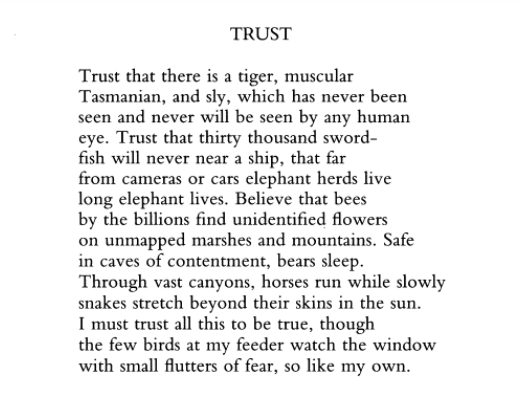
“Trust” — Susan Kinsolving

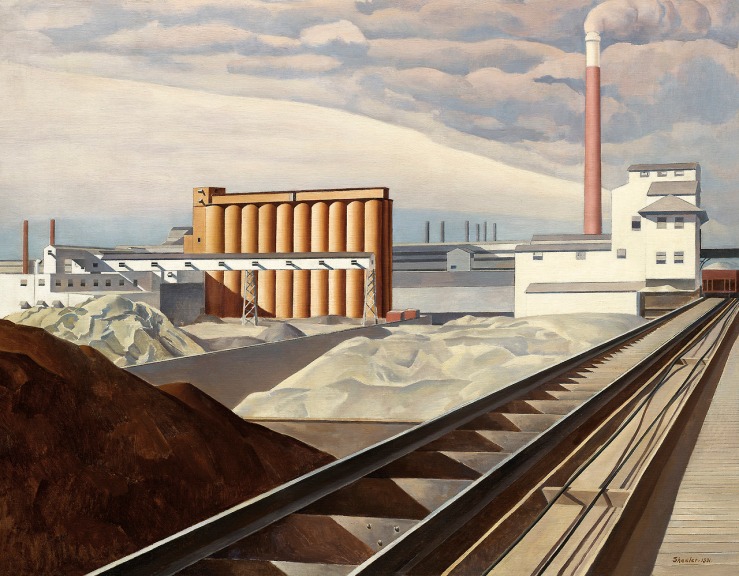
“Classic Scene” — William Carlos Williams

“Classic Scene”

by

William Carlos Williams


A power-house
in the shape of
a red brick chair
90 feet high

on the seat of which
sit the figures
of two metal
stacks–aluminum–

commanding an area
of squalid shacks
side by side–
from one of which

buff smoke
streams while under
a grey sky
the other remains

passive today–

tumblr_ovntm8X5p21rz2lkvo1_1280

Classic Landscape, 1931 by Charles Sheeler (1883–1965)

“A Poem to Read in August” — Gilbert Sorrentino

IMG_3021

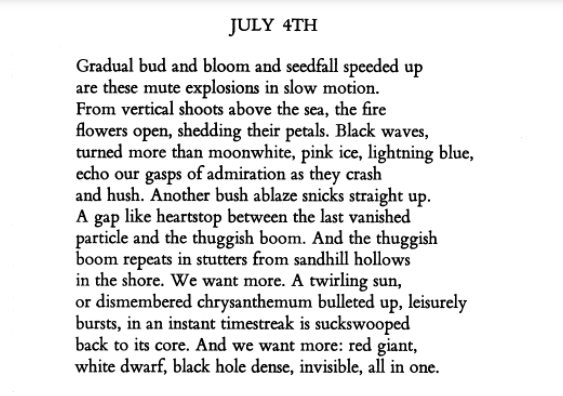
“July 4th” — May Swenson

Screenshot 2020-07-03 at 12.35.51 PM

Claudia Rankine reading from Citizen

The new therapist specializes in trauma counseling | Claudia Rankine

From Citizen by Claudine Rankine


/

The new therapist specializes in trauma counseling. You have only ever spoken on the phone. Her house has a side gate that leads to a back entrance she uses for patients. You walk down a path bordered on both sides with deer grass and rosemary to the gate, which turns out to be locked.

At the front door the bell is a small round disc that you press firmly. When the door finally opens, the woman standing there yells, at the top of her lungs, Get away from my house. What are you doing in my yard?

It’s as if a wounded Doberman pinscher or a German shepherd has gained the power of speech. And though you back up a few steps, you manage to tell her you have an appointment. You have an appointment? she spits back. Then she pauses. Everything pauses. Oh, she says, followed by, oh, yes, that’s right. I am sorry.

I am so sorry, so, so sorry.

/


More…

“Sather Tower Mystery” — Ishmael Reed

“Sather Tower Mystery”

by

Ishmael Reed


Seems there was this Professor
a member of what should be called
The Good German Department

Must have signed his name to
5,000 petitions in front of
the Co-Op on Cedar
and bought two tons of benefit
cookies
Blames Texas for the sorry
state of the oceans
Rode a Greyhound bus “Civil
Rights,” Alabama, 1960
Found the long yellow war
“deplorable”
Believes John “Duke” Wayne’s
values to be inferior to his

He said, “Ishmael, I’d
love to do the right thing
for as you know I’m all for
the right thing and against
the wrong thing, but
these plaster of paris busts
of deceased Europeans
Our secret ways
Our sacred fears
“These books, leather-bound ‘copyright 1789’
All of these things, precious
to me, gleaming like the
stainless steel coffee urn in
the faculty club, an original
Maybeck, 1902

“I’d stand up for Camelot
by golly, even if it meant
shooting all the infidels in
the world,” he said
reaching into his desk drawer

“Why, I might even have to
shoot you, Ishmael”

Staring down the cold
tunnel of a hard .38
I thought

Most people are to the right
when it comes to where they must
eat and lay their heads!

“May” — Tom Disch

Screenshot 2020-03-12 at 7.15.07 PM

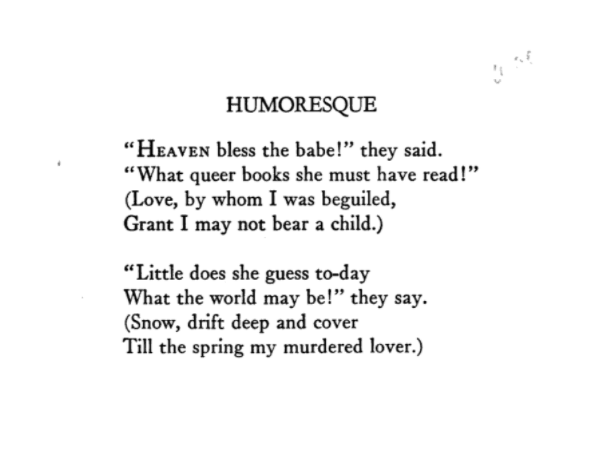
“Humoresque” — Edna St. Vincent Millay

Screenshot 2020-04-25 at 6.03.04 PM

“Short Talk on Vicuñas” — Anne Carson

“Short Talk on Vicuñas”

by

Anne Carson


A mythical animal, the vicuña fares well
in the volcanic regions of northern Peru.
Light thunders down on it, like Milton
at his daughters. Hear that?—they
are counting under their breath.
Think about style of life for a
moment. When you take up your
axe, listen. Hoofbeats. Wind.
It is they who make us at home
here, not the other way around.


More short talks by Anne Carson at BOMB.

“Enough! enough! enough!” — Walt Whitman

Section 38 of Song of Myself

by

Walt Whitman


Enough! enough! enough!
Somehow I have been stunn’d. Stand back!
Give me a little time beyond my cuff’d head, slumbers, dreams, gaping,
I discover myself on the verge of a usual mistake.

That I could forget the mockers and insults!
That I could forget the trickling tears and the blows of the bludgeons and hammers!
That I could look with a separate look on my own crucifixion and bloody crowning.

I remember now,
I resume the overstaid fraction,
The grave of rock multiplies what has been confided to it, or to any graves,
Corpses rise, gashes heal, fastenings roll from me.

I troop forth replenish’d with supreme power, one of an average unending procession,
Inland and sea-coast we go, and pass all boundary lines,
Our swift ordinances on their way over the whole earth,
The blossoms we wear in our hats the growth of thousands of years.

Eleves, I salute you! come forward!
Continue your annotations, continue your questionings.

“Cool gales shall fan the glades” — Harry Mathews

“Cool gales shall fan the glades”

by

Harry Mathews


But how choose the appropriate sticking point to start at?
Who wants to write a poem without the letter e,
Especially for Thee, where the flourished vowel lends such panache to your carnet de bal
(OK, peons: pizzazz to your dance card)? The alphabet’s such a horn
Of plenty, why cork up its treasure? It hurts to think of “you” reduced to u
In stingy text messages, as if ideally expression should be limited to formulas like x ≠ y,

Where the respectable truth of tautology leaves ambiguous beauty standing by
Waiting to take off her clothes, if, that is, her percentage of body fat
Permits it (a statement implicitly unfair, as if beauty, to remain sublime, had to keep up
Lineaments already shaped by uninhibited divinity); implying, as well, fixated onlookers, i.e.,
Men and women kidding themselves that full-front-and-back nudity is the north
Star of delight rather than imagined nakedness, shudderingly draped like a fully rigged, fully laden ship without a drop to bail,

Its hidden cargoes guessed at — perhaps Samian wine (mad-
making!) — or fresh basil
Gently crushed by its own slight weight, reviving memories of delights once stumbled on as a boy,
Delights often wreathed with necessary pain, like the stout unforgiving thorns
That tear shirt and skin as we stretch for ripe blackberries, to be gulped down fast,
Sweeter than butter and marmalade, quenching our thirst better than sucked ice,
Making us almost drunk as we shriek with false contempt at each benighted ump

Who decides against our teams. What happened to those blissful fruits, honeydew, purple plum,
White raspberry, for stealing which from Mrs. Grossman’s stand I invented ingenious alibis
That she never believed (insulting, or what?)? Where are childhood’s innocent sweetnesses, like homemade rice
Pudding and mince pie? Or the delicious resistances of various foods — bony
Lobsters, chops with their succulent tiny interstices, corn sticking to the cob, or the grilled feast
Of brook trout I caught without too much fuss after kicking a 
resentful hornets’

Nest? And when carnality replaced appetite, I was communally pronounced the horniest
Ten-year-old around; and I hadn’t even seen you. But when I did, you became the plume
In the horse’s hat of my lust. I was thirteen when we first danced together. There weren’t many afters
But I cherish my plume. There weren’t any afters, nothing, just a gentle abseil I
Could not climb back up. I still wave my plume, or my horse does, as he canters nobly
Into next year, my eighty-fifth. I hasten to add that “this coyness, lady, were no crime”

If I didn’t, in spite of all, feel so grateful to you. All manner of mercis
Fill my throat, along with immortal memories, of which I must acknowledge the thorniest
To be your disappearance, whether you tanked in river water or were scorched by Zeus’s proximity (or some such baloney);
But your firm breasts, taut nipples, and bent thighs? No thorns. All you wanted was a loosened peplum,
So I still bear your plume, and your name will not die: not to be written here or read, but my voice shall sibilate
It so shrilly that unseeded babies hear me, and every hidden woodworm wake from its dream to fall forever from the rafters.