

Thurston’s Rock n’ Roll Fantasy
Thurston Moore’s memoir Sonic Life kicks off in 1963 with his older brother Gene bringing home a 45 of the Kingsmen’s “Louie Louie,” blowing open five-year-old Moore’s mind to the sonic possibilities of raw guitar power.
Moore describes the primal garage hit as the introduction to “a new current of electricity,” one that rewrites the “soundworld” of his earlier suburban life. Our narrator chases that current, finding it in its purest form in The Stooges’ “I Wanna Be Your Dog,” a pre-punk anthem Moore’s band Sonic Youth would cover on their first full-length album, 1983’s Confusion Is Sex. Sonic Youth would also play “I Wanna Be Your Dog” live throughout their career and eventually perform it with Moore’s hero Iggy Pop.
Moore meets many of his heroes in his Sonic Life. It’s a goddamn rock n’ roll fantasy, albeit a fantasy filtered through the gritty reality of punk, No Wave, and smelly indie rock touring vans.
Sure, Moore meets some of the biggies, especially late in the memoir, as Sonic Youth reaches their sonic majority. He chats with Paul McCartney, professing a preference for McCartney’s brother Mike McGear’s stuff to the Beatles. Sonic Youth gets to back David Bowie on “I’m Afraid of Americans.” (Bowie later coos to Moore’s toddler daughter Coco). Moore tours and records with Yoko Ono.
But Moore’s eyes star starrier for the rough luminaries of the New York seventies scene he thrust himself into: Patti Smith, Joey Ramone, Richard Hell, Alan Vega, Tom Verlaine, Lenny Kaye, et al. He’s just as hot for contemporaries like the Minutemen, Black Flag, and Dinosaur Jr., and maybe even hotter for the bands that took Sonic Youth’s squeal to heart, like Pavement, Royal Trux, and My Bloody Valentine.
Sonic Life is larded with people, vibrations, art, life, a love of the weird. Sonic Youth were always as important as curators of the underground, channeling it to seekers of the strange, as they were as a musical act, and Sonic Life is the literary summation of that career.
Thurston’s Literary Fantasy
Any fan who followed Sonic Youth closely, especially in their nineties heyday, would attest that Thurston Moore was the band’s loquacious mouthpiece, a bit of tall charmed ADHD in verbal action, chatting up the world. Sonic Life is liquid, loquacious, loving. Literary protopunk hero Patti Smith populates the pages from the earliest chapters through the last.
Moore also works his decades-long sightings and meetings of William S. Burroughs into the book. Moore first spies Burroughs in 1977 in NYC at a Patti Smith show; decades later the band gets to hang with him a bit. (It’s unclear if Burroughs registers any of this.)
Kathy Acker’s spirit occasionally pops up; it’s clear she was a hero to Moore and his band, but she ghosts them at a planned joint performance in Rotterdam in 1985. The band reads passages of Blood and Guts in High School between songs, tearing out the pages and destroying the book.
Longtime Sonic Youth fans will anticipate Moore’s prose. Seemingly-oblique psychedelic expressions explode, artful phrases dash into each other, ultimately cushioned carefully into a comfortable syntactic register. The effect is not unlike much of Sonic Youth’s post-Sister output, which by turns twisted avant-garde experimentation into pop sugar and deconstructed classic rock riffs into punk scuzz.
Moore’s punchy prose is best summed up in the titles of his 71 chapters, most of them cribbed from song titles and lyrics (including his own): “Flaming Telepaths,” “Mere Animal in a Pre-Fact Clamour,” “Ecstatic Stigmatic,” “Secret Knowledge of Backroads,” “Latex Gold,” etc. The chapter titles are wonderful clues, sometimes direct, sometimes cryptic, always evocative. The prose generally hurtles along, with Moore’s verbal tricks wedged into easy, flowing configurations, but some of the tricks get tired. Particularly, Moore is particularly fond of “Particularly” as a linking expression. Too, we find the book peopled by characters who “could only laugh” at whatever absurdity life has conjured. An editor might have attended these repetitions, but I’m not sure if Moore’s best stuff ever came about via the hands of an editor. The book is generally well-written.
Experimental New York, Seventies and No Wave
Sonic Life begins in 1963, blasting the Kingsmen’s “Louie Louie,” and ends in 2009 with Moore naming Sonic Youth’s last album The Eternal. There are moments outside of this neat chronology though. Discussing his family, Moore goes back a few generations, if only for a paragraph or two. He touches briefly on the dissolution of both Sonic Youth and his marriage to Kim Gordon in 2011. That’s not what the book’s about. Sonic Life compresses events before 1977 and events after 1994. The book is almost 500 pages long; Steve Shelley, who joined the band in 1985 and who most fans think of as “the drummer of Sonic Youth,” shows up around page 300. This isn’t a tour diary or a tell-all.
Instead, much of Moore’s narrative focuses on New York in the scummy seventies and early eighties. Dirt, crime, and drone rock rules. Glenn Branca, Teenage Jesus and the Jerks, the last days of Sid Vicious. Difficulty making even the cheapest rents. No phones, No Wave, and his first stolen guitar. Moore documents an interstitial period in NYC history. He arrives after punk’s (non-)glory daze, too young to partake, too old to really fit in with the emerging wave of hardcore. Along with Kim Gordon and Lee Ranaldo, Moore shapes the noise and grime and angles and raw hope into something new–Sonic Youth.
Kim Gordon
Kim Gordon is a huge part of Thurston Moore’s life and a huge part of Sonic Life. She’s not exactly Moore’s muse, but he clearly looks up to her, as he, tall boy, looks up to so many of the people who people this memoir. Moore is frank in his description of Gordon as an artistic and musical partner, one whom he sometimes clearly grated on and at other times found himself astounded by.
In Moore’s telling, Gordon often felt outside of the band. Moore relates that when the band (working with Mike Watt under the name Ciccone Youth) were putting together the noises that eventually became The White(y) Album, Gordon felt herself out of sync with the band. She went to a mall and recorded a video karaoke cover of Robert Palmer’s “Addicted to Love,” an artistic gesture that confounded and impressed Moore and the rest of the band, lending ironic license to their Pop Art leanings.
Fans looking for anything gossipy in Moore’s memoir about his marriage and divorce from Gordon won’t find it. His focus is on Gordon as an artist and musician. Indeed, much of duo’s communication was rooted in the actual songs they wrote and played. In one of the book’s stronger passages, Moore details creating a punk poster that appropriated the image of a naked young Latina from a calendar he’d found. He scrawled some would-be feminist slogans over the image and hung it in their house. Gordon didn’t say anything at the time. However, when the band rehearsed their new song “Flower” (which would appear on 1985’s Bad Moon Rising), Gordon began singing Moore’s slogans as lyrics: “Support the power of women / Use the power of man.” But Moore then added her own words:
There’s a new girl in your lifeLong red wavy hairGreen, green lips and purple eyesSkinny hips and big round breastsHanging on your wall
Moore ends the chapter by noting that “the two of us never talked about it outright, only through our songwriting. It wouldn’t be the last time that music was the mode of dialogue in our relationship.” Throughout Sonic Life, he heaps praise on his ex-wife as an artist, intellect, musician, and mother, but she ultimately remains a cipher–like the other members of Sonic Youth.
Lee Ranaldo
Moore credits Ranaldo as the better musician and guitar player throughout his memoir, but for the most part he’s a blip in a book of nearly five hundred pages. Maybe that was Ranaldo’s choice—maybe he asked his musical partner of three decades if it was okay to share certain stories and Ranaldo said No.
Richard Edson
Richard Edson was the first drummer of Sonic Youth. Moore credits him with suggesting “the music would be far more effective if there was some semblance of an arrangement, guitars locking into a rhythm so changes could be audibly established.” Moore seems to receive this basic concept of songwriting as a revelation.
Edson went on to star in Stranger Than Paradise and Do the Right Thing, although most people would probably recognize him from a bit part as one of the garage guys in Ferris Bueller’s Day Off. He also had a bit part in Desperately Seeking Susan, a film featuring Madonna.
Madonna
Madonna wasn’t in Sonic Youth, but she floated in the same circles (and even briefly dated Swans frontman Michael Gira).
Moore brings up Madonna more than Lee Ranaldo or Steve Shelley.
Bob Bert
Moore spends a paragraph or two of Sonic Life implicitly apologizing to Bob Bert, whom Sonic Youth as a whole treated pretty shabbily. They fired and rehired him a few times. He gets more air time than Richard Edson or Steve Shelley (but not as much as Madonna).
Steve Shelley
Steve Shelley’s drumming made Sonic Youth Sonic Youth. He continues to play and record with Thurston Moore, so maybe the lack of words on Shelley in Sonic Life was by way of Shelley’s own request.
Our Band Could Be Your Sonic Life
Michael Azerrad’s 2001 book Our Band Could Be Your Life devotes a skeptical chapter to Sonic Youth. The editorial position of that history of indie bands in the eighties seems to posit that Sonic Youth were art rock prima donnas who eventually yoked a bevy of underground bands into major label harnesses. Azerrad’s book is really about real-life social networks and overlaps and DIY—Black Flag, SST, The Minutemen, Dischord, seven inches and tapes, and touring! touring! touring! Sonic Life doesn’t exactly duplicate Azzerad’s indie serial, but it does further authenticate it.
Range Life
Michael Azerrad’s 2001 book Our Band Could Be Your Life, at least in my memory, tends to dwell on touring: stinky vans, unpaid gigs, hard lodging. Moore doesn’t elide this aspect of the band’s identity, but neither does he dwell on it. Moore focuses on the energies on the stage, calling the band a “sonic democracy” — and really, here, I take back what I said above. They are not ciphers but sonics, musicians making the vibrations come alive. What else could we want?
Einstein A Go-Go
Thurston Moore includes the Einstein a Go-Go in a very short list of “clubs that welcomed the underground scene into their chambers, each with [their] own distinct environment.”
Einstein’s was an all-ages club that existed from 1985 to 1997 in Jacksonville Beach, FL. You could go there and dance to wild music for like a five buck cover, and you could see all kinds of cool bands play for maybe eight or ten bucks. I was there pretty much every Friday and Saturday night between ’95-’97 (and sometimes just hung out outside and walked the beach if I didn’t have the cover). Kids wept when it closed. I got to move, leave for college, words that now, as I type them, seem so cruel.
Sonic Youth played Einstein’s with fIREHOSE in the fall of 1986. This performance left a weird little dent in the city that could be felt a decade later by bands who had seen (or at least claimed they had seen) Thurston, Watt, Kim. There were always the older kids who had seen the band, or they had heard about it from older kids who had seen the band…this was called “a scene.”
The Faircloth family who ran Einstein’s were great people. Bands didn’t want to come to Florida; still don’t, really. The Faircloths made sure the bands were comfortable, had good lodging, good food (fried chicken!), leading to a pipeline of bands coming through — 10,000 Maniacs, Flaming Lips, They Might Be Giants, Alex Chilton, Ween, Soundgarden, Mudhoney, Meat Puppets, Dinosaur Jr., Primus, The Replacements, Jane’s Addiction, Nirvana…
By the time I was old enough to go to the all-ages club, the major indie acts that had passed through had graduated to Bigger Times. But I got to see so many great second-wave indie bands: Archers of Loaf, Polvo, Sebadoh, Thinking Fellers Union Local 282, Luna, the Swirlies, Superchunk, and so many, many more.
My stupid high school band got to play there a few times too. We were too loud and used weird tunings on the cheap guitars that we kept swapping between songs in lieu of actual songwriting.
Better than that, at Einstein’s I got to dance to the music I wanted to dance to through an incredibly loud speaker system, including Sonic Youth “hits” like “Teenage Riot,” “100%,” and “Bull in the Heather.” Some of that feeling of fucked up dancing reverberates still in Sonic Life.
Punk Breaks, Major $$$, Nirvana, Ecstatic Peace
Where does it all go? Well, you know. Punk breaks. Nirvana breaks. Sonic Youth signs to a major label, opens for Neil Young, and later makes enough money touring on Lollapalooza to build their Echo Canyon studio on Murray Street. They start their own label, SYR, releasing some of their more avant-garde projects. Opportunities expand. All of their equipment gets stolen. Moore and Gordon have a kid and move to the burbs. They still keep an apartment in NYC; Gordon is there the morning of the September 11, 2001 attacks on the Twin Towers. A plane engine crashes on Murray Street; thankfully, Sonic Youth producer and bassist Jim O’Rourke escapes, though not unharrowed. O’Rourke leaves the band and is replaced by Pavement’s Mark Ibold. Sonic Youth releases their last studio record, The Eternal, on indie Matador, having fulfilled their contract with Geffen. Moore begins an affair with Eva Prinz, an editor at Rizzoli. In 2011 he and Gordon divorce and Sonic Youth is kaput. Moore and Prinz marry and start a poetry imprint, Ecstatic Peace Library. He claims to have found his own ecstatic peace.
Radical Compression
As I mentioned above, Moore’s memoir focuses on the late seventies and the eighties. He condenses the band’s last twenty years (and the last ten of their sixteen studio albums) into about 100 pages, just a fifth of the book. And that’s probably for the better; Sonic Youth, while not exactly overexposed, were pretty well documented in print and film and web by the onset of the mid-nineties.
The radical compression is wonderfully effective at times, giving the book a clipped, propulsive rhythm and allowing Moore’s humor to shine through. A standout is Ch. 66, “Latex Gold,” the first chapter of the book’s final sixth section. It begins in 1996 with a Pacific Rim tour with the Beastie Boys and Foo Fighters. Moore and Gordon have enlisted Thurston’s sweet mother Eleanor to help out with Coco (and see a bit of the world). She gets hurt in the mosh pit, trying to take photographs, and ends up wheelchair-bound, but ex-Germs, ex-Nirvana Foo Fighter Pat Smear takes up her cause, making sure she doesn’t get left behind when everyone heads to a flea market in Jakarta. A page later, the band plays Late Night with Conan O’Brien; a few paragraphs later, Moore is remixing Yoko Ono, then playing guitar with Patti Smith. Then the band is on The Simpsons: “It was the single mainstream cultural event that we’d find ourselves identified with across the world.” A paragraph later, Moore is seated on a couch between Lou Reed and Jim Carroll watching a rough cut of The Basketball Diaries. Moore praises DiCaprio’s performance; Reed describes the film as “Fucking terrible” and leaves immediately. On the next page, Moore is driving an aging, overweight, and likely insane John Fahey around a series of gigs in the northeast. Fahey greets Moore at his motel room door one morning, fully nude, Fahey’s cracked CDs strewn across the floor. Moore tells Fahey he could be selling the CDs at their gigs. Fahey offers Moore to take as many CDs he wants. By the end of the ten-page chapter, Sonic Youth are backing up David Bowie at the Thin White Duke’s Madison Square Garden birthday bash.
End Hits
I really loved reading Sonic Life. It’s not a perfectly-written or balanced book, but it feels real. Moore forges a fascinating tone, at times deeply apologetic, particularly to the best friend of his teenage years, Harold Paris, whom he eventually alienates to the point of a break up in the mid eighties. The memoir is filled with conciliatory gestures and admissions of punk snottiness, whether it’s Moore apologizing for a nasty music review he wrote in his one semester of college, conceding that his brattiness to mentor Glenn Branca was likely misplaced, or expressing regret at getting in Dee Snider’s face to flip the bird at a Twisted Sister concert. Moore doesn’t try to spin his divorce from Kim Gordon; his recollection of his affair with Eva Prinz is brief, blunt, and frankly loving. Perhaps the most fascinating example of his zen reflection in the memoir is his take on the 1999 theft of all of Sonic Youth’s musical equipment while on tour in California. The band relied on racks of guitars in alternate tunings for their sound; the theft struck me as devastating at the time. Moore affords the episode just a few spare paragraphs, concluding that although he would miss his Fender Jazzmaster, he “embraced the liberation of losing things, being stripped of attachments” — a chance to “reignite” their musical mission. What did Moore feel at the time though? He doesn’t tell us, but the outlook he provides suggests wisdom and emotional maturity.
Mixtape
I made a mixtape based on the chapter titles and content of Sonic Life. I enjoyed listening to the music as I read Moore’s memoir, revisiting old gems and hearing cuts I haven’t heard in ages, along with a few tracks and artists new to me. And that’s what I think Moore and Sonic Youth always did best—expand a taste of the weird and the noisy, share the sonic love.

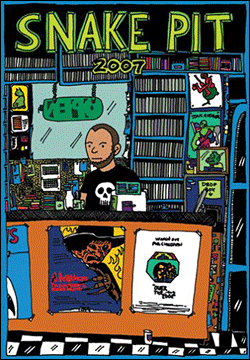
 Jacksonville Public Library’s Zine Collection is one of the first–and largest– such collections in the Southeastern United States. Librarian and collection archivist Josh Jubinsky was kind enough to talk to Biblioklept about the collection, the essence of punk, the future of zines in an increasingly technologically-mediated world, and the million-fart bill. We corresponded via email, although we could have done the interview in person easily–in full disclosure, I should mention that Josh lives down the street from Biblioklept World Headquarters.
 JJ: One that I really enjoyed and I wish I saw more of is A La Maison. It’s a french zine, written in English though. It’s a guide to the city of Lyon, France by some people who live there. Definitely a punk perspective on the city, maybe like a punk travel guide. It goes through the city section by section with what bars, falafel places and record stores are best. And it comes with a CDR of all these bands from Lyon. It’s amazing. The people who put out the zine set up a show for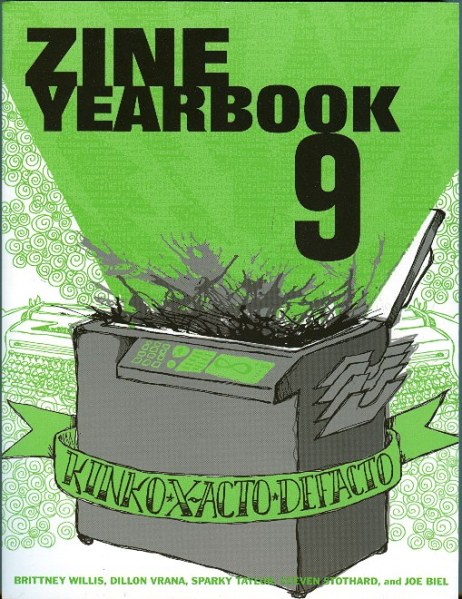
 JJ: Maybe this sounds like an overused reason for me (since it’s the same main reason I give when people ask why I have records), but, essentially that zines are tangible. Personally, that tangibility helps me remember them. I can barely tell you what I read online yesterday, but I can tell you about the book or zine I’m reading. You can bring zines along when you go on a tour or go fishing or go to the bathroom or sit in the park – and you don’t have to have an expensive device you must charge to read them. They also exude a sense of time and place. A zine is self-contained, obviously not in literary or musical references, but you can’t get bored with it and click to an updated version. You can’t add it to your blog reader. Like a record, it’s not convenient. It’s romantic. You aren’t jogging while listening to an audio book – you aren’t trying to maximize productivity. You sit, enjoy and get fresh air at the same time.
 Biblioklept