Take Vladimir Nabokov’s “Good Reader” Quiz

One evening at a remote provincial college through which I happened to be jogging on a protracted lecture tour, I suggested a little quiz—ten definitions of a reader, and from these ten the students had to choose four definitions that would combine to make a good reader. I have mislaid the list, but as far as I remember the definitions went something like this.

Select four answers to the question what should a reader be to be a good reader:

1. The reader should belong to a book club.
2. The reader should identify himself or herself with the hero or heroine.
3. The reader should concentrate on the social-economic angle.
4. The reader should prefer a story with action and dialogue to one with none.
5. The reader should have seen the book in a movie.
6. The reader should be a budding author.
7. The reader should have imagination.
8. The reader should have memory.
9. The reader should have a dictionary.
10. The reader should have some artistic sense.

The students leaned heavily on emotional identification, action, and the social-economic or historical angle. Of course, as you have guessed, the good reader is one who has imagination, memory, a dictionary, and some artistic sense–which sense I propose to develop in myself and in others whenever I have the chance.

—Vladimir Nabokov. Collected in Lectures on Literature.
Ben Marcus on David Markson’s Reader’s Block

 . . . when, for example, David Markson, an expository novelist who fired the starting gun for fictions of information and proved that pure exposition can be alarmingly moving, who purposefully tells instead of shows, is dismissed in The New York Times for failing to provide a story in his novelReader’s Block, no discussion follows about why, exactly, fiction must have one (at 150 words in the book review, how could any discussion follow?). Nor do we learn what a story might have looked like in such an exquisitely felt book that, to summarize, catalogs the various ways historical figures have hated whole races of people and/or died by their own hands. (Yes, you should read this book.)

Markson should have presumably, under the fiction-must-have-a-story criteria, zeroed in on one of his hundreds of characters and gone deep, doing that good old-time psychological work, the person-making stuff, dramatizing how such an interesting fellow had gone on to hate Jews and/or kill himself. Markson should have used more words like “then.” He should have sequenced. He seems to have forgotten that literature is supposedly a time-based art.

Markson’s amnesia is one of the happy accidents of the last decade of fiction writing. By eschewing a fetishistic, conventional interest in character, or a dutiful allegiance to moment creation, to occurrence itself, Markson accomplishes what a story, slogging through time and obedient to momentum, arguably could not: a commanding, obsessive portrait of single behaviors throughout history, a catalog of atrocity that overwhelms through relentless example. In truth, it’s a novel that can be read as an essay, but unlike most essays, it’s lyrically shrewd, poetry in the form of history, and it’s brave enough to provide creepy, gaping holes where we normally might encounter context (the burden of the conventional essayist).

From Ben Marcus’s essay “The Genre Artist,” published in a 2003 issue of The Believer.

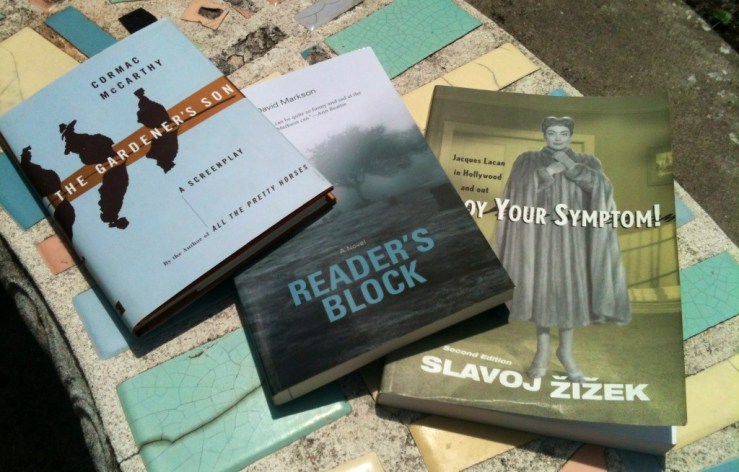
David Markson, Cormac McCarthy, Slavoj Žižek (Books Acquired, 5.19.2012)

20120521-122339.jpg

I ordered David Markson’s Reader’s Block from my local book shop, and intended to get it—and only it—this Saturday. Somehow I took a detour through the film section and picked up the Žižek and didn’t put it back; in the same section I also picked up McCarthy’s screenplay The Gardener’s Son, which is the only thing I haven’t read by him to date, so I picked it up too. So there you go.