I saw The Tree of Life four times in the theater this year. Few things made me happier than those experiences of sitting and soaking up that movie. Conversely, few things this year were as frustrating and draining as all the conversations I inevitably found myself in after the movie, where some asshole put me on the spot, demanding that, since I loved it, I was supposed to explain it to him or even somehow make him not hate it, or at least justify myself, as though I am a paid museum tour guide who must explain the importance of the Mona Lisa at the drop of a hat. But because I’m a sucker, and easily convinced to talk, I almost always took the bait and would stand there, in whatever bar or party and spend far longer than said asshole had really intended, earnestly trying to convey my personal enjoyment of this movie. It was all pretty useless in retrospect. I guess I can’t always know everyone’s intentions, but I’ll guess nine of ten times it was more like a worthless political discussion, as though someone walked up to me and said “I’ve voted Democrat for ten years, convince me to vote Republican in the next ten minutes.”
I’m winding up to something here.
So basically I saw the movie four times and talked about it for god knows how long, thought about it for at least twice that length, and I honestly do think I have come across a few things: call them “ideas” or “perspectives” that I actually think can help make the movie more enjoyable, or possibly more coherent, or something.
At the risk of sounds incredibly defensive (can you tell I’ve been in yelling matches about this already?) I will preface all of this by saying that obviously it is only my opinion. Terrence Malick has done us all a huge favor by completely staying out of the conversation about this or any of his films. I think this is a favor because it allows me to have my opinions without there being any definitive source out there to contradict it. The movie is only what is up there on screen and all my thoughts about it are basically derived only by the amount of time spent actually watching it. So I do not intend to speak for Terry or presume to know what he would say if I could ask him to verify all of my ideas or whatever. You get the point.
And there will be spoilers . . . I guess. Can you actually spoil this movie? Does anyone give a shit at this point? There are dinosaurs—oops! Sorry. Spoiled that Big Surprise. Anyhow, yeah I will be talking about key details from the plot, so be prepared for that.
The quickest, easiest thing I can tell you I learned about The Tree of Life by watching as many times as I did is that there is a simpler more coherent synopsis one could give the film that would sort of situate the story in a different way for most viewers. Just as a reference this is the official synopsis (from Apple trailers):
From Terrence Malick, the acclaimed director of such classic films as Badlands, Days of Heaven and The Thin Red Line, The Tree of Life is the impressionistic story of a Midwestern family in the 1950’s. The film follows the life journey of the eldest son, Jack, through the innocence of childhood to his disillusioned adult years as he tries to reconcile a complicated relationship with his father (Brad Pitt). Jack (played as an adult by Sean Penn) finds himself a lost soul in the modern world, seeking answers to the origins and meaning of life while questioning the existence of faith. Through Malick’s signature imagery, we see how both brute nature and spiritual grace shape not only our lives as individuals and families, but all life.
This sounds fine and all, if a little intimidating. If you saw the movie I imagine you saw all of that stuff in there. It was certainly “impressionistic” enough and I agree that Brad Pitt played the father. But in terms of setting up the viewer for the “story” I’m not sure this is as fast as it could be and it’s certainly not going to fend off any accusations of “pretension.”
Instead, try this one out:
“On the anniversary of his brother’s tragic death a man goes about his day flooded with memories of his childhood and thoughts about mortality and the afterlife.”
The images and characters in The Tree of Life exist simultaneously as both literal and symbolic elements in a complex narrative, and I’m not saying that the movie should be boiled down to something as simple as my one-sentence summary above—only that it can be. And that for all the people that so excessively badgered me about this movie “Not having a story,” here it is:
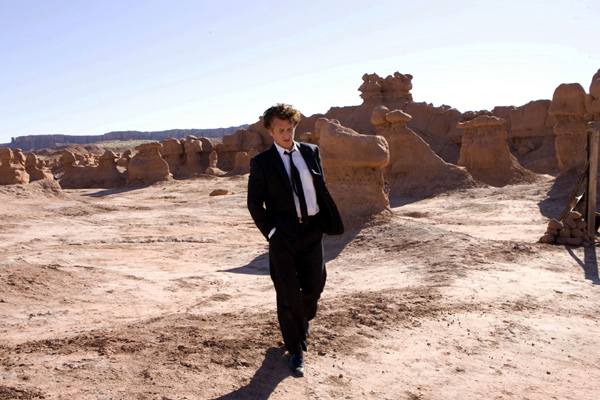
Jack (Sean Penn) wakes up. It’s a shitty day, the shittiest day of his whole year, every year: it’s the day his brother died (substitute this for: the day they found out he died, or for his brother’s birthday. The movie is obviously unclear and any of them could work). It’s been nearly twenty years since that tragic death but it hasn’t gotten any easier. His wife knows what day it is too and even though they’ve been having their problems recently, she can tell she should back off today and give him his space. So they spend that morning sort of avoiding each other, neither sure what to say and eventually Jack sits down to do the only overtly emotional action he ever brings himself to do on this day: he lights a candle in memory.
So he heads to work that morning with the weight of all this on his mind; it’s his own personal 9/11, the biggest single event that helped shaped his life. He loved his brother but their relationship was complicated. And Jack has a good memory. As the oldest of three boys Jack can remember what it was like to be the the sole recipient of his mother’s love. He experiences flashes of the conflicting happiness and subsequent jealousy after the birth of his first brother, and now, as an adult man with his own life and his own problems and his own job, that memory makes him feel like an asshole.
He’s an architect at a major firm in Dallas and they just landed a big city contract to redesign the public transportation system or something and Jack is in charge of the whole thing. In fact, he’s got a lot of important meetings coming up and plenty to think about that doesn’t involve reliving the past. Because who wants to be dealing with fifty years of history when you’ve got work to do? Never mind your coworkers rattling on about their problems and the general chaos of the office, with so much going on it’s a wonder he can get anything done.
A little while later he’s about to head into an important meeting when his phone rings. If all the rest of it weren’t enough now here’s this: The Call. The one he gets every year on this day, the Low Point: His Father. The guy is pushing 80 at this point, living in that huge house there on the coast with plenty of money from the patents he eventually sold, eating at the country club with the rest of his pompous old friends but on this one day you’d think he was a monk wearing burlap and whipping himself. What does he get out of this? Every year he calls and every he says the same line,
“Do you know what day this is?”
“Yeah dad I know what day this is.”
“He was a good boy.”
“Yeah dad he was great.”
“Playing Bach on the guitar when he was eight years old, don’t see that everyday.”
“No I guess not.”
And on and on and on . . . why can’t he just focus on the good things he’s had in life? The guy has had a long career, a beautiful loving wife, and hell, it’s like he doesn’t have two sons still living! Christ, look at me? Am I not good enough? Look at everything I’ve done in life, everything I’ve accomplished, and yet if I had died at 19 would he mourn this much for me?

But in the meantime he has a meeting with the senior partners. He’s trying to be polite with his dad, and sensitive to the man’s pain but business is business. So he cuts him a little short.
“Dad I really want to talk to you but I really have to go.”
“Oh I see this isn’t important to you.”
“No dad it is, but I’ve got to go in a meeting right now.”
The secretary walks up to him and tells him that they are all waiting for him inside.
“Listen dad I gotta go.”
And there, he hangs up on him and goes into the meeting. Of course his mind is elsewhere. Like usual, talking to his dad has brought out all the worst thoughts in him. Even though in his daily life Jack tends to affect a calm, peaceful demeanor, talking to his father brings up some of the darker thoughts in his mind. He remembers all the pain and confusion of his childhood, the soaring emotions and chaos and frustration, the simultaneous guilt and innocence that everybody must feel at that age, right? I’m not alone right? I’m not the only one who thought about killing his father, I’m not the only one who hurt his brother on purpose, I’m not the only one who said horrible things to his mother, or who stole, or who lied . . .
So Jack sleepwalks through the rest of the day. He’s on autopilot, but for the most part his coworkers can’t even tell. Jack’s good at this; he’s had practice being a human. He’s learned to control the volatile emotions of his youth, the reactionary side of him; the side he associates with his father has been muted in his adulthood and he chooses every day to try to be more like his mother, to keep things to himself and attempt to be kind to people. Which is why for all his anger and frustration, as much as he doesn’t want to go there again, he calls his dad back and apologizes for his earlier behavior. He sucks it all up and takes a little more of the old man’s trademark passive-aggressive bullshit. “This guy never changes” Jack thinks to himself. But despite everything Jack loves his father and knows that in his own stubborn way his father loves him. So they say this to one another over the phone, they reconcile for now, as they’ve done so many times before, son forgiving father, father forgiving son.

And with what’s left of his day Jack thinks about all of this: about forgiveness, about redemption, about pain and suffering. About how he isn’t even unique in any of this, how he can spend his entire day completely consumed in himself and his own pain—but isn’t he just one person? Doesn’t everybody have this same experience every day in some way? Sure, this may be the anniversary of his brother’s death, but what significant day is it to any one of the other six billion people on this earth?
The entire planet had to be formed and every living organism had to evolve and change and grow over millions and millions of years to create the perfect set of circumstances that would put Jack in this very moment—but that’s true of everybody, any body. And somewhere in all of this there’s hope.
And just like that, it’s six o’clock. Where did all the time go? Jack steps out into the world again, in the middle the swirling chaos of life and is amazed by everything that can happen in a day, even if it’s all internal—and is there really any difference between the internal world and the external one anyway?
* * *
Wow, what a non-story that was. I can’t believe those characters were so one-dimensional. Sean Penn’s inclusion in the movie really was pointless, wasn’t it? Wouldn’t you rather have had his role cut out entirely? None of those images really fit together in any meaningful way did they? I mean each taken on its own may be pretty and all, but I for one would prefer it if the film coalesced into something more grounded and specific. Like I said before, I like stories in my movies, I don’t want just a random sequence of images.
Okay, obviously I am being a sarcastic asshole in that paragraph. But if you happened to be one of the people who said one of those sentences to me I hope that looking at the film through the perspective I outlined might aid you in getting over some of your issues.
Of course that is assuming you even want to get over your issues. Maybe you would rather persist in using this beautiful film as a punching bag for the rest of your life. I guess I can’t stop you there. But if you want to argue with me and tell me that my version of the movie is not what was up on-screen when you saw it, I will tell you that I didn’t see this version of the The Tree of Life the first time I saw it either. I didn’t quite see my version of it the second time, but by the time I finished it for the fourth time I swear to goodness that the “story” I told you above is exactly the “story” I saw and still do see in this film. And unlike some bullshit Christopher Nolan DVD special feature that “unlocks all the secrets of the film” I have no “objective” source to tell me I’m right or wrong—mine is only an interpretation, but I think it’s one that the film can support and certainly one that answers a lot of the criticism.
As a film-goer, I am more than happy to watch a random sequence of beautiful images (seeing Baraka projected in 70mm remains a favorite viewing experience for me). When I saw The Tree of Life the first time I was absolutely ecstatic with my experience and needed nothing more from the movie than what I got. It is no exaggeration to say that I could have watched a two-hour version of the creation of the universe section, with no dialogue or characters and still have been happy and moved. I don’t give two shits if there is a “story” in The Tree of Life. Which is partly why my early arguments about the film were so fruitless, imagine this conversation over and over:
Them: Why did you love the movie?
Me: Because it was beautiful.
Them: But it had no story.
Me: Maybe you’e right but I didn’t need one.
Them: But if it doesn’t have a story, then it must be a bad movie.
Me: I disagree with you. I thought it was great.
Them: Well I disagree with you because I hated it.
And because of these arguments, I was more surprised than anybody when I found my version of the “story.” It was something that occurred naturally, and I guess I want to stress again that I still think the movie supports layers of meaning, but when I think about the movie now it is almost entirely in these terms. The film doesn’t even seem abstract to me at this point. It’s kind of like Mulholland Dr. in that way, (although I think David Lynch did that film specifically as a mystery to be solved) where, once I figured out how the film works, I never quite see it as the random, crazy, seemingly unconnected series of scenes it appeared to be upon first viewing, (even though in the case of Mulholland Dr. as well, I was totally fine with that).
In some way I kind of resent that it all comes together so easily. I kind of like an endless montage of beautiful images with no story, (although hell even Koyannisqatsi and Baraka seem to each have a thesis; it’s not like the director grabbed clips with his eyes closed). There is a larger, more complex discussion to be had here about the human brain and pattern recognition and our basic, innate desire for Order instead of Chaos and how our brains will basically create order, even where there seems to be none, just basically so that we don’t go crazy.
Which when you think about it is sort of what my version of The Tree of Life is all about anyway. It’s just a day in the life of this one guy, and his desperately trying to come to terms with the chaos of his mind, to give it a structure and an emotional arc, some kind of resolution, if only to just get through it all.
And I do think we all do this. I think every day of our lives is more like The Tree of Life than it is to The Dark Knight. When your life appears to you as a fragmented mess of images and memories and music and sadness and glory and guilt and love, you just deal with it—what the hell else are you going to do? Like Jack, you get through your day and move on. But when you are confronted with that same chaos in the form of a movie, you have the freedom to just throw it away, toss it out of hand and never think twice about it. But allow me to suggest in all humility that there is more to enjoy in The Tree of Life in subsequent viewings. Maybe you can find a different story than I did. Maybe even a better one.

 It’s sort of like those kids who had pet monkeys when you were in elementary school, always someone’s cousin, or their neighbor’s friend from another school; sometimes the story was accompanied by a thumbprint-smudged Polaroid of the creature, clutching lovingly to some human torso. But did you ever actually see it? No never. Not once. And anyone who says they did is part of the conspiracy. Sure, maybe somewhere in Mexico someone has a monkey for a pet, but not here, no way, and certainly not your cousin. And look, I agree that it’s a weird thing to lie about, but that’s part of what makes good liars good, it’s some sort of weird emotional long-con that you are complicit in by listening to them.
 So, I’m thinking this thing goes deep, deeper than any of us ever imagined. Obviously Dave Eggers is involved somehow, either as the mastermind behind the whole thing, or just another pawn like the rest of us. I emailed Mr. Heartbreaking Jerk himself, asking if even he of all people can claim to have actually read all of Rising Up and Rising Down, and in return I received an auto-reply, something about the volume of emails he receives blah blah blah—the point is I think I scared him, and now I know I’m on the right trail . . .