“Smite early and often” (Another Riff on Thomas Pynchon’s Against the Day)

rb
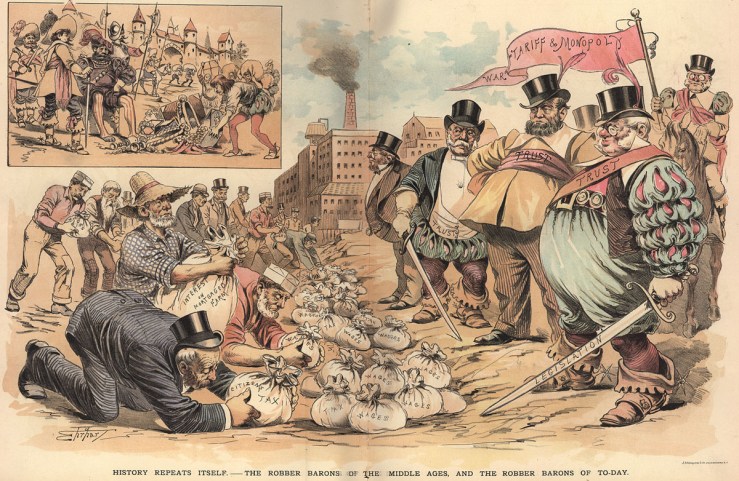
Image by Samuel Ehrhardt, 1889

1. The passage I’ll be riffing on today is hardly the funniest or most dazzling piece of writing I’ve encountered so far in Thomas Pynchon’s massive, shaggy novel Against the Day. However, I think this stretch of writing neatly and concisely illustrates the perspective (maybe world view is a better term; hell, we could even go with fancy-pants Weltanschauung here) of who I take to be the novel’s most prominent villain, ruthless robber baron Scarsdale Vibe.

More significantly, I think this passage illustrates the ways that Pynchon’s big novel analyzes American history and illuminates the contemporary American zeitgeist.

2. The block quote citations are continuous, although I’ll be interrupting. The passage starts at the very bottom of page 331 and goes through 334 in my hardback Penguin first edition.

3. Okay, so a bit of context:

Our scene is mostly a dialogue, or a monologue really, between Scarsdale Vibe and his Other, Foley Walker, who took Scarsdale’s place in the Civil War, took a bullet to the brain, and now, like so many of the characters in Against the Day, has special powers (he can hear voices that tell him how to invest (Scarsdale’s) money in the market).

Back at Pearl Street, the two Vibes were sitting over brandy and cigars.

“A tough one to figure, that kid,” Foley opined. “Sure hope we ain’t got another Red in the root cellar like his old man.”

The “kid” here is hero Kit Traverse, and his old man — the “Red in the root cellar” — is the recently-deceased-on-Scarsdale’s-orders Webb Traverse, the Kieselguhr Kid, enemy of the captains of industry.

Scarsdale is backing Kit in the hopes that he’ll become “the next Edison” — and not, significantly, the next Tesla.

5. (Tesla v. Edison—another set of doubles in the book.

Tesla, Serbian-American, mad magician, prophet of science, seer of the invisible, wants to provide free power for all is clearly allied (in Pynchon’s book, that is) with the unions, the Traverses, labor—the good guys.

His double, Edison: American-American, reputed idea-thief, dog-electrocuter; Edison, a hustler who sweated out idea after idea, perhaps gracelessly; Edison, whose methods and inventions could generate corporate profits.

Tesla remarked of Edison, after his death: “he had a veritable contempt for book learning and mathematical knowledge, trusting himself entirely to his inventor’s instinct and practical American sense”).

6. Note that Scarsdale wouldn’t hesitate to kill Kit:

“Our duty would be no less clear. There are hundreds of these abscesses suppurating in the body of our Republic,” an oratorical throb creeping into Scarsdale’s voice, “which must be removed, wherever they are found. No other option. The elder Traverse’s sins are documented—once they were brought to light, he was as good as lost. Should there be moral reservations, in a class war, about targeting one’s enemies? You have been in this game long enough to appreciate how mighty are the wings we shelter beneath. How immune we are kept to the efforts of these muckraking Reds to soil our names. Unless—Walker, have I missed something? you aren’t developing a soft spot.”

As Scarsdale’s was not the only voice Foley had to attend to, he erred, as usual, on the side of mollification. He held out his glowing Havana. “If you can find a soft spot, use it to put this out on.”

“What happened to us, Foley? We used to be such splendid fellows.”

“Passage of Time, but what’s a man to do?”

“Too easy. Doesn’t account for this strange fury I feel in my heart, this desire to kill off every damned socialist and so on leftward, without any more mercy than I’d show a deadly microbe.”

“Sounds reasonable to me. Not like that we haven’t bloodied up our hands already here.” Scarsdale gazed out his window at a cityscape once fair but with the years grown more and more infested with shortcomings. “I wanted so to believe. Even knowing my own seed was cursed, I wanted the eugenics argument to be faulty somehow. At the same time I coveted the bloodline of my enemy, which I fancied uncontaminated, I wanted that promise, promise unlimited.”

Foley pretended his narrowing of gaze was owing to cigarsmoke. “Mighty Christian attitude,” he commented at last, in a tone as level as he could make it.

Here we see Scarsdale’s hatred of organized labor, of anything that impedes on his profits, get tangled into the ideology that underwrites this conflict. He even cites the conflict as “a class war.”  This class war interweaves into his personal life: he is usurping the coveted “bloodline of my enemy” by attempting to adopt Kit.

7. The scene then takes on a religious dimension, exploring a “Mighty Christian attitude”:

“Foley, I’m as impatient with religious talk as the next sinner. But what a burden it is to be told to love them, while knowing that they are the Antichrist itself, and that our only salvation is to deal with them as we ought.”

Pynchon’s villain here sounds like so many figures on the contemporary American Evangelical right, who repeatedly conflate their political/cultural enemies with “Antichrist” as a means to avoid the Jesusian imperative to love the Other.

8. Remember, wealthy Scarsdale—his father, really—was able to buy a deferment from the Civil War; Foley took his place:

It did not help Foley’s present mood that he had awakened that morning from a recurring nightmare of the Civil War. The engagement was confined to an area no bigger than an athletic field, though uncountable thousands of men had somehow been concentrated there. All was brown, gray, smoky, dark. A lengthy exchange of artillery had begun, from emplacements far beyond the shadowy edges of the little field. He had felt oppressed by the imminence of doom, of some suicidal commitment of infantry which no one would escape. A pile of explosives nearby, a tall, rickety wood crib of shells and other ammunition began to smolder, about to catch fire and blow up at any moment, a clear target for the cannonballs of the other side, which continued to come in, humming terribly, without pause. . . .

Foley has actually fought and been wounded and risked. He’s literally put skin in the game.

In contrast, Scarsdale Vibe was able to continue amassing and controlling wealth—just like other robber barons who bought deferments and then profited from the war (Andrew Carnegie, J.D. Rockefeller, and Jay Gould, just to name a few).

(Hey, can you think of any wealthy American men in contemporary times who avoided serving in a war but made ludicrous sums as war profiteers?)

9. Note how Scarsdale, claiming “My civil war has yet to come,” pitches the conflict between capital and labor in terms of a holy war:

“I didn’t have my war then,” Scarsdale had been saying. “Just as well. I was too young to appreciate what was at stake anyway. My civil war was yet to come. And here we are in it now, in the thick, no end in sight. The Invasion of Chicago, the battles of Homestead, the Coeur d’Alene, the San Juans. These communards speak a garble of foreign tongues, their armies are the damnable labor syndicates, their artillery is dynamite, they assassinate our great men and bomb our cities, and their aim is to despoil us of our hard-won goods, to divide and subdivide among their hordes our lands and our houses, to pull us down, our lives, all we love, until they become as demeaned and soiled as their own. О Christ, Who hast told us to love them, what test of the spirit is this, what darkness hath been cast over our understanding, that we can no longer recognize the hand of the Evil One?

Note the xenophobia here, the fear that the dark Other with their “garble of foreign tongues” will try “to pull us down, our lives, all we love.” Good thing this poor rich captain of industry will fight for Real America!

10. Scarsdale, weary from carrying his White Man’s Burden:

“I am so tired, Foley, I have struggled too long in these thankless waters, I am as an unconvoyed vessel alone in a tempest that will not, will never abate. The future belongs to the Asiatic masses, the pan-Slavic brutes, even, God help us, the black seething spawn of Africa interminable. We cannot hold. Before these tides we must go under. Where is our Christ, our Lamb? the Promise?”

Seeing his distress, Foley meant only to comfort. “In our prayers—”

“Foley, spare me that, what we need to do is start killing them in significant numbers, for nothing else has worked. All this pretending—’equality,’ ‘negotiation’—it’s been such a cruel farce, cruel to both sides. When the Lord’s people are in danger, you know what he requires.”

“Smite.”

“Smite early and often.”

And there it is: The ideological veneer of demagoguery quickly gives way to the violent impulses seething underneath. Scarsdale’s Real America has no place for equality and negotiation. Just smiting.

11. And then quoth Foley:

“Hope there’s nobody listening in on this.”

I can’t help but read this as a joke, an echo (pre-echo?) of Nixonian paranoia. The direct recognition that there is a gap between intention at the core and the way that intention is represented (hidden) on the surface (in language, in gesture).

12. But Scarsdale is unafraid:

“God is listening. As to men, I have no shame about what must be done.” A queer tension had come into his features, as if he were trying to suppress a cry of delight.

“But you, Foley, you seem kind of—almost—nervous.” Foley considered briefly. “My nerves? Cast iron.” He relit his cigar, the matchflame unshaking. “Ready for anything.”

Scarsdale’s God is the god of the white man robber baron Real American capitalist, and “God is listening” not because he is omnipresent but because he is on Scarsdale’s side.

13. Foley doesn’t quite buy this resolve:

Aware of the Other Vibe’s growing reluctance to trust reports from out in the field, Foley, who usually was out there and thought he had a good grasp on things, at first resentful and after a while alarmed, had come to see little point these days in speaking up. The headquarters in Pearl Street seemed more and more like a moated castle and Scarsdale a ruler isolated in self resonant fantasy, a light to his eyes these days that was not the same as that old, straightforward acquisitive gleam. The gleam was gone, as if Scarsdale had accumulated all the money he cared to and was now moving on in his biography to other matters, to action in the great world he thought he understood but—even Foley could see—was failing, maybe fatally, even to ask the right questions about anymore.

Foley, who actually served in war, “who usually was out there,” can see that Scarsdale can only see what he wants to see—the Other Vibe lives in “a moated castle” as a “ruler isolated in self resonant fantasy,” blinded by the lights of his xenophobic ideology, which has moved beyond mere money to pursue some other greater power.

14. Foley, so far anyway, proves an important contrast, a balance even, to Scarsdale’s zealous evil. Through his eyes we can see the effects that isolation have taken on Scarsdale, who is becoming increasingly paranoid, anxious—crazy even. Scarsdale is completely divided from the men and women who create his wealth—he doesn’t understand (let alone empathize with) the average American—yet he sees himself as the God-appointed, self-created savior of America (an America with no place for equality or negotiation). The ways in which this passage diagnoses certain attitudes in contemporary American politics/big-business strikes me as so transparent that I won’t remark on them at further length. Pynchon’s novel documents the tail-end of the Gilded Age through the end of the Great War, showing us that the conflicts of the past are the conflicts of today—and tomorrow. 

Pleasure and Sorrow in Álvaro Mutis’s Novella The Tramp Steamer’s Last Port of Call

The Tramp Steamer — Edward Hopper

1. Biblioklept has already published a review of Álvaro Mutis’s collection of novellas, The Adventures and Misadventures of Maqroll. I didn’t write that review—my friend Dave Cianci did—but the review prompted me to read the book—or rather, to read Maqroll: Three Novellas, which I found used, wrote about here, and passed on to a friend before getting the NYRB edition with all seven novellas.

2. So I read The Tramp Steamer’s Last Port of Call last week. At 66 pages (in a tiny font), it’s the shortest novella in the book. It’s also the first story where we don’t really get an adventure or misadventure of Maqroll, who more or less sits this one out. Instead, an unnamed narrator—a writer of mundane tracts but also poems—tells the story. And of course, because this is Mutis, there is a second storyteller embedded in this tale, a Basque sailor, captain of the titular steamer. The shifting, labyrinthine connections between the steamer, the narrator, the Basque sailor, and a Lebanese woman named Warda frame the plot of The Tramp Steamer’s Last Port of Call.

3. Even though Maqroll the Gaviero is on the margins of this tale, the text resonates with his weary, picaresque spirit. And even though his name doesn’t even appear until the novella’s second half, we nevertheless get one of the more lucid descriptions of our anti-hero thus far in the collection:

The other man, whose name he never understood clearly but who was also called Gaviero, was treated by Bashur with unreserved familiarity and listened to with the greatest attention in matters relating to commercial shipping and the operation of freighters in the most remote corners of the world. The Basque could not determine if Gaviero was a nickname, a surname, or simply a designation left over from the time he was a lookout in his youth. A man of few words, with a rather odd, corrosive sense of humor, he was extremely attentive and sensitive in his friendships, knowledgeable about the most unexpected professions, and, while not a womanize, very conscious of, one might say dependent on, a feminine presence.

4. As fate—and fate is the major theme of The Tramp Steamer’s Last Port of Call (and maybe all of Maqroll, and maybe all of Latin American literature, and maybe all of literature, but specifically the major theme of The Tramp Steamer’s Last Port of Call, which organizes itself around the interconnections between its narrator and the Basque captain)—as fate would have it, the narrator knows the Gaviero,

an old friend whose confidences and tales I have been collecting for many years, considering them of some interest to those who enjoy hearing about the unusual, contrary lives of people who do not follow the common path of gray routine in an age of mindless conformity.

(The above citation is, of course, a wonderful metatextual review of Mutis’s big book).

The narrator doesn’t reveal that he knows the Gaviero though; he doesn’t wish to pollute the Basque captain’s story.

5. Back to fate and chance for a moment: “Chance is always suspect, and much that is fraudulent imitates it.” This might be the thesis statement of The Tramp Steamer’s Last Port of Call. Maybe.

6. The Tramp Steamer’s Last Port of Call, much like the novellas that precede it, is very much a study of heterogeneity, depicting of a world of shifting identities and ever-changing motivations and outcomes. Words like labyrinth, maze, and intertwine repeat in the text, whether Mutis is describing rivers or cultures or individuals. The text is larded with blends and syntheses, but I’ll grab one simple example, one of the rare times this particular novella returns to the Gaviero. Talking to the narrator, the Basque captain says:

I realized that my own provincial and national prejudices had kept me from seeing the enormous wealth of experience and the solid, warm humanity of this man, whose nationality I never learned, as I never learned the correct pronunciation of his name, which sounded vaguely Scottish but could also have been Turkish or Iranian. I found out later that he carried a Cypriot passport. But that doesn’t mean anything, because he himself hinted I should not put too much faith in its authenticity.

7. What is most authentic in the ever-shifting world Mutis depicts? I think it’s food. I can’t think of another writer who depicts scenes of gustation with such sybaritic pleasure. Mutis never neglects to describe a meal, even on a humble tugboat:

Each tug had two cabins for passengers, who shared with the captain the food prepared by two Jamaican women whose culinary talents we never tired of celebrating. The pork in plum sauce, the rice with coconut and fried plantains, the succulent stews made of river fish, and, and indispensable and always welcome complement to the meals, the miraculously refreshing pear juice with vodka that left us splendidly disposed to enjoy the constantly changing panorama of the river and its banks; thanks to the magic of that imponderable drink, everything took place in a velvety, contented distance that we never attempted to decipher.

8. Okay, authentic might not be right word. Everything in Mutis’s novella is authentic, true even when it’s not true. I suppose I mean stable. But: Our narrator warns us that if we try to replicate the pear and vodka drink we’ll fail, like all the others who try.

9. Let me try again: What is most authentic—I realize I’ve already employed the superlative; mea culpa—what is most authentic in the world that Mutis depicts is the strange intersections of pleasure and sorrow, the way these modes intertwine the labyrinths of our lives.

The Tramp Steamer’s Last Port of Call is a beautiful, dark, sad love story.

10. I realize that I’ve failed to summarize the plot. Do you want that—a plot summary? I don’t have it in me, and someone did it way better. I’ll close with a long excerpt from John Updike’s thorough, excellent review of The Adventures and Misadventures of Maqroll (in a 2003 issue of The New Yorker):

Possibly alert to the dangers of doting on his hero, Mutis next provides a tale in which Maqroll hardly appears, except as a cherished acquaintance of the principals. In “The Tramp Steamer’s Last Port of Call,” the shortest of the lot and one of the best, the narrator relates an experience he himself has had, in a voice close to what we know of Mutis’s own life: “I had to go to Helsinki to attend a meeting of directors of internal publications for various oil companies.” In Helsinki, he asks to be driven to the point from which he can see across the Gulf of Finland to St. Petersburg, a shimmering sight passingly eclipsed by the transit of a decrepit tramp steamer:

The captain’s bridge, and the row of cabins on the deck for crew members and occasional passengers, had been painted white a long time before. Now a coat of grime, oil, and urine gave them an indefinite color, the color of misery, of irreparable decadence, of desperate, incessant use. The chimerical freighter slipped through the water to the agonized gasp of its machinery and the irregular rhythm of driving rods that threatened at any moment to fall silent forever.

He sees the wretched, plucky ship, which fragmentary letters on its bow identify as the Halcyon, three more times—in Costa Rica, in Jamaica, and in the delta of the Orinoco River. Its apparition invades his dreams. While on another errand for the oil company, travelling downriver to a strike-threatened seaport refinery, he occupies one of the two cabins in a small tugboat; the other is occupied by a Basque sea captain called Jon Iturri, who, it turns out, was the captain of the ghostly tramp steamer, which broke up and sank in the Orinoco. Its owner, Iturri relates, was a Lebanese woman, a younger sister of Abdul Bashur, named Warda. At their first meeting, he says, he was stunned by her “almost Hellenic” beauty:

“Her blue-black hair was as dense as honey and fell to shoulders as straight as those of the kouros in the Athens Museum. Her narrow hips, curving gently into long, somewhat full legs, recalled statues of Venus in the Vatican Museum and gave her erect body a definitive femininity that immediately dispelled a certain boyish air. Large, firm breasts completed the effect of her hips.”

As he got to know her better, his admiration intensified: “Warda, when she was naked, acquired a kind of aura that emanated from the perfection of her body, the texture of her moist, elastic skin, and that face: seen from above, when we were in bed, it took on even more of the qualities of a Delphic vision.” But the lovestruck captain was fifty, and a non-Muslim, and Warda was twenty-four and, the longer she lived in Europe, ever more approving of the conservative ways of her native Lebanon. The tramp steamer, which she inherited from an uncle, was financing her European sojourn with its hard-won profits; she flew to Iturri’s ports of call and spent rapturous days in hotels with him, but their romance could last only as long as the fragile tramp steamer did. Warda’s perfect, elastic, symmetrical beauty was one with the listing, disintegrating body of the ship as it conveyed her aging lover from port to port. The story, Mutis tells us at the outset, “has something of the eternal legends that have bewitched us over the centuries”; he ends by assuring us that “there has been only one love story since the beginning of time.” Not a happy one.

Riff on Goya’s Painting Highwaymen Attacking a Coach

highwaymen-attacking-a-coach-1787

1. Francisco Goya’s Asalto de ladrones — Highwaymen Attacking a Coach in Ingles, 1786-87. Oil on canvas. 169 by 127 cm. Currently in some lucky soul’s private collection.

2. I love this painting.

3. It’s easy—and probably correct—to call Goya’s work dark. We can see that in his engraving series The Disasters of War and Caprichos, or his famous works Third of May 1808 or Saturn Devouring His Son. And the darkness, the heaviness, in these works, isn’t just in the subject but also on the canvas, in the grooves of the etchings. The blacks and browns blister; the acid goes to work.

4. It would be wholly wrong to suggest that Goya only painted the dark—but even his most joyful paintings, like Playing at Giants or The Swing contain a dark kernel. (Or, perhaps, maybe I find that kernel there, suggested by his oeuvre).

5. The blue skies of Playing at Giants and The Swing both pale in comparison to the top third of Highwaymen Attacking a Coach.

1

That beautiful bright blue sky is somehow the darkest aspect of this very dark painting, a terrible, terrible joke, an ironic reminder of glorious nature’s inglorious indifference to misery, suffering, murder, rape.

6. Moving down—the tree: long, twisting, phallically jutting into the blue sky. It seems to crookedly shift in the wind. Softly echoed by those happy little clouds it takes us down to the vernal forest floor, where we seem to be just-off-the-beaten-path.

2

7. I’ll admit to a certain fascination with the concept of highway robbery—the perils of the path, the road as a dangerous place, Barry Lyndon, Robin Hood, etc.—but what Goya gives us here is shock and horror.

8. If we continue to move our eyes down from that blue sky, we find, just off-center, a gun-wielding usurper perched on a lovely gilded carriage, its mules patiently stalled.

3

9. Left to right: Murder victim number one, his jacket open, torn, his ribs and breast bloodied—he’s already a corpse, but his naked skin suggests something even more sinister.

4

10. Just beside victim number one, a passenger fights for his life against a bandit brandishing a knife. Their twisted, violent grappling prefigures the threat of rape that lurks under the painting.

5

11. To the right of this strange couple, another couple—aristocratic mother-father team—plead for their lives, their palms facing up to that blue sky. The man’s cloak is earth-brown, and the woman’s cape black, but between them rests—I don’t know? Some pink bundle. The hem of the woman’s dress? Something bloodied? The suggestion of infanticide?

6

12. We find their guard uselessly sprawled to the right, his worthless sword neatly parallel to the gun under the grappling couple, blood trickling from under his blood-red coat. As Robert Hughes points out in his long biography of Goya, the guard’s corpse figures “the same pose that Goya would repeat several times in future drawings and paintings to indicate a dead body, so that it became part of his shorthand for death”; Hughes goes on to remind us that this sprawl is the same one we can see of “the dead man facedown to the left of the French firing squad in the Tres de Mayo, his hands scrabbling palms-down to the earth.”

7

13. Immediately above the guard, and to the viewer’s left of him, stands his likely assassin, his chest bared and his gun (jutting from the pelvis) now confidently trained on our hapless couple.

8

14. Gunman #2 is not half so menacing though as his partner who occupies the low dark center of the painting.

9

His hat cocked ever-so-slightly to the right, this central bandit, clothed in greenish-gold garb, raises a rope in his left hand. The rope signifies every awful kind of horror the viewer cares (“cares” is not the right verb) to imagine, but it’s the action that bandit performs with his right hand that is somehow the most menacing gesture of the painting: We can almost hear him coo, “Shhhhhhhh…”

15. And our poor victims? Their hands up, in supplication, what do they have to look to? Perhaps, like the attendant viewer, they return to the sky blue sky.

z

The Chums of Chance vs The Legion of Gnomes (Citation from + Riff on Thomas Pynchon’s Against the Day)

At first the “noise” seemed no more than the ensemble of magnetoatmospheric disturbances which the boys had long grown used to, perhaps here intensified by the vastly resonant space into which they were moving ever deeper. But presently the emission began to coalesce into human timbres and rhythms—not speech so much as music, as if the twilit leagues passing below were linked by means of song.

Lindsay, who was Communications Officer, had his ear close to the Tesla device, squinting attentively, but at last withdrew, shaking his head. “Gibberish.”

“They are calling for help,” ~delared Miles, “clear as day and quite desperately, too. They claim to be under attack by a horde of hostile gnomes, and have set out red signal lamps, arranged in concentric circles.”

“There they are!” called Chick Counterfly, pointing over the starboard quarter.

“Then there is nothing to discuss,” declared Randolph St. Cosmo. “We must put down and render aid.”

They descended over a battlefield swarming with diminutive combatants wearing pointed hats and carrying what proved to be electric crossbows, from which they periodically discharged bolts of intense greenish light, intermittently revealing the scene with a morbidity like that of a guttering star.

“We cannot attack these fellows,” protested Lindsay, “for they are shorter than we, and the Rules of Engagement clearly state—”

“In an emergency, that choice lies at the Commander’s discretion,” replied Randolph.

They were soaring now close above the metallic turrets and parapets of a sort of castle, where burned the crimson lights of distress. Figures could be discerned below gazing up at the Inconvenience. Peering at them through a nightglass, Miles stood at the conning station, transfixed by the sight of a woman poised upon a high balcony. “My word, she’s lovely!” he exclaimed at last.

Their fateful decision to land would immediately embroil them in the byzantine politics of the region, and eventually they would find themselves creeping perilously close to outright violation of the Directives relating to Noninterference and Height Discrepancy, which might easily have brought an official hearing, and perhaps even disfellowshipment from the National Organization. For a detailed account of their subsequent narrow escapes from the increasingly deranged attentions of the Legion of Gnomes, the unconscionable connivings of a certain international mining cartel, the sensual wickedness pervading the royal court of Chthonica, Princess of Plutonia, and the all-but-irresistible fascination that subterranean monarch would come to exert, Circelike, upon the minds of the crew of Inconvenience (Miles, as we have seen, in particular), readers are referred to The Chums of Chance in the Bowels of the Earth—for some reason one of the less appealing of this series, letters having come in from as far away as Tunbridge Wells, England, expressing displeasure, often quite intense, with my harmless little intraterrestrial scherzo.

After their precipitate escape from the ill-disposed hordes of thickset indigenous, over another night and day, as time is reckoned on the surface, the Chums swept through the interior of the Earth and at last out her Northern portal, which they beheld as a tiny circle of brightness far ahead. As before, all remarked the diminished size of the planetary exit. It was a tricky bit of steering, as they emerged, to locate the exact spot, on the swiftly dilating luminous circumference, where they might with least expenditure of time find themselves in the vicinity of the schooner Etienne-Louis Malus, carrying the Vormance Expedition toward a fate few of its members would willingly have chosen.

1.The above citation comprises the final paragraphs of The Light Over the Ranges, the first book in Thomas Pynchon’s massive, byzantine novel Against the Day, which is perhaps too massive and too byzantine for me to approach in any way other way than the occasional riff and citation as I read it.

2. The Light Over the Ranges both begins and ends by focusing on The Chums of Chance, an intrepid band of adventurers who sail their skyship Inconvenience into every manner of trouble. The passage above—which, hey, don’t worry, there are no real spoilers there—-the passage above showcases a jocular, jaunty voice that Pynchon employs frequently throughout the book, a voice appropriate to pulp fiction, to serialized “boy’s novels,” to speculative fiction narratives, etc. The voice is somehow simultaneously engaged and detached, urging its listener to care about the heroes in peril, but also acknowledging its own formal artificiality, the flatness of its characters, their position as placeholders or checkerboard pieces in Pynchon’s big project.

3. The voice that relates the Chums of Chance episodes is wonderfully didactic, its earnest, moral tone buoying the narrative into adventure (and fun!); at the same time, everything else in the novel—its violence, its class warfare, its analysis of exploitation—-ensures that this voice is to be read and interpreted with dark irony.

4. And yet the spirit of adventure, of fun—of imagination—inheres (and not just in the episodes with the Chums).

5. The Chums of Chance: Miles Blundell, Chick Counterfly, Lindsay Noseworth,  Darby Suckling, and commander Randolph St. Cosmo. The names are Pynchonian, tautologies be damned! (They also remind me of porn aliases). I am remiss: Let me include Pugnax, a dog of discerning literary taste, his ability to read just one of many seemingly-metaphysical powers Pynchon grants his characters in Against the Day.

6. My favorite paragraph in the above citation is the penultimate one, where we find our heroes “creeping perilously close to outright violation of the Directives relating to Noninterference and Height Discrepancy” by diving into a strange underworld adventure and battling The Legion of Gnomes. Pynchon (or Pynchon’s adventure-voice, if’n ya’ll permit me) offers us a too-brief peek at “the royal court of Chthonica, Princess of Plutonia, and the all-but-irresistible fascination that subterranean monarch would come to exert, Circelike, upon the minds of the crew of Inconvenience” and then refers us to The Chums of Chance in the Bowels of the Earth, a book we cannot read because it doesn’t exist.

7. But what am I saying? Of course The Chums of Chance in the Bowels of the Earth exists!—we just have to imagine it.

A Short Riff on Shane Carruth’s Film Upstream Color

tumblr_mii1iuUhjR1qzdglao1_500

1. I managed to avoid reading anything about Shane Carruth’s new film Upstream Color before I saw it.

I just knew that this was the guy who did Primer, this was his new film, and I wanted to see it because Primer was so strange and engaging.

2. Two immediate responses after viewing Upstream Color:

i). The desire to see Upstream Color again and

ii). The desire to read what other people thought about Upstream Color.

3. (My wife and I, reading the credits, pausing the credits, reassessing the film against the backdrop of the credits, arguing about the film, discussing the film, etc.).

4. I think it’s better that if you have any interest at all in Upstream Color that you just see it cold [update/warning: the comments section of this post is full of spoilers]. But I know that 100 minutes is an investment of time, so maybe you’d like some kind of précis or at least description. So, a loose attempt, which surely will devolve into fragments and references:

Upstream Color is a sci-film, sort of.

Or maybe its a mystery film about ethics and biology.

Maybe a nature film, sort of.

Henry David Thoreau’s Walden.

Worms—parasites.

Theft.

Pigs.

Shades of Philip K. Dick, David Cronenberg, Terence Malick, but also something utterly original.

Mind control.

Trauma.

Ambient music.

Orchids.

Sampling nature.

Memory.

Swimming.

Drowning.

Creation: knitting, paper chains, music, seeds, life, children, etc.

A film that can and should be described as poetic.

It’s a love story, too.

5. It occurs to me that there’s a trailer for the film. I haven’t seen it yet. Should we watch it?

6. Does that do it for you? I don’t know how to do this anymore. Recommend things. I don’t know, the trailer makes the film perhaps look more pretentious than it is. It isn’t pretentious. It isn’t even confusing—just perplexing, haunting, troubling.

7. (Wanted: Quinoa Valley Record Co., complete discography).

8. My take on Upstream Color, spoiler-free, supporting-detail-free:

The film is about agency, about drive, about how the characters (and, implicitly, us, we, the audience, who identify with the characters on the screen) may be driven by something beyond us, something controlling us like a parasite (internal) or from afar like a ventriloquist (external). That even when we do assert agency the effect, the fallout, the shape lays beyond us, upstream.

9. (This morning, my wife telling me about her dream, a nightmare that our young daughter had ingested hallucinogenic mushrooms, clearly a response to the film).

10. I haven’t done a good job of really saying anything about the film. So, lazily:

I think Caleb Crain provides a perceptive and persuasive reading of the film in his essay “The Thoreau Poison.” He reads the film through the American transcendentalists, particularly Thoreau, of course, but also Emerson and Hawthorne. 

There’s also a piece at Slate by Forrest Wickman that perhaps over-explicates but nonetheless offers perspective, including elements of Carruth’s own take.

11. (I will avoid Carruth’s explanation of the film until I’ve seen it a second time. Maybe I’ll avoid his explanation forever).

12. A take on Upstream Color that I don’t quite buy into (the take is my own): The film perhaps invites us to find metaphysical entities in two of its secondary characters, both of whom exert influence (creative and destructive) over the primary characters. Something something godlike, something something devillike.

I like that the film offers this simple duality and then crushes it, shows something far more complicated, suggests a cycle far more strange.

13. (White orchid. Blue orchid. Yellow orchid).

14. Upstream Color features minimal dialogue and nothing approaching traditional exposition, but we still learn about its characters, come to feel for them, feel their desires and traumas. The film is cerebral and philosophical, but it’s also emotional, offering an aesthetic that sublimely overwhelms the viewer.

15. Carruth wrote, produced, directed, scored, photographed, cast and starred in Upstream Color. (I’m sure he did a lot of other stuff too). He also distributed the film himself. The entire filmmaking process was untouched by the Hollywood system. There’s so much hope for film as an art form in this knowledge.

16. Parting thoughts: See Upstream Color. Resist imposing whatever film grammar you usually bring with you to the movies. Resist the temptation to see the film as a puzzle to figure out. See Upstream Color.

Something on Georges Perec’s La Boutique Obscure

georges-perec-la-boutique-obscure-124-dreams

1. Listening to someone’s dreams is usually pretty boring. Reading about someone’s dreams is even worse.

Except when it’s not, of course.

2. Perec, describing his dream journal La Boutique Obscure:

I thought I was recording the dreams
I was having; I have realized that it was
not long before I began having dreams
only in order to write them.

These dreams—overdreamed, overworked,
overwritten—what could I then
expect of them, if not to make them into
texts, a bundle of texts left as an o)ering
at the gates of that “royal road” I still
must travel with my eyes open?

3. La Boutique Obscure is new in English translation by Daniel Levin Becker, published by the good people at Melville House.

4. The dreams in La Boutique Obscure, rendered in fairly concrete prose (Perec avoids analysis), were recorded between 1968-1972.

5. I’ve been slowly reading the essays and riffs and lists collected in Perec’s Species of Spaces and Other Pieces over the past few years. There’s something wonderful about picking the book up at random and finding some little quip or note (or entire essay) that illuminates some fascinating aspect of what we might initially take to be a dull topic.

La Boutique Obscure works the same way.

6. Sample:

Capture

7. Many of the elements that we see in Dream No. 24 / “Cats” run throughout the collection: Friends, doors, streets, houses, apartments, disasters, performances, lists, etc. etc. Note also Perec’s refusal to analyze or contextualize or otherwise attempt to make meaning out of the dream.

8. My favorite pieces in the collection are the ones that convey more plot—adventures, chases, fragments of films and plays—but there’s also pleasure in Perec’s shortest pieces, which often resemble imagist poems—like “The stone bridge”:

Capture

9. A good review, a responsible review, might try to situate Perec’s dream journal against his role as Oulipo gamesmaster, or set the entries against Perec’s biography, or maybe compare it to other dream journals. Or maybe even try to tackle it as a novel, or a novelish book.

10. But I’m more interested in the aesthetic experience of reading La Boutique Obscure. The book is fun, distracting, and divergent. Perec’s refusal to interpret his dreams leaves plenty of space for the reader to make his own connection—and if need be, interpretations—but to be clear, the same banal anxieties that inform our own dreams are what Perec traces the contours of in La Boutique Obscure. The book’s greatest strength is its imagery, its evocation of place, space, movement. To fault it for lacking depth would be to entirely miss the point.

11. Reading La Boutique Obscure provides another nagging reminder that I have yet to read Life A User’s Manual.

12. Finally: Roman Muradov’s response to the book is better than any review:

tumblr_mkghmeCTMk1qzxelgo1_1280

RIP Chinua Achebe

Achebe

RIP Chinua Achebe, 1930-2013

Nigerian author Chinua Achebe died today at the age 82.

I will never forget the first time I read Things Fall Apart, Achebe’s famous novel that mixes elements of magical realism and postcolonial criticism into the story of brave, stubborn Okonkwo, a killer, an exile, a man too big for his world. I was a high school senior and the book was part of an AP Literature reading list. I found a tattered copy in my classroom library, and compelled by the cover and the book’s name (what a great name!) and the author’s name, I read it. I devoured it. I absorbed it. I read it again.

And I stole the book of course.

And then years later, a student of mine stole it from me, which is as it should be.

I used Things Fall Apart for years in the classroom, reading it aloud with my classes in the inner-city school where I taught. Few of my students were avid readers, especially the angry young boys, who often seemed to show up merely to escape the violent streets they roamed or the chaos at home. But they liked Things Fall Apart and they loved Okonkwo and they understood him, his anger, his pride, his fury. Over the years my class set experienced that special kind of attrition all well-loved books face: The books disappeared, secreted into knapsacks and lockers, loaned to students in other classes. Or they fell apart, fittingly, the spines cracked, the glue brittle and crumbling, the pages torn. This is love, of course.

Achebe was always thrust into a strange position. He had to defend writing in English, for example, and discourse about Things Fall Apart often dwells too much on the book’s final chapters, where British colonials begin systemically decimating traditional Igbo culture. It’s not that that final section isn’t important or meaningful to the book, but there’s so much more there—so much is preserved—and shared—of Igbo culture in the book’s first three quarters. (Achebe’s scathing attack on Conrad’s Heart of Darkness often overshadows his fiction).

If we’re being honest though, let’s admit that what makes Things Fall Apart a great work of literature, a strange, strong work of literature, isn’t merely its anthropological or folkloric or political values. It’s not a book we read again and again because of its allegorical values or its maddening critique of colonialism. The reason that we continue to read and reread Things Fall Apart is that it’s an excellent novel, an aesthetic achievement, a work that produces its own anxieties, that captures terror and pity and humanity. So much humanity.

I Try to Review Ben Marcus’s Novel The Flame Alphabet

Bulgarian Child Eating a Rat, Salvador Dali

1. I don’t know.

I spent most of this day—Sunday that is—swamping out my garden shed, recently rat-infested. Big wood rats, or river rats as we sometimes call them here, some of us.

This meant sterilizing the whole deal, spraying a bleach solution, wearing appropriate eye and nose and mouth protection, because getting older and having kids I now seem to care about my oh-so-important sensory organs more than I did in my twenties. This meant removing rat feces and a few dead rats. Just fucking gross, really.

I don’t know.

2. Point 1 has almost nothing to do with Ben Marcus’s novel The Flame Alphabet. It’s just that I told myself I’d finally write about it here, after finishing it a few weeks ago and all. The farther out it gets, the harder it is to write about.

3. But really, there is some kind of corollary between my rat business and The Flame Alphabet: Both were repellent experiences. Now, to be fair, the rat purging dealie was wholly repellent and in no way intriguing, whereas Marcus’s book was simultaneously attractive and repellent. The novel’s ugliness hit me hard sometimes, and the final chapters were a sludgy slog.

4. Maybe you’re just like, Hey, c’mon, cut it out with the rats, nobody came here for that, get with the program, tell us the plot:

Okay:

So, language becomes toxic. First in kids, who hold an immunity of some kind, but the toxicity spreads to all elements of language and just kills people and makes them sick &c. In this mix our (reliably unreliable) narrator Sam kinda sorta tries to protect/save/help his family, wife Claire and daughter Esther. He undertakes home experiments, his “smallwork,” and keeps up the old time religion of the forest Jews (you’ll have to read the book for clues to this mysticism; I am too exhausted from rat-swamping to further explicate).

Society falls apart, sort of. (This is one of the major maybe-problems with The Flame Alphabet: There’s this hideous apocalypse underway but there also seems to be authority somewhere, external to the narrative, a government or scientific cadre or just really a they who keep the system moving, bread baking, electricity crackling &c).

There’s our narrator’s nemesis LeBov (the name undoubtedly borrowed from William Labov, who you learned about in your linguistics classes, I’m sure).

Midway through the novel our feckless hero starts new smallwork for Labov. LeBov is my favorite character—whenever he shows up the novel is alchemically invigorated.

Other stuff happens.

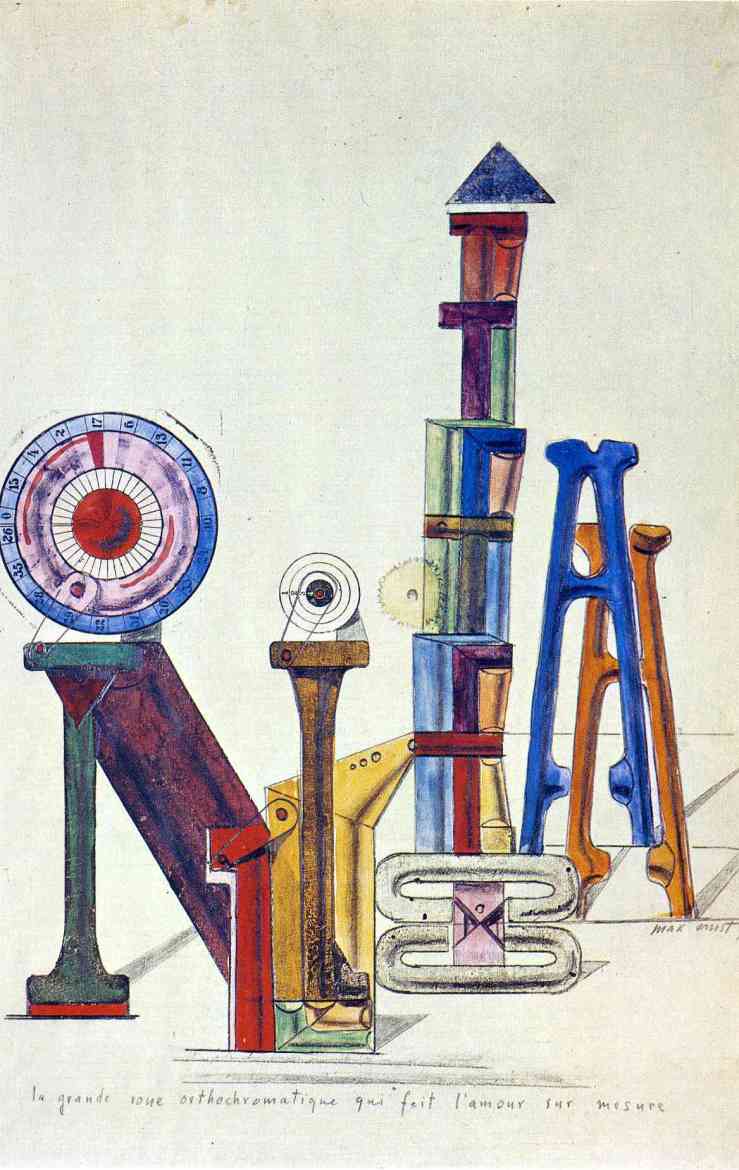
La Grande Roue Orthochromatique…, Max Ernst

5. Really though, The Flame Alphabet is an apocalypse novel, filled with mounds of salt and despair and isolation and probably madness, rarely energized by action, but hardly ponderous.

6. (Here’s a paltry criticism for me to critically make: I wish The Flame Alphabet was shorter. Like significantly shorter. Maybe a novella. Maybe a long short story).

7. Finishing the novel, I sketched out a list, which hey why not just cut and paste here:

    1. Joseph Cornell’s boxes.
    2. Much of J.G. Ballard, especially the stuff in the ’70s and ’80s.
    3. The Residents.
    4. The films of the Brothers Quay.
    5. Charles Burns’s stuff.
    6. Wm. Burroughs, or the idea of Wm. Burroughs.
    7. Joseph Beuys and his goddamn fat and felt.

This is the stuff that The Flame Alphabet reminded me of—this and David Cronenberg’s films, which Jesus, how did they not make the list?

8. I mean, really, I think Ben Marcus has given us a sort of lost Cronenberg film here. Maybe what the book most reminded me of, language plot aside, was Cronenberg’s underrated icky 1999 effort eXistenZ, a film that seems to take place in several worlds at once (including the imaginations of the protagonist and the viewer). 

9. Actually, comparing Marcus’s novel to a film is stupid.

Really, I think what The Flame Alphabet most resembles—its best parts, I mean—are directions to some kind of far-out art installation.

Which may be a way of saying The Flame Alphabet is best—or really, I like The Flame Alphabet best—when it recalls Ben Marcus’s older, more “experimental” stuff.

10. To wit:

The practice of language smoking originates in Bolivia but quickly travels north. In Mexico City it is perfected. Words and sentences tested by a delegate in a smoke-filled tube, at the end of which is stationed a sacrificial listener called, for unknown reasons, the bell.

The bell’s brain, when he dies, is pulled and separated into loaves. The loaves are tagged and named. Only drawings survive.

11. Or maybe you want some textual evidence of TFA’s Cronenbergian contours:

Ruptured mattresses littered the floor, sleeping bags with the bottoms kicked through. A brittle pillow bore the facial welt of the last patient who slept here. A man’s work shirt had been chewed, swallowed, spit up in a glaze of bile.

Mesh baggies of hair hung from the ceiling, repelling flies. Possibly the hair attracted them instead.

The Pack, Joseph Beuys

12. Or a Joseph Beuys moment. Our narrator in his language lab:

To test this I created white text on white paper, gray on gray, froze water into text-like shapes and allowed it to melt on select surfaces—slate, wood, felt—which it scarred so gently, you’d need a magnifying glass to spot the writing.

13. And a passage that showcases our narrator’s smallwork as an act of love (of sorts):

On Esther’s final birthday in our house I went to the kitchen to get to work on the cake. There wasn’t much food left in the cupboard, just some pancake mix and a blend of baking powders I’d dumped into a bag. From the meaty, mineral smell I figured this would give a lift to the cake, at least if I got the batter down to room temperature and shocked it into a hot oven so it might have some spring.

For liquids I had an egg and some buttermilk, the custardy sludge from the bottom of the carton.

I could boil the buttermilk to kill off bacteria, then flash freeze it before dumping it into the batter. The egg, too, would need flame, because it was likely spoiled by now.

I broke it into a pan, stifled a gag, then whisked it over a simmer until it frothed up, sputtered, and grew clear again. Mostly it did not congeal. The hardened parts were easy to flick out. When the pan cooled I slid it into the freezer, went to work on sifting the powders.

For sugar I reduced the last of the orange juice until it thickened into a syrup, then whipped in a thread of honey. This would have to do, because I needed the last of the sugar for frosting. I liked to feather it on lightly, then comb it up while hardening it with the medical cold blower, as if the cake had a fright wig.

The frosting I colored silver with a bead of food-grade aluminum.

14. These are all great fragments. Let’s keep going:

15. Desire—need—predicates language:

Presumably if you wanted nothing, you’d have no occasion to speak.

16. And Beckett:

“Failures have their place in our work,” he admitted, after hearing me out. “I’ve had my flirtations with failure. There is a small allure there. I commend you for seeking out failure so aggressively. But this idea people have of failing on purpose, failing better? Look at who says that. Just look at them. Look at them very carefully.”

17. Failure: Failure to imagine (better):

The linguist held forth, smugly dismissing an idea that had recently come into its own. It interested me that the linguist’s inability to imagine something constituted a sound rejection of its possibility.

Hotel Eden, Joseph Cornell

18. And:

We kept believing it couldn’t get any worse, as if our imaginations held sway in the natural world. We should have known that whatever we couldn’t imagine was exactly what was coming next.

19. I think I’ve shared a nice slice of Marcus’s prose. Dude can sling it. Seriously. I think he’s a great writer. I just wish more was stripped away from The Flame Alphabet. Feels overtly novelly at times—I mean, yes, it’s a novel, but this seems to be its biggest weakness: Marcus’s concessions to the form.  

20. ( Let me parenthetically insert here what might be my biggest problem with The Flame Alphabet: I felt the ghost of Sam Lipsyte working under its contours. And I love Lipsyte’s stuff, seriously—but I often felt like Marcus was copping Lipsyte’s syntax, rhythms etc. as a means to a more, I dunno, normal narrative.

And while I’m here, in these parentheses, maybe I should direct you to a good and proper and real review. David Winters does a marvelous job at The Millions. And he brings  up the Lipsyte thing that I just brought up, but he does a better job parsing the two styles than I.

Oh, and there’s also this chapter where Marcus totally imitates/pays homage to David Markson).

21. The biggest tussle I had with TFA though is undoubtedly my agon (look how I make myself protagonist!) with its confounding reading rules.

The novel’s overtly parricidal/infantical scope, its estranging metaphors of language and extinctions, its remote anxieties of parenting—all of these pop up like red flags.

I wanted to—no, I set out to––deny the book as an allegory. I sought to resist metaphor, symbolism, analogy. But it’s hard, you know?

22. “Mythology is the lowest temptation,” our narrator tells us at one point.

And then Marcus wedges fairy tales and fables into the mixology.

23. And then our narrator:

I grew so alert to its obvious meanings that they sickened me, leading me to secondary, ironic intentions, disguises of rhetoric I would not normally notice. But soon these, too, felt fraudulent and then I returned to the literal meanings, which had gained more force now that I’d spurned them. That, however, did not last, and by the end the words had shucked their meaning entirely and evolved into a language of groaning, beyond interpretation. Or susceptible to the most obvious interpretation of all.

Language! Language! The problem of language!

24. And hence, what I take to be the book’s thesis, a two-sentence manifesto:

Explanations of any kind, in fact, were simply extinct.

Among the many rhetorical modes that had perished.

25. Does The Flame Alphabet enact its own holocaust, its own perishing; does it self-immolate? I don’t think so—although maybe that’s not what it sets out to do, maybe that’s just what I think it should do. I see a stronger book writhing there under the language, eager to consume some of the unnecessary pages, paragraphs, sentences, words. A book that would consume itself. (This is a silly metaphysical conceit; please move on).

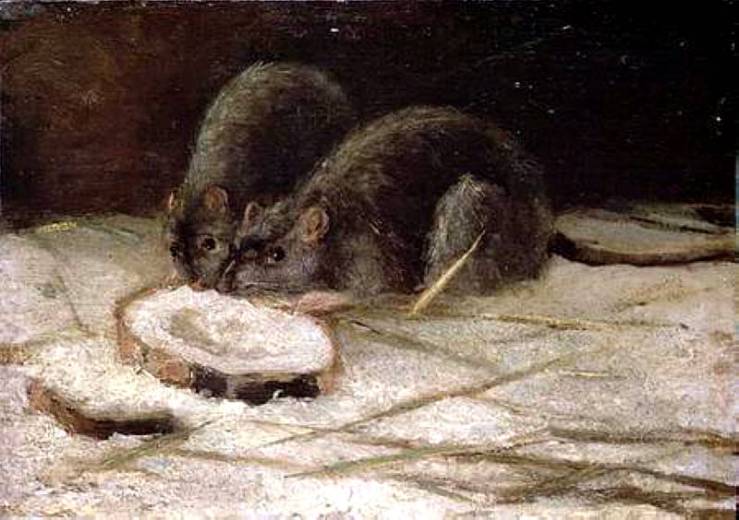
Two Rats, Vincent van Gogh

26. So maybe I’ve knocked on the book a bit, rated it low even, you  may perceive, dear reader: Let me be clear then: The Flame Alphabet is the sort of burning ugly vibrant affecting blazing grueling confounding bizarre novels that we need more of. It’s stronger than most of the contemporary stuff out there, definitely the stuff coming from the major houses. And if I seem to pick at it, it’s only because I see in it concessions to a so-called reading public; I wished to see Marcus pull publishing and readers closer to him.

I won’t forget cleaning the dead rats from the shed anytime soon; neither will I forget reading The Flame Alphabet. 

Watch Return to Oz, the Bizarre 1985 Sequel to The Wizard of Oz (Also: A Riff)

1. Ah, 1985. I was just a kid. A young kid. And my folks took me to see Walter Murch’s Return to Oz, an unofficial sequel to The Wizard of Oz.

Return to Oz is a film so bleak and dark and bizarre that its imagery still lives in the nooks of my nightmares.

2. Not that I didn’t enjoy Return to Oz—to be clear, I did. But it horrified me in ways that surpassed the deep horror I’d experienced viewing the 1939 film The Wizard of Oz.

3. (The green Wicked Witch cackling “I’ll get you my pretty” in The Wizard of Oz being something of a founding moment of horrific horror, a horror amplified by my mother’s tendency to act out the line at weird moments as she tickled me or chased me or picked me up from school).

4. But Return to Oz: this movie is dark. It’s fucked up.

Dorothy gets institutionalized and treated with electroshock therapy. Then she goes to Oz, where she’s pursued by Wheelers, these things that roll around on rollerskate hands and feet, which, you know, should be whimsical, but are instead horrific. Then there’s this cabinet of detached heads, which could have been handled playfully, but no, instead it’s like something out of Hieronymus Bosch. Even Dorothy’s friends are these weird, off-putting versions that don’t match up to the original trio of Scarecrow, Tinman, and Lion. Instead we get Tik-Tok, an android who looks like a swollen pot-bellied C3PO, and Jack Pumpkinhead, a guy with a pumpkin for a head. These friends don’t look human at all (because they aren’t). There’s a quest; they cross a desert; they save the day, etc.

It ends with Dorothy returned, not exactly safely, to aunt and uncle.

5. So Disney made another unofficial sequel, Oz the Great and Powerful, this time from director Sam Raimi (Return’s Murch never directed another film, by the way). Despite his franchise work on the first trilogy of Spider-Man films, Raimi is an auteur who gave us cult classics like Darkman and the Evil Dead trilogy. I loved his last film Drag Me to Hell, which mixed humor with noir and genuine horror.

6. Oz the Great and Powerful is of course doomed, no matter how much money it makes. It’s doomed in the way that The Two Jakes was doomed, or Godfather III was doomed, or Citizen Kane 2: Electric Boogaloo was doomed: There’s no way that it can surpass, let alone stand up next to, the strength of the prototype.

7. Still, I think that if Raimi has brought enough of his own weirdness to the film, we might get a fascinating artifact. My real hope is that there will be a strong streak of Evil Dead 2 in Raimi’s Disney, a streak of bizarre dark weirdness to baffle and disturb a new generation. Hell, maybe I’ll take my kids.

I Am Baffled by the Trailer for Spring Breakers, the New Film from Harmony Korine

You remember Harmony Korine, right? The scruffy auteur who gave us the nightmare white trash tornado-disaster cat-killing opus Gummo? The curb-dancing maniac who never got around to putting out that movie where he provoked strangers to beat him up? The guy who broke the Dogme 95 rules on Julien Donkey-Boy, a film featuring a pregnant Chloe Sevigny ice skating to Oval? The guy who stitched Trash Humpers together using VHS decks? The guy who wrote Kids? That guy?

So he has this new movie coming out called Spring Breakers. He wrote and directed the film. It stars James Franco, along with Disney alumni Vanessa Hudgens and Selena Gomez.

Here is the NSFW trailer for Spring Breakers:

I am baffled.

I do not know what to make of this.

Sure, there’s something of Kids in there, but the lurid, saturated cinematography by Benoît Debie (who has worked with Gaspar Noé in the past) has this nauseating MTV/Hype Williams feel to it that seems miles away from Larry Clark’s plain, unadorned style, or Korine’s own patchy VHS buzz.

The film also seems to be a fairly straightforward, character-oriented plot, likely with clear exposition, an arc—all that stuff that Korine was known to dismiss in the past. Now, I’m not saying that Korine should just keep making the same films again and again (not that he’s ever done that, to be clear)—I’m just surprised by the look and feel of Spring Breakers, and how it seems to be marketed. 

My gut feeling, which might be entirely wrong, is that Spring Breakers is an expensive prank, a film shot entirely in ironic quotation marks that the viewer will never see because Korine will never call attention to them. (This potentially puts Spring Breakers in the same territory as masterpieces like Road House and RoboCop).

Lead actor James Franco, who is currently pursuing seven PhDs in irony studies and metawhatevers, would seem an ideal fit for such a prank. Additionally, Franco’s begrilled performance as Alien is clearly channeling wunderkind RiFF RaFF, (Mr. RaFF even has a song called “RAP GAME JAMES FRANCO” which contains the genius hook “Non-stop through desert / Salisbury steak sweater”). RiFF RaFF’s shtick is even more bewildering than Spring Breakers; it’s difficult to tell if he’s some kind of art genius doing the Andy Kaufman thing or just a white kid from Houston with a bizarre sense of humor. Or both. Or neither. Either way, there’s something endearingly intriguing about him, whether you’re watching him infiltrate an art show in Miami or claim that his underwear is “moccasins.”

But back to Spring Breakers—it looks awful—but so did the previews for Wild Things, so, you know. And, again, the marketing isn’t the film. Still, it’s hard to get excited about this one.

Moby-Dick: A Short Riff on a Long Book

Green and White, Georgia O'Keeffe
Green and White, Georgia O’Keeffe

1. Prompted by Call Me Ishmael, Charles Olson’s marvelous study of Moby-Dick, I took a fifth trip through Melville’s massive opus this past month.

2. Every time I read Moby-Dick it seems funnier and sadder. Richer. Thicker.

3. I cobbled together my reading over different media and spaces: I listened to William Hootkins‘ outstanding unabridged audiobook version, and then reread on my Kindle key passages I’d mentally underlined; I then checked those passages against the copy of Moby-Dick I annotated the hell out of in grad school.

As I read, I posted some of my favorite excerpts on this blog.

4. I posted some of my favorite excerpts of Moby-Dick here on Biblioklept because I knew that I wouldn’t be able to write about the book—not really—that I wouldn’t be able to handle all of its language. (My riff on Olson’s book obsesses over Olson’s ability to write after Melville and Melville’s ability to write after Shakespeare).

5. Really, in posting so many fragments of Moby-Dick, I suppose that I’ve attempted to abrogate any kind of critical duty to describe the book under discussion in terms of its own language.

6. Point 5 is really a way of saying: Moby-Dick, like any sublime work of literature, is a self-defining, self-describing, and even self-deconstructing text.

7. Or, another way of making such a claim:

Let me (mis)appropriate Samuel Beckett’s description of Finnegans Wake and contend that the description fits Moby-Dick just as aptly:

Here form is content, content is form. You complain that this stuff is not written in English. It is not written at all. It is not to be read – or rather it is not only to be read. It is to be looked at and listened to. His writing is not about something, it is that something itself.

8. So here circumnavigate back to my own recent reading and auditing of the book:

Hootkins’ audio recording would make a great starting point for anyone (unnecessarily) daunted by Melville’s big book. He performs the book, commanding his audience’s attention. He unpacks the humor that might otherwise hide from untuned 21st century ears; he communicates the book’s deep, profound sorrow. His Ishmael is perceptive, clever, generous. His Stubb, hilarious. His Ahab a strange philosophical terror.

After listening to Hootkins on my commute, I’d return to key passages on my Kindle, and then finally review the notes I wrote in the cheap hardback Signet edition I read in grad school.

But why bring this up?

9. I don’t know.

Maybe: Unpacking Moby-Dick is too hard, too much—would require its own book, a book that would cite the entirety of Melville’s book.

But discussing the book this way seems a disservice to potential readers; it’s as if we would cloak the book in a mystic veil.

White Figure, Wassily Kandinsky

10. If I have a point to all of this: Moby-Dick is wonderful, funny, moving, engaging; a genre-bender that tackles philosophy, history, science; an adventure tale; a psychological novel brimming with ideas, allusions—but one delivered in sonorous, poetic language. It’s good, great, grand. Read it, if you haven’t. Reread it.

11. So I’ve failed to even try to begin to attempt to pretend to describe the plot.

Here: Ishmael, depressed, suicidal perhaps, decides to go to sea. To go whaling.

He tries to measure the whale, and by measuring the whale, maybe measure the world. But this is not really possible, certainly not in language. Certainly not in first-person perspective.

In Chapter 86, “The Tail,” Ishmael tells us:

The more I consider this mighty tail, the more do I deplore my inability to express it. At times there are gestures in it, which, though they would well grace the hand of man, remain wholly inexplicable. … Dissect him how I may, then, I but go skin deep. I know him not, and never will. But if I know not even the tail of this whale, how understand his head? much more, how comprehend his face, when face he has none? Thou shalt see my back parts, my tail, he seems to say, but my face shall not be seen. But I cannot completely make out his back parts; and hint what he will about his face, I say again he has no face.

(I don’t suppose I need to remark that Melville here lets one mighty tail stand in for another mighty tale—a tale he cannot face).

12. “Call me Ishmael”: our protagonist hails us.

But these famous opening lines aren’t really the beginning of the book. First we have the section titled “Extracts,” and before that “Etymology.” The first entry on the etymology of the whale, from  Hackluyt, warns us not to leave out “the letter H, which almost alone maketh up the signification of the word.”

Whaling. Hailing. Wailing.

The whiteness of the whale.

The witness of the wail.

13. How, just how, does Ishmael witness? How does he manage to tell this story? Did I obsess over this in earlier readings? I don’t think so—I was too concerned with absorbing the what and the why of the story to closely attend the how of its telling.

14. The novel begins in standard first-person point-of-view territory, Ishmael guiding us through Manhattan, New Bedford, Nantucket—but by the time he’s boarded the Pequod and set out into the wide watery world, this first-person perspective transcends the limits of physics: Our narrator not only attends the private conversations of Ahab, his mates, his harpooners, his men—but also the very interior of those men, their minds, their dreams, their imaginations.

Is Ishmael a ghost?

Leviathan-Job 40-21, Salvador Dali

15. And to return to Ahab for a moment: My god, what a voice! His infecting, addicting insanity. His agon with Moby Dick, with the sun, with himself.

16. And Starbuck: Starbuck comes across weaker and weaker each time I read the book. We’re to believe he’s a man of convictions, but he moves in half-measures. In his final moments he tries to match or feign or approximate Ahab’s insanity: tragicomedy.

17. And Stubb: Despite his cruelties, he may be my favorite character in the book.

18. While I’m riffing: Is there a novel more phallic in the American canon than Moby-Dick? All that sperm: All that life-force.

19. This is maybe what Moby-Dick is about: Life-force. The attempt to to resurrect and die and resurrect again. The coffin that serves as life-buoy. The life-line that connects men that might also be their death. A counterpane to counter pain. A condensation of oppositions.

A yarn, a rope, a series of knots, layered, layering, self-contextualizing.

An attempt to put into language what cannot be put into language.

20. Twenty points: Maybe too long for the “short riff” promised in the title, but also surely too short to even begin to start to approach to pretend to say something adequate about the novel. So a parting thought: Moby-Dick is better—richer, fuller, deeper—each time I read it, and I look forward to reading it again.

A Riff on Nathaniel Hawthorne’s Tale “The Birth-Mark”

  1. Nathaniel Hawthorne’s tale “The Birth-Mark” — or is it “The Birthmark”? — has been a favorite story of mine for years despite (or maybe because of) its being so damn symbolically overdetermined.
  2. You can read the story online.

  3. Or perhaps you want a quick summary—a refresher—okay:

Aylmer, “a man of science,” has this totally hot wife Georgiana—only she’s got a birthmark on her cheek, a small red mark that resembles a tiny hand—and it drives our scientist mad—so mad that he determines to make her perfect by removing the mark. Tragic ending ensues.

  1. One of the reasons I like “The Birth-Mark” so much is that it so clearly limns the futility of idealism.
  • Aylmer’s driving desire for mastery over Nature (echoing Shelley’s Frankenstein): the desire to “lay his hand on the secret creative force and perhaps make new worlds.”

  • The word “God” does not appear in “The Birth-Mark.”

  • But of course gods and creators are repeatedly invoked.

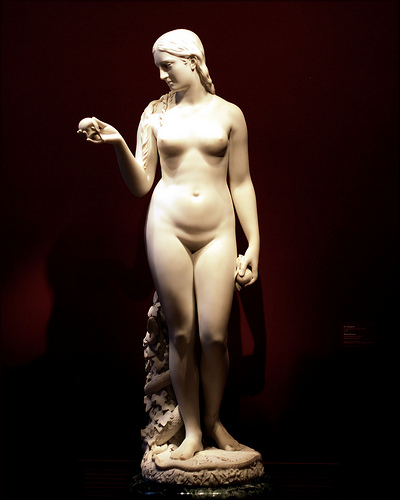
  • One such creator is Hawthorne’s friend Hiram Powers, whose sculpture Eve Tempted is invoked (invoking that other creator, the one who made a garden . . . )

  • powers eve
    Eve Tempted, Hiram Powers
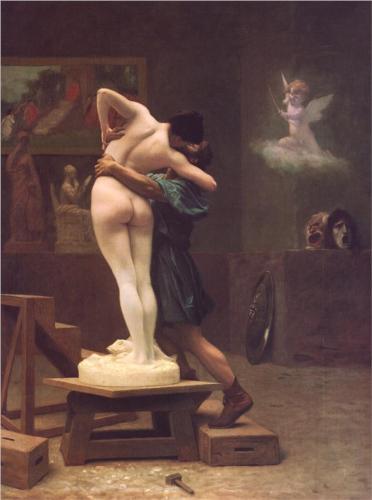
    1. And Pygmalion—
    pygmalion-and-galatea-1.jpg!Blog
    Pygmalion and Galate, Jean-Leon Gerome

    Aylmer, having convinced his wife that he’ll erase her mark: “Even Pygmalion, when his sculptured woman assumed life, felt not greater ecstasy than mine will be!”

    1. Aylmer’s plan is shameful. It’s based on an obsessive misreading of the symbolism of his wife’s birthmark. We’re told that Aylmer “select[s] it as the symbol of his wife’s liability to sin, sorrow, decay, and death, Aylmer’s sombre imagination was not long in rendering the birthmark a frightful object, causing him more trouble and horror than ever Georgiana’s beauty, whether of soul or sense, had given him delight.”

    He’s a very poor reader. His judgments are overawed by idealism.

    1. Georgiana asks him: “Cannot you remove this little, little mark, which I cover with the tips of two small fingers?”

    On one level, Georgiana is offering her husband the opportunity to play doctor with her, to get rid of the mark that’s driving him mad—but I think there’s an ironic second meaning at work here as well. I think she’s suggesting that he remove his perception of the mark, his reading of the mark. That he change his attitude.

    1. Hawthorne’s homeboy Herman Melville, in his big book Moby-Dick, has Ishmael point out—in a simple, charming, homey way—that there is no simply no ideal purity available to us:

    We felt very nice and snug, the more so since it was so chilly out of doors; indeed out of bed-clothes too, seeing that there was no fire in the room. The more so, I say, because truly to enjoy bodily warmth, some small part of you must be cold, for there is no quality in this world that is not what it is merely by contrast. Nothing exists in itself. If you flatter yourself that you are all over comfortable, and have been so a long time, then you cannot be said to be comfortable any more.

    13. Actually, even though we’re told he’s brilliant, it turns out that Aylmer is not the transcendent scientist he’d like to be. In a scene that almost edges into comedy (just a dab to give this tragedy dimension), Georgiana reads

    a large folio from her husband’s own hand, in which he had recorded every experiment of his scientific career, its original aim, the methods adopted for its development, and its final success or failure, with the circumstances to which either event was attributable. The book, in truth, was both the history and emblem of his ardent, ambitious, imaginative, yet practical and laborious life. He handled physical details as if there were nothing beyond them; yet spiritualized them all, and redeemed himself from materialism by his strong and eager aspiration towards the infinite. In his grasp the veriest clod of earth assumed a soul. Georgiana, as she read, reverenced Aylmer and loved him more profoundly than ever, but with a less entire dependence on his judgment than heretofore. Much as he had accomplished, she could not but observe that his most splendid successes were almost invariably failures, if compared with the ideal at which he aimed. His brightest diamonds were the merest pebbles, and felt to be so by himself, in comparison with the inestimable gems which lay hidden beyond his reach. The volume, rich with achievements that had won renown for its author, was yet as melancholy a record as ever mortal hand had penned. It was the sad confession and continual exemplification of the shortcomings of the composite man, the spirit burdened with clay and working in matter, and of the despair that assails the higher nature at finding itself so miserably thwarted by the earthly part. Perhaps every man of genius in whatever sphere might recognize the image of his own experience in Aylmer’s journal.

    1. I should clarify, perhaps, that Georgiana reads the journal as she waits out Aylmer’s experiments in his laboratory.
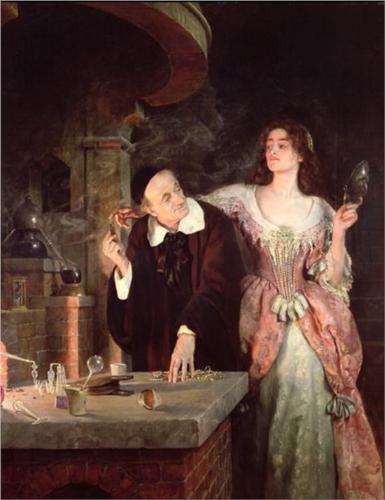
    The Laboratory, John Collier
    The Laboratory, John Collier
    1. Oh, gosh, I almost forgot—there’s a third player in this piece, Aminadab, Aylmer’s manservant/lab assistant, who’s described throughout the text (usually by Aylmer) as “clod,” “man of clay,” “human machine,” “earthly mass,” “thing of the senses” — he’s the pure-material to contrast Aylmer’s (would-be) pure-spirit. Although he’s not described as hunchbacked I can’t help but see him that way, this Igor to a Hollywood Frankenstein. And he laughs.

    2. Aminadab laughs at Aylmer’s folly. Here is the conclusion of this story:

    Alas! it was too true! The fatal hand had grappled with the mystery of life, and was the bond by which an angelic spirit kept itself in union with a mortal frame. As the last crimson tint of the birthmark—that sole token of human imperfection—faded from her cheek, the parting breath of the now perfect woman passed into the atmosphere, and her soul, lingering a moment near her husband, took its heavenward flight. Then a hoarse, chuckling laugh was heard again! Thus ever does the gross fatality of earth exult in its invariable triumph over the immortal essence which, in this dim sphere of half development, demands the completeness of a higher state. Yet, had Alymer reached a profounder wisdom, he need not thus have flung away the happiness which would have woven his mortal life of the selfsame texture with the celestial. The momentary circumstance was too strong for him; he failed to look beyond the shadowy scope of time, and, living once for all in eternity, to find the perfect future in the present.

    17. I won’t comment any further on the story, other than to suggest that the final two lines—in bold above—seem perfectly sensible and wonderfully wise to me. I think Wittgenstein may have been approaching a similar idea some eighty years later in his Tractatus Logico-Philosophicus:

    Death is not an event in life: we do not live to experience death. If we take eternity to mean not infinite temporal duration but timelessness, then eternal life belongs to those who live in the present. Our life has no end in the way in which our visual field has no limits.

    A Lazy Riff on the First Three of Álvaro Mutis’s Maqroll Novellas

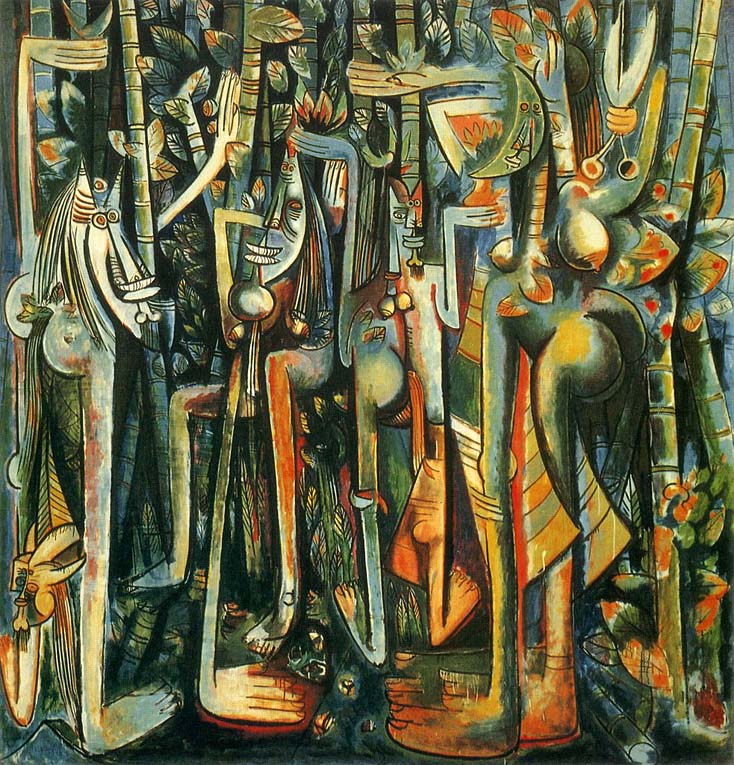
    The Jungle by Wilfredo Lam
    The Jungle by Wilfredo Lam

    1. Last year on this blog, my friend Dave Cianci reviewed Álvaro Mutis’s collection of seven novellas, The Adventures and Misadventures of Maqroll. That review got me to eventually pick up the book and start reading. That review is better written and more accomplished than what I’ll likely end up doing here.

    2. There are seven Maqroll novellas; I’ve read the first three. They are excellent.

    3. Let me steal from Cianci’s review. He describes Maqroll the Gaviero as

    a fleshed-out character, as well as the embodiment of an ideal: the knife fighters and Viking poets idolized by Borges, a mixture of Robinson Crusoe, Sam Spade, and Don Quixote. He indulges fantasy but prepares for disappointment. He lives between lawlessness and acceptability.

    4. The Gaviero—the lookout—is a picaro, a roguish but poetical sailor. Mutis’s book is picaresque, carnivalesque, a river—or maybe a maze—of storytelling.

    5. This is maybe what Maqroll is about: storytelling. Each Maqroll novella is framed as another’s story, or a found document—you know this trick, you’ve read Borges, right? 

    6. The book is crammed with stories, stories that lead to other stories, that recall other stories, that tell their own stories—or cover over other stories.

    7. A line that might instructively illustrate point 6: In Ilona Comes with the Rain, Mutis unpacks the life of a minor character, a sea captain named Wito. Consider his opening gambit:

    His life deserves an entire book. It was so full of adventures, some of which he hurried over as if they were hot coals, that one became lost in their labyrinthine complexity.

    The life described here could just as well be the Gaviero’s.

    8. Well of course, that’s what Mutis is doing, channeling and conveying and expressing Maqroll’s life, a life of picaresque adventures (and titular misadventures), of loss and gain, of love and despair, drinking, sailing, scheming and plotting—a life full of allusions and hints and digressions. Mutis’s technique is marvelous (literally; he made this reader marvel): he gives us an aging (anti-)hero, a hero whose life is overstuffed with stories and mishaps and feats and enterprises and hazards; he gives us one strand of that life at a time in each novella—but then he points to the other adventures, the other serials of Maqroll that we would love to tune into if only we could.

    9. To illustrate point 8: Consider Maqroll in Un Bel Morir, doing some time in prison: His consciousness floats to other prisons, other countries: Afghanistan, British Columbia: And then we get those stories, miniature epics—and nested within them, their own characters tell stories.

    10. There’s a wonderful timelessness to Maqroll, a sense that the adventures exist somehow before the postmodern world, that they belong to the pulp fictions of jungle adventure…

    11. (Indeed, re: point 10: In Ilona, we find one character who is unstuck in time, taking a Naopleonic lover during a transcontinental voyage…)

    12. I’ve already noted the Borgesian quality of Mutis’s tales, brought up their picaresque scope (a la Cervantes), so let me lazily compare Mutis to others: let me note the sprawl of his storytelling, which recalls García Márquez—only more compact, more precise. Let me suggest that there’s something of Kafka in there too—indeed, the first novella, The Snows of the Admiral seems to me a reworking of “Before the Law.” (The tale is also conspicuously quixotic; tilting at windmills and all that). Conrad of course, but also something of Melville—the grand (Moby-Dick) and the sly (The Confidence Man). And hell, also something of Edgar Rice Burroughs’s high adventure, or even, dare I say it, the better parts of the Indiana Jones films.

    13. Lazy as I am, I’ve failed to quote Mutis at any length—a shame, because it’s wonderful prose (translated by Edith Grossman, by the way). So here’s a little morsel—one that I think captures why we tell stories—from the appendix to Un Bel Morir, the last of the three novellas I read; before I offer it up I’ll conclude my riff by saying how happy I am that there are four more of these Maqroll novellas to read:

    All the stories and lies about his past accumulating until they formed another being, always present and naturally more deeply loved than his own pale, useless existence composed of nausea and dreams.

    Children Left Behind (I Riff on Season Four of The Wire)

    1. I’ve been rewatching David Simon’s Baltimore epic The Wire, generally regarded as one of the best if not the best, TV series ever. I’ve been watching with my wife, who’s never seen the show before. I’m going to riff on a few of the themes of season four of The Wire here, and there will be spoilers.

    If you’ve never seen The Wire and you think that some day you want to see it (it’s as good as everyone says it is, so you should want to see it) you shouldn’t read this post because of the spoilers.

    2. Season four of The Wire takes education as its central subject. Specifically, it examines the different ways in which personal circumstance and chance (and maybe fate) intersect with institutions. The simplest example of one of these institutions might be Edward J. Tilghman Middle School, but there are other institutions too—the city’s political core, including the Mayor and his advisers, the police and their various detention centers, and even the criminal organizations that foster their own trainees.

    3. Season four gives us four eighth graders to care about. The first episode of the season, “The Boys of Summer,” establishes these characters as they prepare to head from childhood into a more complex—and violent—world:

    Childish joy and youthful agitation mixes with real territorial violence here; everything that follows in the season shades this scene with a bleak irony.

    4. Season four presents a series of possible mentor relationships, wherein various principal characters contend to steward, foster, educate, or otherwise help these four kids turn into four men.

    Roland Pryzbylewski, one-time detective-cum-fuck-up, becomes the teacher Mr. Presbo. He idealistically tries to help the four kids, who all take his class together. Parallel to Pryzbylewski’s efforts in the classroom are Dennis “Cutty” Wise’s efforts in the boxing gym; he hopes to take these kids off the corners as well. Initially, Presbo fosters Randy and Dukie while Cutty tries to make headway with Namond and Michael.

    As the season develops, different mentors present themselves for each of the kids. Almost all fail.

    Cutty loses whatever inroads he had on mentoring Michael, who comes under the tutelage of the dark assassin Chris. Tellingly, Michael enlists Chris in killing off his brother Bug’s father; the assassination is Oedipal.

    Mr. Presbo helps Dukie in real and meaningful ways, making sure that the indigent child has clean clothes and a place to shower, but also showing him a kind of loving respect wholly absent in his relationship with “his people,” hopeless, horrible drug addicts. However, after Dukie is promoted to high school early, Mr. Presbo realizes that he will have to limit his involvement with the boy. He sees that there will always be another Dukie to come along, and that he can’t “keep” the boy—only steward him for a year or two.

    After a series of institutional bungles, Carver tries to protect Randy, but loses him to a group home. The last time we see Randy he receives a savage beating at the hands of his roommates.

    5. (I should now bring up Sherrod, a dim bulb of maybe 15 who seems to have dropped out of school years ago. Homeless, he’s “schooled” by Bubbles, who first tries to make him return to Tilghman, and then, seeing the boy won’t go, tries to teach him some basic survival skills. Sherrod ends up dead though, and Bubbles, feeling that the death is his fault (which it is in part), attempts suicide. Another failed mentor.

    We can also bring up Bodie, whom McNulty attempts to help, albeit the relationship here is hardly on the mentor/avuncular (which is to say, displaced father/son) axis that the other five boys experience. Still, McNulty tries to steer Bodie to a path that would help absolve the young man’s conscience. The path leads to the young man’s murder).

    6. And Namond?

    Namond is perhaps the most fascinating figure in season four, at least for me. He’s a spoiled brat, hood rich, the son of infamous Barksdale enforcer Wee-Bey Brice who is doing life for multiple murders. Namond is petulant and mean and immature. He bullies Dukie, yet he doesn’t have the “heart” (in the series’s parlance) to manage selling drugs on his corner, a weakness that comes to harsh light when a child of no more than eight steals his package of drugs. Namond is a mama’s boy, but bullied by an overbearing mother, a woman who encourages him to drop out of school to sell drugs for her own material comfort. He is not made of the same stuff as his father.

    Namond is also creative, funny, charismatic, individualistic, and intelligent. Bunny Colvin sees these qualities and sees an opportunity to help—to really help—one person. And here is the moment of consolation in season four. It’s a consolation for Colvin, who has experimented twice now with programs that bucked the institutional path (Hamsterdam in season three; the corner kids project in season four), and perhaps it’s a consolation for Cutty, who is instrumental in connecting Colvin with Wee-Bey. But it’s also a consolation for the audience, who perhaps will concede that one out of four ain’t bad. (Although clearly, three out of four children are left behind).

    7. The Wire’s emphasis on Baltimore locations, specific regional dialects, and its use of local, semi-professional actors afforded the show a strong sense of realism. Straightforward shots and short scenes added to this realism. What I perhaps like most about The Wire’s realism is its near-complete lack of musical cues: other than the opening song and closing credits soundtrack, the only music that appears in any scene in The Wire is internal to the scene, i.e., we only hear music if the characters are hearing it (in their cars, on their stereos, etc. — a la rule two of Dogme 95).

    The Wire breaks from these formal realistic conventions at the end of each season, using a montage—a device it almost always avoids—overlaid with a song. Here’s the montage from the end of season four:

    8. I include the montage as a means to return to point 6, Namond. The images unfold, giving a sense of where our characters (those who survive season four) will go next (the universe of The Wire is never static; our characters are always in motion). The montage settles (about 4:40 in the video above) to rest on Namond, working on his homework, clearly more comfortable if not at ease in his new life with the Colvins. A family embraces on the porch of the house behind the Colvin house, signaling that Namond has finally arrived in an institution that can protect and foster and nourish him—a loving family. A reminder of his old life as a corner boy enters  the scene as the young car thief Donut pulls up, smiling; there’s an implicit offer to return to the corner life here. Then Donut blazes through a stop sign, almost causing a wreck. Namond’s troubled face signals that he’s learned something, but it also twists into a small grin. The shot lingers on the crossroads: open possibility, but also the burden of choice.

    9. (Parenthetical personal anecdote that illustrates why season four is, for me, easily the most emotionally affecting entry in The Wire:

    For seven years I taught at an inner city high school that was plagued by low test scores, low student interest, and violence. The school’s population was about 95% black, with most students receiving free or reduced lunch. I was still working at this school when I first saw The Wire’s Edward J. Tilghman Middle School, and although the depiction was hyperbolic in places, the general tone of chaos and apathy was not at all unfamiliar to me. There were fights at my school. Brawls. Gang violence. Murders even—student-on-student murders that still haunt me today (these didn’t happen on campus, but they were still our students). I recall one day leaving early—I had fourth period planning and my principal allowed me to leave once a week to attend a graduate school course—and being stunned to see two swat trucks pull up around the school and unload teams of militarized police.

    Most of our students were good people trying to get a good education despite very difficult circumstances that were beyond their own control—poverty, unstable family environments, severe deficits in basic skills like reading and math. And most of our teachers were good people trying to help these students as best as they knew how in spite of a draconian, top-heavy management structure that emphasized the  Florida Comprehensive Assessment Test (FCAT) as the end-all be-all of education.

    I’m tempted here to rant about tests like the FCAT and legislation like the No Child Left Behind Act, rant about how they drain schools of resources, rob children of a true education, and limit teachers’ and schools’ ability to differentiate instruction—but that’s not the point of this riff.

    Probably more productive to let The Wire illustrate. I’ve sat in meetings like this one (I imagine many educators have):

    The primary goal of the institution is always to maintain the institution, no matter what the mission statement might be.

    What I’m trying to say here is that The Wire’s  Edward J. Tilghman Middle School strikes me as very, very real).

    10. I’ll conclude by returning to Namond and Colvin and suggest that this is the closest thing to a happy ending that The Wire could possibly produce. The Wire perhaps boils down to the evils of institutionalism (of any kind); Colvin (and, to be fair, Cutty and Wee-Bey to a certain extent) must take an individualistic response to bypass institutional evils. (In season five, McNulty will carry out an individualistic response to institutional apathy—which is to say practical evil—on a whole new level).

    The Wire plainly shows us that life costs, that all decisions cost, and that decisions cost in ways that we cannot calculate or measure or foresee. Namond’s future comes at the cost, perhaps, of Michael, Dukie, and Randy, the children who are left behind. And here is the real evil of a mantra like “no child left behind”—its sheer meaningless as a philosophy inheres in its essentially paradoxical nature, whereby if no single child can be left behind then all children can be left behind—the institution simply redefines or “jukes” what “behind” means. Colvin’s solution, on one hand, is to pragmatically assess the costs and payoffs of managing his interest in education, in being “a teacher of sorts” (as he calls it). (This pragmatic side echoes his Hamsterdam experiment in season three). Colvin’s pragmatism is successful though not only because he realizes his limitations—he cannot help just any child, and certainly not every child—it is also successful because it is tempered in love.

    I Riff on Clarice Lispector’s Novella The Hour of the Star, a Strange Work of Pity, Humor, Terror, and Abjection

    20120814-170735.jpg

    1. How to go about this?

    A starting place:

    Clarice Lispector’s 1977 novella The Hour of the Star is a superb collection of sentences.

    2. But what do I mean by this ridiculous statement? I mean isn’t that what all or most writing amounts to–a “collection of sentences”?

    What I mean then is that Lispector’s sentences prickle and tweak and glare, launch off in strange angles from each other as if they were building out narratives in disparate, separate tones, moods, colors.

    3. Another way to say this: the writing is strange, marvelous, uncanny. The good weird.

    4. Or maybe I should let Lispector’s narrator say it:

    Remember that, no matter what I write, my basic material is the word. So this story will consist of words that form phrases from which there emanates a secret meaning that exceeds both words and phrases.

    (Our narrator repeatedly invokes the power of “the word,” but I’ll linger on the way those words string together in sentences).

    5. And yes, our narrator is a “he.” Clarice Lispector the ventriloquist. Early in the book the narrator says that the tale could only come from “a man for a woman would weep her heart out.”

    6. I’ll be frank: I don’t know how to unpack all the ventriloquizing here, the layering between Lispector and her narrator Rodrigo S.M., who relates the sad tale of  Macabéa (a typist!), indigent slum-dweller, no talent and no beauty.

    7. Narrator Rodrigo S.M. seems unsure himself how to unpack the tale. He spends almost the first fifth of the book dithering over actually how to begin to start to commence:

    I suspect that this lengthy preamble is intended to conceal the poverty of my story, for I am apprehensive.

    And a page or two later:

    I am scared of starting. I do not even know the girl’s name. It goes without saying that this story drives me to despair because it is too straightforward. What I propose to narrate sounds easy and within everyone’s grasp. But its elaboration is extremely difficult. I must render clear something that is almost obliterated and can scarcely be deciphered. With stiff, contaminated fingers I must touch the invisible in its own squalor.

    8. (I promise to pick back up on that squalor and whatever invisible might be at the end of this riff).

    9. The Hour of the Star: The story is thin, the plot is a shell, a threadbare ancient trope, as brave Rodrigo S.M. repeatedly tells us.

    10. The plot is archetypal even. The orphan girl in the big city. Cinderella who imagines the ball, or tries to imagine the ball. Etc.

    11. So here’s a proper plot summary, c/o translator Giovanni Pontiero (who surely deserves large praise heaped at his feet (or a location of his choice) for his poetic translation):

    The nucleus of the narrative centres on the misfortunes of Macabéa, a humble girl from a region plagued by drought and poverty, whose future is determined by her inexperience, her ugliness and her total anonymity. Macabéa’s speech and dress betray her origins. An orphaned child from the backwoods of Alagoas, who was brought up by the forbidding aunt in Maceió before making her way to the slums of Acre Street in the heart of Rio de Janeiro’s red-light district. Gauche and rachitic, Macabéa has poverty and ill-health written all over her: a creature conditioned from birth and already singled out as one of the world’s inevitable losers.

    Her humdrum existence can be summarized in few words: Macabéa is an appallingly bad typist, she is a virgin, and her favorite drink is Coca-Cola. She is a perfect foil for a bullying employer, a philandering boy friend, and her workmate Glória, who has all the attributes Macabéa sadly lacks.

    12. A dozen things that The Hour of the Star may or may not be about: Poverty, storytelling, lies, illusions, abjection, resistance, agency, self, class, power, romance, fate.

    13. But let’s get back to those words the narrator is braggin’ on:

    Another angle at approaching The Hour of the Star: Its page of thirteen alternate titles, which act as a prose-poem descriptor for the novella:

    20120814-170352.jpg

    14. And some sentences:

    The first provides a context. The second tells us everything about Macabéa. The third tells us everything about her awful, venal “boy friend” Olímpico:

    For quite different reasons they had wandered into a butcher’s shop. Macabéa only had to smell raw meat in order to convince herself that she had eaten. What attracted Olímpico, on the other hand, was the sight of a butcher at work with his sharp knife.

    15.  Macabéa, our primary, and Olímpico a distant second. But also Rodrigo S.M. (and a few others):

    The story—I have decided with an illusion of free will—should have some seven characters, and obviously I am one of the more important.

    16. (Again though, how to parse Rodrigo from Clarice Lispector . . .)

    17. So maybe in one of his (her) parenthetical intrusions (but how can they be intrusions?). From late in the novella:

     (But what about me? Here I am telling a story about events that have never happened to me or to anyone known to me. I am amazed at my own perception of the truth. Can it be that it’s my painful task to perceive in the flesh truths that no one wants to face? If I know almost everything about Macabéa, it’s because I once caught a glimpse of this girl with the sallow complexion from the North-east. Her expression revealed everything about her . . .)

    Solipsism? Hubris? Humor? Irony?

    Truth?

    18. But I want to say something about how funny this novella, but I don’t know how to say it, or I’m not sure how to illustrate it, how to support such a claim with text—how does one support a feeling, a vibe, a phantom idea? Is The Hour of the Star actually funny? Or am I a sick man? Why did I chuckle so much?

    19. I think, re: 18, I think that it must be a mild streak of sadism, or an identification with the narrator’s flawed empathy, his raw presentation of a pathetic, abject heroine, a heroine whose heroism can only manifests in strange eruptions of self-possession, minor triumphs of the barest self-assertions.

    20. Perhaps an illustration, re: 18/19—a lengthy one maybe, but indulge me (or, rather, indulge yourself):

    At this point, I must record one happy event. One distressing Sunday without mandioca, the girl experienced a strange happiness: at the quayside, she saw a rainbow. She felt something close to ecstasy and tried to retain the vision: if only she could see once more the display of fireworks she had seen as a child in Maceió. She wanted more, for it is true that when one extends a helping hand to the lower orders, they want everything else.; the man on the street dreams greedily of having everything. He has no right to anything but he wants everything. Wouldn’t you agree? There were no means within my power to produce that golden rain achieved with fireworks.

    Should I divulge that she adored soldiers? She was mad about them. Whenever she caught sight of a soldier, she would think, trembling with excitement: is he going to murder me?

    Can you feel the shifts here? A distressing Sunday, a hungry Sunday (“without mandioca”); its strange happiness; an ecstasy that repeats a childhood vision; the desire for more, to rise above one’s allotment (The Right to Protest, or, She Doesn’t Know How to Protest); the limits of words, of language. An unexpected, seemingly irrelevant anecdote. A rare dip into our heroine’s consciousness.

    21. There’s a certain absurdity here, a methodical absurdity, of course. There’s a rhythmic certainty to the prose—a sense of aesthetic uniformity—but the content jars against it, the meaning spikes out in subtly incongruous jags that form some other shape. Folks say folks say Lispector echoes Kafka in this way. (I’m reminded of Robert Walser’s sentences too).

    22. But I’ve shared enough to give you a sense of Lispector’s style, a taste anyway, right?

    What about the book’s claim, its viewpoint, its thesis?

    23. Okay, so it’s right there upfront in the  book’s fifth paragraph, delivered early enough when the reader is suitably perplexed, looking for some kind of narrative inroad, not looking necessarily for a theme or a message or what have you:

    Even as I write this I feel ashamed at pouncing on you with a narrative that is so open and explicit. A narrative, however from which blood surging with life might flow only to coagulate into lumps of trembling jelly. Will this story become my own coagulation one day? Who can tell? If there is any truth in it—and clearly the story is true even though invented—let everyone see it reflected in himself for we are all one and the same person . . .

    24. Let’s not misunderstand the last sentiment as some hippy-dippy bullshit: Let’s go back to: “I must touch the invisible in its own squalor.”

    25. That squalor is the abject, the filth, the not-me, the other, signified most strongly in waste, blood, filth, vomit, the corpse.

    26. The gesture of The Hour of the Star is to make visible—in sentences, in words, in language—the invisible in its own squalor.

    27. Highly recommended.

    A Riff on William Gaddis’s The Recognitions

    20120325-143631.jpg

    1. I finished reading William Gaddis’s enormous opus The Recognitions a few days ago. I made a decent first attempt at the book in the summer of 2009, but wound up distracted not quite half way through, and eventually abandoned the book. I did, however, write about its first third. I will plunder occasionally from that write-up in this riff. Like here:

    In William Gaddis‘s massive first novel, The Recognitions, Wyatt Gwyon forges paintings by master artists like Hieronymous Bosch, Hugo van der Goes, and Hans Memling. To be more accurate, Wyatt creates new paintings that perfectly replicate not just the style of the old masters, but also the spirit. After aging the pictures, he forges the artist’s signature, and at that point, the painting is no longer an original by Wyatt, but a “new” old original by a long-dead genius. The paintings of the particular artists that Wyatt counterfeits are instructive in understanding, or at least in hoping to understand how The Recognitions works. The paintings of Bosch, Memling, or Dierick Bouts function as highly-allusive tableaux, semiotic constructions that wed religion and mythology to art, genius, and a certain spectacular horror, and, as such, resist any hope of a complete and thorough analysis. Can you imagine, for example, trying to catalog and explain all of the discrete images in Bosch’s triptych, The Garden of Earthly Delights? And then, after creating such a catalog, explaining the intricate relationships between the different parts? You couldn’t, and Gaddis’s novel is the same way.

    I still feel the anxiety dripping from that lede, the sense that The Recognitions might be a dare beyond my ken. Mellower now, I’m content to riff.

    1. I read this citation in Friedrich Nietzsche’s Human, All Too Human, Part II the other night, mentally noting, “cf. Gaddis”:

    188. The Muses as Liars. —“We know how to tell many lies,” so sang the Muses once, when they revealed themselves to Hesiod.—The conception of the artist as deceiver, once grasped, leads to important discoveries.

    1. The Recognitions: crammed with poseurs and fakers, forgers and con-men, artists and would-be artists.
    2. To recognize: To see and know again. Recognition entails time, experience, certitude, authenticity.

    3. Who would not dogear or underline or highlight this passage?:

    That romantic disease, originality, all around we see originality of incompetent idiots, they could draw nothing, paint nothing, just so the mess they make is original . . .

    1. In many ways The Recognitions, or rather the characters in The Recognitions whom we might identify with genuine talent, genius, or spirit (to be clear, I’m thinking of Wyatt/Stephan, Basil Valentine, Stanley, Anselm, maybe, and Frank Sinisterra) are conservative, reactionary even; this is somewhat ironic considering Gaddis’s estimable literary innovations.

    2. Esme: A focus for the novel’s masculine gaze, or a critique of such gazes?

    3. The central problem of The Recognitions (perhaps): What confers meaning in a desacralized world?

    Late in the novel, in one of its many party scenes, Stanley underlines the problem, working in part from Voltaire’s (in)famous quote that, “If there were no God, it would be necessary to invent him”:

    . . . even Voltaire could see that some transcendent judgments is necessary, because nothing is self-sufficient, even art, and when art isn’t an expression of something higher, when it isn’t invested you might even say, it breaks up into fragments that don’t have any meaning . . .

    Here we think of Wyatt: Wyatt who rejects the ministry, contemporary art, contemporary society, sanity . . .

    1. Wyatt’s quest: To find truth, meaning, authenticity in a modern world where the sacred does not, cannot exist, is smothered by commerce, noise, fakery . . .
  • The Recognitions conveys a range of tones, but I like it best when it focuses its energies on comic irony and dark absurdity to detail the juxtapositions and ironies between meaning and noise, authenticity and forgery.

  • (I like The Recognitions least when its bile flares up too much in its throat, when its black humor tips over into a screed of despair. A more mature Gaddis handles bitterness far better in JR, I think—but I parenthesize this note, as it seems minor even in a list of minor digressions).

  • Probably my favorite chapter of the book — after the very first chapter, which I believe can stand on its own — is Chapter V of Part II. This is the chapter where Frank Sinisterra reemerges, setting into motion a failed plan to disseminate his counterfeit money (“the queer,” as his accomplice calls it). We also meet Otto’s father, Mr. Pivner, a truly pathetic figure (in all senses of the word). This chapter probably contains more immediate or apparent action than any other in The Recognitions, which largely relies on implication (or suspended reference).

  • More on Part II, Chapter V: Here we find a savagely satirical and very funny discussion of Dale Carnegie’s How to Win Friends and Influence People, a book that seems to stand as an emblem (one of many in The Recognitions) of the degraded commercial world that Gaddis repeatedly attacks. The entire discussion of Carnegie’s book is priceless — it begins on page 497 of my Penguin edition and unfurls over roughly 10 pages—and the book is alluded to enough in The Recognitions to become a motif.

  • I’ll quote from page 499 a passage that seems to ironically situate How to Win Friends and Influence People against The Recognitions itself (this is one of the many postmodern moves of the novel):

    It was written with reassuring felicity. There were no abstrusely long sentences, no confounding long words, no bewildering metaphors in an obfuscated system such as he feared finding in simply bound books of thoughts and ideas. No dictionary was necessary to understand its message; no reason to know what Kapila saw when he looked heavenward, and of what the Athenians accused Anaxagoras, or to know the secret name Jahveh, or who cleft the Gordian knot, the meaning of 666. There was, finally, very little need to know anything at all, except how to “deal with people.” College, the author implied, meant simply years wasted on Latin verbs and calculus. Vergil, and Harvard, were cited regularly with an uncomfortable, if off-hand, reverence for their unnecessary existences . . . In these pages, he was assured that whatever his work, knowledge of it was infinitely less important that knowing how to “deal with people.” This was what brought a price in the market place; and what else could anyone possibly want?

    1. I’m not sure if Gaddis is ahead of his time or of his time in the above citation.

    The Recognitions though, on the whole, feels more reactionary than does his later novel JR, which is so predictive of our contemporary society as to produce a maddening sense of the uncanny in its reader.

    1. Even more on Part II, Chapter V (which I seem to be using to alleviate the anxiety of having to account for so many of the book’s threads): Here we find a delineation of (then complication of, then shuffling of) the various father-son pairings and substitutions that will play out in the text. (Namely, the series of displacements between Pivner, Otto, and Sinisterra, with the subtle foreshadowing of Wyatt’s later (failed) father-son/mentor-pupil relationship with Sinisterra).
  • Is it worth pointing out that the father-son displacements throughout the text are reminiscent of Joyce’s Ulysses, a book that Gaddis pointedly denied as an influence?

  • Ignorant of Gaddis’s deflections, I wrote the following in my review almost three years ago:

    Gaddis shows a heavy debt to James Joyce‘s innovations in Ulysses here (and throughout the book, of course), although it would be a mistake to reduce the novel to a mere aping of that great work. Rather, The Recognitions seems to continue that High Modernist project, and, arguably, connect it to the (post)modern work of Pynchon, DeLillo, and David Foster Wallace. (In it’s heavy erudition, numerous allusions, and complex voices, the novel readily recalls both W.G. Sebald and Roberto Bolaño as far as I’m concerned).

    1. But, hey, Cynthia Ozick found Joyce’s mark on The Recognitions as well (from her 1985 New York Times review of Carpenter’s Gothic):

    When ”The Recognitions” arrived on the scene, it was already too late for those large acts of literary power ambition used to be good for. Joyce had come and gone. Imperially equipped for masterliness in range, language and ironic penetration, born to wrest out a modernist masterpiece but born untimely, Mr. Gaddis nonetheless took a long draught of Joyce’s advice and responded with surge after surge of virtuoso cunning.

    1. We are not obligated to listen to Gaddis’s denials of a Joyce influence, of course. When asked in his Paris Review interview if he’d like to clarify anything about his personality and work, he paraphrases his novel:

    I’d go back to The Recognitions where Wyatt asks what people want from the man they didn’t get from his work, because presumably that’s where he’s tried to distill this “life and personality and views” you speak of. What’s any artist but the dregs of his work: I gave that line to Wyatt thirty-odd years ago and as far as I’m concerned it’s still valid.

    1. And so Nietzsche again, again from Human, All Too Human, Part II:

    140. Shutting One’s Mouth. —When his book opens its mouth, the author must shut his.

    1. And if I’m going to quote German aphorists, here’s a Goethe citation (from Maxims and Reflections) that illustrates something of the spirit of The Recognitions:

    There is nothing worth thinking but it has been thought before; we must only try to think it again.

    1. And if I’m going to quote Goethe, I’ll also point out then that Gaddis began The Recognitions as a parody of Goethe’s Faust. Peter William Koenig writes in his excellent and definitive essay “Recognizing Gaddis’ Recognitions” (published in the Winter Volume Contemporary Literature, 1975):

    To understand Gaddis’ relationship to his characters, and thus his philosophical motive in writing the novel, we are helped by knowing how Gaddis conceived of it originally. The Recognitions began as a much smaller and less complicated work, passing through a major evolutionary stage during the seven years Gaddis spent writing it. Gaddis says in his notes: “When I started this thing . . . it was to be a good deal shorter, and quite explicitly a parody on the FAUST story, except the artist taking the place of the learned doctor.” Gaddis later explained that Wyatt was to have all talent as Faust had all knowledge, yet not be able to find what was worth doing. This plight-of limitless talent, limited by the age in which it lives-was experienced by an actual painter of the late 1940s, Hans Van Meegeren, on whom Gaddis may have modeled Wyatt. The authorities threw Van Meegeren into jail for forging Dutch Renaissance masterpieces, but like Wyatt, his forgeries seemed so inspired and “authentic” that when he confessed, he was not believed, and had to prove that he had painted them. Like Faust and Wyatt, Van Meegeren seemed to be a man of immense talent, but no genius for finding his own salvation.

    The Faust parody remained uppermost in Gaddis’ mind as he traveled from New York to Mexico, Panama and through Central America in 1947, until roughly the time he reached Spain in 1948. Here Gaddis read James Frazer’s The Golden Bough, and the novel entered its second major stage. Frazer’s pioneering anthropological work demonstrates how religions spring from earlier myths, fitting perfectly with Gaddis’ idea of the modern world as a counterfeit-or possibly inspiring it. In any case, Frazer led Gaddis to discover that Goethe’s Faust originally derived from the Clementine Recognitions, a rambling third-century theological tract of unknown authorship, dealing with Clement’s life and search for salvation. Gaddis adapted the title, broadening the conception of his novel to the story of a wandering, at times misguided hero, whose search for salvation would record the multifarious borrowings and counterfeits of modern culture.

    1. Is Wyatt the hero of The Recognitions? Here’s Basil Valentine (page 247 of my ed.):

    . . . that is why people read novels, to identify projections of their own unconscious. The hero has to be fearfully real, to convince them of their own reality, which they rather doubt. A novel without a hero would be distracting in the extreme. They have to know what you think, or good heavens, how can they know that you’re going through some wild conflict, which is after all the duty of a hero.

    1. If Wyatt is the hero, then what is Otto? Clearly Otto is a comedic double of some kind for Wyatt, a would-be Wyatt, a different kind of failure . . . but is he a hero?

    When I first tried The Recognitions I held Otto in special contempt (from that earlier review of mine):

    Otto follows Wyatt around like a puppy, writing down whatever he says, absorbing whatever he can from him, and eventually sleeping with his wife. Otto is the worst kind of poseur; he travels to Central America to finish his play only to lend the mediocre (at best) work some authenticity, or at least buzz. He fakes an injury and cultivates a wild appearance he hopes will give him artistic mystique among the Bohemian Greenwich Villagers he hopes to impress. In the fifth chapter, at an art-party, Otto, and the reader, learn quickly that no one cares about his play . . .

    But a full reading of The Recognitions shows more to Otto besides the initial anxious shallowness; Gaddis allows him authentic suffering and loss. (Alternately, my late sympathies for Otto may derive from the recognition that I am more of an Otto than a Wyatt . . .).

    1. The Recognitions is the work of a young man (“I think first it was that towering kind of confidence of being quite young, that one can do anything,” Gaddis says in his Paris Review interview), and often the novel reveals a cockiness, a self-assurance that tips over into didactic essaying or a sharpness toward its subjects that neglects to account for any kind of humanity behind what Gaddis attacks. The Recognitions likes to remind you that its erudition is likely beyond yours, that it’s smarter than you, even as it scathingly satirizes this position.

    I think that JR, a more mature work, does a finer job in its critique of contemporary America, or at least in its characterization of contemporary Americans (I find more spirit or authentic humanity in Bast and Gibbs and JR than in Otto or Wyatt or Stanley). This is not meant to be a knock on The Recognitions; I just found JR more balanced and less showy; it seems to me to be the work of an author at the height of his powers, if you’ll forgive the cliché.

    I’ll finish this riff-point by quoting Gaddis from The Paris Review again:

    Well, I almost think that if I’d gotten the Nobel Prize when The Recognitions was published I wouldn’t have been terribly surprised. I mean that’s the grand intoxication of youth, or what’s a heaven for.

    (By the way, Icelandic writer Halldór Kiljan Laxness won the Nobel in lit in 1955 when The Recognitions was published).

    1. Looking over this riff, I see it’s lengthy, long on outside citations and short on plot summary or recommendations. Because I don’t think I’ve made a direct appeal to readers who may be daunted by the size or reputation or scope of The Recognitions, let me be clear: While this isn’t a book for everyone, anyone who wants to read it can and should. As a kind of shorthand, it fits (“fit” is not the right verb) in that messy space between modernism and postmodernism, post-Joyce and pre-Pynchon, and Gaddis has a style and approach that anticipates David Foster Wallace. (It’s likely that if you made it this far into the riff that you already know this or, even more likely, that you realize that these literary-historical situations mean little or nothing).

    26.Very highly recommended.

    “I Lost My One True Love” — Bob Dylan Riff (1966)

    Bob Dylan gets extra-rambly in a 1966 interview with Playboy. I like to read the following riff as a surreal story-poem. If you want more context, the interviewer asks Dylan as a preamble to the ramble: “Mistake or not, what made you decide to go the rock-‘n’-roll route?”:

    Carelessness. I lost my one true love. I started drinking. The first thing I know, I’m in a card game. Then I’m in a crap game. I wake up in a pool hall. Then this big Mexican lady drags me off the table, takes me to Philadelphia. She leaves me alone in her house, and it burns down. I wind up in Phoenix. I get a job as a Chinaman. I start working in a dime store, and move in with a 13-year-old girl. Then this big Mexican lady from Philadelphia comes in and burns the house down. I go down to Dallas. I get a job as a “before” in a Charles Atlas “before and after” ad. I move in with a delivery boy who can cook fantastic chili and hot dogs. Then this 13-year-old girl from Phoenix comes and burns the house down. The delivery boy – he ain’t so mild: He gives her the knife, and the next thing I know I’m in Omaha. It’s so cold there, by this time I’m robbing my own bicycles and frying my own fish. I stumble onto some luck and get a job as a carburetor out at the hot-rod races every Thursday night. I move in with a high school teacher who also does a little plumbing on the side, who ain’t much to look at, but who’s built a special kind of refrigerator that can turn newspaper into lettuce. Everything’s going good until that delivery boy shows up and tries to knife me. Needless to say, he burned the house down, and I hit the road. The first guy that picked me up asked me if I wanted to be a star. What could I say?