“I am like one of those seeds taken out of the Egyptian Pyramids” — Herman Melville Writes to Nathaniel Hawthorne

From Herman Melville’s June 1851 letter to Nathaniel Hawthorne (read the whole letter here)—

But I was talking about the “Whale” [“Moby-Dick”]. As the fishermen say, “he’s in his flurry” when I left him some three weeks ago. I’m going to take him by his jaw, however, before long, and finish him up in some fashion or other. What’s the use of elaborating what, in its very essence, is so short-lived as a modern book? Though I wrote the Gospels in this century, I should die in the gutter. — I talk all about myself, and this is selfishness and egotism. Granted. But how help it? I am writing to you; I know little about you, but something about myself so I write about myself, — at least, to you. Don’t trouble yourself, though, about writing; and don’t trouble yourself about visiting; and when you do visit, don’t trouble yourself about talking. I will do all the writing and visiting and talking myself — By the way, in the last “Dollar Magazine” I read “The Unpardonable Sin.” He was a sad fellow, that Ethan Brand. I have no doubt you are by this time responsible for many a shake and tremor of the tribe of “general readers.” It is a frightful poetical creed that the cultivation of the brain eats out the heart. But it’s myprose opinion that in most cases, in those men who have fine brains and work them well, the heart extends down to hams. And though you smoke them with the fire of tribulation, yet, like veritable hams, the head only gives the richer and the better flavor. I stand for the heart. To the dogs with the head! I had rather be a fool with a heart, than Jupiter Olympus with his head. The reason the mass of men fear God, and at bottom dislike Him, is because they rather distrust His heart, and fancy Him all brain like a watch. (You perceive I employ a capital initial in the pronoun referring to the Deity; don’t you think there is a slight dash of flunkeyism in that usage?) Another thing. I was in New York for four-and-twenty hours the other day, and saw a portrait of N.H. And I have seen and heard many flattering (in a publisher’s point of view) allusions to the “Seven Gables.” And I have seen “Tales,” and “A New Volume” announced, by N.H. So upon the whole, I say to myself, this N.H. is in the ascendant. My dear Sir, they begin to patronize. All Fame is patronage. Let me be infamous: there is no patronage in that. What “reputation” H.M. has is horrible. Think of it ! To go down to posterity is bad enough, any way; but to go down as a “man who lived among the cannibals”! When I speak of posterity, in reference to myself, I only mean the babies who will probably be born in the moment immediately ensuing upon my giving up the ghost. I shall go down to some of them, in all likelihood. Typee will be given to them, perhaps, with their gingerbread. I have come to regard this matter of Fame as the most transparent of all vanities. I read Solomon more and more, and every time see deeper and deeper and unspeakable meanings in him. I did not think of Fame, a year ago, as I do now. My development has been all within a few years past. I am like one of those seeds taken out of the Egyptian Pyramids, which, after being three thousand years a seed and nothing but a seed, being planted in English soil, it developed itself, grew to greenness, and then fell to mould. So I. Until I was twenty-five, I had no development at all. From my twenty-fifth year I date my life. Three weeks have scarcely passed, at any time between then and now, that I have not unfolded within myself. But I feel that I am now come to the inmost leaf of the bulb, and that shortly the flower must fall to the mould. It seems to be now that Solomon was the truest man who ever spoke, and yet that he a little managed the truth with a view to popular conservatism; or else there have been many corruptions and interpolations of the text. — In reading some of Goethe’s sayings, so worshipped by his votaries, I came across this, “Live in the all.” That is to say, your separate identity is but a wretched one, — good; but get out of yourself, spread and expand yourself, and bring to yourself the tinglings of life that are felt in the flowers and the woods, that are felt in the planets Saturn and Venus, and the Fixed Stars. What nonsense! Here is a fellow with a raging toothache. “My dear boy,” Goethe says to him, “you are sorely afflicted with that tooth; but you must live in the all, and then you will be happy!” As with all great genius, there is an immense deal of flummery in Goethe, and in proportion to my own contact with him, a monstrous deal of it in me.

H. Melville.

P.S. “Amen!” saith Hawthorne.

N.B. This “all” feeling, though, there is some truth in. You must often have felt it, lying on the grass on a warm summer’s day. Your legs seem to send out shoots into the earth. Your hair feels like leaves upon your head. This is the all feeling. But what plays the mischief with the truth is that men will insist upon the universal application of a temporary feeling or opinion.

P.S. You must not fail to admire my discretion in paying the postage on this letter.

“Out, Vile Jelly!”

A scene from the Peter Brook directed version of King Lear. Cornwall gouges out old man Gloucester’s eyes. The horror!

Heinrich Heine’s Death Mask

“Shakespeare Humiliates the Prior Body of Language” — Wayne Koestenbaum

A passage from Wayne Koestenbaum’s new book, Humiliation

Shakespeare humiliates the prior body of language—the poor body of English, lackluster before he came along and renovated it. Shakespeare ennobled English, and so it may seem odd to say that he also humiliated it; but in his semantic magnanimity, his aural cornucopia, I detect the presence of lacerations. When Shakespeare commits lexical excess (by coining new words, by larding a simple thought with plump, dense sounds and metaphors, by hyper-enlivening every sentiment with figurative language), English becomes a body punctured by his violent actions. Example: “The murmuring surge / That on th’ unnumb’red idle pebble chafes / Cannot be heard so high.” “Murmuring” and “surge” and “unnumb’red” present the ear with a glut of “u” and “m” and “r” sounds. And “idle” and “pebble,” next to each other, create a pebble effect. With purple ripeness, low-pitched vowels (“murmuring surge”) ascend to high-pitched vowels (“high”). This apex virtuosity—language creaming, ascending, and thickening—this process (I’m straining my point) alerts me to a violence committed, symbolically, against English’s body. Poetic intensity—linguistic bravado, musical compression—hurts the mother tongue. “Good” language is hurt language. Bare, desiccated language—Samuel Beckett’s—is also humiliated: shorn, Samson-like. If you don’t understand what I’m saying, I will feel humiliated. If I fail to communicate my meaning, and if you tell me I’ve failed, then you will have humiliated me.

The Greeting — Bill Viola

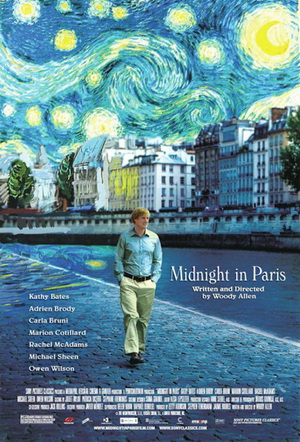
Midnight in Paris — Woody Allen

Woody Allen’s new film Midnight in Paris opens with a sumptuous montage of the City of Light, clearly establishing from the get-go that the movie is Allen’s love letter to Paris. The romantic overture idealizes Paris, just as the film’s protagonist Gil, played pitch perfect by Owen Wilson, idealizes the Lost Generation of writers and artists who populated the cafes and bars of Paris in the ’20s. Gil is on a working vacation with his fiancé and future in-laws; he’s a successful Hollywood screenwriter but dreams of becoming a great novelist. Only he’s struggling with his novel-in-progress, which features a protagonist who runs a nostalgia shop. Nostalgia, or the romance of nostalgia, is the primary idiom of Midnight in Paris, and Owen Wilson transcends the usual parameters of Woody-surrogate in bringing this idiom to life. Wilson’s breezy charisma propels the movie forward at all times; indeed, the entire plot rests on Wilson’s charm, which saves the film from falling into syrupy dreck or boring indie whimsy.

Midnight in Paris works to literally charm its viewers and its protagonist, transporting the narrative back into the ’20s via a magical motorcar, where Wilson’s Gil falls in with a host of notable writers, artists, dancers, and other personalities. There are Cole Porter and Salvador Dali, Man Ray and Luis Bunuel, Pablo Picasso and Josephine Baker—but the standouts are the Fitzgeralds, Gertrude Stein, and Ernest Hemingway. The Hemingway character is a marvelous parody of both Hemingway’s caricature and Hemingway’s prose—although I think the humor in his scenes was lost on more than a few of the audience members I watched the film with. On Hemingway’s advice, Gil submits his manuscript to Gertrude Stein for an honest critique. In the meantime, Gil engages in a romance with Adrianna, Picasso’s muse and mistress, who herself pines for the Belle Époque era. Through another magical transposition, Gil and Adrianna move again through time, heading back to the 1890s to meet Toulouse-Lautrec and Paul Gaugin. As Gil pursues a romance with Adrianna (and the nostalgia of an idealized past), his own fiancé seems to be spending a bit too much time with a windbaggish and pretentious American who is a visiting lecturer at the Sorbonne. The reality of this conflict pulls Gil into making dramatic choices about his own future.

Midnight in Paris falls squarely into Allen’s fantasy films like The Purple Rose of Cairo, A Midsummer Night’s Sex Comedy, Alice, and Shadows and Fog. The film has much to offer those who, like Gil, find themselves fascinated by the romance of the Lost Generation. Allen’s parodies of the Fitzgeralds, Hemingway, and the rest are loving and gentle, and will surely be appreciated by most English majors. At the same time, Midnight in Paris is a slight, ephemeral work, one that relies on beautiful cinematography and the charm of its lead character more than plot, insight, or even jokes. There is no risk or danger in Gil’s fantasy, no sense that his sanity is in jeopardy or that he might not come to realize the theme of the film, which he spells out clearly for the audience if they somehow missed it—the tendency to romanticize the past has more to do with a dissatisfaction with the present than with any objective evidence that the past was somehow better, and dissatisfaction with the present should be viewed positively, for dissatisfaction can be productive and meaningful if we engage it. Recommended.

RIP Lucian Freud

(More, more).

Mad Meg — David Teniers the Younger

Mad Meg — Pieter Brueghel the Elder

We Review All Six Seasons of The Sopranos in a Relatively Short Post

1. The Sopranos is widely considered to be the best TV show of all time, but you already knew that, right? I watched all six seasons over the past few weeks; although I’d seen most of the episodes over the last decade, I was never a regular viewer, and I certainly didn’t evaluate the episodes I saw through any kind of critical lens. What follows is hardly an in-depth analysis, but rather my thoughts on the show. There are spoilers.

2. Tony Soprano is a vile character. Hard to relate to. He kills his friends and even family members; he lies to his family; he cheats on his wife. He’s a bad guy. He’s not a hero. He’s not an anti-hero. He’s both protagonist and villain of a series that begs us to identify with him, to see in him the expression of our own throbbing id. The gambit pays off at times, but over the duration of the series identifying with Tony becomes exhausting, painful, depressing.

3. I’ll go ahead and submit that I view the series as a study in existential nihilism against the backdrop of American-Dream-as-flow-of-capital. To put it in the series’ own terms, life is “all a big nothing.” In the series’ final scene in a diner, we’re reminded that the best we can hope for is to enjoy the “good times,” to focus on those moments of peace and happiness with our families. But ultimately, the series suggests nihilism, the “big nothing,” a void signaled in its famous closing shot of extended, abyssal blackness.

4. To be very clear, Tony dies at the end. I do not think that the ending is ambiguous. Any other reading is unsupported by the arc of not only the episode’s internal logic, but the arc of the sixth season, and indeed, the arc of the entire series. Any reading that allows Tony to live is wish fulfillment.

5. Pretty much everyone dies in The Sopranos. Again, “big nothing.”

6. There are lots of scenes of people eating sandwiches in The Sopranos.

7. The Sopranos is a commentary on and perhaps rejection of psychoanalysis as a mode of therapy, yet it uses the techniques of psychoanalysis to frame its stories.

8. The Sopranos is a Oedipal drama. I might submit that any drama about a family contains some kernel of Oedipal tension, but The Sopranos is formally Oedipal.

9. The Sopranos aired from 1999 to 2007. That’s a long time. When viewed successively over a short period, the series’ gaps and seams show prominently: characters appear from nowhere, story lines disappear, and key plot points often have to be explicated through clunky exposition.

10. A cultural value of The Sopranos: the series documents the Bush-era zeitgeist.

11. An easy criticism to make about The Sopranos: it’s ultimately an exercise in style and tone rather than plot and character development. Its themes and motifs build and simmer, but they are not enriched by this process. Rather, the series’ themes and motifs swell like thick plaster, obvious, concrete, depressing. Again, The Sopranos can only point to its own nihilism, to its “big nothing.”

12. The show is depressing. I mean, watching the show is a depressing process. It normalizes murders, lies, bullying, and violence—that’s pretty bad—but what becomes especially distressing is that the Sopranos are always fighting with each other. They are usually angry or sad. There aren’t really too many of those “good times”  to remember.

13. TVs are always on in The Sopranos, usually tuned to documentaries about war or war movies.

14. Some favorite episodes: “College,” “I Dream of Jeannie Cusamano” (season one), “Commendatori,” “Funhouse” (season two), “Mr. Ruggerio’s Neighborhood,” “University,” “Pine Barrens” (season three), “Calling All Cars,” “Whitecaps” (season four), “Rat Pack,” “Irregular around the Margins,” “The Test Dream,” “Long Term Parking” (season five), “Join the Club,” “Mayham,” “Live Free or Die,” “Soprano Home Movies,” “Made in America” (season six).

15. For years, I thought that the Comorra enforcer Furio Giunta, played by Federico Castelluccio, was played by Brent Spiner, who played Data on Star Trek: The Next Generation. Looking at pics of these actors, I do not understand my previous confusion. This comment is in no way germane to this “review.”

16. I don’t know if I’ve ever hated a character as much as I hate Paulie Walnuts.

17. Chris Moltisanti, played by actor Michael Imperioli, is probably my favorite character on the show. He too is vile—a drug addict, a thief, a woman-beater—but he’s also tender and funny. Maybe I just like Imperioli.

18. Steve Buscemi’s run on The Sopranos was pretty great, although it was part of a trope that the series leaned on too often—the guy-gets-out-of-prison-and-now-what? storyline.

19. Buscemi directed what might be the best episode of the series, “Pine Barrens.”

20. It’s easy to forget or overlook or understate the impact that The Sopranos had on HBO shows in particular and TV shows in general, but that impact should be noted here. Its formal elements either influenced or paved the way for the superior shows Deadwood and The Wire. It’s hard to imagine Mad Men without The Sopranos.

21. The early episodes of The Sopranos look and feel surprisingly cheap, perhaps in part due to the heavy use of canned music and an emphasis on longer takes. Plus, the need for exposition and character grounding leads to a kind of clunkiness. These episodes compensate with graphic violence and nudity.

22. Lots of strippers on The Sopranos.

23. You could argue that The Sopranos is a study in patriarchy, in patriarchy-as-capitalism.

24. One of the major themes of The Sopranos traces how women attempt to find agency within this strict patriarchy, a patriarchy that repeatedly objectifies, dehumanizes, uses, and discards women. Carmella, in particular, seeks to find voice in freedom, and her plan to do so invokes, again, the American Dream—the accumulation and sale of property. The flow of capital is freedom.

25. As a way of closing, I’ll return to the series’ final scene, probably one of the most remarked-upon moments in TV history (I cringe now at having written the execrable and odious phrase “TV history”). For me, the ending is unambiguous—the cut to black is a POV shift into Tony’s consciousness at the precise moment that he loses that consciousness forever. The ending is neither cheap nor gimmicky, but a formal masterstroke that corresponds to the series’ overarching themes of nihilism. This nihilism perhaps prevents the series achieving the cohesion of, say, The Wire, an equally dark series that takes capitalism as its major subject. The Wire proposes struggle itself as raison d’être. The Sopranos makes no argument for that struggle, finds no honor or humanity in it, instead shifting philosophical emphasis to “focus on the times that were good” against the face of a “big nothing.” The end of The Wire is a beautiful montage that suggests that even though history may be cyclical, this fact alone does not foreclose human agency. It is difficult to call the end of The Wire “happy,” but the series conclusion nevertheless suggests generative possibility: there might not be space for the viewer in that particular world, but David Simon suggests that that world will nevertheless continue without the viewer. In metaphorical terms, it lives. The formal device of the cycle-montage at the end of The Wire would feel cheap or even hackneyed had the series not earned it by establishing its threads years in advance. The end of The Wire shows us everything; it gives us the future. It is big everything, the perfect end for a show that attempt to measure the everything of one particular place. Similarly, the final shot of The Sopranos is formally and thematically appropriate. It gives us that “big nothing” that the series has repeatedly promised is ours to collect. The black thematizes the profound moral failures of its characters and dramatizes the loss of enlightenment and moral vision that permeates the family members in the final season. It’s a clever, elegant, and ugly way to end a very depressing show.

“On Leaving Some Friends At An Early Hour” — John Keats

“On Leaving Some Friends At An Early Hour” by John Keats—-

Give me a golden pen, and let me lean
On heaped-up flowers, in regions clear, and far;
Bring me a tablet whiter than a star,
Or hand of hymning angel, when ’tis seen
The silver strings of heavenly harp atween:
And let there glide by many a pearly car
Pink robes, and wavy hair, and diamond jar,
And half-discovered wings, and glances keen.
The while let music wander round my ears,
And as it reaches each delicious ending,
Let me write down a line of glorious tone,
And full of many wonders of the spheres:
For what a height my spirit is contending!
‘Tis not content so soon to be alone.

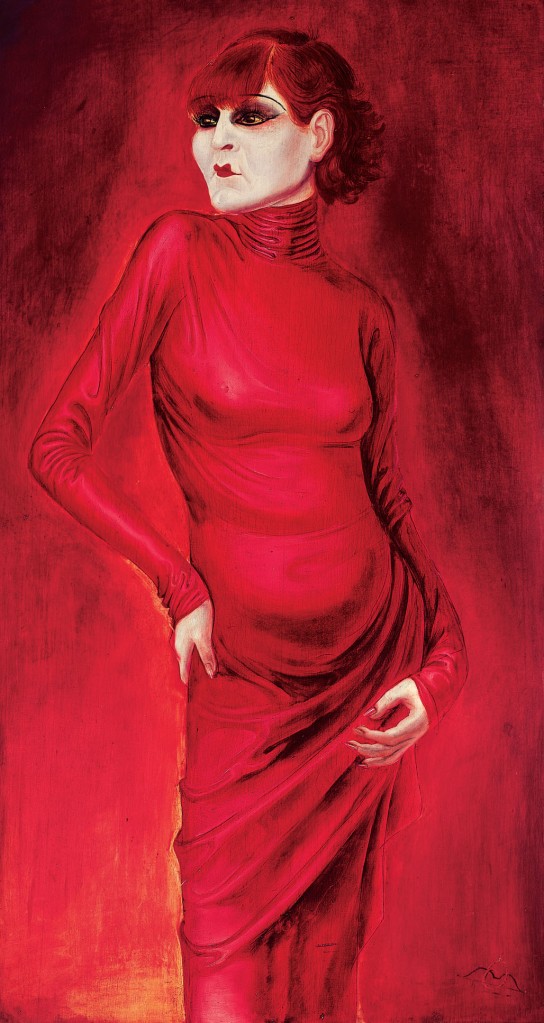
Portrait of Dancer Anita Berber — Otto Dix

Portrait of Dancer Anita Berber -- Otto Dix (1925)

“The Book of Mythologies” — A Scene from Peter Greenaway’s Film Prospero’s Books

Shy Coworker, Dirty Movies

Started Wayne Koestenbaum’s Humiliation (forthcoming from Picador) last night, and it’s excellent—one of the best cultural commentaries I’ve read in years. Abjection, King Lear, Julia Kristeva, Michael Jackson, Liza Minelli, A Star Is Born, fear of writing—great stuff. Full review soon.

“I Have a Very Vivid Child’s View” — A 1967 Interview with J.R.R. Tolkien

Read this marvelous 1967 profile of J.R.R. Tolkien by Philip Norman, in The New York Times. The piece focuses on Tolkien’s impact in America, particularly in the universities and the counterculture. From the piece—

Tolkien wasn’t a hearty child. At the age of 3 he was brought home from Bloemfontein, South Africa, his birthplace, and brought up at Sarehole, near Birmingham. Until he won a scholarship to grammar school his mother taught him. He is particularly attached to the powder horn; it reminds him of being “borrowed” by an African named Isaac, who wanted to show a white baby off in his kraal. “It was typical native psychology but it upset everyone very much, of course. I know he called his son Isaac after himself, Mister Tolkien after my father and Victor-ha! ha!-after Queen Victoria.

“I was nearly bitten by a snake and I was stung by a tarantula, I believe. In my garden. All I can remember is a very hot day, long, dead grass and running. I don’t even remember screaming. I remember being rather horrified at seeing the Archdeacon eat mealies [Indian corn] in the proper fashion.” …Tolkien stuck his fingers in his mouth.

“Quite by accident, I have a very vivid child’s view, which was the result of being taken away from one country and put in another hemisphere-the place where I belonged but which was totally novel and strange. After the barren, arid heat a Christmas tree. But no, it was not an unhappy childhood. It was full of tragedies but it didn’t tot up to an unhappy childhood.”

Jacob’s Ladder — William Blake

Herman Melville’s Lifetime Literary Earnings

The chart below is from The Life and Works of Herman Melville.

Note: This chart does not represent Melville’s entire literary production. It does not list earnings for the magazine articles or for Israel PotterThe Piazza Tales, and The Confidence-Man, for which surviving records are incomplete; nor does it give figures for the volumes of poetry that were published at private expense.

		    UNITED STATES	       UNITED KINGDOM		      TOTALS

		Copies       	            Copies       	        Total       Total
Title		Sold	     Earnings	    Sold	 Earnings (a)   Sales       Earnings
--------------------------------------------------------------------------------------------
Typee		9,598	     1,138.61	    6,722	   708.40	16,320	    1,847.01

Omoo		7,403	     1,719.78	    5,932	   644.00	13,335	    2,363.78

Mardi		2,900	       740.88	    1,000	   970.65	 3,900      1,711.53

Redburn		4,718	       683.57	      750	   484.00	 5,468	    1,167.57

White-Jacket	4,922	       969.44	    1,000	   968.00	 5,922	    1,937.44

Moby-Dick	3,215	       556.37	      500	   703.08	 3,715	    1,259.45

Pierre		1,821	       157.75	      --	      --	 1,821	      157.75
Battle-Pieces	  471	     - 229.71 (b)     --	      --	   471	    - 229.71
	       ------	     --------	   ------	 --------	------	   ---------
TOTALS	       35,048	     5,736.69 	   15,905	 4,478.13       50,953	   10,214.82