An Incomplete List of Stuff I Wish I’d Written About in 2011

Let me get this out of my system:

In no particular order a list of stuff I wished I’d written about in 2011:

1. Renata Adler’s amazing novel-in-vignettes Speedboat.

2. Wittgenstein’s Mistress by David Markson. End of the world cultural riffage. No raffage.

3. The Stories of Breece D’J Pancake: soul-crashing sad. [Not a typo].

4. Season two of Boardwalk Empire: The Oedipal complex as a plot arc hasn’t been done so well since The Sopranos. Most HBO shows seem to be about capitalism and law (see also: Deadwood, The Wire, The Sopranos).

5. That first episode of Luck. I love David Milch. Michael Mann seems imminently capable of filming things (although I think Heat is overrated, even though it has Val Kilmer, and he’s radness in the form of a lion in the form of a sea lion). The opening episode was dry like vermouth. But I will watch, because of Deadwood.

6. Hung. My wife and I are the only two people in America who liked Hung. Then it got canceled.

7. Captain America: All of the shots + set design in this film seem to have been straight up stolen from the Star Wars films—except the shots that were stolen from the Indiana Jones films. It’s funny in a way because Lucas (and Spielberg) were stealing from old serial films that were contemporaneous with the age that Captain America is meant to be set in. (And, oh, yeah, the movie was contrived bullshit).

8. I wish I’d reviewed How to Keep Your Volkswagen Alive by Chris Boucher. It was new and fresh and strange and deserved a good review from this blog, but it was very difficult to write about. I tried. It’s simultaneously sad, funny, too-experimental, but also rich and rewarding. An excellent flawed début.

9. The Trip: Steve Coogan and Rob Brydon take a trip through Northern England, eating at Michelin starred inns, creeping on the wild misty moors, referencing plenty of Romantic lit, and riffing—and backbiting—a lot. Comedy + tragedy done right. Lovely.

10. The Adventures of Buckaroo BanzaiAcross the 8th Dimension: Okay, frankly, I was ashamed to admit that I hadn’t seen it until this summer. Batshit insane interstellar hi-jinks. Rasta aliens. Buckaroo and his men are in a band! The ending credits sequence is the second best I’ve ever seen (after Lynch’s closing credits for INLAND EMPIRE).

11. The last Harry Potter movie. It was good. I’m glad they’re over though.

12. Baudolino by Umberto Eco, which I listened to on mp3 while refinishing a room in my new house. The first half was great—silly, bawdy, funny—but it unraveled into a sloppy mess by the end.

13. The Hunger Games by whoever wrote The Hunger Games, I think her name is Suzanne Collins, but Christ I’m not gonna waste any time checking: I listened to this audiobook working on the same room project that I worked on while listening to Baudolino. Look, I get that these books are for kids, and that they’re probably a sight better than Twilight, but sheesh, exposition exposition exposition. There’s nothing wrong with letting readers fill in the gaps (especially when your book is ripping off The Running Man + a dozen other books). Also, there’s a character in this book who I think is named after pita bread.

14.  A Canticle for Leibowitz by Walter M. Miller. Another audiobook that I listened to working on the aforementioned project—only this book is pure excellence, a post-apocalyptic examination of faith and meaning set against Big Nothing. The first third recalled Blood Meridian to me, although McCarthy’s book must have been composed 25 years after Miller’s.

15. I finally watched Party Down after all of my friends kept telling me, “You gotta watch Party Down!” Have you seen Party Down? You gotta watch Party Down!

16. Various short stories by Melville and Hawthorne: I read a lot of short pieces from these guys, mostly obscure, often half-baked stories that were still better than 99.9% of the contemporary stuff American writers are doing.

17. Uncreative Writing by Kenneth Goldsmith. Goldsmith is a hero: Ubuweb is magic. But a lot of Uncreative Writing just felt like an excuse for Goldsmith to share his favorite riffs on avant gardism from the classroom. And I know he’s probably a great and inspiring teacher, and I’m sure his Uncreative Writing class was gangbusters and meaningful for his students. Maybe it’s because I teach at a community college; maybe I’m conservative—I’m a fan of Dada; I get Walter Benjamin, blah blah blah. I just think we should cite sources still. Originality may be a fiction, but synthesis isn’t. Research and documentation are meaningful. Still, an entertaining book.

18. Music. Although most writing about music sucks.

19. Probably several dozen other books, movies, TV shows, etc. But there’s always 2012 to become overwhelmed by!

Happy New Year!

A Scapegoat for Promiscuous Drunks, Friendly Calls, and Humbug Resolutions

mark-twain

From Mark Twain’s January 1st, 1863 column in the Territorial Enterprise:

Now is the accepted time to make your regular annual good resolutions. Next week you can begin paving hell with them as usual. Yesterday, everybody smoked his last cigar, took his last drink, and swore his last oath. To-day, we are a pious and exemplary community. Thirty days from now, we shall have cast our reformation to the winds and gone to cutting our ancient short comings considerably shorter than ever. We shall also reflect pleasantly upon how we did the same old thing last year about this time. However, go in, community. New Year’s is a harmless annual institution, of no particular use to anybody save as a scapegoat for promiscuous drunks, and friendly calls, and humbug resolutions, and we wish you to enjoy it with a looseness suited to the greatness of the occasion.

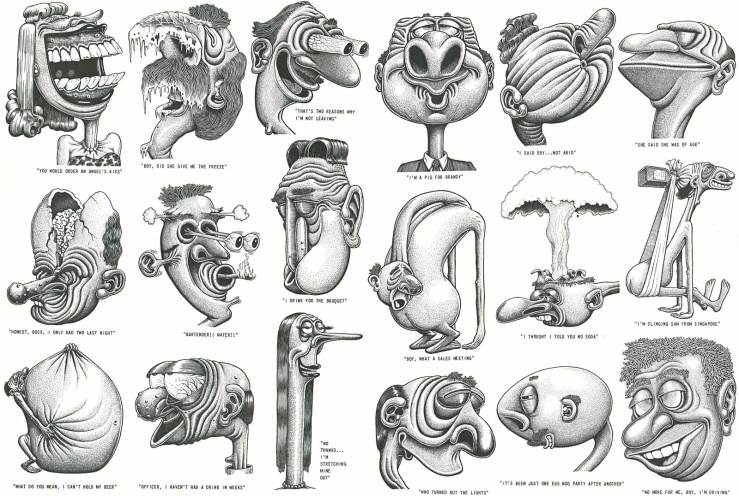
Basil Wolverton’s Guide to Drinking

Riff on Recent Reading, 12.31.2011

20111229-200717.jpg

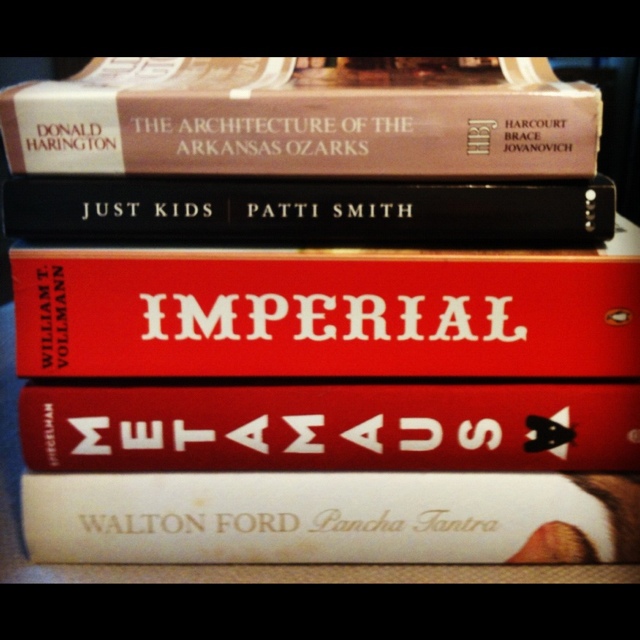
1. Donald Harington, The Architecture of the Arkansas Ozarks

I want to publicly thank blogger BLCKDGRD for sending me this book; it arrived in sections, the binding glue cracked, its abused condition surely a sign of love. I happened to be recaulking the margins of my screened in porch the day it arrived, so I used silicone caulk (along with c-clamp) to repair it.

The Architecture of the Arkansas Ozarks rightfully should have shown up on my Books I Didn’t Read in 2011 post, but it was doubly neglected, left under a pile of half-read books that I intend to keep reading: Georges Perec’s Species of Spaces, the Vollmann reader Expelled from Eden, a volume of stories by Breece D’J Pancake (two stories remain unread; I am sure they are awfully sad), Stendahl’s The Charterhouse of Parma. In short, I didn’t want to own up to abandoning it because I intend to go back and finish it. I read a little over half of Harington’s big, rich, funny history of Arkansas, told through the lens of the species of spaces inhabited by the Ingledews and their fellow Stay Morons. The book is lively, deeply ironic, and stands with Kurt Vonnegut as perfect American satire.

2. Just Kids, Patti Smith

I found Just Kids, which was a Big Deal book in 2010, while looking for a copy of Lillian Smith’s The Killers of the Dream (don’t fret; I found that book too). I’ve loved Smith’s music since I was a kid; like The Talking Heads, she was hard to place, not outright punk rock, definitely not pop, very weird.

I usually read the first few pages of books in the store if I think I’m going to buy them; I ended up reading about 10 pages of Just Kids, taking it home, and then reading for a few more hours. I’m almost finished with it now.

Smith documents a fascinating time in a fascinating place (New York City’s art/lit/music scene in the late sixties/early seventies), but her perspective for most of the book is that of an outsider, a would-be artist struggling to help Robert Mapplethorpe become famous for his art. Smith is in love with literature, particularly Romantic French stuff.

She’s also an object fetishist; I can’t think of another book that details so many tchotchkes, so many surfaces, so many contours, so many things. She’s an aesthete. There are also several incidences of book theft. I’m not sure if I’ll write up a proper review of this book—it won the Nat’l Book award and made all the year end lists in 2010—but I have been enjoying it as a chronicle of creative energy.

3. Imperial, William T. Vollmann

There’s a strange shift between the first and second chapters of Vollmann’s massive book about Imperial County. The first chapter, “The Gardens of Paradise,” reads like a magazine article (and it was; it was published in abbreviated form in Gear in 1999)—lots of dialogue, short paragraph breaks, a spare, lucid syntax, but nevertheless rippling with verve. The second chapter, “Delineations” is a heady brew, a page right out of Ishmael’s big book, as we see Vollmann try to delineate or define his white whale Imperial. And yet he seems to realize that delineation is a fantasy:

People say it was miraculous that Christ walked across the water, and yet they don’t think twice when the same is performed by this entity invisible everywhere except in its representations, whose substance is comprised of equal parts imagination, measurement, memory, authority, and jurisdiction! Delineation is the merest, absurdest fiction, yet delineation engenders control.

The territory and the time Vollmann treks in just a few dozen pages astounds . . .

4. MetaMaus, Art Spiegelman

Okay—not really recent reading, although I did pick it up again and thumb through it before writing this piece; mostly, I wanted to try to write something about this book before the end of the year (I put it on my “best of ’11” list, by the bye). This book is Spiegelman’s attempt to measure Maus: where it came from, how it was made, what making it did to him and for him—and to his family. Like Smith’s book, MetaMaus is very much about the creative process (forgive the hackneyed phrase)—only, where Smith breathlessly gushes in the glowing, enriching flames of art, Spiegelman guides us through the nitty-gritty nooks and crannies of how he made what is perhaps the signature work of comics art of the twentieth century.

The book is beautiful. Take a gander:

5. Pancha Tantra, Walton Ford

The index at the end of Pancha Tantra contains a series of citations that illustrate Ford’s paintings (hang on, the elements of that last phrase should be vice versa, right?). To wit:

20111230-205013.jpg

20111229-200847.jpg

6. A Dance with Dragons, George R. R. Martin (audiobook read by Roy Dotrice)

I really liked the first three Game of Thrones books (yeah, I know they have that long silly name; I’m not gonna write it). I listened to them on audio, all read by Roy Dotrice—who is a great reader—and I gave them a positive review. The first three books detail a world of Machiavellian scheming, a phallocentric, desacralized universe where power is constantly shifting and idealism will get you beheaded. The character development is excellent, the plots are engaging, and the prose is good enough.

The fourth book, narrated by John Lee, was almost too much to get through. Here are some words to describe it: bloated, plodding, sagging, lazy, meandering, over-expansive.

I’d heard that A Dance with Dragons was much better, knew that Dotrice was narrating again, and knew that the book picked up with some of my favorite characters who were left out of that fourth book (Tyrion, Danaerys).

I’m nearing the end—it’s much better than the last one, but not nearly as good as the first three. Martin could probably make the book a third shorter simply by cutting out the endless descriptions of food, the awful, gross sex scenes (actually, he can go ahead and keep those), and the terrible stock phrases. (How long do things last in ADwD? “Half a heartbeat.” Also, I would love to never hear the phrase “Much and more” again in my life. I’m not even kidding. And “Useless as the nipples on a breastplate” doesn’t need to show up more than once in your book).

Even with my gripes, there have been some good episodes so far, including a creepy cabin fever Sadean setpiece that reminded me of the South Africa episode of Pynchon’s V, which is like one of my favorite things in literature.

7. Various public domain books on Kindle Fire, including Poe, Hawthorne, Melville, Whitman, and Dickinson

I got a Kindle Fire. I like it. I downloaded a bunch of obscure American Renaissance stuff—letters, reviews, essays—and have been scrolling over it quite a bit late at night. More thoughts on this device to come.