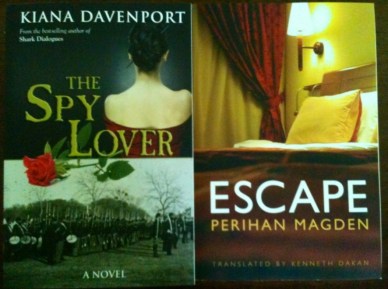
Perhihan Magden’s Escape. Pub copy:
Time passes slowly in the hotel rooms. This is what the daughter thinks. They’ve been moving since the beginning, in and out of hotels, sometimes staying for months, sometimes for a mere hour, but never with luggage, heavy things weighing them down. The mother and daughter are singular, a “Moon Unit,” revolving so far away that no one can touch them. They form attachments to no one, not the pool boy who watches the daughter swim for hours, nor the girl at the front desk who counts the moments she sees the daughter as little good luck charms for her day. They are bound together with a secret language, the beautiful girl loved solely by her mother, who will never ever ever leave her side.
Prize-winning Turkish novelist and journalist Perihan Magden delivers a heartbreaking meditation on the intense and sometimes isolated love between a mother and daughter against the world.
Kiana Davenport’s The Spy Lover. Pub copy:
Thrust into the savagery of the Civil War, a Chinese immigrant serving in the Union Army, a nurse doubling as a spy for the North, and a one-armed Confederate cavalryman find their lives inextricably entwined.
Fleeing drought and famine in China, Johnny Tom arrives in America with dreams of becoming a citizen. Having survived vigilantes hunting “yellow dogs” and slave auction- blocks, Johnny is kidnapped from his Mississippi village by Confederate soldiers, taken from his wife and daughter, and forced to fight for the South. Eventually defecting to the Union side, he is promised American citizenship in exchange for his loyal services. But first Johnny must survive the butchery of battles and the cruelties inflicted on non-white soldiers.
Desperate to find Johnny, his daughter, Era, is enlisted as a spy. She agrees to work as a nurse at Confederate camps while scouting for the North. Amidst the unspeakable carnage of wounded soldiers, she finds solace in Warren Petticomb, a cavalryman who lost an arm at Shiloh. As devastation mounts in both armies, Era must choose where her loyalties lie—with her beloved father in the North, or with the man who passionately sustains her in the South.
A novel of extraordinary scope that will stand as a defining work on the Chinese immigrant experience, The Spy Lover is a paean to the transcendence of love and the resilience of the human spirit.


 Biblioklept