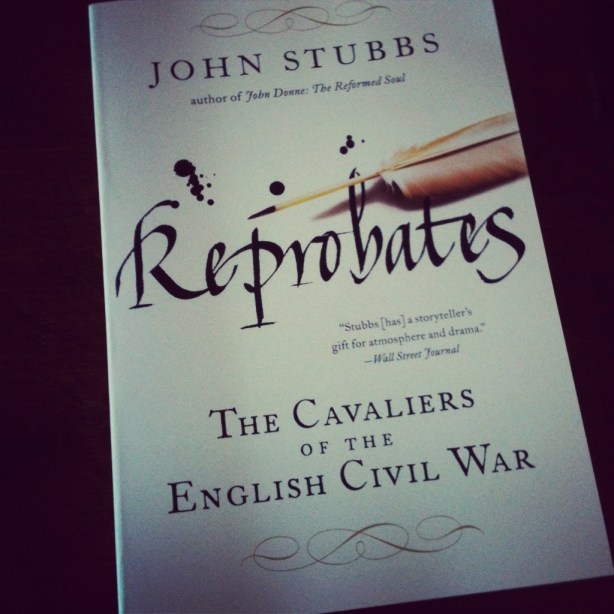
This one looks pretty cool—Reprobates, John Stubbs’s history of the English Civil War. A cursory flip through the book suggests that the subtitle is perhaps a little misleading—Reprobates seems to be more of a survey of the shifts in English culture in the 17th century than a dry study of the actual war between Roundheads and Royalists. In his insightful review at Literary Review, Adrian Tinniswood points out that,
. . . the real focus of Stubbs’s book is the cavalier poets, that motley collection of royalist writers who gathered around the aging and irascible Ben Jonson in the late 1620s and 1630s and went on to seek their fortunes at court, simultaneously memorialising and mythologising its decline. The self-styled ‘Tribe of Ben’ – William Davenant, Thomas Carew, Sir John Suckling and the rest – remain resolutely minor figures, both in literature and in history. Most are remembered for a single poem, like Sir John Denham and ‘Cooper’s Hill’, or even a single line, like Richard Lovelace’s ‘Stone walls do not a prison make’ or Robert Herrick’s ‘Gather ye rosebuds while ye may’. Some aren’t even remembered for that. Can you recall anything Suckling wrote? . . . Under Stubbs’s affectionate but forensic gaze these reprobates seem like figures of fun in a Restoration comedy rather than the heroes they so clearly believed themselves to be.
At The Guardian, Christopher Bray finds even more comedy in these reprobates, suggesting that,
If Ben Elton ever writes another series of Blackadder, Reprobates ought to be top of his research list. Not because John Stubbs offers a daringly revisionist take on the English civil war. The book’s subtitle notwithstanding, the war occupies rather fewer than a quarter of its nearly 500 pages. What we do get, though, is a colourful braiding of poetry criticism, literary biography and social and political history – the whole lot knotted together by characters of such effervescent high spirits the sitcom form might have been invented for them.
Looks like good stuff.



 Biblioklept