Alexander Alexeieff Illustrates Poe’s Story “The Fall of the House of Usher”

(More/via/about).

Read Edgar Allan Poe’s Story “A Descent into the Maelström”


“A Descent into the Maelström” by Edgar Allan Poe—

The ways of God in Nature, as in Providence, are not as our ways; nor are the models that we frame any way commensurate to the vastness, profundity, and unsearchableness of His works, which have a depth in them greater than the well of Democritus.
Joseph Glanville.

WE had now reached the summit of the loftiest crag. For some minutes the old man seemed too much exhausted to speak.

“Not long ago,” said he at length, “and I could have guided you on this route as well as the youngest of my sons; but, about three years past, there happened to me an event such as never happened before to mortal man –or at least such as no man ever survived to tell of –and the six hours of deadly terror which I then endured have broken me up body and soul. You suppose me a very old man –but I am not. It took less than a single day to change these hairs from a jetty black to white, to weaken my limbs, and to unstring my nerves, so that I tremble at the least exertion, and am frightened at a shadow. Do you know I can scarcely look over this little cliff without getting giddy?”

The “little cliff,” upon whose edge he had so carelessly thrown himself down to rest that the weightier portion of his body hung over it, while he was only kept from falling by the tenure of his elbow on its extreme and slippery edge –this “little cliff” arose, a sheer unobstructed precipice of black shining rock, some fifteen or sixteen hundred feet from the world of crags beneath us. Nothing would have tempted me to within half a dozen yards of its brink. In truth so deeply was I excited by the perilous position of my companion, that I fell at full length upon the ground, clung to the shrubs around me, and dared not even glance upward at the sky –while I struggled in vain to divest myself of the idea that the very foundations of the mountain were in danger from the fury of the winds. It was long before I could reason myself into sufficient courage to sit up and look out into the distance.

“You must get over these fancies,” said the guide, “for I have brought you here that you might have the best possible view of the scene of that event I mentioned –and to tell you the whole story with the spot just under your eye.”

“We are now,” he continued, in that particularizing manner which distinguished him –“we are now close upon the Norwegian coast –in the sixty-eighth degree of latitude –in the great province of Nordland –and in the dreary district of Lofoden. The mountain upon whose top we sit is Helseggen, the Cloudy. Now raise yourself up a little higher –hold on to the grass if you feel giddy –so –and look out beyond the belt of vapor beneath us, into the sea.” Continue reading “Read Edgar Allan Poe’s Story “A Descent into the Maelström””

The Fall of the House of Usher — Edgar Allan Poe’s Tale Comes to Life in a Creepy Stop-Motion Film by Jan Svankmajer

Book Shelves #41, 10.07.2012


20121001-205929.jpg

Book shelves series #41, forty-first Sunday of 2012

Lots of lovely books and mags with pictures.

Several years worth of subscription to The Believer, with an unsorted stack setting up front:

20121001-200254.jpg

I suppose I could write a whole post about The Believer, which I think is an excellent mag but no longer subscribe to, but instead, here’s a cover from Charles Burns:

20121001-200318.jpg

Charles Burns also shows up in this section, which includes stuff by R. Crumb, Daniel Clowes, Art Spiegelman, and more:

20121001-200329.jpg

The wife got me a subscription to The Paris Review last year; then, some unsorted books, and then the Nausicaä collection (also courtesy the wife):

20121001-200342.jpg

Nausicaä spread out on my couch. (My son and I ended up looking through them for an hour):

20121001-200353.jpg


Portrait of Edgar Allan Poe — Felix Vallotton

Railway — Edouard Manet

Lunch Break with a Knight — Norman Rockwell

Songs from the Second Floor (Roy Andersson, Full Film)

“Life in the jungle” (Kafka)

(From Kafka’s Diaries).

Breakfast — Diego Velazquez

The Cup of Tea — Andre Derain

Birdwalk Empire

Ingmar Bergman’s Persona (Full Film)

Lust for Life — Max Ernst

“Evil does not exist” (Kafka)

(From Kafka’s Diaries).

New in Trade Paperback from Picador (Books Acquired Some Time Last Month)

20120923-131033.jpg

Amitav Ghosh’s River of Smoke is the second entry in a proposed trilogy about the opium trade. (The first was 2008’s Sea of Poppies). Here’s Picador’s blurb:

In Amitav Ghosh’s Sea of Poppies, the Ibis began its treacherous journey across the Indian Ocean, bound for the cane fields of Mauritius with a cargo of indentured servants. Now, in River of Smoke, the former slave ship flounders in the Bay of Bengal, caught in the midst of a deadly cyclone.  The storm also threatens the clipper ship Anahita, groaning with the largest consignment of opium ever to leave India for Canton. Meanwhile, the Redruth, a nursery ship, carries horticulturists determined to track down the priceless botanical treasures of China. All will converge in Canton’s Fanqui-town, or Foreign Enclave, a powder keg awaiting a spark to ignite the Opium Wars. A spectacular adventure, but also a bold indictment of global avarice, River of Smoke is a consuming historical novel with powerful contemporary resonance.
20120923-131043.jpg

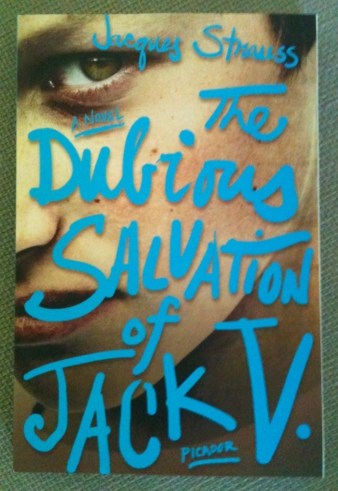
Jacques Strauss’s debut novel The Dubious Salvation of Jack V. got a good review from John Self, which is worth a read—Self does a marvelous job expressing the trepidation and wariness—and yes, prejudice—that some of us might have toward contemporary novels.

Here’s Picador’s blurb:

Above all, The Dubious Salvation of Jack V. is funny; both witty and ironic. Jack hates to be reminded that Susie “didn’t stay with us because she loved me … She stayed with us because it was her job.” The irony is that to stop her being their servant, to give her her freedom, he may end up having to do something terrible to her. Around all this cultural specificity, more general principles are touched on (“one could only conclude that humanity, rather than a ballast against the arbitrary, was … its very agent”) which feed back into the story.
20120923-131049.jpg

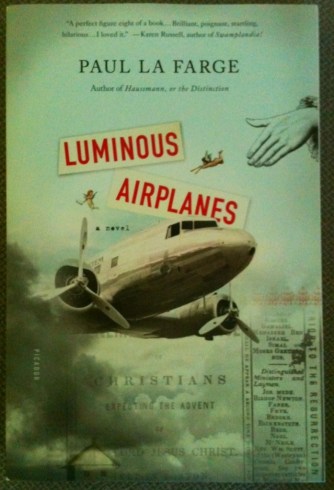
Here are the epigraphs to Paul La Farge’s novel Luminous Airplanes, via the book’s site, which is worth checking out:

We hope it will not be unconsidered, that we find no open tract, or constant manduction in this Labyrinth; but are oft-times fain to wander in the America and untravelled parts of Truth.

— Thomas Browne

Nothing odd will do long.

— Samuel Johnson

Ein schönes Protokoll. Ein nie bevor gesehenes Protokoll.

— Werner Herzog

…but the path of what happened is so brightly lit that it places everything else more deeply in shadow.

— The 9/11 Commission Report

The truth, fellow UFOlogists, is that I have known precisely what I was doing all along. It is just that very few other people knew what I was doing.

— William L. Moore

Run!

— Hal Hartley

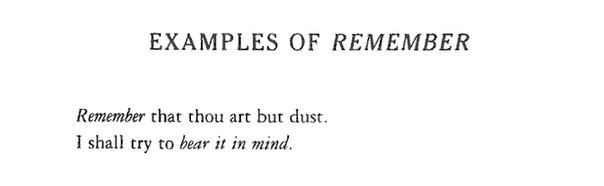
“Examples of Remember” — Lydia Davis